Robbie Thain
Founder, CEO

Higher booth engagement and qualified lead conversion stem from strategic architecture, provable live product demonstrations.
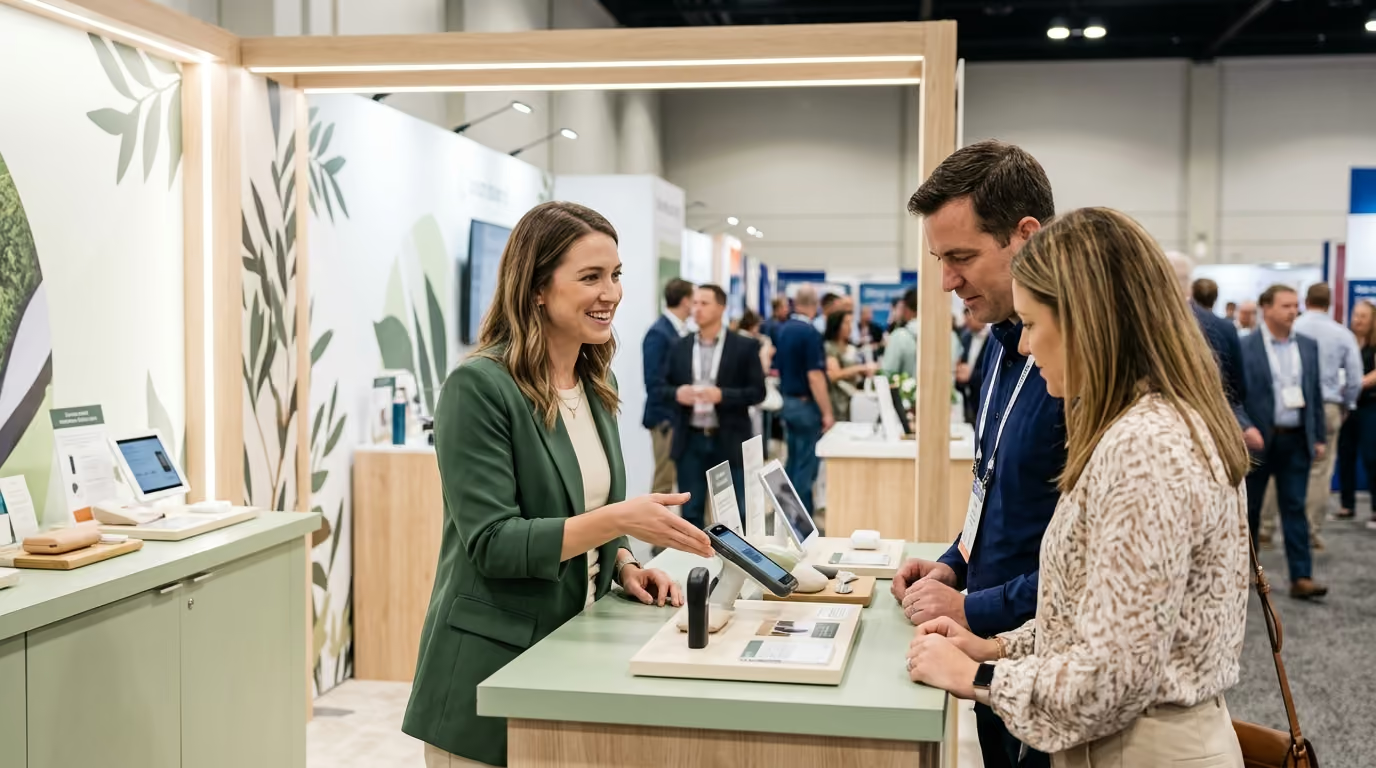
Exhibiting in a crowded trade show hall requires a deliberate balance between visual salience, clear messaging, and technical competence. By aligning booth architecture with attendee behavior and staffing the floor with technical experts, brands can turn fleeting aisle foot traffic into measurable commercial pipeline.
Every trade show morning begins with a brief moment of calm before thousands of attendees surge through the registration gates. Within minutes, the exhibit hall turns into a wall of competing noise, flashing overhead LED displays, and aggressive aisle canvassing. Attendees face hundreds of identical booth footprints, generic promotional giveaways, and overzealous sales teams scanning badges indiscriminately.
In this environment, buyer fatigue sets in within the first hour of walking the concrete aisles. Attendees develop tunnel vision, looking straight down the carpet lines to avoid eye contact with aggressive booth staff. They bypass elaborate displays that fail to communicate a clear category or direct benefit within three seconds.
For brand leaders, this reality creates a painful operational challenge. Companies invest tens of thousands of dollars on floor space, custom fabrication, drayage, and travel logistics. Yet, their presence often fades into background noise because their booth relies on superficial spectacle rather than genuine utility.
The core challenge of the trade show floor is not merely getting noticed. The real challenge is converting raw visual attention into immediate brand comprehension and meaningful business dialogue. Winning the floor requires moving past passive brand theater to build an activation that respects attendee time, provides immediate answers, and solves real operational problems.
To stand out in an exhibition hall, marketers must understand how the human eye navigates complex physical environments. Attention in a crowded venue is fragmented, rapid, and defensive. Attendees scan continuously to filter out irrelevant information while searching for specific solutions or recognizable reference points.
An eye-tracking research study presented through the International Association of Exhibitions and Events (IAEE) examined how attendees perceive trade show booths in live exhibition settings compared to laboratory environments. The research analyzed 31 participants in a controlled laboratory setting and 32 participants on an active exhibition floor. The researchers tracked visual fixations across several structural elements, including free-standing towers, overhead canopies, wallpaper, text, lighting fixtures, furniture, graphics, and floor coverings.
The field study revealed that elevated vertical structures and free-standing towers generated the highest average fixation count among individual design elements. Furniture and seating arrangements ranked second in visual fixation, followed by overhead canopies, wall text, focused lighting, graphic imagery, and flooring. These findings indicate that three-dimensional, elevated architectural features attract human visual attention much more effectively than eye-level flat wall graphics.
However, the IAEE study also revealed an important split between visual attention and information retention. While structural towers, overhead canopies, and distinct lighting rigs dominated visitor gaze fixations, participants frequently failed to recall the specific text or branding placed on those high-salience features. A dominant physical structure makes a booth visible from down the aisle, but visibility does not guarantee that the attendee understands or remembers the company name.
These findings support a strict two-stage visual design principle for high-impact exhibits:
The eye-tracking research also challenged the common assumption that images always outperform written copy. In field conditions, concise text placed on towers and canopies frequently attracted more total gaze fixations than decorative background graphics. Visuals draw the initial glance, but purposeful text provides the cognitive clarity attendees need to decide whether to stop.
The study showed a marked difference between laboratory tests and live floor environments. Laboratory participants recorded significantly longer and more frequent fixations because they were free from real-world distractions. In contrast, live floor attendees distributed their attention rapidly across competing stimuli, moving crowds, and ambient lighting shifts.
Exhibitors should evaluate booth concepts under conditions that simulate live floor competition rather than relying on clean, isolated digital renderings. When planning an exhibit, marketing leaders must establish a strict visual hierarchy.
First, construct a distinct silhouette that rises above standard ten-foot pipe-and-drape lines. Second, select one primary structural focal point rather than cluttering the space with competing visual gimmicks. Third, anchor core brand identification directly next to the primary focal element. Fourth, keep explanatory text concise, positioned precisely where walking attendees naturally rest their eyes.
A central strategic question for any exhibitor is how closely their booth should match established industry design norms. Every commercial category maintains distinct visual codes. Natural food expos feature raw wood, reclaimed finishes, and muted earth tones. Enterprise technology shows feature minimalist white laminates, blue backlighting, and sleek aluminum framing. Industrial manufacturing halls are filled with functional metal trussing, high-visibility yellow accents, and heavy machinery platforms.
There is a natural tension between category conformity and category disruption. Following industry codes signals instant credibility and tells attendees what broad category you occupy. However, complete conformity makes an exhibit invisible among dozens of direct competitors using identical color palettes and layouts. Conversely, extreme disruption can create confusion if attendees cannot decipher what product or service your company provides.
Current trade show research does not establish a universal mathematical formula for breaking category codes. The most reliable strategic approach is selective contrast. An exhibitor must retain sufficient category markers to remain immediately identifiable, while changing one or two high-visibility cues to command attention.
To execute selective contrast effectively, brand teams can apply a simple operational framework:
For brands planning an expansive calendar, understanding the architecture of high conversion booth design helps balance distinct identity with functional utility. When an exhibit looks radically different yet remains intuitively clear, attendees stop because the visual contrast signals a fresh approach to a familiar industry problem.
Once an attendee pauses at your booth perimeter, the interaction shifts from visual capture to value validation. Static product displays on pedestals rarely justify an attendee taking ten minutes out of a packed conference schedule. Attendees need to see how a product performs under realistic operating conditions.
Research from the Center for Exhibition Industry Research (CEIR) on attendee and exhibitor engagement emphasizes interactive product displays, welcoming personnel, and hands-on demonstrations as core drivers of floor engagement. CEIR research highlights that interactive experiences allow visitors to evaluate solutions directly, moving beyond passive observation toward active participation.
A successful product demonstration operates as a compact learning session rather than a rehearsed sales pitch. The demonstration must resolve specific doubts, validate performance claims, and provide verifiable proof of differentiation.
An evidence-aligned demonstration follows a structured five-part sequence:
Demonstrations must be engineered for continuous floor flow. If a demonstration takes twenty minutes to reset, the booth will miss hundreds of prospective buyers during peak floor hours. Build modular, rapid-reset demonstration stations that allow staff to engage multiple small groups simultaneously.
By reviewing demo centric experiences and revenue focused lead capture, marketing teams can structure floor layouts that support fast, hands-on trials while capturing rich behavioral data.
The physical design of a booth creates the opportunity for a conversation, but the staff on the floor determines whether that opportunity creates commercial value. Many trade show investments underperform because the staffing roster does not match what visitors actually want when they walk the hall.
A comprehensive peer-reviewed staffing study analyzed secondary empirical data from 9,215 trade show attendees and 885 exhibiting companies. The research revealed a persistent structural mismatch between exhibitor staffing choices and attendee preferences. Exhibiting companies consistently overrepresented corporate executives, upper management, and general sales personnel on the floor. At the same time, exhibitors significantly understaffed technical personnel, application engineers, and product specialists.
This mismatch persisted across decision-makers and influencers, across diverse industry verticals, and across regional, national, and international trade shows. Attendees visit exhibitions to inspect products, verify technical compatibility, and resolve complex implementation questions. When a booth is staffed exclusively by general sales representatives who must deflect technical inquiries, the visitor leaves unsatisfied.
Aligning booth staffing with attendee expectations provides an immediate competitive advantage. Brands should balance their booth presence by deploying multi-disciplinary teams organized around customer problem-solving:
Staff behavior on the carpet must reinforce a helpful, low-friction environment. CEIR reports indicate that meaningful interpersonal interactions and welcoming staff behavior are foundational to trade show engagement. Furthermore, industry data shows that 84% of exhibitors intentionally employ emotional connection tactics, such as warm hospitality and trust-building conversations, to engage visitors.
Effective booth staff avoid aggressive tactics like blocking aisles or demanding badge scans before exchanging pleasantries. Instead, staff should ask diagnostic questions about what the visitor is trying to solve at the conference. They should offer visitors an upfront choice between browsing independently, viewing a scheduled live demo, or speaking directly with a product engineer.
When your team operates as trusted technical consultants rather than aggressive canvassers, attendees stay longer and share more accurate project requirements.
In high-density exhibit halls where several direct competitors occupy the same aisle, the pressure to stand out can tempt brands toward aggressive, misleading, or disruptive tactics. Gimmicks like deafening sound systems, blinding strobe lights, costumed mascots roaming unauthorized aisles, and disparaging competitor claims often generate friction rather than pipeline.
True differentiation does not require deceptive theatrics or nuisance marketing. It requires superior clarity, provable performance, and professional respect for the event ecosystem. Brands that anchor their strategy in transparent value build durable customer relationships that outlast the show floor.
To stand out ethically and effectively, marketing leaders should follow five operational principles:
Avoid vague marketing superlatives like "the most revolutionary platform" or "the lowest-cost solution in the market." If you present a comparative claim, clearly define the testing methodology, baseline parameters, and operational conditions under which the results were achieved. When comparing your product against market alternatives, use verified third-party laboratory data, published industry benchmarks, or clear live tests that visitors can inspect themselves.
The IAEE eye-tracking research confirms that high structures, canopies, and lighting rigs command initial visual attention. Ethical design uses these structural elements to signal clear brand identity and direct category relevance. Using sensational visual spectacles that disguise the real product offering creates immediate visitor frustration once the attendee realizes the booth content does not match the visual promise.
Exhibition halls are dense sensory environments where audio bleed, intense lighting, and congested aisles create cognitive exhaustion. Running excessive audio volumes or projecting lights into neighboring spaces violates event rules and damages your brand reputation.
A well-designed booth manages its own footprint cleanly. Keep demonstration sound contained within your perimeter through directional speakers, maintain open internal walkways to prevent aisle blockages, and ensure your space is physically accessible to all attendees.
Attendees value autonomy and control over their show floor interactions. Forcing visitors into aggressive lead capture funnels before they have evaluated your product breeds resentment.
Allow attendees to explore displays at their own pace. Make digital collateral easily downloadable via open QR codes without mandatory registration barriers for basic product sheets. Ensure that opting into a badge scan represents an agreed-upon request for substantive follow-up rather than a prerequisite for entering the booth.
Rather than pretending your product solves every conceivable problem, train your staff to be honest about technical parameters, system requirements, and ideal use cases. Openly explaining where your product fits best and where a competitor might be a better match establishes immediate credibility. Buyers recognize and reward professional integrity, especially in technical and high-stakes procurement decisions.
Executing a differentiated, high-conversion trade show presence requires disciplined preparation across three distinct phases: pre-show alignment, live floor operations, and rapid post-show conversion.
Adopting diagnostic trade show qualification methods ensures that the foot traffic captured by your visual design translates into verified sales pipeline rather than unworked badge data.
Measuring the real Return on Investment (ROI) of a trade show activation requires tracking both leading indicators on the floor and lagging commercial metrics over the full sales cycle. Relying solely on raw badge scan totals produces misleading results, as scan volume measures foot traffic density rather than commercial pipeline value.
Marketing leaders must implement a measurement framework that connects physical booth behaviors to pipeline generation and downstream revenue.
Leading metrics track real-time engagement and operational execution while the show is active:
Lagging metrics evaluate commercial conversion over the weeks and months following the event:
A comprehensive review of trade show strategy and measurable commercial outcomes confirms that top-performing exhibitors prioritize pipeline quality and account progression over raw booth scan numbers.
Consumer packaged goods (CPG), beverage, and food brands face unique operational challenges in dense trade show environments like Natural Products Expo West, the Summer Fancy Food Show, or the National Restaurant Association Show. In these massive halls, hundreds of food exhibitors offer bite-sized samples, creating overwhelming flavor fatigue and aisle congestion.
To stand out in a food and beverage hall, a brand must elevate sampling from an unmanaged handout into an organized, high-value brand trial.
In our experience across national trade show activations, high-volume sampling booths succeed by building structured, dual-track operational layouts. One track provides rapid, compliant sample distribution to the main aisle to capture consumer interest and drive immediate trial. The second track guides professional retail buyers, category managers, and distributors into a dedicated conversation zone equipped with full product packaging, wholesale margin sheets, and regional distribution maps.
Consider an emerging organic beverage brand exhibiting in an aisle filled with competing ready-to-drink options. A conventional booth hands out small cold cups to passing crowds without qualifying interest or explaining ingredients. Most attendees grab the cup, drink it while walking, and forget the brand name within ten paces.
A high-conversion activation structures the space differently:
We have executed over 1,000 campaigns across all 50 states, bringing brands to life in every major U.S. market. From retail demos in Seattle to roadshows in Miami and events in Honolulu, our teams activate brands wherever our clients' audiences are located.
When food and beverage brands bridge their trade show presence with regional retail execution, they turn trade show trial into long-term velocity. Exploring how brands design booths for retail buyer meetings provides practical blueprints for building spaces that serve both high-volume consumer sampling and serious wholesale buyer negotiations.
Furthermore, integrating high conversion roadshow activations with trade show campaigns helps consumer goods companies validate consumer demand directly before meeting major national retail category buyers.
Even experienced trade marketing teams can fall into habits that compromise their trade show performance. Recognizing and eliminating these operational errors protects your budget and maximizes lead conversion:
Exhibitors often attempt to display every product variant, brochure rack, and promotional item they own. This creates visual disorder and physically restricts visitor movement into the booth.
Keep your footprint open, accessible, and focused on your core hero offerings. Leave ample negative space so attendees can comfortably step off the busy aisle carpet without feeling trapped.
Distributing cheap plastic promotional items, branded pens, or generic tote bags rarely attracts serious commercial buyers. Generic giveaways attract professional swag collectors who have zero purchasing authority or project intent.
Replace low-value promotional handouts with useful technical resources, such as printed industry benchmark reports, interactive configuration calculators, or premium product trial kits designed specifically for verified buyers.
Booth staff sitting behind tall counters, looking down at laptops, or checking smartphones sends an immediate signal of disinterest to passing attendees. Counters should be positioned along the sides or rear of the booth rather than acting as physical barriers across the front aisle line. Staff must remain standing, alert, and ready to make welcoming eye contact with visitors exploring the perimeter.
Relying entirely on random walk-up foot traffic leaves your trade show success to chance. High-performing exhibitors execute targeted pre-show outreach campaigns four to six weeks prior to the event to book high-value meetings before setting foot in the convention center.
Utilize targeted email outreach, social coordination, and direct sales scheduling to secure confirmed calendar slots with priority retail buyers, partners, and enterprise prospects.
A qualified trade show lead loses momentum rapidly as attendees return to their daily workplace responsibilities. When companies take two to three weeks to process badge scan data and distribute contact lists to sales teams, buyer interest cools significantly.
Establish an automated data workflow that cleans, scores, and routes qualified leads to sales representatives within 48 to 72 hours after the exhibit hall closes.
Review this guide during your annual trade show calendar planning, when designing a new custom exhibit property, or four weeks prior to major industry activations to align your staffing, demonstration, and measurement workflows.
Mastering trade show differentiation is an operational discipline that turns physical presence into a predictable engine for enterprise growth.

30 Years Experiential & Retail Activation Partner for CPG & Beverage Brands | Multi-Market Demos, Roadshows & Costco/Club Programs That Actually Sell