Robbie Thain
Founder, CEO

A high-performing campus field team emerges from structured onboarding that builds essential operational competencies, compliance standards.
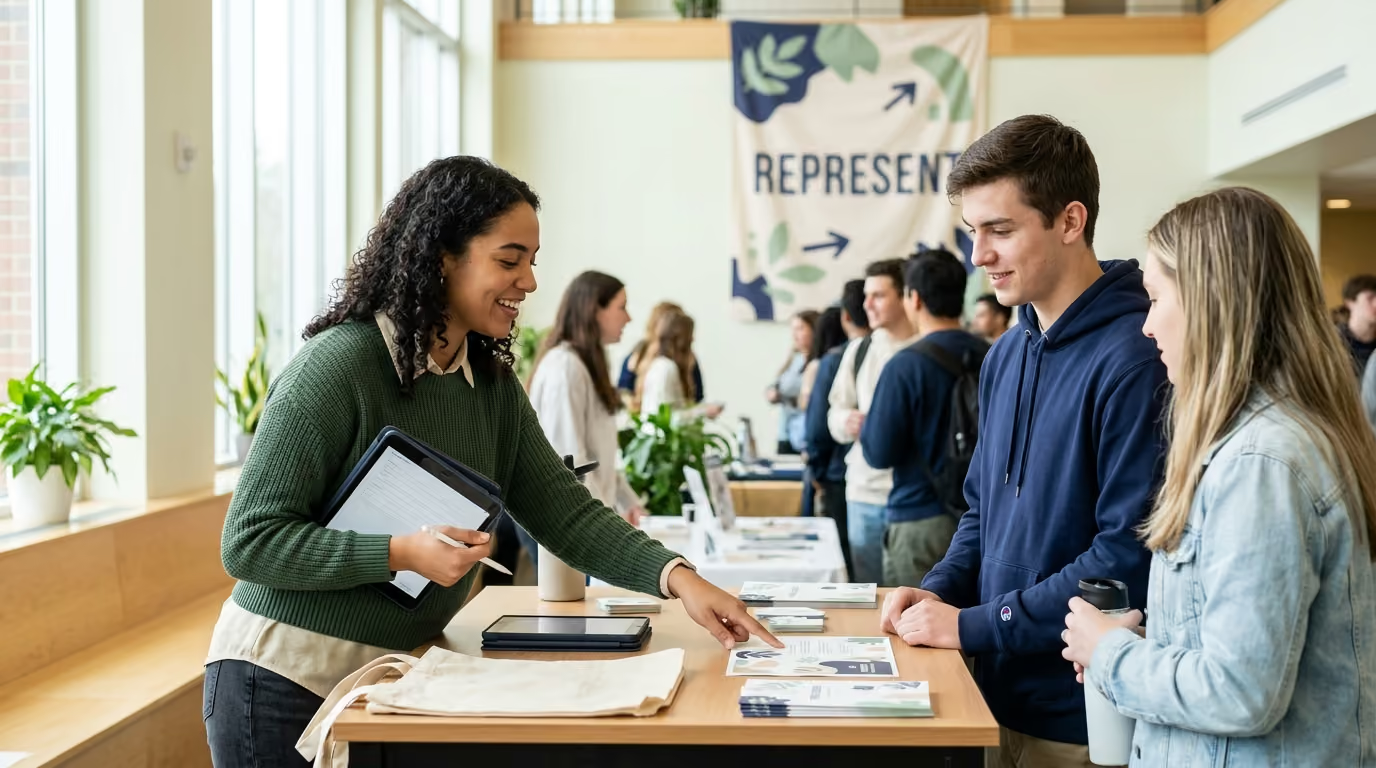
Student brand ambassador onboarding is a structured operational readiness system, not a single orientation meeting or a passive slide presentation. When built correctly, this onboarding program equips student representatives to master brand messaging, enforce retail standards, execute live sampling activations, and protect legal compliance across collegiate environments.
Student brand ambassador onboarding is the formal process of preparing collegiate representatives to act as authorized field operators for a brand. It is not an informal briefing, a casual product drop, or a generic welcome email. It is a systematic curriculum that transitions a newly hired student from an enthusiastic consumer into a trained brand representative.
The chaos of a campus environment quickly exposes weak preparation. Picture a campus plaza during peak class transition. Hundreds of students stream past a sampling footprint while music plays and campus administrators observe from nearby walkways. A poorly trained ambassador freezes, hands out full-size inventory without saying a word, fails to scan QR codes, and makes unauthorized medical claims about ingredients to curious passersby. Within thirty minutes, inventory is depleted, zero qualified consumer interactions are logged, and the brand faces an administrative complaint from student life officials.
A professional onboarding architecture eliminates this friction before representatives ever set foot on campus. Peer-to-peer contact is the reason campus programs work. Students act on recommendations from other students, whether that means researching a product, visiting a retailer, talking about the brand with friends, or buying it outright. That advantage only holds when the ambassador in front of them behaves like a trained representative rather than an untrained volunteer.
Capturing this level of engagement requires rigorous operational readiness. Building an effective campus initiative begins with establishing a structured student brand ambassador program that treats students as field professionals. Ambassadors must understand their specific responsibilities, know how to navigate campus regulations, and master basic operational routines.
Student brand ambassadors carry responsibilities that extend far beyond casual social media posting. Depending on campaign design, a student representative functions as:
Collegiate marketing operates across distinct micro-environments, each with unique behavioral norms and administrative rules. An ambassador must navigate:
Each environment demands tailored conversational approaches and strict adherence to university policies. A comprehensive onboarding process ensures that ambassadors adapt their field tactics without deviating from core messaging standards.
Competency-based onboarding focuses on verifiable capability rather than passive listening. Program managers must evaluate what ambassadors can actively execute under pressure, not merely what slides they reviewed during an orientation session. A fully onboarded representative must prove proficiency across six operational domains.
Ambassadors must explain the brand purpose, product portfolio, ingredient benefits, and retail pricing accurately from memory. They must know precisely where products are sold in local markets, including specific brick-and-mortar grocery, convenience, or club store accounts. They must also recognize the precise boundary between approved marketing claims and unauthorized medical or functional promises.
Representatives must deliver a clear, engaging value proposition within fifteen to twenty seconds. They must tailor their vocabulary to fellow students without relying on canned corporate scripts that undermine personal credibility. Communication training also requires teaching active listening techniques, polite disengagement strategies for uninterested consumers, and de-escalation tactics for adversarial interactions.
Ambassadors must independently set up, maintain, and tear down physical activation footprints using standardized checklists. This includes:
Campus representatives must follow federal advertising guidelines, university solicitation policies, and internal brand rules. They must consistently disclose their commercial relationship with the brand across digital content and live activations. They must also identify physical boundaries where brand promotion is prohibited by campus authorities.
Ambassadors must make sound decisions when field realities diverge from the standard operational plan. They need the authority to pause operations during severe weather, manage uncooperative crowds, and protect personal safety. Judgment training teaches representatives when to resolve issues independently and when to escalate problems to program managers immediately.
Field data collection must be precise, prompt, and verifiable. Ambassadors must accurately log quantitative distribution numbers, record qualitative consumer feedback, and submit high-resolution photos of retail shelves or event footprints. They must understand the technical differences between passive impressions, direct verbal engagements, product samples distributed, and verified digital conversions.
A systematic onboarding curriculum moves student workers through structured stages of development. Rather than overwhelming new hires with a single four-hour lecture, high-performing programs use a five-stage progression that builds operational competence over time.
The foundational stage establishes intellectual comprehension of the brand and the role. During this phase, ambassadors complete self-paced digital modules covering:
The second stage requires active practice and behavioral demonstration before live deployment. Ambassadors participate in interactive workshops to rehearse:
Ambassadors participate in a supervised field activation or a simulated pilot event. Working alongside an experienced field lead or program coordinator, the new ambassador executes the complete activation lifecycle from morning load-in through afternoon reporting. This live practice allows managers to observe student communication style, physical pacing, and procedural compliance under real-world conditions.
Certification serves as the formal gatekeeper between training and independent field deployment. Ambassadors must pass objective assessments demonstrating mastery of core workflows. The evaluation includes a written claims examination, a timed physical equipment assembly test, and an oral product demonstration scenario. Representatives who fail any component complete targeted remediation before receiving live shift assignments.
Onboarding does not terminate once an ambassador receives certification. Continuous enablement maintains high operational standards throughout the academic semester. The ongoing reinforcement cadence includes:
Product education for student brand ambassadors must be practical and operationally strict. Ambassadors frequently interact with peers who ask detailed questions about product ingredients, sourcing, dietary classifications, and functional benefits. If training is vague, well-meaning students often improvise, creating severe legal and regulatory liabilities.
Establishing comprehensive legal guidelines is crucial, as detailed in our guide on how to build an FTC compliant brand ambassador program. The Federal Trade Commission (FTC) enforces strict standards regarding commercial disclosures and product claims. Under the FTC Endorsement Guides, an ambassador who receives payment, free product, or other incentives possesses a material connection that must be disclosed clearly and conspicuously.
To eliminate guessing in the field, onboarding programs must provide an approved claims matrix. This framework categorizes marketing language into three clear categories.
These are verified statements that ambassadors may use freely in conversations and social media captions:
These statements require precise qualifying language or exact phrasing approved by brand legal counsel:
These statements must never be made under any circumstances. Unauthorized claims create immediate legal risk:
Ambassadors must understand that peer conversations that cross into paid promotions require transparency. The FTC dictates that disclosures must be unavoidable and easy to understand. For social media posts, stories, and videos, ambassadors must use unambiguous identifiers such as "#ad", "#paidpartnership", or "Paid partnership with [Brand]".
Disclosures must appear before the user clicks to expand a caption. In video content, the disclosure must be superimposed on screen long enough to be read easily and stated verbally when practical.
During physical activations, ambassadors must wear branded apparel, utilize branded footprint assets, or verbally introduce themselves as paid brand representatives when conducting surveys or promotional pitches. For a deeper breakdown of structural legal standards, consult our compliance guide to student brand ambassador programs.
Ambassadors will inevitably encounter consumer questions they cannot answer. Onboarding must teach students that admitting uncertainty is far better than providing inaccurate information. Representatives should memorize a standard response:
> "I want to make sure I give you the 100 percent accurate answer on that ingredient. Let me pull up our official product FAQ, or I can take your email and have our team send you the exact specifications."
Every ambassador must have access to a searchable digital knowledge base on their mobile device to look up nutritional facts, allergen warnings, and corporate policies instantly.
Live campus event execution is the most visible element of a field marketing program. Successful execution requires operational discipline, spatial awareness, and careful adherence to safety standards. Onboarding must break event operations into three distinct operational phases.
Before arriving on site, ambassadors must verify operational parameters using a standardized pre-event checklist. This preparation prevents wasted time and logistical failure:
During live operations, ambassadors must maintain an inviting, organized, and compliant footprint. Onboarding should teach specific behavioral standards:
The activation is not complete when the last sample is distributed. Professional programs train representatives to leave campus spaces cleaner than they found them:
Campus activations that create positive brand impressions must also drive measurable retail velocity. If a student enjoys a product sample on the quad but cannot locate it at local stores, marketing capital is wasted. Onboarding must teach ambassadors how to bridge experiential trial with retail conversion, a discipline detailed in our analysis of connecting student ambassadors with retail demos.
Every sampling interaction must conclude with a clear retail destination. Ambassadors should not just hand out a product and end the conversation. They must be trained to guide students directly to nearby points of purchase:
Ambassadors should regularly visit key campus-adjacent retail accounts to perform structured shelf audits. Onboarding must train students on how to inspect retail environments without disrupting store operations:
Ambassadors must understand store courtesy rules. They must never argue with store managers, alter shelf pricing independently, move competitor inventory, or take unauthorized photos if prohibited by store policy. They act as eyes and ears for the field marketing director, recording objective data into their mobile reporting forms.
Safety and risk management training is essential when deploying collegiate brand ambassadors. Field operations expose students to physical hazards, unpredictable crowds, adverse weather, and health risks. Onboarding curricula must align with recognized safety standards to protect both workers and consumers.
The Occupational Safety and Health Administration (OSHA) provides clear guidance on protecting young workers from workplace hazards, stressing the importance of job-specific safety training, hazard recognition, and emergency planning. Under OSHA training standards, safety instructions must be delivered in clear, understandable language and documented systematically. Furthermore, the Food and Drug Administration (FDA) establishes stringent guidelines for food safety, hygiene, and allergen management that apply directly to consumer product sampling.
Ambassadors routinely move heavy cases of inventory, promotional canopies, and display tables. Onboarding must teach foundational physical safety:
When sampling food, beverages, or cosmetics, ambassadors must follow strict sanitary guidelines to prevent contamination and allergic reactions:
Student workers must feel secure during all campus assignments. Onboarding should establish clear personal safety protocols:
Every ambassador possesses complete stop-work authority. If an activation becomes unsafe due to severe weather, aggressive crowds, or structural hazards, the ambassador can pause operations immediately without fear of reprimand.
A student ambassador program is only as valuable as the business intelligence it produces. Without disciplined reporting, field marketing becomes unmeasurable brand theater. Onboarding must train ambassadors to treat data collection with the same rigor as product sampling, transforming daily field moments into actionable business insights.
To optimize campaign performance, brand operators must track both leading and lagging indicators throughout the program lifecycle. Our team provides clear reporting on reach, trials, leads, and sales to guide next steps in campaign optimization. In our experience, establishing a standardized measurement approach tracks awareness, engagement, and conversion, turning brand moments into actionable data that demonstrates business impact.
Leading metrics track the operational inputs that drive campaign success. Monitoring these data points ensures activations remain on schedule:
Lagging metrics evaluate the commercial outcome and Return on Investment (ROI) of field marketing investments. These figures demonstrate commercial impact:
For an exhaustive guide on building conversion models, review our framework for how to measure student brand ambassador program ROI.
Ambassadors must understand the difference between high-quality field evidence and inflated metrics. Onboarding should define reporting categories explicitly to prevent common reporting errors:
Reports must be submitted within twelve hours of activation completion. Every field submission must include time-stamped, geotagged photographs showing the active footprint, inventory layout, crowd interaction, and final site cleanup.
Analyzing real-world collegiate campaigns highlights the direct link between structured ambassador onboarding and measurable commercial performance. These case patterns illustrate how leading consumer brands implement structured training across varied product categories.
Haircare and lifestyle brand OUAI launched a campus sampling initiative designed to drive direct product trial, peer recommendation, and digital community expansion. The campaign deployed 15 trained student brand ambassadors across targeted universities. The team executed 45 on-campus activations, partnering with more than 70 student organizations.
The onboarding process focused heavily on product education, hygienic sampling execution, and post-trial survey collection. Ambassadors were trained to explain specific hair health benefits and direct students to complete digital feedback forms.
Over the course of the campaign, ambassadors distributed more than 9,610 samples and conducted over 4,770 direct peer-to-peer interactions. A post-campaign survey of 730 participating students revealed the impact of effective peer education: 61 percent stated they planned to continue purchasing OUAI products, and 79 percent reported they were likely or very likely to recommend the brand to a friend.
Functional snack brand Barebells utilized a collegiate ambassador network to build brand awareness and drive in-store grocery velocity. The brand deployed 24 ambassadors across 15 university campuses, focusing training on product benefits, taste profiles, and local retail findability.
Ambassadors were trained not only to sample protein bars during high-energy campus events, but also to guide consumers directly to local retail accounts where the product was stocked. Representatives completed weekly retail shelf checks at campus-adjacent stores, auditing product availability and display presentation.
The campaign executed more than 100 activations, distributing 25,000 product samples and reaching over 15,000 students directly. The initiative generated an 81 percent lift in brand awareness across target campuses and produced 391,000 organic social impressions with an average engagement rate of 4.13 percent. In post-activation surveys of 870 students, 81 percent reported that the ambassador interaction taught them something new about the brand, 92 percent expressed intent to purchase again, and 93 percent stated they planned to buy the product at local retail stores.
Under Armour demonstrated the operational necessity of standardized training systems when deploying campus programs at scale. Executing across dozens of collegiate markets simultaneously requires strict procedural alignment to maintain brand consistency.
The brand's ambassador initiative conducted 350 live activations over a 15-week period. The program relied on standardized onboarding playbooks, digital reporting templates, and rigid compliance checklists.
By training student ambassadors to manage event logistics, execute athletic field trials, and generate peer content, the program generated more than 209,000 direct interactions with collegiate consumers. The trained ambassador cohort produced student-generated content that delivered over 1.8 million digital impressions, showing how operational rigor enables national scale.
For insights into building high-volume field operations, explore our guide on how to build a student ambassador program that drives trial and sales.
A comprehensive onboarding process typically requires seven to ten business days. This timeframe allows new hires to complete asynchronous administrative paperwork and compliance modules within four days, attend a live interactive workshop on day five, shadow an experienced lead during a weekend activation, and complete their formal certification assessment before independent deployment.
If an ambassador posts non-compliant content, the program manager must act swiftly to mitigate legal exposure. Contact the student immediately to request the removal or editing of the post to include accurate language and proper commercial disclosures. Document the infraction, conduct a one-on-one compliance retraining session, and review recent posts across the entire cohort. If an ambassador repeatedly violates advertising guidelines, terminate their program contract.
Train ambassadors to remain polite and cooperative. Ambassadors must carry physical or digital copies of their approved campus permits, space reservations, and university liaison contact details. If an official insists that the team vacate the area, the ambassador should de-escalate, pack up the footprint smoothly, and contact their program coordinator immediately to resolve the administrative misunderstanding.
Combine a written multiple-choice claims quiz with a live verbal role-play scenario. The written test verifies comprehension of ingredients, allergen warnings, and retail availability. The verbal role-play requires the student to deliver a 20-second product pitch and respond to common customer objections under realistic, timed conditions.

30 Years Experiential & Retail Activation Partner for CPG & Beverage Brands | Multi-Market Demos, Roadshows & Costco/Club Programs That Actually Sell