Robbie Thain
Founder, CEO

Predictable commercial revenue and flawless event execution emerge when organizations implement structured operational controls spanning portfolio selection.
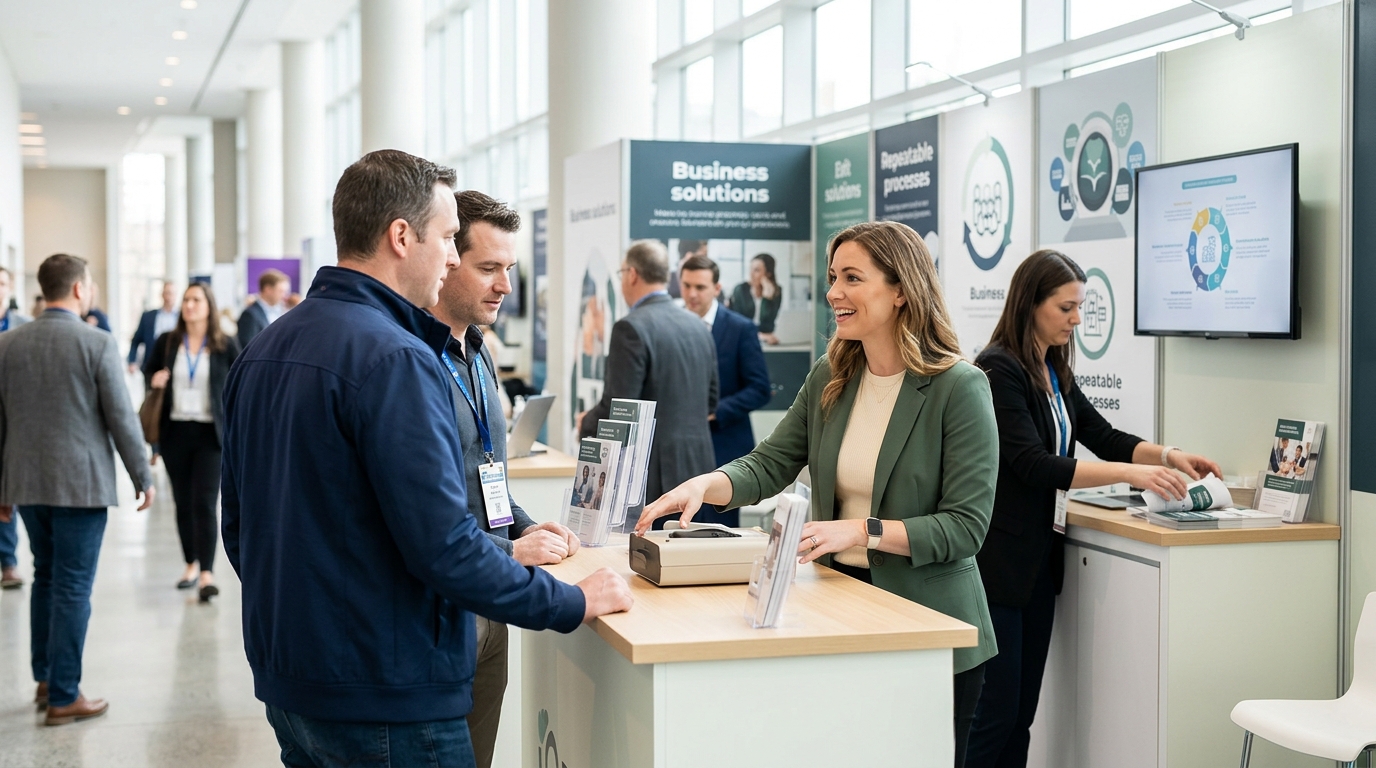
A trade show standard operating procedure is not a simple packing checklist or a generic calendar reminder. It is an end-to-end operational architecture that governs how your organization selects events, trains field teams, qualifies booth visitors, and captures pipeline. This playbook provides marketing leaders with a systematic operating model to eliminate event day chaos, enforce rigorous execution standards across every market, and convert live booth interactions into predictable commercial revenue.
A trade show standard operating procedure establishes documented controls across planning, execution, and post-show follow-up to turn live event investments into predictable revenue. By institutionalizing these field protocols across every market, marketing leaders can eliminate execution variance and reliably measure pipeline impact.
Walk onto any convention floor an hour before opening, and the symptoms of operational drift are immediately visible. Crates sit unopened in aisles because drayage paperwork was completed incorrectly. Booth staffers huddle around electrical drops searching for missing display adapters. Sales representatives flip through marketing literature they have never seen before while arguing over booth schedule rotations.
When the floor opens, the confusion deepens into expensive commercial waste. Passing attendees look for someone to answer technical questions, but find only tired staff members looking at their mobile phones. High-value retail buyers walk past crowded counters because nobody greets them within ten seconds of entering the exhibit perimeter. Scanned badge data gathers dust inside rented lead retrieval devices while hot sales leads cool down over several days.
This chaotic breakdown happens when organizations treat exhibiting as an ad-hoc project rather than a repeatable business system. Without documented operating procedures, every single trade show relies entirely on individual heroics. If your best field manager is unavailable, the activation falls apart. If an agency partner swaps on-site personnel, brand messaging degrades immediately.
The cost of this inconsistency is massive. Premium floor space, custom fabrication, and travel expenses drain enterprise budgets while producing negligible sales conversion. When execution is left to chance, marketing leaders cannot determine whether a low-performing event was caused by bad audience fit or poor booth behavior. A documented operating procedure replaces guesswork with operational control.
A comprehensive trade show operating system must manage the activation as an integrated lifecycle rather than an isolated three-day appearance. Academic research published in the Journal of Small Business Strategy demonstrates that trade show effectiveness requires a structured three-phase model that spans planning, at-show execution, and post-show follow-up.
To build a repeatable program, your standard operating procedure must formalize nine specific control points across this three-phase lifecycle.
Every event entry must pass defined commercial criteria before budget commitment. The procedure requires evaluating audience demographics, expected buying authority, historical attendee volume, competitor presence, and overall strategic alignment. Teams should use a structured trade show portfolio optimization process to compare event opportunities against strategic revenue targets.
Every show business case must establish concrete targets before design work begins. The standard operating procedure separates selling goals from non-selling goals. Selling targets quantify lead volume, qualified prospect counts, retail distributor meetings, and direct revenue pipeline. Non-selling targets define media briefings, competitive audits, and partnership discussions.
Preparation begins three to five months before the opening bell. This control point governs pre-show marketing campaigns, direct invitations to key accounts, booth presentation scheduling, and media appointments. It guarantees that target accounts are booked for dedicated meetings weeks before they arrive at the venue.
Logistics protocols define the precise timelines for show service orders, freight shipping, customs documentation, and structural booth fabrication. Standardized trade show logistics playbooks prevent freight penalties, electrical surcharge delays, and missing marketing assets on install day.
Booth personnel represent the single most important variable determining event success. The staffing protocol defines clear job descriptions, shift rotations, escalation paths, and behavioral rules. It mandates structured training sessions on messaging, product demonstrations, and qualification questioning before any employee steps onto the exhibit floor.
This protocol establishes the rules of engagement for live show hours. It details how staff members greet visitors, introduce product samples, conduct discovery, and record commercial interest. It also details specific procedures for gathering field intelligence and tracking competitor activities.
Lead capture must happen in real time using standardized qualification criteria. The procedure mandates the collection of explicit buying roles, purchase timelines, budget scopes, and agreed next steps. Loose business cards and unannotated badge scans are strictly prohibited.
Teardown is treated with the same precision as initial installation. The SOP dictates post-show physical inventory counts, asset inspection for damage, repacking standards, bill of lading filing, and carrier handoff verification. It prevents lost equipment and prepares displays for the next tour stop.
The final stage governs lead ingestion into CRM systems within twenty-four hours of show close. It enforces automated sales assignment rules, tracks sales representative response times, and evaluates event Return on Investment (ROI) over twelve months.
A reliable standard operating procedure does not rely on a single, overwhelming checklist. Instead, it organizes tasks across explicit approval gates tied to strict calendar countdowns. Each gate requires designated executive sign-off before the project moves to the next operational phase.
In our experience across national tours, establishing formal sign-off gates prevents costly rush shipping fees, graphic reprint surcharges, and misaligned sales messaging. We have executed over 1000 campaigns across all 50 states, bringing brands to life in every major U.S. market. From retail demos in Seattle to roadshows in Miami and events in Honolulu, our teams activate brands wherever our clients' audiences are located.
The event owner submits a formal event charter ninety to one hundred twenty days before the show. This charter outlines the target audience fit, physical space requirements, total budget allocation, and revenue targets.
The gate checklist requires:
Sixty days before the show, the creative architecture and promotional engine are locked down.
The gate checklist requires:
Thirty days before opening, all operational infrastructure must be confirmed to avoid late service penalties.
The gate checklist requires:
One week prior to setup, the team confirms physical execution readiness.
The gate checklist requires:
Academic research in Marketing Science established an empirical three-stage model of industrial trade show performance: attraction, contact, and conversion efficiency. The study proved that staffing levels and sales training have distinct, measurable impacts across each operational phase.
An effective booth cannot operate with unassigned floor staff wandering aimlessly. It requires an owned operating system where every person on site has a defined commercial function. Teams looking to scale their field operations should implement proven staffing operating systems for repeatable teams to maintain high performance.
To optimize visitor flow, divide your on-site team into four dedicated roles:
The Booth Manager commands the floor. This individual does not engage in long sales pitches. Instead, the manager monitors traffic density, tracks lead capture rates against daily hourly quotas, manages staff breaks, and resolves facility issues.
Stationed at the outer perimeter of the booth footprint, the Greeter initiates contact with passing attendees. Their sole responsibility is to break the ice within five seconds, offer a targeted product sample or brief demonstration hook, and transition qualified visitors inward.
The Qualifier takes handoffs from the Greeter. This professional conducts structured discovery using open-ended questions, explains technical product capabilities, presents targeted solutions, and establishes agreed next actions.
For complex product demonstrations, technical formulations, or executive buyer negotiations, the Subject Matter Expert steps in. They provide deep technical credibility without tying up general floor staff.
Visitor flow must follow a disciplined cueing procedure to prevent congestion at the perimeter while keeping sales conversations focused:
Every show day begins and ends with mandatory operational meetings.
The morning briefing takes place thirty minutes before the floor opens. The Booth Manager reviews the daily lead target, assigns specific shift zones, reviews key VIP buyer meetings, and reinforces message focus.
The evening debrief occurs immediately at show close. The team reviews total leads gathered, evaluates lead quality, identifies supply shortages, logs competitor intelligence, and agrees on tactical adjustments for the next morning.
Executing a high-performing trade show requires disciplined execution during setup, live show days, and breakdown. The following checklist guides your on-site team through each operational milestone.
Maximizing raw badge scans without qualification creates pipeline pollution. Sales teams quickly learn to ignore event leads when they spend weeks calling unqualified contacts who only wanted a free promotional pen.
Research published in the Journal of Small Business Strategy warns against maximizing contact volume without qualification. The study advocates structured lead capture on site, using disciplined categorization rules and preplanned follow-up schedules. Deploying real-time lead scoring platforms allows field teams to capture and qualify buyer interest instantly on the show floor.
To qualify as an actionable commercial lead, every record captured inside your retrieval software must include ten standard data points:
Lead categorization must follow unambiguous qualification rules rather than subjective staff opinions.
These contacts represent verified decision-makers from target accounts with active projects, defined budgets, and immediate purchase timelines under ninety days.
Standard Operating Procedure: Priority A leads are exported and assigned in the CRM every evening during the show. The designated sales representative must initiate direct contact within twenty-four hours of show closing.
These contacts possess buying influence and express strong product interest, but operate with longer evaluation timelines between three and six months or pending budget approvals.
Standard Operating Procedure: Priority B leads are enriched and imported into automated marketing nurture tracks within forty-eight hours of show closing. A sales development representative follows up by phone and email within seven business days.
These contacts include peripheral industry professionals, students, or low-level evaluators seeking general educational literature with no active buying authority.
Standard Operating Procedure: Priority C leads receive an automated email thank-you sequence containing digital product catalogs and educational case studies within five business days. They are routed to long-term newsletter lists rather than direct sales queues.
The post-show follow-up plan must be established before the event begins. A standard operating procedure establishes a binding Service Level Agreement between marketing and sales leadership:
Evaluating a trade show program using only total badge scans produces an incomplete picture of commercial impact. To make trade show performance truly comparable across different markets, agency partners, and booth footprints, marketing leaders must measure performance through an integrated funnel.
Cross-national research published in the Journal of Marketing and Marketing Science establishes that trade show performance should be evaluated through three distinct efficiency ratios.
Measuring performance at each conversion stage allows marketing operators to diagnose the exact cause of performance gaps. Connecting your event data directly to retail sell-through and commercial ROI frameworks bridges the gap between field marketing activity and enterprise revenue.
Attraction Efficiency measures your exhibit's capacity to draw target prospects from the total available show floor.
Calculation: Total Target-Audience Visitors Entering Booth divided by Total Target-Audience Registered at Event.
This metric isolates the effectiveness of your pre-show marketing campaigns, exhibit architectural design, booth location, and sponsorship visibility.
Contact Efficiency evaluates how effectively your on-site staff engages the qualified prospects who enter the exhibit perimeter.
Calculation: Target-Audience Visitors Contacted by Staff divided by Total Target-Audience Visitors Entering Booth.
This metric isolates staffing density, booth schedule management, active staff posture, and greeting protocol execution.
Conversion Efficiency measures the percentage of meaningful conversations that yield fully qualified commercial leads.
Calculation: Total Qualified Leads (A and B) Captured divided by Total Target-Audience Visitors Contacted by Staff.
This metric isolates sales messaging clarity, product demonstration quality, and discovery questioning discipline.
To measure physical productivity during live hours, the planning framework established in the Journal of Small Business Strategy utilizes the Personal Reach Count metric.
Personal Reach Count estimates total interactive capacity by multiplying average staff contact time per visitor by average visitors engaged per hour. Tracking this operational metric identifies whether a booth team is spending too much time chatting with casual visitors or moving efficiently through qualified discovery interactions.
A mature standard operating procedure evaluates event outcomes across three distinct reporting windows.
The Booth Manager produces an operational report at the close of each show day:
Delivered one week after show close, this report audits operational compliance:
This commercial review measures true enterprise Return on Investment:
The following is an illustrative operating model, not a client result. It shows how the procedures above fit together for a high-volume Consumer Packaged Goods (CPG) exhibitor, where the team has to run consumer sampling and high-stakes retail buyer meetings at the same booth.
Without written procedures, the failure pattern is predictable. Chilled samples run out during peak afternoon traffic. Retail buyers walk through the booth unassisted because sales representatives are busy serving samples. Lead badges get scanned without recording distributor affiliation or store count, so regional sales directors receive disorganized spreadsheets weeks after the show.
A documented Trade Show Standard Operating Procedure puts controls on every stage of the tour:
The point of writing these procedures down is to remove variance between events, so performance stops depending on which staff happen to be on the floor that week. A documented model is built to keep sampling running through peak hours instead of stalling on inventory, to make sure a buyer is never left unattended while ambassadors serve consumers, to capture the commercial detail a distributor conversation needs on the show floor rather than reconstructing it later, and to move qualified leads into the sales process while the conversation is still fresh.
Measure your own program against these outcomes using the review horizons described earlier. Benchmarks from another company's tour will not transfer to your booth, your category, or your buyer set.
Your logistics protocol must mandate a mandatory freight tracking milestone at seventy-two hours prior to move-in, combined with an advance warehouse shipping strategy rather than direct-to-site delivery. The SOP must include a standard emergency kit packing list containing essential graphic repair tools, backup digital display drivers, core promotional collateral, and generic table drape kits shipped directly to the team hotel. If primary freight is delayed, the on-site team executes a documented Contingency Setup plan using local rental assets to maintain a professional brand presence when doors open.
The underlying operating principles remain identical, but staffing ratios and hardware checklists scale proportionally. In a ten-by-ten inline booth, roles are compressed: one individual acts as both Greeter and Qualifier, while the Booth Manager handles facility coordination and executive conversations. The approval gates, qualification criteria, twenty-four-hour lead handoff rules, and post-show attribution models remain completely unchanged regardless of booth size.
Enforce lead capture compliance by linking sales compensation and territory lead distribution directly to SOP adherence. The standard operating procedure should state that unassigned event inquiries and inbound territory leads generated by the event are routed exclusively to representatives who complete mandatory pre-show training and maintain one hundred percent data compliance on the floor. When sales representatives realize that incomplete badge scans result in lost commission opportunities, data capture compliance becomes an operational norm.
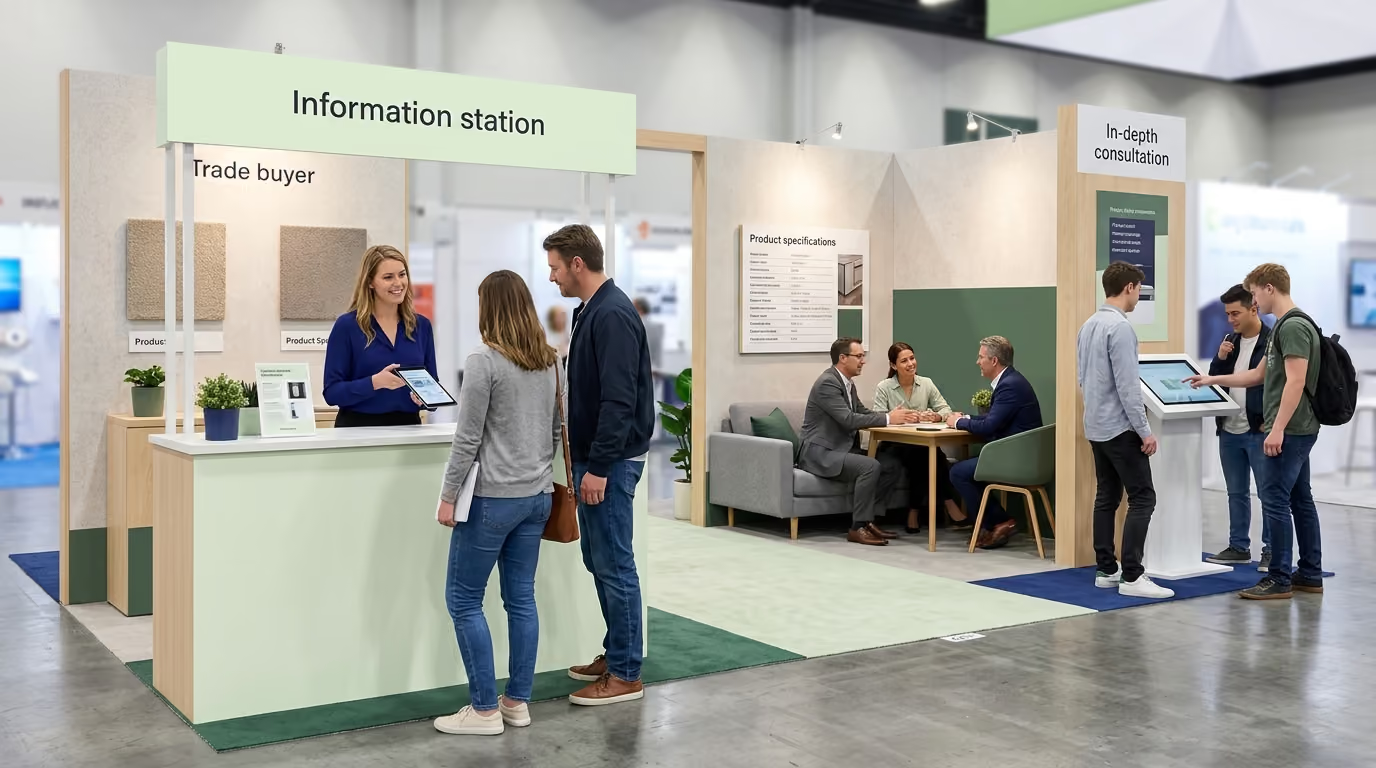
A robust standard operating procedure physically and operationally isolates high-volume engagement from commercial discovery. The forward perimeter of the exhibit is engineered as a high-flow sampling engine staffed by trained brand ambassadors. The interior core of the booth is structured as an access-controlled meeting space staffed by enterprise account managers. Greeters are trained on specific verbal triage scripts to identify retail buyers instantly and escort them out of the public sampling queue into the commercial lounge within thirty seconds.

30 Years Experiential & Retail Activation Partner for CPG & Beverage Brands | Multi-Market Demos, Roadshows & Costco/Club Programs That Actually Sell