Robbie Thain
Founder, CEO

Stronger booth lead conversion rates result from organizing exhibition spaces into targeted functional zones that guide distinct buyer segments through personalized journeys.
Most exhibitors build trade show spaces for an imaginary average visitor who does not exist. Designing a single, linear floor experience for every attendee creates friction, squanders prime buyer attention, and dilutes commercial results.
Treating audience segmentation as a real-time spatial routing challenge turns chaotic event traffic into a disciplined revenue engine. Segmenting attendees by motivation, buying authority, and functional information need allows marketing teams to guide distinct audiences along custom paths within one unified brand environment.
The trade show floor is an environment of sensory overload and fragmented attention. Hundreds of attendees stream past your perimeter every hour, each carrying radically different agendas, budgets, and timelines. Within a single ten-minute window, your booth staff might encounter a national grocery buyer, an independent distributor, an end consumer hunting for free merchandise, a trade journalist, and a legacy client.
When a booth relies on a one-size-fits-all layout, operational failure quickly follows. Brand ambassadors get trapped delivering entry-level product overviews to casual browsers. Meanwhile, high-value retail buyers wait in aisle congestion, lose patience, and walk away to a competitor.
Without intentional routing, booth staff treat every badge scan identically. This dynamic turns your event footprint into an expensive bottleneck rather than a precision sales environment. The fundamental problem is not a lack of foot traffic. The problem is the absence of a spatial architecture that triages visitors at the perimeter.
Exhibitors often attempt to fix this issue by adding more staff or expanding screen displays. These surface adjustments fail because they treat symptoms rather than the root cause. Without structured entry points, diagnostic qualification, and tiered engagement zones, booth staff remain overwhelmed by volume while high-margin opportunities slip through unnoticed.
Job titles printed on convention badges rarely tell the entire operational story. A director of procurement might attend an expo merely to audit market trends, while a store manager might carry direct authority to test and authorize a regional product trial. Segmenting your trade show footprint requires understanding attendee motivation, buying status, and information requirements.
Academic research demonstrates that visitor intent drives on-site behavior far more than demographic labels. A peer-reviewed study of 2,698 attendees at the New York National Boat Show analyzed trade show motivations using factor and cluster analysis. The researchers identified three distinct visitor groups:
These motivational segments exhibited stark differences in commercial intent. Over 73% of purchase seekers reported intent to buy on-site or immediately post-event, compared to only 35.8% of show-event browsers. Furthermore, 58.8% of purchase seekers planned direct follow-up actions with sellers, whereas only 28.1% of browsers planned continued dialogue.
Industrial marketing research on trade show dynamics reinforces this perspective by segmenting audiences into current buyers, potential buyers, and non-buyers. Current buyers use events to reinforce commercial partnerships, review product roadmaps, and secure executive alignment. Potential buyers require education, comparative evidence, and risk reduction. Non-buyers, including media analysts and industry students, seek macro trends and category data.
A Cornell University study examining more than 2,500 exhibitors and attendees revealed a deep structural divide in trade show objectives. Exhibitors prioritize brand promotion, immediate lead capture, and tactical relationship management. Attendees prioritize professional education, technical learning, problem solving, and peer networking.
When an activation focuses exclusively on aggressive lead capture, it alienates buyers looking for functional education. Research on exhibition visitors confirms that functional value, such as clear technical demonstrations and comparative data, directly drives purchase intention. Emotional engagement alone does not generate commercial conversion without functional substance.
To execute multi-track engagement without fragmenting your physical footprint, you must define the operational profiles that enter your space. A well-designed booth accommodates eight primary audiences by matching their core objectives with dedicated physical pathways.
Active commercial buyers arrive with immediate category mandates, shelf-space allocations, and purchasing authority. They evaluate margin structures, supply chain reliability, minimum order quantities, and unit velocity. They do not want promotional theater.
Provide these buyers with rapid access to commercial tear sheets, gross margin calculators, packaging certifications, and private meeting zones. Keep entry barriers low and transition them quickly from the perimeter into structured commercial conversations.
Category explorers understand their internal operational problems but have not committed to a specific vendor or methodology. They are benchmarking competitive solutions, gathering technical documentation, and determining budget allocations for future quarters.
These visitors need structured product demonstrations, clear capability matrices, and verifiable case evidence. Offer them interactive demonstration stations that clearly display performance metrics and operational workflows.
Distributors focus on inventory turnover, logistics, cross-docking capabilities, and channel conflict management. They want to know how your product line complements their existing warehouse portfolio and whether your brand provides active field marketing support.
Design a pathway that presents pallet configurations, distribution territory models, and retail support commitments. Connect these visitors directly with channel managers who can discuss regional expansion strategies.
End users and technical evaluators are the individuals who handle, install, or operate your product daily. While they may lack final sign-off authority, their operational feedback heavily influences corporate purchasing decisions.
Provide tactile, hands-on testing benches where technical users can inspect materials, test software interfaces, or sample formulations. Give them deep technical documentation and direct access to product engineers or field application specialists.
Existing clients visit your booth to gauge company health, preview upcoming product releases, resolve account issues, and renew personal ties with leadership. Treating a long-standing client like an unknown prospect damages brand equity.
Incorporate a hospitality check-in workflow that identifies existing accounts instantly. Direct them to account directors, executive roadmaps, and comfortable seating areas where staff can express client appreciation and discuss expansion opportunities.
Media professionals look for compelling narratives, new product announcements, executive access, and concrete market trends. They operate under tight publishing deadlines and need immediate access to verified assets.
Equip your perimeter team with digital media kits, concise executive summary sheets, and a direct line to your public relations lead. Maintain clean, well-lit visual backdrops for video interviews and photography.
Strategic partners and financial investors assess your market momentum, organizational leadership, intellectual property, and category dominance. They look beyond unit mechanics to evaluate corporate trajectory and strategic stability.
Direct these visitors away from general traffic flow into private hospitality or conference suites. Ensure senior executives are available for pre-scheduled briefings supported by corporate performance materials.
Browsers consist of students, general attendees, and adjacent vendors wandering the aisles without immediate commercial intent. While they do not warrant dedicated sales time, their presence creates energy and word-of-mouth momentum.
Engage browsers through open perimeter sampling counters, high-visibility kinetic displays, and automated digital capture points. This self-service track delivers a memorable brand impression without consuming the time of your senior sales personnel.
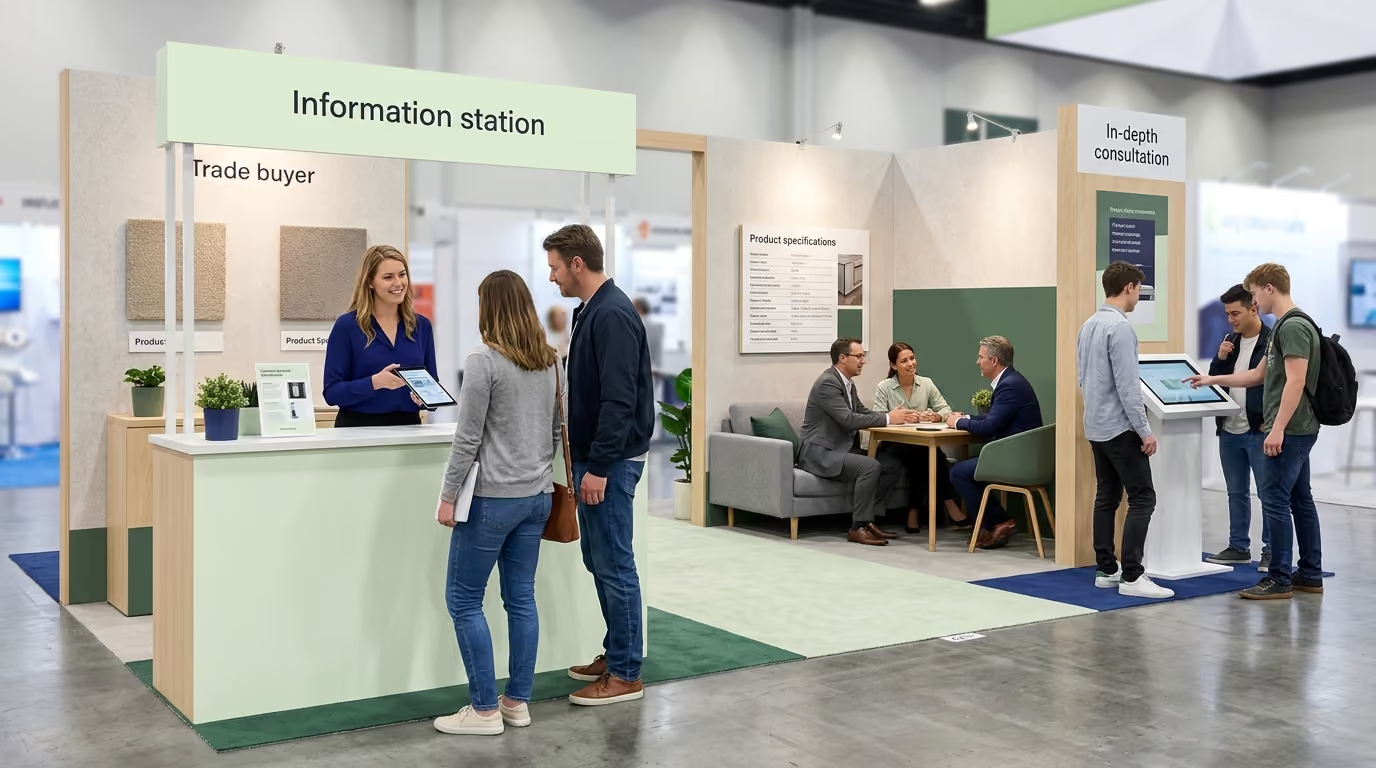
Managing multiple visitor tracks within a single booth requires a zoned spatial design. Rather than creating isolated, walled-off rooms that confuse traffic, structure your space into three concentric layers of depth. This layout maintains a unified visual identity while organizing foot traffic based on intent.
The perimeter handles high-volume traffic directly adjacent to the main aisle. Its operational purpose is rapid visual orientation, low-barrier product trial, and initial attendee triage.
Design this zone with open sightlines, clear overhead category positioning, and rapid engagement stations. Visitors should understand what your brand does within three seconds of visual contact.
Place high-energy demonstration counters and self-service sampling displays at this exterior boundary. Orientation hosts stationed here greet visitors, answer basic questions, and conduct immediate diagnostic triage to guide qualified buyers inward.
The mid-booth area serves qualified evaluators, technical users, and serious category explorers who want to understand product capabilities. This zone moves beyond surface branding to deliver functional proof points.
Incorporate modular testing stations, workflow demonstration tables, and digital configuration kiosks. Visitors can engage in structured five-minute product walkthroughs led by technical specialists.
By centralizing high-converting product demonstrations in this middle zone, you filter out passive browsers while providing genuine evaluators with the operational evidence they need to make buying decisions.
The inner core or rear of the footprint is reserved for high-value negotiations, distributor agreements, customer account reviews, and press briefings. This environment must provide acoustic privacy, comfortable seating, and dedicated presentation technology.
Shield this space from aisle chaos using frosted architectural glass, acoustic paneling, or raised flooring systems. Equipping this area with enterprise presentation displays and hospitality amenities allows sales leaders to conduct uninterrupted business.
For brands investing in multi-city expo schedules, designing booth layouts for buyer meetings ensures that executive deal-making remains isolated from general trade show noise.
A well-zoned booth fails if staff members act like generalists who wander aimlessly. Operational success requires assigning your on-site team specific operational roles, diagnostic scripts, and handoff protocols.
Instead of assigning booth staff to generic shifts, deploy personnel based on clear functional responsibilities:
In our experience across more than 1,000 campaigns in all 50 states, matching booth staff to specific operational roles increases qualified lead output while eliminating floor confusion. From high-volume retail expos in Seattle to medical conventions in Miami and specialty roadshows in Honolulu, disciplined role assignment protects key sales conversations from aisle interruptions.
Staff should never open conversations with passive questions like "Can I help you?" or "Are you enjoying the show?" Train orientation hosts to ask diagnostic qualifying questions that uncover motivation and buying status within thirty seconds:
These diagnostic questions mirror proven trade show qualification models that classify attendees before valuable booth resources are committed.
When an orientation host identifies a high-value buyer, they must execute a warm, structured handoff rather than pointing across the booth. The host walks the buyer to the appropriate zone, introduces them to the designated specialist, and shares their qualifying context:
"David, this is Sarah from Regional Grocery Co. She manages 45 retail doors across the Pacific Northwest and wants to review our shelf-stable margins and direct-store-delivery logistics."
This introduction establishes immediate professionalism, prevents the buyer from repeating basic information, and allows the commercial specialist to jump straight into high-value discussions. If specialists are occupied, the host escorts the buyer to a hospitality lounge, provides refreshments, and queues them for the next available representative.
Evaluating trade show success solely by total badge scans produces misleading pipeline data. A high-volume booth full of unqualified browsers can register 2,000 scans but yield zero commercial Return on Investment (ROI).
True measurement tracks how efficiently each audience segment moves through its designated physical path into post-event pipeline milestones. Segment your event data into lead and lag indicators across every operational track.
Monitor real-time indicators to adjust staff allocation throughout the event:
Evaluate commercial outcomes thirty, sixty, and ninety days after the show floor closes:
Reviewing performance across distinct visitor paths helps marketing leadership justify budgets and supports shifting resources toward high-impact activations that deliver measurable revenue.
A national packaged food and beverage brand prepared to launch a premium functional snack line at Natural Products Expo West. The brand faced a complex operational challenge within a 20x30 island footprint.
They needed to engage high-volume foot traffic to drive trial, while simultaneously hosting confidential meetings with national grocery category managers, regional direct-store-delivery distributors, and lifestyle media editors.
The brand divided its footprint into three distinct engagement zones:
Trained brand ambassadors staffed the outer sampling bar. When an attendee scanned their badge for a sample, the ambassador asked a simple qualifying question: "Are you picking this up for personal snacking, or do you manage retail purchasing for a store network?"
When an attendee identified themselves as a retailer, broker, or distributor, the ambassador immediately notified an on-site commercial manager via a discreet mobile messaging channel.
The manager greeted the buyer at the perimeter, bypassed the sampling crowd, and guided them directly to the Retail Velocity Lab or into the private boardroom for pre-arranged meetings.
Over the three-day exhibition, the brand distributed more than 6,500 consumer trial samples without creating aisle congestion. More importantly, the commercial sales team conducted 48 private, distraction-free retail buyer meetings.
These structured buyer sessions resulted in verified purchase orders across three major regional grocery chains and secured direct-store-delivery distribution in twelve new metropolitan markets within ninety days post-event. By separating high-volume trial from commercial negotiations, the brand maintained high energy while closing high-value accounts.
Executing a segmented booth strategy transforms trade shows from chaotic marketing expenditures into predictable, revenue-generating commercial engines.

30 Years Experiential & Retail Activation Partner for CPG & Beverage Brands | Multi-Market Demos, Roadshows & Costco/Club Programs That Actually Sell