Robbie Thain
Founder, CEO

Higher trade show revenue comes from replacing random badge scanning with targeted qualification frameworks that schedule direct conversations with real decision-makers.
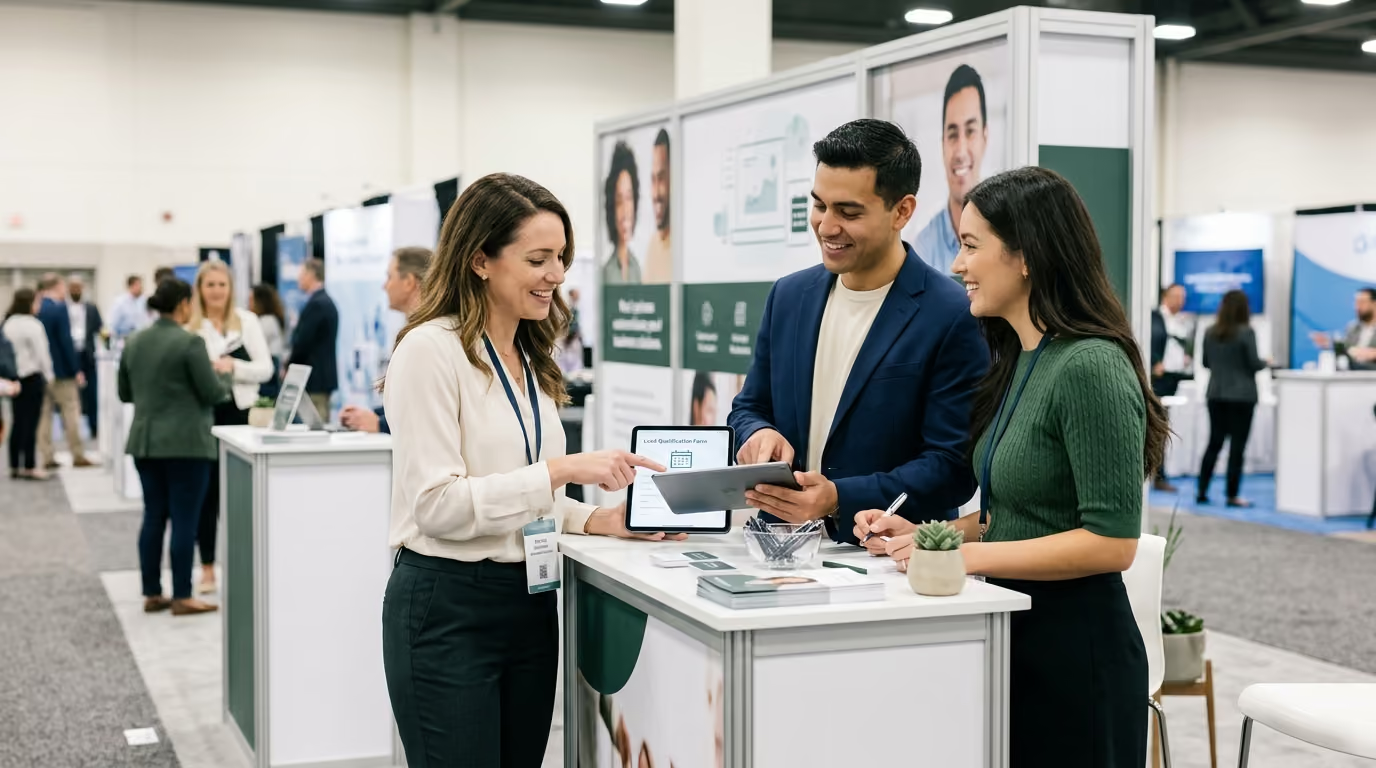
Securing qualified meetings at trade shows is not about collecting badges, but about securing mutual commitments to concrete business conversations. This guide delivers a complete operational framework to design purpose-driven appointments, route prospects to the right experts, prevent no-shows, and convert booth interactions into measurable pipeline.
Trade show floors are loud, crowded, and chaotic environments where hundreds of exhibitors compete for limited attendee attention. Brand managers and field marketing directors invest heavy capital into exhibit space, custom booth builds, and travel logistics. Yet most teams measure event success by badge scans and foot traffic volume.
This reliance on raw volume creates an illusion of commercial momentum. Booth staff smile, distribute branded merchandise, and scan every badge within arm's reach. Attendees gladly trade a quick badge tap for a free promotional item or a product sample. At the end of the day, marketing hands a spreadsheet of five hundred scanned badges to sales.
The breakdown happens the moment the sales team attempts post-show outreach. Sales representatives send emails and place phone calls to contacts who do not remember the interaction. Many scanned attendees were never decision-makers, had no active purchasing project, and only wanted free swag. Sales teams quickly lose faith in trade show leads, abandoning outreach after a single generic attempt.
The root problem lies in treating a badge scan as a business conversion. Without an intentional qualification conversation and a confirmed appointment for a specific next step, raw attendee scans create administrative noise rather than sales pipeline. To produce a measurable Return on Investment (ROI), exhibiting teams must redesign their on-site operations to secure verified, scheduled meetings with appropriate subject-matter experts.
A trade show lead is not an email address captured by a handheld scanner. According to research from the Center for Exhibition Industry Research (CEIR), a lead is someone with whom booth staff interact who requires follow-up that delivers measurable value to the exhibiting company.
This strict definition excludes passive visitors, badge collectors, and unqualified passersby. CEIR notes that improving lead quality requires two specific actions. Booth teams must capture information beyond basic contact data, and they must collaborate with the visitor to secure commitment to a clear next action. A scheduled meeting is the direct result of a structured qualification conversation, never an automatic byproduct of booth traffic.
Despite the obvious value of qualifying questions, industry data reveals a massive operational gap. CEIR reports, citing data from lead retrieval providers Experient and CompuSystems, that fewer than 10 percent of exhibitors use custom customer qualifiers during trade shows. Most exhibitors collect only names and email addresses, ignoring project timelines, buying authority, and specific business pain points.
When exhibitors implement disciplined qualification criteria before, during, or after an exhibition, CEIR finds that approximately 39 percent of captured leads meet qualified standards. This benchmark illustrates why unvetted badge collection generates wasted labor. Over sixty percent of general booth traffic lacks the project fit, budget, or timeline required for active sales pursuit.
To systematically filter traffic, high-performing field teams use a three-tier qualification architecture on the floor.
Tier A visitors have an active business problem that your solution directly addresses. They hold direct decision-making authority or play a decisive role on the buying committee.
These prospects operate with a defined implementation timeframe and express clear commercial intent. Tier A interactions should conclude with an immediate calendar booking for a purpose-specific meeting on-site or during the following week.
Tier B contacts match your ideal customer profile and demonstrate clear organizational fit. However, their internal project is still exploratory or their purchase timeline sits several quarters away.
Requesting an immediate deep-dive meeting with an executive specialist may cause friction with Tier B prospects. Instead, booth staff should document their specific operational challenges and schedule a educational follow-up or digital product demonstration.
Tier C visitors consist of job seekers, general consumers, vendors selling services to exhibitors, and attendees seeking free promotional merchandise. They have no budget, no authority, and no active business requirement.
Booth staff should treat Tier C visitors with professional warmth, answer surface-level questions, and conclude the interaction quickly. Staff must avoid logging these contacts as sales leads or booking them into expert calendar slots.
Many exhibitors fail to book meetings because their offer is entirely self-serving. Booth representatives frequently ask visitors to sit down for a generic sales pitch or demo.
An academic study published in Marketing Intelligence and Planning examined visitor and exhibitor expectations across multiple trade exhibitions. The researchers discovered that exhibitors and attendees routinely enter events with conflicting, incompatible objectives. Even experienced exhibitors with large marketing budgets frequently fail to align their booth conversations with specific visitor needs.
Attendees do not attend trade shows to be subjected to standard sales presentations. They attend to solve operational problems, evaluate new market categories, and gather technical information quickly. High-converting appointment designs frame the meeting around a concrete visitor outcome rather than an exhibitor sales target.
Instead of offering a standard meeting, field teams should package appointments as purpose-specific consultations.
This appointment format targets engineers, operations managers, and technical buyers who need to verify integration requirements. The session focuses entirely on data architectures, packaging specs, or technical compliance. The meeting delivers immediate diagnostic value to the prospect, making it highly attractive to busy professionals.
For consumer packaged goods brands, retail buyers care about margin structure, velocity data, and slotting terms. Structuring an on-site meeting around unit economics and category growth models provides immediate commercial relevance for category managers. You can review strategies for trade show activations at Expo West to see how food and beverage brands package buyer conversations.
Enterprise buyers often worry about deployment friction, staff training, and onboarding timelines. An implementation planning session pairs the buyer with a customer success lead to outline a realistic launch schedule. This meeting design reduces perceived purchase risk before commercial negotiations even begin.
To secure these appointments consistently, booth staff should use a five-step structured conversational sequence.
A common failure in trade show execution occurs when a general booth staffer attempts to answer deep technical or commercial questions. When the staffer runs out of answers, they promise that someone from the corporate office will reach out later. This handoff delay destroys conversational momentum and causes prospective buyers to disengage.
High-performing exhibits function as structured routing hubs. Booth ambassadors identify attendee needs and immediately route visitors to the appropriate subject-matter specialist. When organizations deploy strategic pre-booked meeting strategies, on-site routing becomes smooth and predictable.
Before stepping onto the convention floor, event leaders should establish an explicit routing matrix that matches prospect signals to specific team roles.
Route visitors to technical specialists when the conversation centers on product architecture, system integration, ingredient sourcing, or technical specifications. These experts should carry dedicated appointment calendars to conduct live diagnostic evaluations in private or semi-private booth areas.
Route visitors to commercial sales leads when the discussion shifts to enterprise pricing, contract terms, distribution territory exclusivity, or immediate request-for-proposal processes. Commercial leads manage negotiations and secure follow-up pipeline commitments.
Route visitors to customer success leads when prospects express anxiety regarding onboarding, supply chain reliability, or account management. These experts build operational confidence by walking buyers through post-sale execution workflows.
For brands in functional food, medical devices, or financial technology, regulatory compliance represents a major purchasing barrier. Connecting buyers directly with compliance experts resolves technical objections that would otherwise stall sales cycles for months.
Route visitors to partnership executives when the conversation involves co-packing, broker networks, white-label distribution, or co-marketing opportunities. Keeping partnership inquiries separate from direct sales workflows ensures channel relationships receive focused strategic attention.
Every routing transaction must generate a complete digital lead record inside your customer relationship management platform. The digital record should capture the primary discussion topic, the assigned expert, the agreed meeting objective, and the visitor's project timeline.
CEIR recommends using digital lead capture tools to enforce accountability across the exhibiting team. Event leaders must designate an on-site lead captain who monitors routing logs and ensures no scheduled appointment remains unassigned.
Booking an appointment during a trade show is only half the battle. Convention environments are filled with distractions, schedule overruns, and competing social invitations. As a result, many booked meetings fail to materialize because attendees forget the time or get pulled into competing sessions.
While empirical research on trade show no-shows is limited, adjacent scientific literature demonstrates the clear power of automated reminders. A pragmatic randomized study on appointment attendance published in the medical literature found that sending automated reminder notifications reduced missed appointments significantly across diverse populations. A systematic review published in BMJ Open revealed that notification recipients were 23 percent more likely to attend their scheduled sessions compared to those who received no notification.
Field teams should apply these notification principles to trade show operations by testing a structured communication cadence.
The moment a booth visitor agrees to a meeting, the staff member must dispatch a digital calendar invite containing exact booth coordinates, meeting room numbers, and contact phone numbers. The invite title should state the specific session outcome, such as Technical Architecture Review or Retail Distribution Analysis.
On the morning of the scheduled meeting, the assigned specialist should send a personalized text message or brief email. The message should confirm the meeting time, restate the core agenda topic, and provide a direct cell phone number for easy coordination.
If an attendee encounters a schedule conflict, forcing a binary choice between attending or missing the meeting usually leads to a complete no-show. Reminders should include an easy link or text prompt allowing the prospect to shift the meeting to an alternate time slot later in the afternoon or the following morning.
Many exhibitors invest in comfortable meeting lounges, premium espresso bars, or private conference rooms within their booth layout. While hospitality features create a quiet environment for serious business discussions, they do not inherently guarantee qualified lead conversion. Teams must evaluate hospitality areas as controlled operational experiments.
Hospitality spaces should be reserved for confirmed Tier A appointments rather than general foot traffic. When you align your floor footprint with verified buyer needs, you avoid turning high-cost booth square footage into a rest area for unqualified attendees. To understand how physical environments impact commercial outcomes, examine how brands handle booth design for product trials and retail buyer meetings.
When an attendee misses a scheduled trade show appointment, booth staff must not abandon the lead. In our experience across more than 1,000 campaigns across all 50 states, from retail demos in Seattle to activations in Miami and Honolulu, immediate and professional recovery workflows regularly salvage high-value opportunities.
A research study published in the healthcare domain evaluated post-no-show outreach and found that structured follow-up messages doubled the likelihood of securing a completed follow-up appointment within thirty days. Field teams should deploy a polite, non-accusatory recovery message within two hours of a missed trade show meeting.
The recovery communication should follow a clear structure:
Executing a high-converting meeting strategy requires rigorous preparation before the show, disciplined engagement on the floor, and systematic tracking after the event closes.
To maximize operational efficiency, marketing leaders should follow this phased implementation playbook.
To justify trade show marketing budgets to executive leadership, field marketing directors must move beyond vanity metrics like total badge scans, booth impressions, or promotional giveaway counts. Measuring real commercial success requires tracking both leading indicators on the floor and lagging financial metrics across the sales cycle.
Analyzing metrics at each stage of the funnel allows teams to identify operational bottlenecks and calculate precise event profitability. You can explore additional measurement frameworks in our guide on metrics to prove trade show Return on Investment.
This metric measures actual logged attendee interactions against total planned booth capacity. It reveals whether booth staffing levels were optimized for the event's actual foot traffic volume.
Calculate this by dividing total qualified leads (Tier A and Tier B) by total badge interactions. A qualification rate significantly below the CEIR 39 percent benchmark indicates weak audience targeting, poor booth location, or loose screening by front-line staff.
This metric tracks the percentage of Tier A qualified leads who commit to a scheduled appointment. Low booking conversion often signals that the appointment offer lacks clear diagnostic value for the attendee.
Calculate this by dividing attended booth appointments by total booked meetings. Tracking show-up rates reveals whether your calendar confirmation and reminder cadence is functioning effectively.
This metric measures the total dollar value of sales opportunities created from attended trade show meetings within 60 to 90 days post-event. It connects physical booth conversations directly to sales pipeline velocity.
Calculate this by dividing total trade show expenditure (booth space, fabrication, staffing, travel, and logistics) by the number of completed, qualified meetings. This metric provides a clear efficiency baseline for comparing different marketing channels.
Track how rapidly trade-show-originated opportunities move through the sales pipeline compared to inbound digital leads. In-person meetings frequently accelerate trust, resulting in shorter sales cycles and higher contract close rates.
Measure total closed-won revenue directly attributed to trade show interactions over a full sales cycle. Reviewing historical data published in the CEIR report on trade show strategy shifts confirms that senior executives increasingly demand explicit revenue attribution rather than soft brand awareness metrics.
A rapidly scaling plant-based snack brand prepared to exhibit at a major national food expo. In previous years, the company invested heavily in large footprint displays, passed out thousands of product samples, and collected hundreds of badge scans. Despite intense booth activity, post-show sales conversion remained negligible because retail category buyers walked past the crowded sampling tables without engaging in commercial discussions.
For the upcoming expo, the leadership team restructured their operational strategy to focus entirely on booking qualified retail buyer meetings. The brand partnered with our field team to design an activation that separated high-volume consumer sampling from high-value buyer interactions.
The brand divided its booth space into two distinct functional zones. The outer perimeter featured dynamic sampling stations staffed by professional brand ambassadors who engaged general foot traffic, distributed samples, and screened visitors.
The interior of the booth housed a private, sound-dampened buyer lounge equipped with a full product showcase, margin analysis sheets, and refrigerated display units. Brand ambassadors used custom digital qualification scripts on mobile tablets to identify retail buyers, regional distributors, and convenience store category managers.
When an ambassador identified a qualified buyer, they presented a specific commercial offer: a 15-minute retail margin evaluation with the Vice President of Sales, paired with an exclusive tasting of unreleased product SKUs.
If the sales executive was conducting another meeting, the ambassador immediately scheduled an appointment into the executive's calendar for later that afternoon. Automated calendar invitations and SMS reminders were dispatched instantly to the buyer's smartphone.
By filtering general consumer traffic at the perimeter and maintaining strict qualification criteria, the brand transformed its event performance.
By treating the trade show as an appointment generation engine rather than a passive sampling station, the brand generated verified pipeline that satisfied executive leadership and retail partners alike.
Booth ambassadors should maintain polite, professional hospitality while protecting executive calendar availability. Staff can offer the visitor general product literature, invite them to participate in open booth demonstrations, and collect their contact details for standard email updates. Staff must never assign executive meeting slots without verifying that the visitor meets established Tier A qualification criteria.
Exhibiting teams should initiate pre-show outreach three to four weeks prior to the event opening. Use pre-registered attendee lists, existing CRM target accounts, and direct outreach to secure high-priority meetings before arriving on-site. Reserving 30 to 40 percent of executive calendar capacity for high-value walk-up prospects discovered on the show floor ensures operational balance.
On-site appointments should typically last between 15 and 30 minutes. Trade show attendees manage tightly packed schedules and rarely commit to hour-long sessions during expo floor hours. A focused 20-minute discussion provides sufficient time to diagnose business challenges, establish technical fit, and agree on a post-show follow-up plan without causing schedule fatigue.
Account executives should send a brief personal note within 24 hours of the meeting concluding, while the discussion remains fresh in the buyer's memory. Formal post-show deliverables, such as custom pricing proposals, technical integration briefs, or co-op marketing agreements, should be delivered within three to five business days following the close of the exhibition.

30 Years Experiential & Retail Activation Partner for CPG & Beverage Brands | Multi-Market Demos, Roadshows & Costco/Club Programs That Actually Sell