Robbie Thain
Founder, CEO

Discover how to transform a passive trade show booth into an interactive commercial engine that generates qualified conversations and measurable sales pipeline.
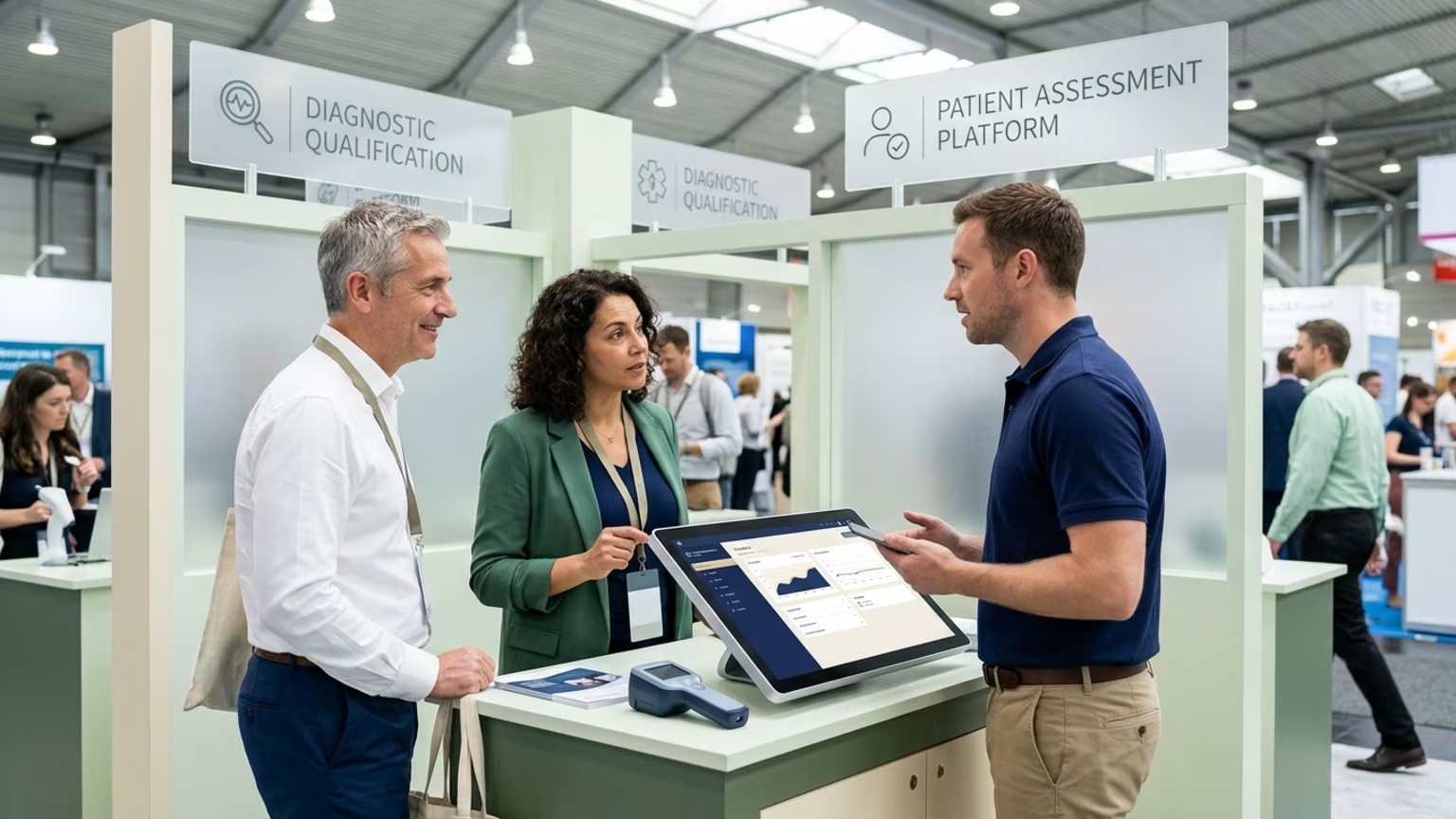
A 10x10 footprint on the Las Vegas convention floor sits mostly empty while three representatives wait passively behind a draped folding table. This common scene perfectly captures the operational tension between checking a box and actually driving revenue. Marketers face extreme pressure to prove that physical events generate a measurable Return on Investment instead of empty leads. To achieve actual commercial results, teams must rethink how they capture and qualify attention.
The trade show environment has historically tolerated vague metrics and poor data discipline. Field teams often celebrate raw attendance figures and massive piles of generic business cards. However, executives no longer accept vanity metrics when evaluating expensive physical activations. They demand clear visibility into exactly how a live interaction translates into a closed deal.
A basic display relies heavily on indiscriminate data collection and static product visibility. Teams wait for attendees to walk up and then scan badges without asking any diagnostic questions. The primary logistical constraints here include a lack of structured CRM mapping and a total absence of strategic floor routing.
Trade show performance should be evaluated against the commercial objective, not simply attendance or booth traffic. However, the standard approach treats every badge scan as a victory, regardless of the visitor's actual intent. Without notes, context, or agreed next steps, the scan functions merely as a contact record rather than a business opportunity.
This operational model ultimately fails when leadership asks for financial accountability. A secondary source citing CEIR research reports limited use of custom qualifier questions. It says 39 percent of leads qualified against exhibitors' own criteria in the cited study. Relying on an incomplete capture strategy guarantees a messy follow up process that frustrates both sales teams and prospects.
When a representative relies on a standard badge scan, they capture a name and an email address without any context. This produces a chaotic CRM record that offers no real value to the sales team. Many marketing departments set their objectives around vague brand awareness without defining the measurement model. They assume that exposing their logo to a high volume of foot traffic justifies the massive expense of a national exhibition.
However, high traffic often reflects giveaways or general curiosity rather than actual commercial intent. Without identifying a specific business problem or purchase timeframe, the organization simply collects useless data.
The modern alternative transforms the physical space into an active diagnostic tool. This method requires designing the booth backward from the commercial action you want the visitor to take. The execution footprint differs entirely from a standard setup because it uses structured paths for distinct visitor types.
Freeman's 2026 research found that respondents would ideally spend 54 percent of their learning time outside traditional session rooms and 64 percent at trade shows. The study surveyed more than 3,300 attendees and exhibitors. Freeman reports that attendees increasingly see the expo floor and peer conversations as part of the event's learning experience. Marketers can capitalize on this by offering product trials, comparisons, and expert conversations directly on the floor.
A high performing physical footprint quickly answers three distinct questions for the visitor. The design must immediately explain what the product is, why the visitor should care, and what specific action they can take. Representatives are trained to open conversations with a diagnostic question rather than a promotional pitch. They might ask the visitor what specific problem they are trying to solve.
This diagnostic approach helps the team identify the exact buying context and commercial timeframe before they ever begin a formal product demonstration. A useful qualification record includes the visitor's pain point, budget context, and a clear next step.
Every conversation in this model ends with a deliberate qualification step. Representatives listen for a specific business problem before proposing an agreed next action. They record the qualification tier and use case directly into the CRM, ensuring that the marketing team can separate sourced pipeline from influenced pipeline effectively.
We create experiential marketing programs built to connect emotion with action. Our process blends creativity, strategy, and data to ensure every brand interaction drives measurable results. We craft experiences that engage all five senses, helping people not just see brands, but feel them, turning moments into meaningful business outcomes.
A passive strategy remains appropriate under a few strict constraints. When budget restrictions absolutely limit the activation to a minimal footprint, a basic table layout might be the only feasible option. It also functions adequately when an organization is required to show support for a partner without expecting measurable lead generation.
This tactic occasionally wins when the target audience density is exceptionally low and the commercial stakes are negligible. Small regional mixers rarely require the extensive logistical orchestration of a full commercial engine. Teams operating with minimal field staff can set up a static display without rigorous sales alignment. If a team only needs to show their face at an industry mixer, a table setup is perfectly adequate.
However, these conditions rarely apply to premium brands operating at a national scale. Marketers deploying this minimal approach must actively manage leadership expectations. They must clearly communicate that this minimal investment will not produce the high volume pipeline generated by surround show activations.
An interactive commercial engine is nonnegotiable when launching a premium consumer product that requires physical taste testing. A brand entering a massive retail expansion must utilize this strategy to prove product demand directly to retail buyers. You cannot build confidence among national distributors with a static flyer and an unenthusiastic greeting.
When preparing for a massive retail expansion, brands must segment their booth for different buyers. They need dedicated routes for high intent distributors and a separate path for curious consumers. This approach dominates for complex technology launches that require deep product demonstration. High intent buyers expect rapid access to knowledgeable staff, clear proof points, and an immediate route to book a formal meeting.
Segmenting the experience allows the team to prioritize these critical conversations over general attendee traffic. When marketing leaders face intense pressure to document their pipeline contributions, they must deploy this structured methodology. It allows them to present clear data on product trials, completed demonstrations, and future revenue potential. This disciplined execution provides the exact operational visibility required to scale future mobile roadshow programs successfully.
Properly measuring physical activations requires rigorous financial tracking. World Financial Review, citing CEIR data, reports that 23 percent of B2B exhibitors have a formal process for measuring trade show ROI. Total event costs must include the exhibition space and physical construction. They must also factor in freight delivery, staff travel, hotel accommodations, and internal labor hours.
Ignoring these logistical expenses creates a highly distorted view of the final event return. The investment required to secure a qualified conversation varies widely across different industries and formats. Secondary sources citing CEIR data show trade show cost per qualified lead estimates ranging from about $96 to $600. Because these figures differ materially, field teams must calculate their own internal baseline rather than rely on generalized averages.
Speed of response heavily dictates the ultimate return on this initial investment. High intent leads should receive personal follow up within one business day, with warm and lower intent contacts entering appropriately segmented nurture paths. Harvard Business Review research on online leads found that companies responding within an hour were nearly seven times more likely to qualify a lead than those waiting longer. Timely action ensures that post event follow up translates directly into booked meetings.
A practical formula calculates event ROI by subtracting the total event cost from the attributed revenue, and then dividing by the total event cost before multiplying by 100. Measuring the full commercial funnel requires multiple reporting intervals. Teams should review early pipeline activity thirty days after the floor closes.
Mid funnel performance should be evaluated after one full quarter. Longer cycle revenue requires a six to twelve month attribution window to accurately capture complex business decisions. In a Sparks case study, the company measured post event behavior, sales conversations, funnel movement, and maturing pipeline alongside basic attendance.
Evaluating field performance strictly by superficial foot traffic is an outdated operational standard. Successful organizations design their physical footprint to generate qualified conversations, target account meetings, and measurable revenue. They reject passive data collection in favor of structured diagnostic interactions.
The passive display model assumes that raw attention will miraculously convert into a closed deal. The interactive commercial engine accepts that every lead must be qualified, recorded, and routed to an owner immediately. Marketers who enforce this strategic discipline will consistently transform their physical floor space into a reliable pipeline channel.
Relying on indiscriminate badge scans creates massive operational blind spots when marketing teams must report on field performance. Makai eliminates the difficulty measuring real ROI from live events by designing strategic Brand Activations that turn raw awareness into active participation and drive measurable consumer response. Request a proposal

30 Years Experiential & Retail Activation Partner for CPG & Beverage Brands | Multi-Market Demos, Roadshows & Costco/Club Programs That Actually Sell