Robbie Thain
Founder, CEO

Executing high-volume experiential sampling during summer heat requires strict temperature monitoring, sanitary field staging, transit logistics.
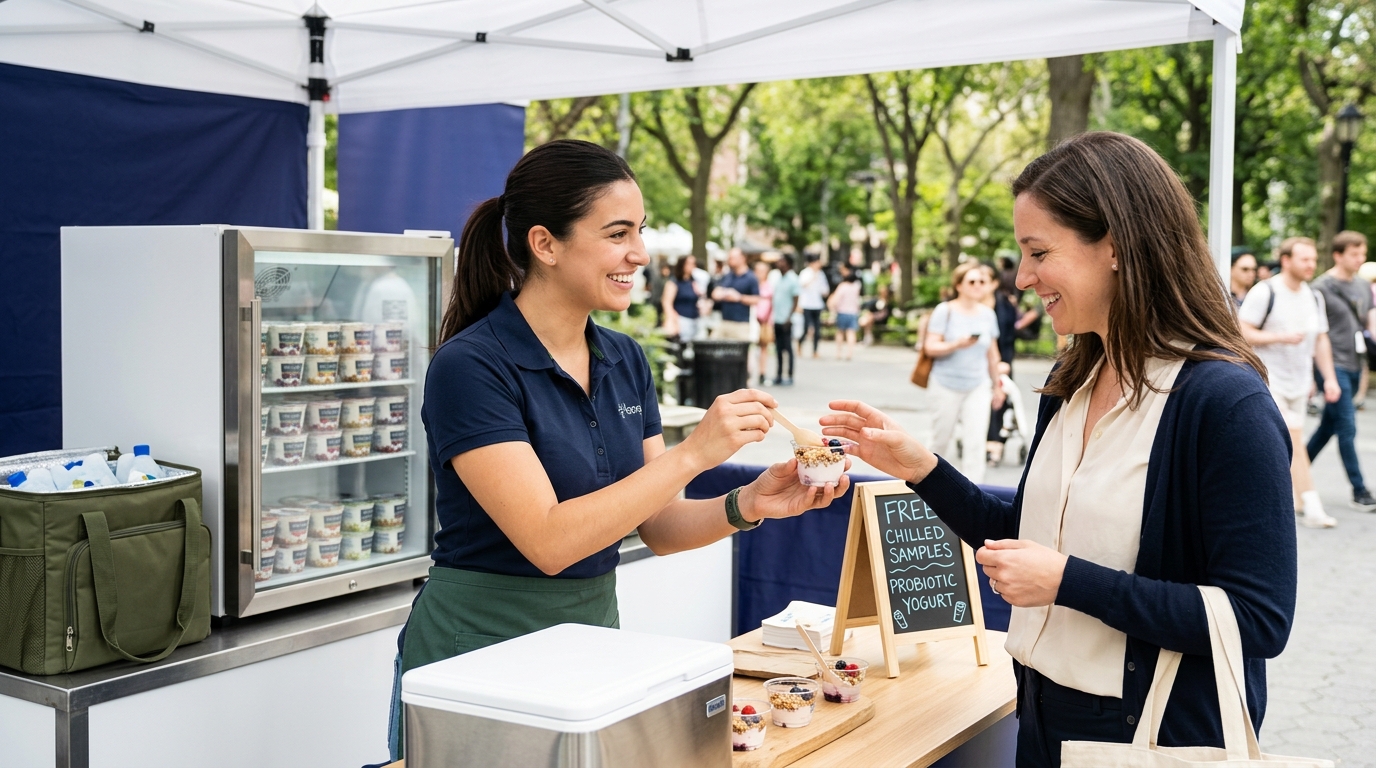
A mobile cold chain is a strictly verified, temperature-controlled distribution and handling system designed to protect perishable items from warehouse loading to the consumer handoff. It is not merely a marketing display with a cooler and some ice bags. This comprehensive operational guide details the protocols, regulatory standards, storage logistics, allergen management, and field auditing required to protect consumer health and brand equity during high-volume experiential activations.
On a live event floor, the reality of field marketing quickly collides with harsh physical environments. Picture an outdoor summer festival or a crowded trade show hall where ambient temperatures climb past 90 degrees Fahrenheit, shore power flickers, and thousands of attendees surround your footprint. Brand ambassadors battle loading dock delays, melting ice, and high foot traffic while trying to distribute hundreds of samples per hour. In this chaotic environment, a single procedural breakdown can transform an exciting brand activation into a severe public health hazard.
The stakes of food safety in experiential marketing are massive. The Centers for Disease Control and Prevention estimates that roughly 48 million Americans get sick from foodborne illnesses annually, resulting in 128,000 hospitalizations and 3,000 deaths. Furthermore, the World Health Organization reports that unsafe food sickens approximately one in nine people globally each year. When a consumer experiences foodborne illness from a promotional activation, the brand suffers immediate reputational damage, social media backlash, regulatory fines, and permanent loss of consumer trust.
Managing field food safety requires treating your activation footprint as a distributed commercial food service operation rather than a simple promotional display. We specialize in creating retail demos, product sampling programs, and roadshows that bring brands face to face with their audiences. In our experience, high-volume trial only builds lasting consumer loyalty when supported by operator-grade sanitary discipline. Marketing directors and experiential leads must establish clear operational boundaries, continuous temperature verification, and uncompromising stop-service rules before a single sample reaches the public.
Executing a successful campaign means understanding that logistical friction is guaranteed. Delivery trucks get delayed in transit, event venues lose generator power, and refrigeration doors open repeatedly during peak sampling hours. Brand teams that anticipate these failure points build resilient operational systems that protect product integrity under the most grueling conditions. Rigorous food safety protocols do not restrict your marketing reach. Instead, they provide the operational foundation that allows your field teams to sample aggressively, protect consumers, and secure a verifiable Return on Investment (ROI) across every market.
Maintaining a cold chain requires an unbroken series of refrigerated storage and transit steps from the manufacturing line to the moment of sampling. The chain encompasses staging commisaries, refrigerated transport vehicles, portable ice chests, active mechanical refrigerators, and serving vessels. If product sits on an unconditioned loading dock for two hours, the cold chain is broken. Even if the product is chilled again later, pathogenic bacteria may have multiplied or produced heat-stable toxins that refrigeration cannot reverse.
The Food and Drug Administration defines Time/Temperature Control for Safety (TCS) foods as items requiring specific temperature controls to prevent pathogen growth or toxin formation. TCS products include dairy items, plant-based milks, cut fruits, sliced leafy greens, cooked vegetables, meats, seafood, eggs, and items containing raw sprouts. Shelf-stable products can instantly become TCS foods the moment an ambassador cuts, blends, rehydrates, or opens the primary container. Every field marketing director must classify every campaign Stock Keeping Unit (SKU) before launching a tour.
Under the 2022 FDA Food Code, all cold TCS foods must be maintained at 41 degrees Fahrenheit (5 degrees Celsius) or below during storage, transit, and cold holding. Hot foods must remain at 135 degrees Fahrenheit (57 degrees Celsius) or above. To prevent accidental non-compliance, experienced operators establish an internal operating target of 38 degrees Fahrenheit or below for refrigerated assets. This three-degree buffer provides an essential safety margin when staff repeatedly open refrigeration doors during peak foot traffic.
Temperature abuse happens frequently during intermediate transport steps. FDA transportation research indicates that temperature abuse occurs in roughly 30 percent of shipments moving from shippers to distribution centers. It also occurs in 15 percent of transport runs from distribution hubs to local retail endpoints. These statistics show why experiential operators cannot assume that inbound inventory is safe simply because it arrived on schedule. Every inbound crate must undergo physical inspection, surface scanning, and core temperature logging before acceptance.
The FDA Food Code allows the use of time as a public health control under strict parameters. If cold food starts at 41 degrees Fahrenheit or lower, operators can hold it without temperature control for up to four hours, provided the product is clearly marked with the removal time and discard deadline. An alternative six-hour window applies only if the food temperature remains below 70 degrees Fahrenheit throughout the activation and continuous monitoring is documented. Any unconsumed food remaining at the end of the time limit must be discarded immediately. Field teams must never return time-controlled food back to cold storage.
Accurate temperature measurement requires calibrated equipment and consistent methods. Air temperature indicates ambient cooler conditions, but product core temperature reveals the true biological state of the food. Teams should use digital probe thermometers accurate to within 2 degrees Fahrenheit, alongside automated data loggers that record continuous interior vehicle temperatures. Infrared surface thermometers provide quick operational checks, but staff must verify any borderline reading with an internal probe thermometer inserted into a sacrificed test sample.
Designing a safe sampling activation requires evaluating four interacting operational pillars: Product, Process, Place, and People. When marketing teams evaluate these four dimensions simultaneously, they identify hidden vulnerabilities before hitting the field. A breakdown in any single pillar compromises the entire campaign, exposing consumers to unsafe products and the brand to severe liability.
The Product pillar evaluates the inherent biological and chemical vulnerabilities of your sample. Is the product highly perishable, frozen, or sensitive to temperature spikes? Does the item contain fragile emulsions that separate when exposed to heat, or active cultures that spoil quickly? You must determine whether opening the factory seal alters the product shelf life or handling requirements. Formulating clear operational checklists for multi-location product sampling ensures that every SKU has an unambiguous operating specification before the roadshow begins.
The Process pillar reviews every physical action applied to the product on site. Serving pre-packaged, factory-sealed samples requires minimal manual intervention and presents the lowest operational risk. Conversely, slicing fruit, blending dairy smoothies, or heating sauces introduces open food contact, requiring intensive sanitation routines. Process planning must define exact portioning techniques, utensil change intervals, batch sizes, and physical replenishment routes. Every extra physical touchpoint added to your on-site prep workflow increases the statistical probability of consumer cross-contamination.
The Place pillar examines the physical constraints and environmental challenges of the venue. Outdoor festival grounds, street corners, and remote parking lots lack the controlled infrastructure of commercial kitchens. You must evaluate access to clean potable water, dedicated electrical hookups, shaded prep zones, and compliant graywater disposal stations. High ambient heat, windblown dust, direct solar exposure, and pests represent significant environmental risks that require physical barriers, custom tent sidewalls, and commercial refrigeration hardware.
The People pillar focuses on training, supervisory control, and accountability among brand ambassadors and field managers. High-energy promotional talent often excels at consumer engagement, but they may lack commercial food sanitation experience. The operational framework must designate a certified Person in Charge on every shift who has the authority to halt distribution when protocols fail. Field managers must enforce strict personal hygiene, correct handwashing techniques, glove use rules, and accurate logging procedures across the entire team.
A flawless mobile cold chain requires tactical discipline at every phase of execution. Managing field logistics across multi-city routes demands strict adherence to documented Standard Operating Procedures. To execute your tour safely, follow this detailed, chronological field playbook.
Managing food allergens on a mobile tour requires precision and transparency. The Food Allergen Labeling and Consumer Protection Act, expanded by the FASTER Act of 2021, identifies nine major food allergens in the United States: milk, eggs, peanuts, tree nuts, wheat, soybeans, fish, crustacean shellfish, and sesame. These nine categories account for the vast majority of severe food-allergic reactions. In a mobile environment, failure to declare an allergen or improper segregation can result in life-threatening anaphylaxis for consumers.
Allergen cross-contact occurs when an allergenic food or ingredient touches another non-allergenic food directly or indirectly via shared equipment. In a compact mobile sampling trailer, cross-contact risks multiply rapidly. Common culprits include shared blenders, multi-use cutting boards, tongs, contaminated gloves, and windblown powders. Sanitizing chemicals kill biological pathogens, but they do not break down or remove allergenic proteins. Thorough physical washing with soap and clean water is the only reliable way to remove allergen residues from preparation surfaces.
Field teams must maintain clean, comprehensive ingredient displays directly at the sampling counter. Display boards or branded counter signs should list every ingredient clearly, highlighting major allergens in bold typography. If a product formulation changes between batches or production runs, ambassadors must update on-site signage immediately. When launching multi-city sampling tours across diverse markets, consistent signage and ingredient literature protect both consumers and event staff.
Field personnel must receive clear scripts regarding allergen inquiries. Brand ambassadors should never guess, assume, or downplay potential allergen risks when answering consumer questions. If an attendee asks whether a product contains traces of sesame, tree nuts, or gluten, the ambassador must consult the official master specification matrix. If the answer is not explicitly confirmed on the specification sheet, the ambassador must politely advise the consumer not to eat the sample.
Operational planning must account for severe environmental stress and logistical failures. Mobile tours regularly face extreme summer heat waves, high humidity, generator failures, and sudden multi-hour traffic delays. Without written corrective action protocols, field teams often make hurried, unsafe decisions under pressure. Establishing clear if-then parameters empowers field managers to take immediate action, protecting consumer health and minimizing product loss.
Outdoor summer activations represent a primary failure point for commercial refrigeration. When ambient temperatures exceed 95 degrees Fahrenheit, mobile compressor units struggle to dissipate heat, causing interior storage temperatures to creep upward. If cooler air temperatures rise above 41 degrees Fahrenheit, staff must close the unit doors, check circuit breakers, and measure internal food temperatures. If the product remains at 41 degrees Fahrenheit or below, transfer the inventory immediately to backup coolers packed with commercial ice.
Dairy beverages, plant milks, and frozen confections present unique operational challenges on the road. Frozen products must maintain solid consistency without internal temperature spikes that cause partial thawing and microbial multiplication. USDA agricultural transport standards indicate that frozen items should travel at 0 degrees Fahrenheit or below, never exceeding 10 degrees Fahrenheit during temporary transit windows. If frozen products soften, melt, or exhibit refrozen ice crystals on the exterior packaging, discard the batch immediately.
When discarding compromised food inventory, staff must follow controlled disposal procedures to prevent scavengers or event attendees from retrieving rejected items. Move condemned inventory to a private staging zone away from public view. Open primary master cases, slash outer packaging, and apply food-grade dye or water before placing items into heavy-duty trash liners. Record the condemned lot codes, case quantities, verified temperatures, and failure reasons in your digital audit log before securing the bags in commercial dumpsters.
Measuring food safety performance requires tracking operational lead and lag indicators alongside traditional marketing metrics. Marketing executives evaluate live events by total sample distributions, consumer interactions, retail velocity, and overall Return on Investment. Operational directors, however, recognize that field marketing ROI drops to zero if a foodborne illness outbreak closes down your tour. A robust compliance logging system provides the empirical evidence needed to protect your brand from fraudulent claims while proving high execution quality.
Field teams should use digital logging applications on ruggedized tablets rather than loose paper sheets. Digital systems time-stamp entries, capture GPS coordinates, and require staff to attach photos of calibrated thermometer readings. When managing high-volume tours, capturing structured compliance data proves that your cold chain remained continuous across every activation market. Linking these logistics to effective CPG sampling execution models gives retail buyers confidence that your brand delivers professional execution.
Consider an illustrative example, not a client result. A chilled beverage brand runs a summer mobile roadshow across several metropolitan markets to support a grocery rollout. It faces high ambient heat, separate local health permit requirements in each market, and strict corporate quality standards. Dedicated refrigerated vehicles, automated cellular temperature alarms, and trained shift leads are what keep cold-chain integrity unbroken across the tour. The operating lesson is that cold-chain discipline is a precondition for sampling at all: product served out of temperature is not a weak sample, it is a compliance failure.
No, hand sanitizer cannot replace a compliant handwashing station when staff handle exposed, cut, or blended food products. Alcohol-based hand sanitizers do not remove physical dirt, grease, or food residues, nor do they eliminate allergenic proteins. Municipal health jurisdictions require a dedicated handwashing station equipped with clean running water, antibacterial soap, single-use paper towels, and a wastewater collection container whenever staff work with open food. Hand sanitizer should be used only as an optional secondary step after washing with clean water.
Greet the health inspector politely, request their official credentials, and direct them immediately to the designated Person in Charge. Escort the inspector through your activation footprint, providing immediate access to your temporary health permits, staff food handler cards, and digital temperature logs. If the inspector identifies an operational deviation, correct the issue immediately in their presence without arguing. Document their written feedback and file an internal compliance incident report as soon as the inspection concludes.
Under the FDA Food Code four-hour time control rule, cold TCS foods can sit without temperature controls for up to four hours if specific requirements are met. The product must start at 41 degrees Fahrenheit or lower when removed from cold storage and must feature a clear label noting the exact removal time and discard deadline. Any product remaining when the four-hour limit expires must be condemned and thrown away. If ambient temperatures exceed 70 degrees Fahrenheit, this four-hour rule cannot be extended under any circumstances.
The most frequent violations involve inadequate handwashing setups, improper cold holding temperatures, lack of calibrated thermometers, and poor wastewater management. Many marketing teams bring basic ice chests without verifying that products stay submerged in fresh ice below 41 degrees Fahrenheit. Other common failures include discharging graywater onto public streets or failing to provide ingredient labels that declare major food allergens. Establishing clear operational checklists before deploying your tour prevents these avoidable compliance errors.

30 Years Experiential & Retail Activation Partner for CPG & Beverage Brands | Multi-Market Demos, Roadshows & Costco/Club Programs That Actually Sell