Robbie Thain
Founder, CEO

A clear management strategy helps marketing leaders choose between internal teams and agency partners for their collegiate field marketing campaigns.
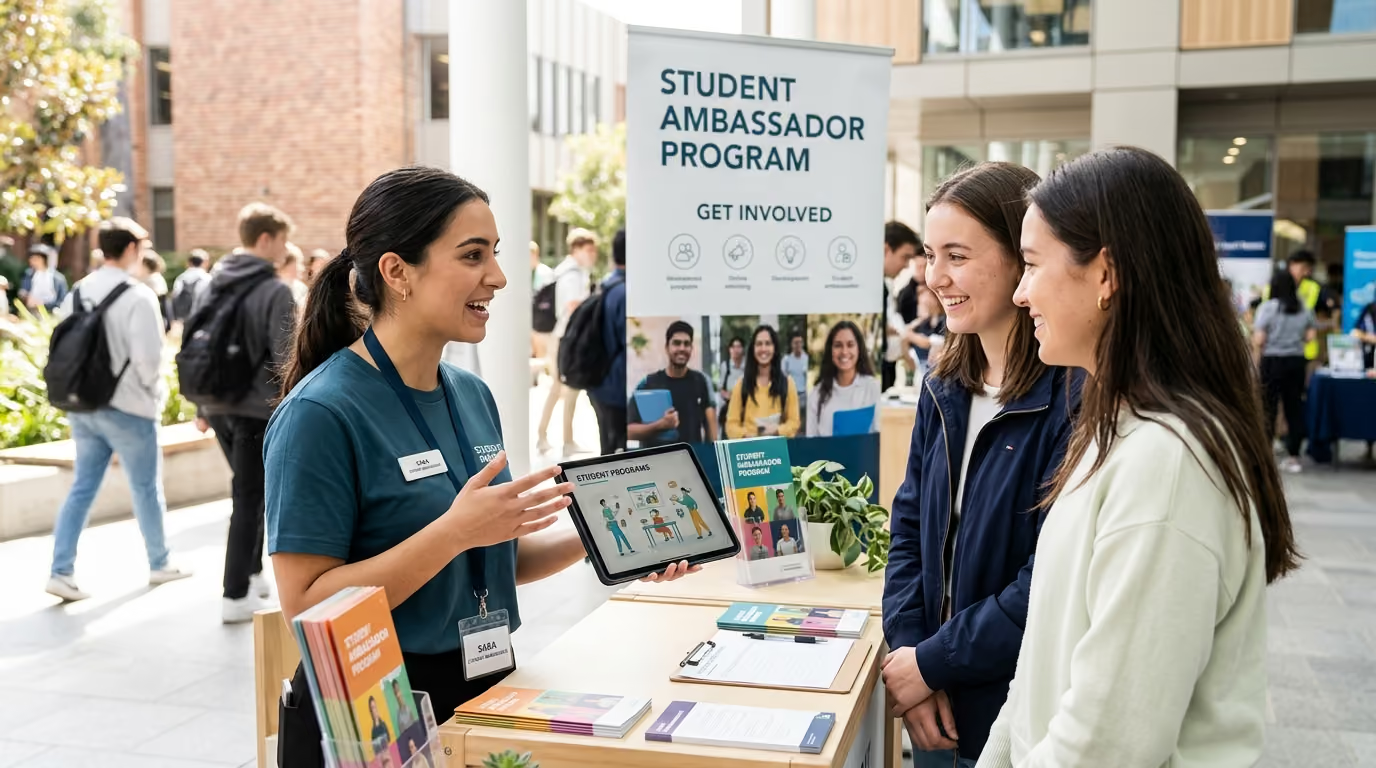
A student ambassador program is a structured peer marketing system that activates enrolled collegiate talent to represent a brand on campus. It is not an unmonitored product giveaway, and it is not a detached digital influencer campaign. Deciding between building an internal campus management team or partnering with an experiential marketing agency determines your operational risk, capital efficiency, and real-world sales velocity. This decision guide gives marketing leaders a clear framework to evaluate operational capacity, compliance risks, total cost models, and hybrid execution strategies across collegiate markets.
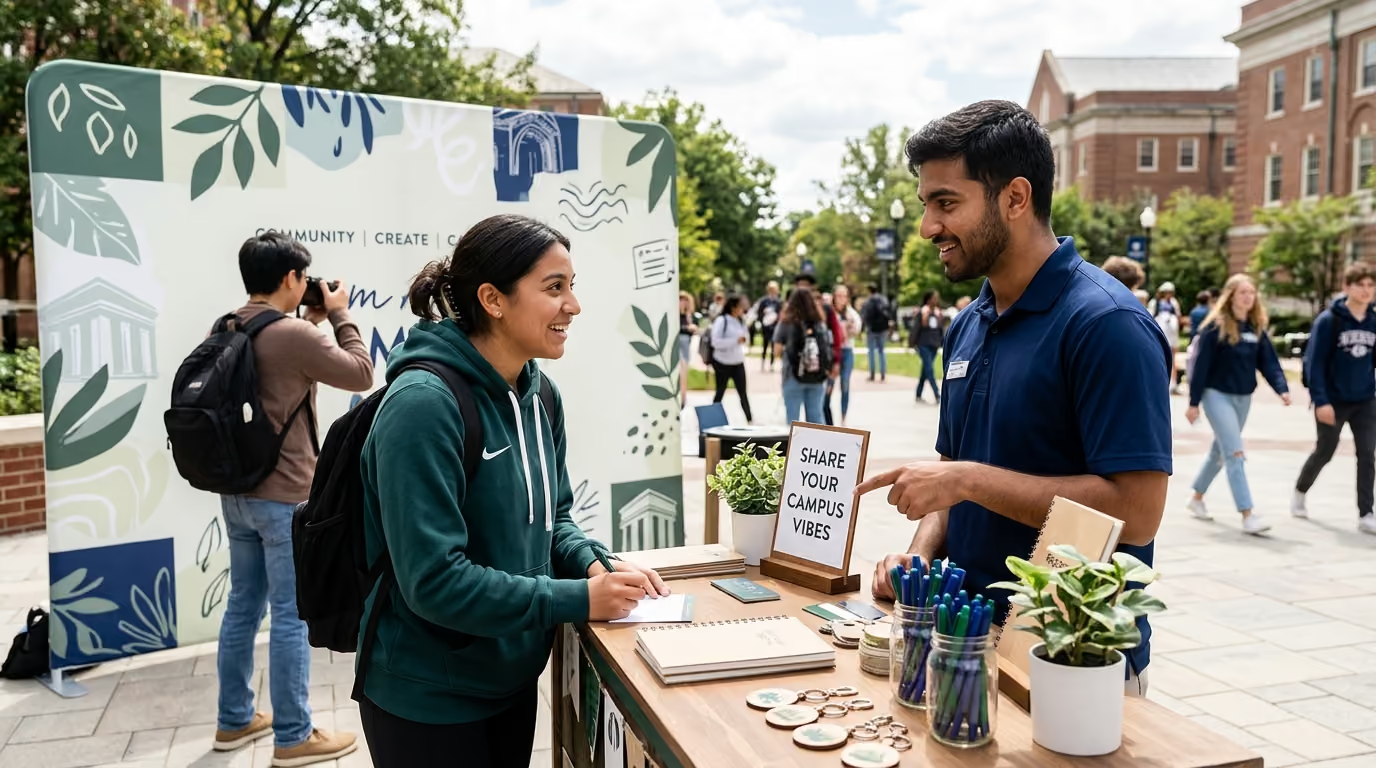
Campus marketing campaigns quickly collapse into operational chaos without disciplined systems. Marketing directors often envision polished student leaders distributing cold beverages or demonstrating software on quad lawns. The reality on the ground often looks completely different. Sample pallets arrive at university central receiving docks with no student authorized to sign for them. Student reps lose access to storage units, forget campus permit requirements, and face immediate removal by campus security.
Meanwhile, headquarters faces a steady stream of administrative emergencies. Brand managers spend Sunday evenings answering frantic direct messages about missing promotional gear. Reps publish blurry social videos with improperly placed disclosures, creating severe regulatory exposure. Inventory sits rotting in residence hall closets while regional grocery retailers report zero footfall lift. The company pays stipends to dozens of students who submit fabricated event reports.
This breakdown happens because marketing leaders underestimate the operational friction of collegiate environments. Campuses function as independent municipalities with complex solicitation rules, security protocols, and distinct social calendars. When brands run campus programs as informal side projects, accountability disappears. Deciding how to resource, manage, and supervise your campus presence is an operational foundation that determines whether your program builds pipeline or drains capital.
Every brand entering collegiate markets must choose how to allocate management overhead, logistics, and accountability. Four operational architectures dominate modern field marketing.
In a fully in-house model, your internal marketing team owns every stage of the ambassador lifecycle. Your staff handles sourcing, interviewing, hiring, contracting, payroll, onboarding, and training. Your team also coordinates product shipments, approves creative assets, manages daily communications, and builds custom performance reports.
This model requires significant internal bandwidth. It requires dedicated program owners, established human resources workflows, legal support for student contracts, and robust logistics infrastructure. Building this internal capability makes sense when a company views campus engagement as a permanent, multi-year growth engine. Teams exploring this route often study the complete guide to building a student brand ambassador program to understand the foundational operational workflows required before hiring their first campus lead.
In an outsourced model, an external experiential agency manages end-to-end field operations. The agency uses established campus recruitment networks, handles student onboarding, administers payroll, secures institutional permits, and manages field logistics. The agency also provides dedicated field managers who conduct daily check-ins, quality assurance audits, and performance tracking.
This structure allows brands to launch across dozens of universities simultaneously without adding internal corporate headcount. The agency assumes the administrative burden of micro-managing student schedules and replacing non-responsive representatives. The brand sets commercial goals, provides brand guardrails, and reviews consolidated performance data.
The campus representative model assigns full territory ownership to one or two high-performing students per target university. Unlike casual brand promoters, these student representatives function as localized field operators. They build direct partnerships with Greek organizations, academic clubs, intramural leagues, and nearby retail stores.
The brand provides these representatives with specialized toolkits, monthly budgets, and strategic playbooks. The students exercise autonomy over how and when they activate their campus. This model delivers authentic community penetration in geographically concentrated markets. However, it requires students with exceptional project management skills and strong personal maturity.
The hybrid model divides strategic governance and field operations between the brand and an external partner. The brand maintains direct ownership of messaging, positioning, product education, and customer research loops. The external agency manages high-friction operational tasks, including legal contracts, student payments, sample freight, warehouse distribution, and permit applications.
Many enterprise organizations find that hybrid structures provide the ideal balance of control and operational scale. The internal marketing team protects brand identity and extracts customer intelligence. The agency partner absorbs logistical headaches and enforces field discipline across distributed regions.
Choosing an operating model requires evaluating how each approach performs across the core requirements of experiential execution.
In-house programs offer total control over brand voice, messaging nuances, and customer interactions. When your internal staff trains ambassadors, you eliminate layers of communication filters. This direct link is vital for brands operating in highly regulated categories, including financial services, supplements, and health technology.
Outsourced programs rely on agency account managers to train field teams. High-caliber agencies use strict certification protocols to guarantee message accuracy. However, small details can get diluted if the agency uses generic playbooks. If your product requires deep technical demonstrations or strict legal disclaimers, in-house governance or high-touch hybrid oversight delivers greater safety.
Launching an internal program across thirty nationwide universities requires months of preparation. Your human resources team must navigate state-specific employment laws, establish tax entities, and create onboarding funnels. Sourcing hundreds of qualified student applicants across unfamiliar campuses consumes hundreds of staff hours.
Experiential partners excel at rapid, wide-scale distribution. Established agencies maintain proprietary databases of active student leaders, campus organizations, and local venue contacts. An external partner can recruit, onboard, and activate a multi-campus campaign in a fraction of the time required by an internal team.
Managing campus logistics is an intense physical undertaking. Someone must store, pack, track, and ship thousands of product samples, display banners, tables, and branded merchandise. Residential halls often reject commercial freight deliveries, leaving student ambassadors without activation materials.
When you manage in-house, these logistical failures land on your marketing managers. Experiential agencies maintain dedicated warehouse facilities, freight networks, and regional field coordinators. They track shipments to the final doorstep, resolve shipping exceptions, and ensure that field materials arrive intact and on schedule.
An internal program captures qualitative feedback directly from target consumers. When students share product complaints, pricing reactions, or onboarding friction, that intelligence flows straight into your product and brand teams. Over multiple academic semesters, your company builds valuable institutional knowledge and an ongoing pipeline of future full-time hires.
Outsourced models risk isolating that intelligence within agency reports. If your contract ends, you may lose access to student relationships, historical operational logs, and campus contact lists. Brands using agencies must require direct access to raw interaction logs, survey outputs, and student feedback streams.
Marketing leadership can avoid costly operational missteps by systematically scoring their program requirements across six strategic dimensions. Rate each dimension on a scale from 1 to 5 to determine the ideal operational model.
Score high (4 or 5) if your product involves complex claims, regulated ingredients, financial transactions, or strict data privacy considerations. Score low (1 or 2) if you sell simple impulse items with self-evident value propositions. High strategic sensitivity demands internal ownership or a hybrid model with mandatory brand-led training modules.
Score high if your program spans dozens of universities across multiple time zones, climates, and retail regions. Score low if you focus on five regional campuses located near your corporate headquarters. High geographic complexity points directly toward an experiential agency with distributed field managers.
Score high if your campaign requires heavy event production, refrigerated storage, physical sampling, complex municipal permits, or extensive vehicle transportation. Score low if your ambassadors focus on digital content creation, peer referral codes, and virtual student group presentations. High operational intensity requires professional agency logistics.
Score high if success depends on deep integration within specific campus subcultures, club sports, Greek chapters, or creative arts departments. Score low if your product targets the broad student body with general awareness activations. High authenticity requirements favor decentralized campus representatives who possess established social capital on their specific campus.
Score high if your organization already uses custom promo codes, localized retail scan data, geotargeted landing pages, and sophisticated attribution modeling. Score low if you lack systems to track field activity to commercial revenue. Brands with low measurement maturity should lean on experienced agencies to provide vetted tracking toolkits and reporting dashboards.
Score high only if you have a full-time marketing manager with at least twenty hours of weekly bandwidth dedicated entirely to campus operations. Score low if you plan to assign campus management to an existing brand manager as a secondary duty. If internal management capacity scores low, attempting an in-house build will lead to program failure.
Review your composite score across all six dimensions:
Evaluating program economics requires looking beyond baseline agency management fees or student hourly wages. Marketing operators must calculate the fully loaded cost per qualified outcome. When assessing operational investments, calculating true Return on Investment (ROI) requires accounting for hidden overhead, manager hours, and administrative friction.
Building an internal program introduces multiple cost centers that rarely appear on initial budget drafts:
Outsourcing consolidates these diverse expenses into a contractual fee structure, though brands must account for specific agency cost categories:
To compare models objectively, measure cost efficiency against concrete business outcomes rather than top-line budget totals:
When evaluating external partners, review the complete guide to budgeting a student ambassador program to benchmark realistic pass-through labor rates, logistics allocations, and management overhead.
Flawless campus execution requires operational discipline at every stage of the campaign lifecycle. Whether managing internally or auditing an external agency, marketing leaders should enforce this step-by-step execution playbook.
Campus marketing programs must produce tangible business evidence, not just social media noise and empty activity counts. We provide clear reporting on reach, trials, leads, and sales to guide next steps in campaign optimization. Our measurement approach tracks awareness, engagement, and conversion, turning brand moments into actionable data that demonstrates business impact.
Activity metrics track whether your field team completed their required operational tasks. These metrics confirm baseline execution:
Engagement metrics measure how target students reacted to your field presence. These data points confirm whether interactions generated real interest:
Commercial outcome metrics evaluate whether the program delivered measurable financial return. These metrics justify ongoing program investment:
For an extensive breakdown of attribution modeling, review how to measure student brand ambassador program ROI to align your reporting framework with executive expectations.
Examining real-world campaigns across diverse consumer sectors illustrates how different operating structures solve specific commercial challenges.
Fashion retailer Topman wanted to drive store footfall across key brick-and-mortar retail markets. The brand deployed a campus representative model targeting universities located directly within the trade radius of their physical stores. Ambassadors hosted tailored on-campus style sessions, coordinated localized lead capture, and distributed store-specific invitations.
Over a four-week campaign window, the program recorded 10,200 direct student interactions, generated 366,000 social impressions, and secured 1,000 pieces of student-generated content. By aligning ambassador territories with physical retail stores, the brand successfully converted collegiate peer conversations into measurable foot traffic.
Apparel brand Aerie focused its campus strategy on driving direct commercial transactions through trackable promotional incentives. The company activated ambassadors across priority campuses to host pop-up events, showcase seasonal collections, and distribute unique promotional coupon codes.
The campaign recorded over 18,000 direct student interactions and generated 1.9 million impressions on Instagram. The program achieved an 11% coupon redemption rate, which exceeded the brand's baseline promotional redemption rate by five times. Providing student representatives with compelling, trackable offers bridged the gap between experiential trial and commercial checkout.
Haircare brand OUAI needed to execute a wide-scale product sampling campaign across dozens of college campuses without expanding its internal marketing department. The company partnered with a specialized collegiate agency to manage end-to-end recruitment, inventory shipping, and field execution.
The agency coordinated sample distribution around high-stress academic moments, including midterm study sessions, wellness fairs, and spring formals. The campaign distributed over 9,600 physical samples across the United States. Outsourcing field operations allowed the brand to achieve national scale and precise event timing without internal logistical strain.
Personal care brand Not Your Mother's launched a multi-campus ambassador initiative across five major universities, including UCLA, UT Austin, and the University of Miami. The brand deployed a focused cohort of 25 ambassadors who balanced physical product sampling with organic content creation on TikTok and Instagram.
Ambassadors distributed monthly product packages to student organizations, hosted residence hall demonstrations, and shared genuine product testimonials online. This structure allowed the brand to test different collegiate environments while maintaining high engagement standards across a manageable cohort. For fast-moving consumer goods, linking campus sampling to local retail shelves is essential, as detailed in how CPG brands expand Gen Z student ambassador programs to connect experiential marketing with retail sales.
Higher education institutions also rely heavily on ambassador models to drive student recruitment and enrollment. Fort Hays State University established a specialized ambassador program to connect prospective international students with current university peers.
The university selected ambassadors specifically for their language capabilities to support key geographic markets. Ambassadors completed weekly operational workshops, managed live chat channels on the university website, and provided authentic perspectives on campus life. Peer conversations proved decisive in helping prospective students navigate complex admissions decisions, proving that ambassador models excel in high-consideration environments.
Marketing leaders must identify and avoid the common misconceptions that undermine campus marketing programs.
Brands often recruit students with massive social media followings, assuming digital reach translates into real-world influence. In practice, high-follower accounts often have disengaged audiences or followers spread across the globe. A student with 1,500 highly engaged campus connections, active club memberships, and a leadership role in an athletic organization drives far more local action than a detached content creator.
Handing a sample to a student rushing between classes does not guarantee product trial. If the student drops the item into a crowded backpack, your investment is wasted. Effective programs train ambassadors to create meaningful trial moments. Ambassadors must explain product benefits, demonstrate usage, answer questions, and secure immediate digital engagement before handing over physical inventory.
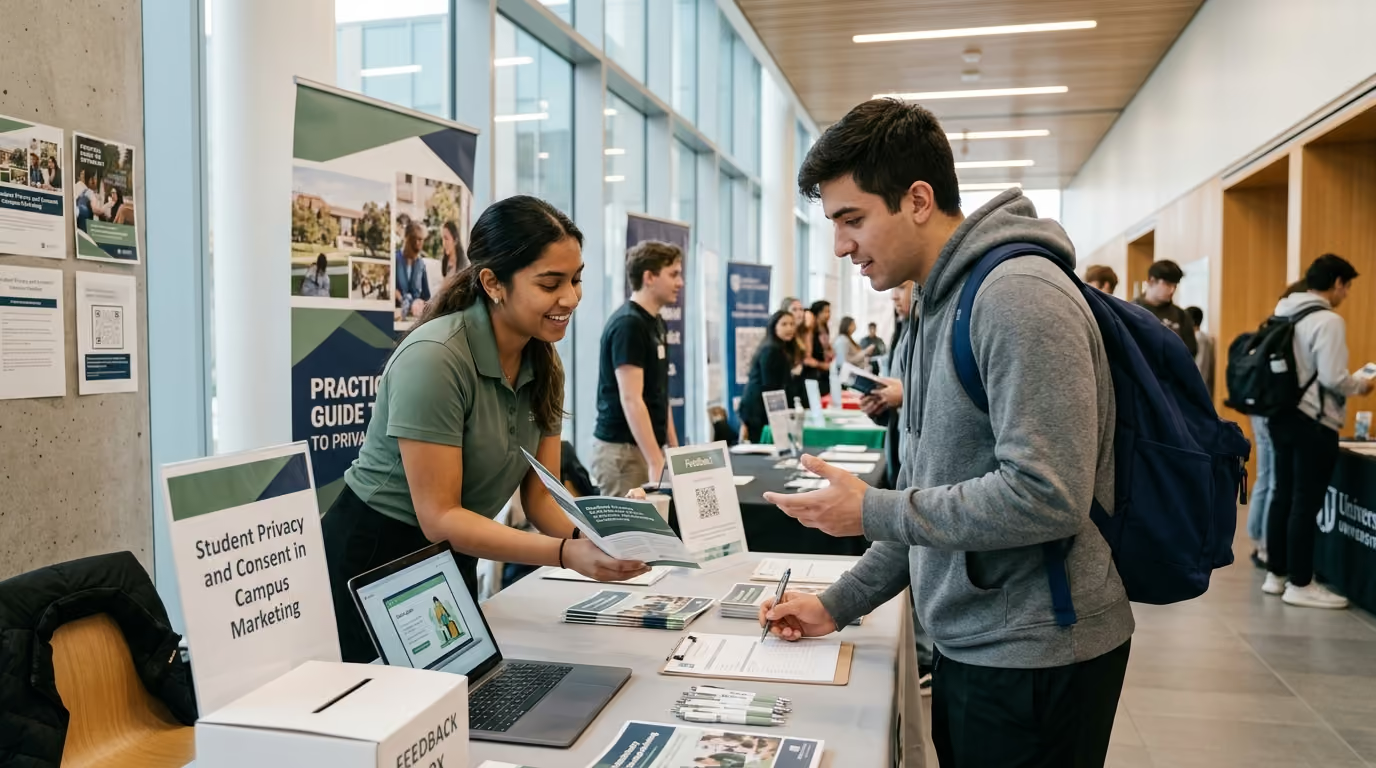
Some marketing teams mistakenly believe campus activations operate outside corporate compliance standards. In reality, the FTC strictly regulates collegiate influencer and ambassador activities. Ambassadors who fail to disclose their commercial relationship with a brand expose the parent company to severe regulatory fines and public backlash. Every post, video, and public endorsement must feature clear, conspicuous, and unambiguous disclosures.
Attempting to run standard commercial marketing cadences on a college campus leads to predictable failure. Student attention shifts dramatically across the academic year. Launching a major activation during final exam weeks or scheduled spring breaks guarantees poor attendance and wasted budget. Successful programs plan around campus milestones, including freshman orientation, homecoming, Greek recruitment, and midterms.
Students sign up for ambassador programs to gain professional experience, build resumes, receive mentorship, and connect with brands they admire. If a company treats them merely as disposable, low-cost labor, student motivation rapidly evaporates. High-performing programs invest in student professional development, provide genuine leadership opportunities, and maintain transparent communication channels.
Classifying student ambassadors as independent contractors versus W-2 employees depends on behavioral control, financial terms, and state employment regulations. If your brand mandates specific working hours, dictates minute-by-minute scripts, and provides direct tools, labor regulators may classify those students as employees. Most enterprise brands use external experiential agencies or professional employer organizations to administer student payroll, ensuring full compliance with state and federal labor laws.
Brand protection starts with rigorous onboarding and strict creative guardrails. Provide ambassadors with a clear content playbook outlining approved messaging pillars, required hashtag disclosures, and strictly prohibited topics. Implement pre-approval workflows for high-reach video assets while allowing flexibility for low-risk daily social interactions. Maintain strict contract clauses that allow immediate termination and content removal if an ambassador violates brand safety policies.
Transitioning in-house makes sense when your company establishes a multi-year campus commitment, achieves predictable unit economics, and builds dedicated internal management capacity. If your brand activates on campus year-round and maintains internal logistics infrastructure, internalizing management can lower marginal costs. However, many enterprise brands maintain hybrid models indefinitely, keeping strategic control in-house while relying on agency partners for physical logistics, payroll, and seasonal scaling.
Many university campuses prohibit unpermitted commercial solicitation, flyer distribution, and corporate tabling on institutional grounds. Experienced marketing operators bypass these restrictions through several proven strategies. Brands can sponsor recognized student organizations, host private off-campus events adjacent to campus borders, partner with nearby commercial retail establishments, or deploy mobile experiential marketing units on public municipal streets surrounding the university.

30 Years Experiential & Retail Activation Partner for CPG & Beverage Brands | Multi-Market Demos, Roadshows & Costco/Club Programs That Actually Sell