Robbie Thain
Founder, CEO

Campus activations fail when brands recruit charismatic social media creators instead of reliable student leaders who actually engage their peers daily.
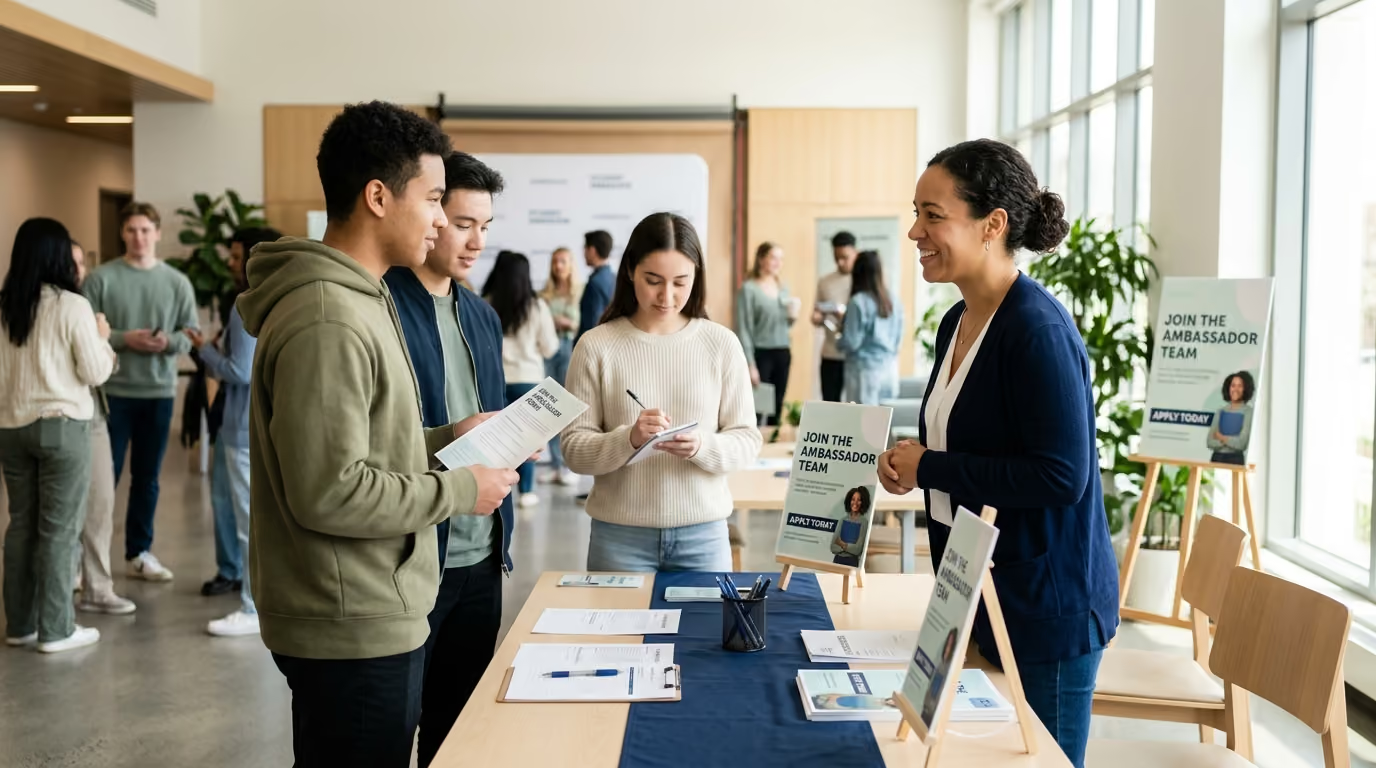
Building a dependable student ambassador program requires a structured talent selection system rather than a popularity contest based on social media follower counts. This operational playbook provides field marketing leaders with the frameworks, rubrics, and screening protocols needed to recruit campus teams that deliver measurable retail sell-through and brand equity.
A Friday afternoon campus activation exposes every crack in a weak selection process. A tent sits half-assembled near the student union while two student workers scroll through their phones. The third student never arrived, having sent a text message ten minutes after the shift began about an unscheduled exam review. Meanwhile, the few samples distributed to passing students come with vague, unscripted explanations that fail to communicate the product value proposition.
Field marketing leaders across food, beverage, and consumer packaged goods know this scene well. When campus staffing decisions rely on vanity metrics and informal interviews, execution falls apart in the field. Building a dependable ambassador roster requires operational discipline, standardized evaluation rubrics, and objective screening methods.
A student ambassador is an enrolled student who represents an organization, product, or institution to peers through conversations, live events, product demonstrations, digital content, and community outreach. The role differs fundamentally from a traditional social media influencer. An influencer is evaluated on audience size and digital visibility. An ambassador is evaluated on trust, reliability, interpersonal communication, availability, and task completion.
A student with 1,000 deep campus connections often delivers more local impact than an account with 50,000 scattered online followers. Research from SheerID indicates that Generation Z discovers brands through multiple distinct touchpoints. Social media accounts for 68 percent of discovery, recommendations from friends and family drive 42 percent, podcasts and video content represent 33 percent, and influencer reviews account for 27 percent. Trust operates locally on college campuses.
Field programs must evaluate candidates across four operational dimensions:
Reach measures the number of relevant students a candidate can access directly. This includes involvement in campus clubs, academic faculties, athletic programs, and residence halls. It also includes their local digital footprint.
Relevance determines whether the candidate's existing campus footprint matches the target audience of the brand. A student studying engineering may have high standing in technical societies but low access to culinary groups needed for a specialty snack launch.
Resonance reflects how effectively peers listen to, trust, and act on the candidate's recommendations. Resonance is visible in past leadership outcomes, community participation, and peer engagement.
Reliability is the non-negotiable baseline of field execution. It encompasses punctuality, communication responsiveness, milestone completion, accurate reporting, and adherence to brand guardrails. A charismatic candidate without reliability creates operational failure.
When teams balance these four dimensions, they avoid letting follower counts override execution capabilities. Field programs require authentic brand alignment rather than superficial fit. Brand alignment means the student understands the mission of the organization, communicates product benefits accurately, and handles critical peer questions with poise.
Selection must also prioritize representation across three distinct layers:
The ambassador roster should reflect the diverse cultural and background makeup of the student body.
The team must span different academic departments, colleges, and year groups to avoid clustering within a single social circle.
Coverage should include commuter students, residential students, student athletes, campus workers, and club leaders. Broad representation ensures the brand penetrates distinct campus ecosystems rather than circulating within one insular group.
Before opening an application portal, field marketing teams must define the operational requirements of the position. A vague job posting produces mismatched candidates who expect casual social posting instead of scheduled event execution. Writing a comprehensive role charter clarifies expectations for both candidates and hiring managers.
Every role charter must establish clear parameters:
Field leaders should separate baseline requirements from trainable capabilities. Baseline criteria include active student enrollment, geographic availability, clear verbal communication, and basic technological literacy. Trainable capabilities include in-depth product knowledge, CRM logging, key messaging nuances, and sampling logistics. Demanding excessive prior marketing experience limits the candidate pool and overlooks highly capable students.
Scalable campus programs recruit specific talent archetypes matched to distinct campaign responsibilities:
The Connector maintains extensive relationships across student government, Greek life, campus organizations, and sports clubs. They excel at securing partnership opportunities and driving group attendance.
The Host thrives in live event environments. They are comfortable operating behind a sampling table, using a microphone, greeting passing students, and managing high-footprint activations.
The Creator produces short-form video, high-quality event photography, and digital stories. They understand campus humor, local trends, and visual storytelling formats.
The Explainer translates complex product attributes or technical information into clear, relatable concepts. They are well-suited for functional beverages, consumer technology, and educational services.
The Organizer manages logistics, tracks sampling inventory, coordinates event supplies, and maintains scheduling calendars. They ensure activations run smoothly behind the scenes.
The Community Specialist holds deep trust within specific cultural, academic, or identity-based campus groups. They ensure brand interactions are culturally competent and respectful.
The Feedback Partner excels at listening, conducting peer surveys, and synthesizing qualitative consumer sentiment. They provide brand teams with clear field intelligence regarding product reception.
Organizations that map these archetypes to specific regional initiatives can build a student ambassador program that drives trial and sales with minimal operational friction.
Relying exclusively on passive application links creates a self-selection bias. It attracts students who already monitor campus job boards or search for promotional work. A dependable recruitment funnel actively combines open channels with structured outreach across campus departments.
Field teams must set operational milestones across the recruitment lifecycle:
Opportunity announcements must clearly explain transferable resume skills, professional development opportunities, and exact time commitments. Setting clear expectations early reduces candidate drop-off during onboarding and establishes execution toolkits and compliance standards from the first point of contact.
An initial application should collect necessary screening data without creating excessive administrative hurdles. Lengthy essay requirements often filter out dependable, busy students while selecting for candidates who write polished marketing copy. The initial application should take less than fifteen minutes to complete.
High-value written application questions focus on practical judgment and past behavior:
"What specific aspect of our product or brand resonates with you, and how would you explain that value to a skeptical classmate?"
"Which campus communities, clubs, or living groups do you interact with weekly, and how would you introduce this product into those environments?"
"Describe a week when you had overlapping academic deadlines, work obligations, and personal commitments. How did you organize your schedule to meet every deadline?"
"A student approaches your sampling table and claims the product made their friend sick last year. How do you respond in real time?"
"You arrive at your scheduled activation site on campus and find another student organization has reserved the space. What steps do you take to salvage the activation?"
Practical auditions provide clearer performance signals than polished resumes. Auditions must be short, highly relevant, and evaluated against standardized rubrics.
Audition submissions should be evaluated on clarity, accuracy, and judgment rather than expensive production quality. A candidate recording a steady video on a standard phone with clear audio demonstrates sufficient technical ability for campus content creation. Evaluating baseline communication rather than high-end editing ensures equitable access for all applicants.
When brand activations require direct retail support, practical simulations should test how effectively candidates can connect student ambassadors with retail demos to drive foot traffic into nearby grocery stores.
Unstructured interviews produce inconsistent evaluations based on personal rapport rather than job-related competency. A standardized interview process asks every applicant the same questions in the same order and evaluates responses against an established scoring rubric. Research summarized by the Society for Industrial and Organizational Psychology (SIOP) indicates that structured interviews demonstrate a mean operational validity of approximately 0.42. This makes structured assessments significantly more reliable than informal conversations.
Interviews should balance behavioral inquiries with realistic situational prompts.
Interviewers must evaluate the substance of candidate responses rather than superficial charisma. High-scoring responses outline the specific context, the direct actions taken by the candidate, the reasoning behind those actions, and the measurable outcome.
Background screening and reference checks must be applied proportionately based on specific role risks. Screening is necessary when student workers handle cash, manage expensive assets, work around minors, or drive company-leased vehicles.
According to the Equal Employment Opportunity Commission (EEOC), employers may run background checks provided they avoid unlawful discrimination and inform candidates that the information will be used for employment decisions. Organizations must review local state statutes, institutional rules, and privacy regulations regarding background inquiries. A prior record should not serve as an automatic disqualification. Review teams must evaluate the severity of the conduct, the time elapsed, its direct relevance to ambassador duties, and evidence of subsequent rehabilitation.
Standardized reference checks should verify past reliability through concise, structured questions:
Conducting structured references provides objective validation of candidate dependability before final contracts are signed.
Objective scoring systems prevent interviewer bias and ensure candidate evaluation reflects operational needs. Panel members should score candidates independently using established rubrics before discussing their impressions as a group.
Every dimension should be scored using a clear 5-point anchor scale:
Field leaders must establish non-negotiable minimum thresholds. A candidate who scores exceptionally high on social reach but fails to earn at least a 3 out of 5 in reliability should not be extended an offer. High reach paired with poor punctuality creates severe operational liability in the field.
Once individual candidates clear the qualification threshold, managers must assemble a balanced cohort. Building an effective campus team requires portfolio optimization rather than simply hiring the top ten overall point earners. If the top five scorers are all third-year business majors living in the same residential complex, hiring all five will leave science faculties, commuter networks, and creative arts departments completely unserved. Field marketing directors must review the final roster to ensure comprehensive territory, schedule, and demographic coverage.
Tracking these selection scores through campaign execution allows brand managers to evaluate student brand ambassador program Return on Investment (ROI) against real-world retail sell-through data.
Managing campus recruitment across dozens of regional universities requires a hybrid governance structure. Centralized marketing teams must control the assessment standards, while regional field managers execute localized interviews and candidate evaluations.
Scaling recruitment systems requires thorough interviewer calibration training. Interviewers should evaluate sample recorded interviews and compare their scoring against established master ratings. Calibration sessions eliminate scoring drift and ensure a candidate earning a score of 80 points in California is evaluated against the same standard as an applicant in Ohio.
Field marketing operations must also establish real-time funnel reporting. Tracking recruitment metrics across regions highlights systemic bottlenecks early:
Reviewing centralized resources, such as a complete guide to building a student brand ambassador program, helps national brands deploy standardized evaluation frameworks across hundreds of campuses simultaneously.
Field marketing teams often encounter operational hurdles when scaling campus programs. Avoiding predictable selection pitfalls protects budget allocation and event performance.
A student with 25,000 followers may have an audience distributed across multiple continents. If only 200 of those followers attend their specific university, their ability to drive on-campus event attendance is minimal. Brand teams must evaluate localized campus influence over gross digital follower counts.
Some managers believe that providing detailed brand guidelines ruins a student's natural authenticity. In reality, untrained ambassadors make inaccurate product claims, violate disclosure guidelines, and mishandle sensitive customer inquiries. Effective training establishes product guardrails while allowing students to express core messages in their own voice.
Unstructured, conversational interviews favor extroverted candidates who share personal interests with the interviewer. This creates homogeneous teams and overlooks conscientious, organized students who excel at logistics, reporting, and event execution.
Requiring applicants to complete extensive creative campaigns, host mock events, or produce commercial assets during selection exploits student labor. Work samples must remain brief, simulated, and strictly evaluation-focused.
A recruitment system is only as good as the field results it produces. Measuring the effectiveness of a selection process requires tracking both lead operational indicators and lag business outcomes.
Vendor-reported research from Refuel Agency indicates that 90 percent of students take an action after interacting with a campus ambassador. Reported actions include researching the product (46 percent), speaking to friends or family (43 percent), buying the product (46 percent), and visiting a physical retail store (42 percent). Furthermore, a 2026 Gen Z brand credibility study reports that students place high trust in customer reviews (72 percent), independent research (68 percent), and expert opinions (68 percent). Ambassadors must be trained to serve as informed product resources rather than superficial sales reps.
A national functional ready-to-drink tea brand launched an ambassador campaign across twelve major university markets to support distribution in adjacent grocery chains. The primary operational objective was driving verified foot traffic and product trial at retail locations within one mile of each campus boundary.
The brand abandoned its previous strategy of hiring campus lifestyle influencers. Instead, they implemented a structured selection process using standardized 15-minute applications, 60-second video auditions, and scored situational interviews. The candidate rubric prioritized organized club leaders, campus recreational athletes, and commuter student coordinators over high-follower social accounts.
The operational results demonstrated the power of disciplined selection:
When to revisit this resource: Review this recruitment and selection playbook prior to each semester hiring push, when expanding your campus activation footprint into new geographic territories, or if your current ambassador program experiences mid-season attrition and inconsistent field reporting.
Building a dependable student ambassador program requires treating campus recruitment with the same operational rigor, objective evaluation, and strategic planning applied to enterprise talent management.

30 Years Experiential & Retail Activation Partner for CPG & Beverage Brands | Multi-Market Demos, Roadshows & Costco/Club Programs That Actually Sell