Robbie Thain
Founder, CEO

Stop treating badge scans as qualified leads. Use fit, need, timing and an agreed next step to capture useful context and report meaningful event outcomes.
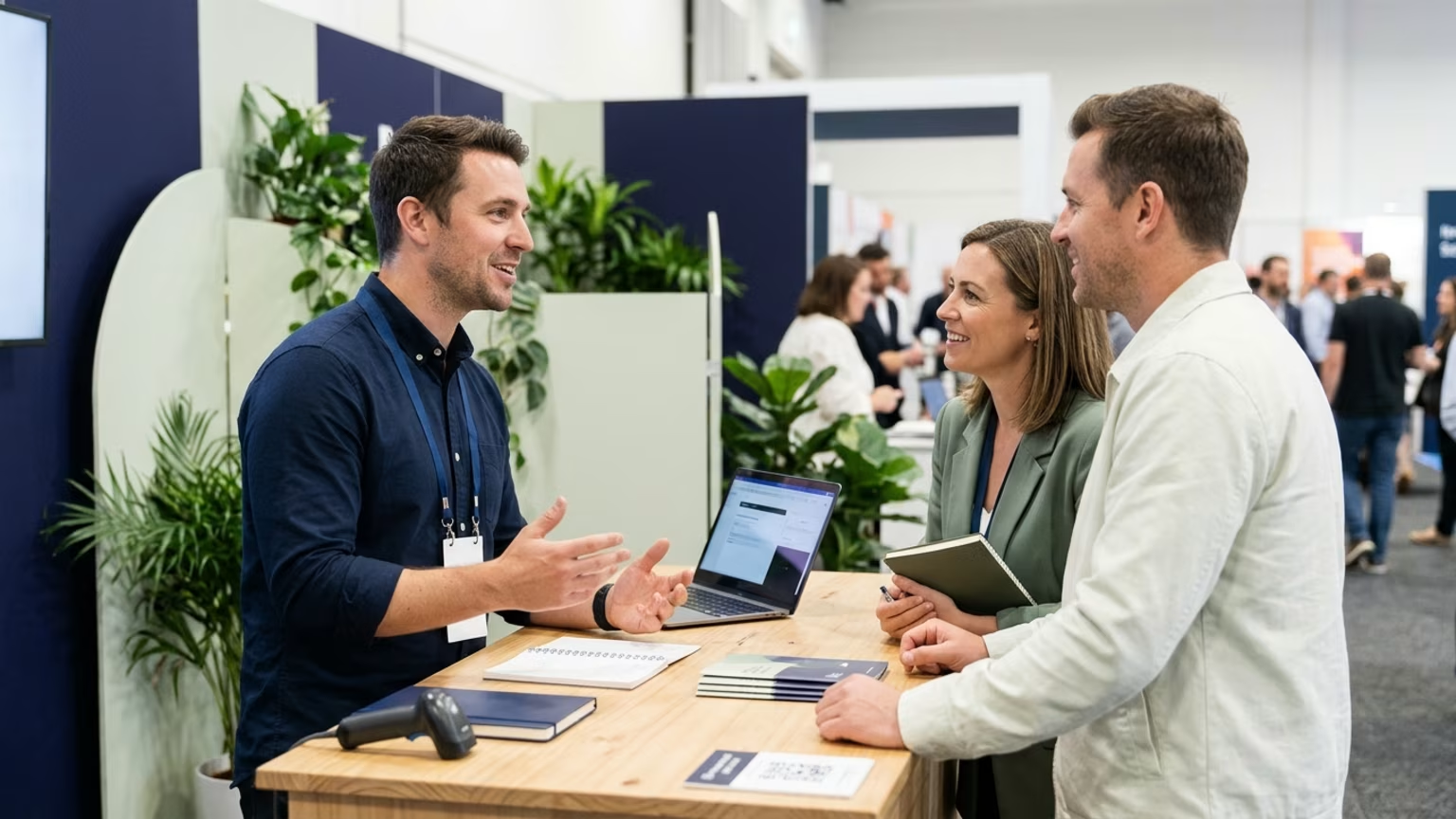
A packed booth is not a pipeline strategy. Neither is an expensive interactive installation surrounded by people who cannot explain why they stopped.
The sacred cow worth questioning is not creativity. It is the assumption that enough attention will eventually turn into commercial value. A badge scan records contact information. It does not explain whether that person belongs in your sales pipeline.
Our position is straightforward: the conversation deserves at least as much operational attention as the attraction. Otherwise, the most impressive thing your activation produces may be its recap video.
The CMO's anxiety is not whether the booth will photograph well. It is whether a six-figure activation could end with no qualified pipeline to defend.
Raw activity totals do not answer that concern. A scan alone cannot tell the difference between product curiosity and purchasing responsibility. A sign-up does not explain what someone needs or what they agreed to receive next.
One exhibitor guide on improving lead capture recommends defining lead criteria before the show and recording a note and grade during the conversation. That guidance addresses the gap between collecting contact details and collecting useful commercial context.
Our diagnosis is that mainstream activation planning often gives the visible experience a clearer brief than the business conversation. The structure gets approved. The graphics get reviewed. Yet the meaning of a qualified contact remains open to interpretation.
That is how a beautiful booth becomes a beautiful dumpster fire. The recap celebrates traffic while the sales team still needs to establish who belongs in its pipeline.
Scans are not the enemy. Asking them to prove something they never captured is the problem. Without a shared definition of a useful event contact, a larger list can leave the commercial question unanswered.
Makai's alternative is not to replace creativity with clipboards. It is to pair an approachable human experience with disciplined delivery.
For us, aloha means welcoming the person without treating them as another unit of throughput. It is not permission to be casual about execution. Warmth belongs in the interaction. Precision belongs in everything supporting it.
Across our history, we have delivered more than 1,000 campaigns in all 50 states for more than 200 brands. That experience spans different products and audiences rather than a single activation format. Our view is that an experience should respect both the person participating and the business paying for it.
Our trained brand ambassadors support in-store sales through real conversations and product trials. We also store sampling products and event gear, then manage shipping and delivery coordination nationwide. These capabilities belong in the same discussion: a thoughtful conversation still needs a functioning physical experience around it.
The argument is not that attractive experiences lack value. We converted a vintage Ultra Van into a mobile VIP beauty lounge for Refinery29 and Smashbox at Coachella. The activation generated more than 260,000 vehicle impressions and hosted more than 1,200 VIP guests. It also reached a seven-figure social audience.
Those results describe reach and participation. They should not be relabeled as qualified retail pipeline. Creative ambition and honest measurement can occupy the same space.
We believe human authenticity creates a stronger foundation for trial and conversion when operational discipline supports it. The goal is a useful encounter with a clear purpose, not a forced sales interview disguised as hospitality.
Start by replacing the vague goal of more engagement with a tangible outcome. That might mean samples distributed to target shoppers. It might mean retail meetings booked or relevant contacts agreeing to further information. Those outcomes deserve separate definitions.
Guidance on event lead-capture planning recommends defining a target profile and asking brief qualifying questions. A separate practitioner guide to concise capture fields recommends recording timing and a pre-agreed rating alongside the next action and a short note.
The following framework adapts that vendor guidance. It is an operational recommendation rather than a validated scoring model, and the conversational prompts are editorial examples rather than tested scripts.
Listen for fit, need, timing and an agreed next step. These are areas of context to capture, not a compulsory questionnaire to read aloud.
A target shopper and a retail buyer may both be valuable. They do not represent the same commercial outcome.
For a trade show conversation, a brief prompt could be: “Are you looking at this for your stores or for yourself?” For a consumer experience, “Is this something you would use?” may be more appropriate.
The purpose is relevance. Do not turn ordinary product interest into a claim of buying authority. Define fit around the campaign's audience rather than the person's willingness to accept a sample.
“What caught your interest?” gives the visitor room to explain the attraction in their own terms.
For a business conversation, “What are you trying to solve?” is a question suggested in the event lead-capture guidance. The useful record is the person's expressed need or interest, not a staff member's guess about enthusiasm.
A positive reaction can matter without becoming a purchase commitment. Keep that distinction intact when the conversation becomes a CRM record.
“When are you looking to decide?” appears in the same practitioner guidance. It fits a commercial discussion more naturally than a casual tasting.
At a consumer activation, an editorial adaptation could be: “When might you try this?” The aim is to capture a stated occasion or timing signal where it makes sense.
Do not manufacture urgency when the visitor has not expressed any. An unknown timeline is more useful than an invented one.
“Would you like product information or a link to find it?” can establish a relevant consumer follow-up. For a retail contact, “Would a retail meeting be useful?” makes the proposed action explicit.
A scan is not agreement to a meeting. A sample is not a request for a sales call. Record the action discussed and identify who owns it.
Keep the interaction conversational. If the visitor has already explained their need, there is no reason to ask the same question again from a script. The source guidance favors concise questions and short notes rather than longer forms.
The record should preserve enough context for someone else to understand the conversation. That is the point of a better handoff after the event, not simply a more complete contact list.
The reporting goal should be clarity about what happened and what followed. Do not compress every stage into a single lead total.
Use separate categories that match the activation's purpose:
A consumer trial should not need a business buyer's purchase timeline to count as a valid trial. Equally, a valid trial should not automatically count as a qualified sales opportunity.
In eMarketer's reporting on event measurement, a Canva executive described setting targets with the CFO and choosing different measures for different events. Pipeline and marketing-qualified leads were among the measures used for one event.
Our takeaway is to select measures around the business purpose rather than borrow another activation's scorecard. A sampling program and a retail-buyer meeting program have different jobs.
Qualified contacts are an intermediate result. They are not sales or proof of Return on Investment (ROI). Report the movement from interaction to agreed action and then to measurable business outcomes without presenting every stage as interchangeable.
Core takeaway: Demand more from the execution than a good photograph and a large scan total. A strong activation gives people a welcoming reason to engage and gives the business an honest record of that engagement. Fit and need provide context. Timing and an agreed next step make follow-through clearer. Keep the creativity, but stop asking aesthetics to carry a commercial argument that only disciplined execution and useful evidence can support.
Field marketing managers own booth readiness day to day; Makai handles sampling-product and event-equipment storage alongside shipment tracking and nationwide delivery coordination. For teams facing low-quality contacts at crowded shows, Makai's experiential campaigns and trade show activations are designed to turn consumer interactions into qualified leads for premium CPG brands.

30 Years Experiential & Retail Activation Partner for CPG & Beverage Brands | Multi-Market Demos, Roadshows & Costco/Club Programs That Actually Sell