Robbie Thain
Founder, CEO

Learn how to connect student ambassador programs to retail demos. This playbook covers geo-fencing, scripting, and tracking metrics to drive in-store sales.
Campus brand awareness is a vanity metric if it does not ring the register. This playbook outlines the exact method to connect student ambassador buzz directly to measurable in-store sales through coordinated retail sampling.
Brand teams frequently hire enthusiastic college students to hand out free energy drinks or snacks across the quad. These students pass out thousands of units over a few hours. The brand manager soon receives a cheerful report showing massive sample distribution. But when that manager looks at the local retail sales data, the needle has barely moved.
The core problem is a broken bridge between awareness and action. Handing out free product creates a fleeting moment of joy for a busy student. It does not teach that consumer where to buy the product. The campus activation happens in a vacuum entirely separated from the nearest grocery store.
Field marketing teams spend weeks organizing permits and staffing for university events. They build beautiful tents and load in pallets of product. The students line up eagerly for a free sample. Yet this high energy moment rarely translates into a lasting relationship with the brand. The consumer walks away with a snack but lacks any instruction on what to do next.
Marketing directors are under immense pressure to prove Return on Investment for every dollar spent. They cannot justify six-figure student programs that only generate social media photos. Buyers at major grocery chains demand to see actual sell-through data. A successful field program must move units off the shelf and into shopping carts.
We specialize in creating retail demos, product sampling programs, and roadshows that bring brands face to face with their audiences. Each program is designed to drive trial, build consumer relationships, and accelerate retail velocity across multiple locations. We see too many companies leave money on the table by keeping campus efforts separated from retail execution.
The solution involves treating the university and the surrounding retail environment as a single connected ecosystem. You do not just activate on the campus greens. You activate the entire physical path to purchase.
This unified strategy demands strict geographical focus for your field teams. Every student ambassador interaction must point directly to a specific retail location within a two-mile radius. If the campus buzz acts as the initial spark, the retail demo serves as the engine that converts that energy into actual basket rings.
Executing this requires synchronizing your campus street teams with your in-store brand ambassadors. When a student tries a new protein bar between classes, the ambassador hands them a geo-targeted offer. That offer explicitly directs them to the local grocery store where a formal retail demo is happening that same weekend.
A unified ecosystem requires a shift in how budgets are allocated. You cannot fund the campus street team from one budget and the retail demo from another without aligning their goals. Both teams must share the exact same objective of moving units off a specific retail shelf. This alignment forces your agencies and internal teams to communicate daily.
Smart brands that invest in building a structured campus presence understand that the end goal is always the retail shelf. College students are forming their first independent grocery shopping habits. Catching their attention on campus is only half the battle. You must physically guide them to the point of sale to build long-term loyalty.
Connecting these two environments requires operator-grade discipline and precise timing.
Map universities against your most important retail partners to find the best overlap. Choose campuses where the target demographic heavily mirrors the shopper profile of nearby high-volume grocery locations. You want stores that are within easy walking distance or a very short drive from the dormitories. This physical proximity removes friction from the buying process.
Equip your student ambassadors with trackable physical coupons or scannable codes. These offers must apply strictly to the specific retailers located near the university. Generic online discount codes will not drive foot traffic to your priority retail partner. The tangible nature of a printed coupon often serves as a physical reminder for the student to visit the store.
Train student ambassadors to do much more than just smile and hand out free items. Provide exact scripts that direct their peers to the correct aisle in the local store. An ambassador might mention they are doing a full tasting setup at the nearby grocery store this Saturday. This plants the seed for a weekend grocery trip. It transforms a random sample into a deliberate invitation.
Before any student sets foot on the quad, check the inventory levels at your target retail locations. Your in-store demo team cannot sell what is not on the shelf. Coordinate with the grocery store managers to secure additional endcap space or extra cases in the back room. Stockouts during the peak weekend push will destroy the momentum your campus team built.
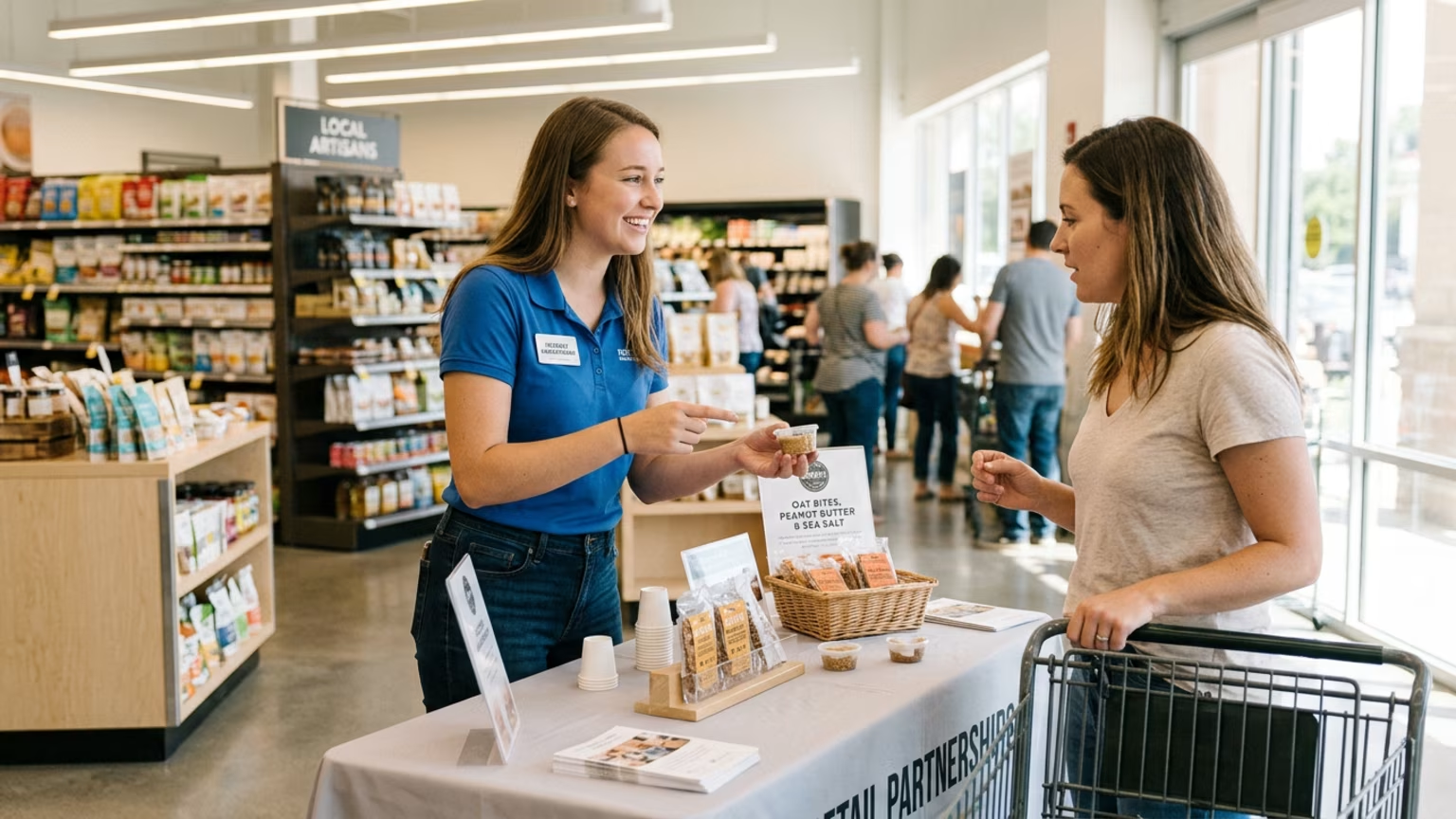
Schedule your formal in-store retail demos to coincide directly with major campus sampling pushes. Have your highly trained demo staff ready at the retail location to catch the traffic your students just generated. Learning how to run youth-focused retail demos guarantees your field teams know exactly how to handle this influx of college-aged shoppers.
Maintain strict visual consistency across both the campus and retail environments. The signage on the university quad must match the branding at the in-store demo table to build immediate recognition. Familiar colors and logos help the consumer connect the two separate experiences into one cohesive brand story.
Data collection is the only way to prove your field strategy actually works. You must define clear metrics for both the campus activation and the retail execution.
Lead metrics tell you if the top of your funnel is wide enough. Track the number of samples distributed on campus and the total number of targeted coupons handed out. Log the total conversations initiated by your student ambassadors. Monitor the scan rates of any codes leading to your local store locator.
Lag metrics prove the financial impact of the campaign. Measure the total coupon redemptions at the specific local retailer over the following week. Track the unit sales lift during the fourteen days following the activation. Monitor the retailer reorder rates for the targeted stores to see if the velocity sustains itself.
Your final reporting must connect these dots for your senior leadership team. A marketing leader needs to see clear evidence that five thousand campus interactions led directly to eight hundred coupon redemptions. Measuring this path is how brands accurately calculate attribution for live events and prove their value to retail buyers.
Retail buyers respond to clear data points. When you walk into a category review meeting, you must bring proof that your marketing drives foot traffic. Showing a buyer that your integrated campus and demo program lifted local sales by a certain percentage makes future placement conversations much easier. The data transforms your brand from a vendor into a reliable traffic driver.
A growing premium popcorn brand wanted to increase shelf velocity at a major regional grocery chain. Instead of running isolated campus events, they matched three large universities with five nearby grocery locations. They treated each university and its surrounding stores as one unified marketing zone.
Student ambassadors sampled the popcorn heavily on the campus grounds every Tuesday and Wednesday. They handed out thick branded cards inviting students to a snack takeover at the local grocery store that coming weekend. The cards featured a barcode tied strictly to those specific retail locations. Industry guides on experiential campaigns highlight that this type of direct product interaction significantly increases purchase intent.
That Friday and Saturday, the brand ran high-energy retail demos at those exact stores. The demo staff intercepted regular shoppers and warmly welcomed the students redeeming their campus offers. The combined effort resulted in a massive spike in weekend sales and a permanent increase in baseline retail velocity.
This integrated approach proves that physical marketing works beautifully when it is organized with military precision. If you are tired of running disconnected campaigns that produce fog instead of evidence, you can book a strategy call with our team. We can map out a precise plan to turn your next live event into measurable pipeline.
The distance between a busy college campus and a local grocery store is often just a few short miles. When the strategy is sound, that short walk becomes the most predictable path to long-term brand loyalty.

30 Years Experiential & Retail Activation Partner for CPG & Beverage Brands | Multi-Market Demos, Roadshows & Costco/Club Programs That Actually Sell