Robbie Thain
Founder, CEO

Learn why a recent multistate Salmonella outbreak traced to fresh jalapeños proves that experiential marketing teams need strict supply chain controls.
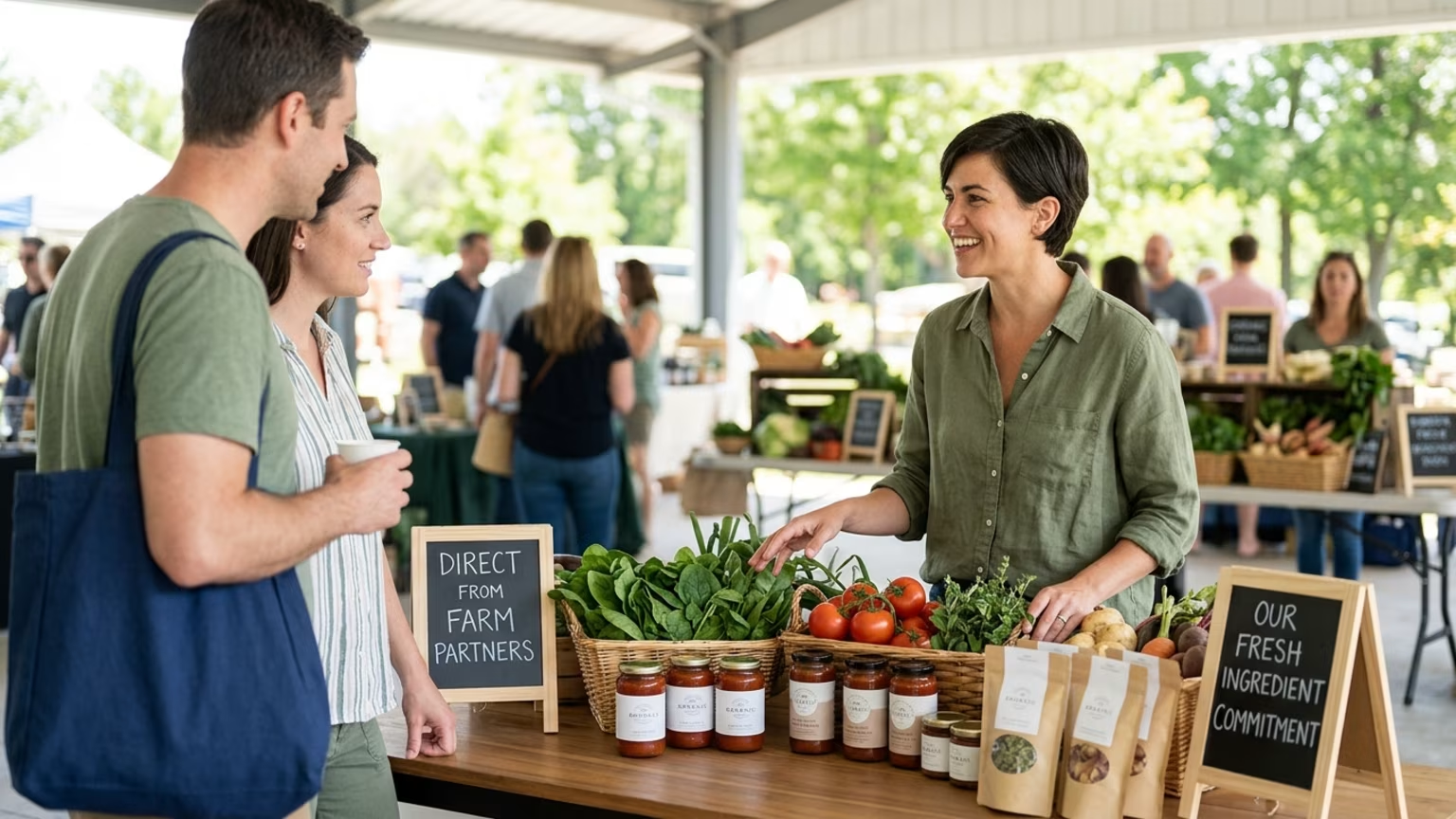
As of August 5, 2026, health officials had identified 345 people infected with Salmonella across 27 states. This multistate outbreak was traced back to fresh jalapeño peppers moving through standard food service distribution networks. For experiential marketing teams running live consumer sampling, this serves as a stark reminder that ingredient safety is a live operational control.
Myth: Providing fresh food samples simply requires buying great ingredients and hiring enthusiastic brand ambassadors.
Truth: Treating ingredient supply chains casually in live environments will burn your brand equity in a single weekend.
Smart field marketing leaders fall into this trap for completely understandable reasons. Marketing budgets remain tight, activation timelines continuously shrink, and agency partners often promise seamless execution under extreme pressure. When a team is focused on securing permits and building beautiful brand spaces, actual ingredient sourcing becomes an afterthought. A regional manager might assume that any produce bought from a reputable local supplier is perfectly safe.
The pressure to deliver high volume campaigns creates a dangerous tunnel vision for operators. Brands want to drive trial and boost retail sell-through without getting bogged down by logistics. Operators prioritize throughput and aesthetic presentation over rigorous backend supply documentation. They trust that generic food handling certificates will protect the consumer experience during busy promotional events.
Marketing operators face immense pressure to prove that activations lead to measurable sales lift. When launching a new product or executing a massive retail expansion, the focus naturally drifts toward aesthetics. Agencies will pitch visually stunning trade show spaces that attract attention and start conversations. However, the operational backbone required to safely serve fresh samples often gets buried in the fine print.
The reality of live food service demands far more discipline than a simple compliance checklist provides. A mid-to-senior marketing operator is ultimately responsible for the physical execution of the campaign. If a sampling tour looks busy but serves unverified ingredients, it creates a massive liability for the brand. Planning must shift from pure brand theater to operator-grade discipline.
The ground truth is that experiential food sampling relies on complex and multi-layered distribution networks. A recent investigation highlights exactly how vulnerable these networks are in practice for live operations. The Salmonella outbreak involved fresh peppers traced to a grower in Sinaloa, Mexico. These peppers were imported and distributed in the United States by Coast Citrus Distributors.
Because these products passed from a grower to a distributor and then to end operators, tracking failures takes time. The FDA noted that the jalapeños did not appear to have been supplied directly to grocery stores. Instead, they moved directly to distributors, restaurants, and food service companies. Among 191 interviewed patients, 177 reported eating at a Mexican-style restaurant before becoming ill.
This data dismantles the myth that standard commercial procurement acts as a fail-safe operational strategy. The reported restaurant exposure history included Chipotle Mexican Grill and QDOBA. Both chains removed the affected jalapeños immediately to halt the spread of the compromised product. Following this swift product removal, the FDA stated that those establishments did not pose a current ongoing risk.
The 93 percent exposure figure is significant, but it requires careful operational interpretation. It is based on 177 of 191 interviewed patients, rather than every consumer who dined out during the period. This nuance proves that not every jalapeño served in a restaurant was inherently contaminated. Instead, it demonstrates that contamination follows specific supply chain pathways rather than broad cuisine categories.
We have executed over 1000 campaigns across all 50 states, bringing brands to life in every major U.S. market. From retail demos in Seattle to roadshows in Miami and events in Honolulu, our teams activate brands wherever our clients' audiences are located. In our experience, the ability to instantly isolate and remove a compromised ingredient is the only true defense against a supply chain failure.
Our exclusive focus on the nuances of CPG, food, and beverage sectors reveals how quickly small oversights compound. When brands navigate complex event logistics, permits, and staffing, ingredient verification often drops in priority. Low quality execution in the field directly causes poor booth flow and scattered consumer attention. To combat this, makai manages end to end Costco roadshows that bring brands to shoppers through strict, measurable protocols.
Every ingredient represents a potential point of failure if the sourcing documentation is incomplete. Thirty-six people had been hospitalized during this specific outbreak, and no deaths had been reported. This detail reinforces that even non-fatal food safety incidents carry massive operational and reputational weight. The only reliable strategy is strict adherence to verifiable supply chain management.
Brands must plan their activations with strict containment protocols to avoid becoming victims of upstream supplier errors. The FDA advised operators to stop serving the identified peppers and to discard recalled products immediately. They specifically noted that operators should discard recalled peppers when the supplier or origin could not be confirmed. Experiential teams must translate this direct regulatory guidance into mandatory field policies.
The jalapeño investigation emerged alongside other food safety stories involving lettuce, eggs, and berries. These events reinforce the need for brands to treat fresh food sourcing as live operational controls. A food related recall should never require a senior executive to improvise a decision in front of consumers. The activation plan must clearly specify who can pause sampling and substitute an ingredient safely.
A live brand activation cannot rely on hoping a supply chain problem never occurs. Your retail sampling strategy should dictate an immediate stop service protocol if an ingredient source cannot be verified. Staff must maintain detailed receiving logs, record exact lot numbers, and document all preparation steps. If a supplier alert surfaces, the field manager must have the authority to pull the product instantly.
Food preparation requires a controlled process that separates creative flexibility from actual food safety protocols. While creative teams can quickly swap colors or signage, ingredient substitutions require formal approval. A substitute must be evaluated for allergen implications, preparation requirements, and exact supplier traceability. This systematic approach ensures that high energy activations turn awareness into participation safely.
Sanitation is not a creative choice; it is a rigid and observable field requirement. Teams should follow strict pop-up activation procedures that include specific schedules for cleaning prep tables. The FDA advised careful cleaning and sanitizing of surfaces and containers that contacted the recalled peppers. Accountability at the field level secures consumer trust and protects your marketing investments.
Measuring operational readiness is just as critical as measuring total consumer impressions. A premium CPG brand should track the percentage of ingredients with complete source and lot documentation. Field teams should measure the exact time required to identify every location receiving a specific product. These metrics allow marketing leaders to prove that their experiential campaigns are fundamentally secure.
Brands often struggle with measuring real Return on Investment from live events when execution is fragmented. If a campaign suffers a food safety delay, any potential Return on Investment instantly evaporates. To prevent this, makai creates high impact experiential marketing campaigns that treat risk mitigation as the foundation of conversion. Over thirty years of specialized national execution experience has taught us that safety protocols drive retailer confidence.
If your team cannot answer exactly what was served and where it originated, you are operating blind. True trade show activations rely on consistent and strategic execution to maximize measurable pipeline. Experiential marketing connects digital and real world touchpoints, but only if the physical foundation is safe. Operational excellence is the hidden engine behind every successful product trial.
While an alert affecting hundreds of consumers across 27 states can paralyze an unprepared team, rigorous supply chain tracking ensures your live sampling campaigns remain completely secure.

30 Years Experiential & Retail Activation Partner for CPG & Beverage Brands | Multi-Market Demos, Roadshows & Costco/Club Programs That Actually Sell