Robbie Thain
Founder, CEO

Local pilot enthusiasm rarely guarantees national success, demanding standardized operational architectures, rigorous staff certifications.
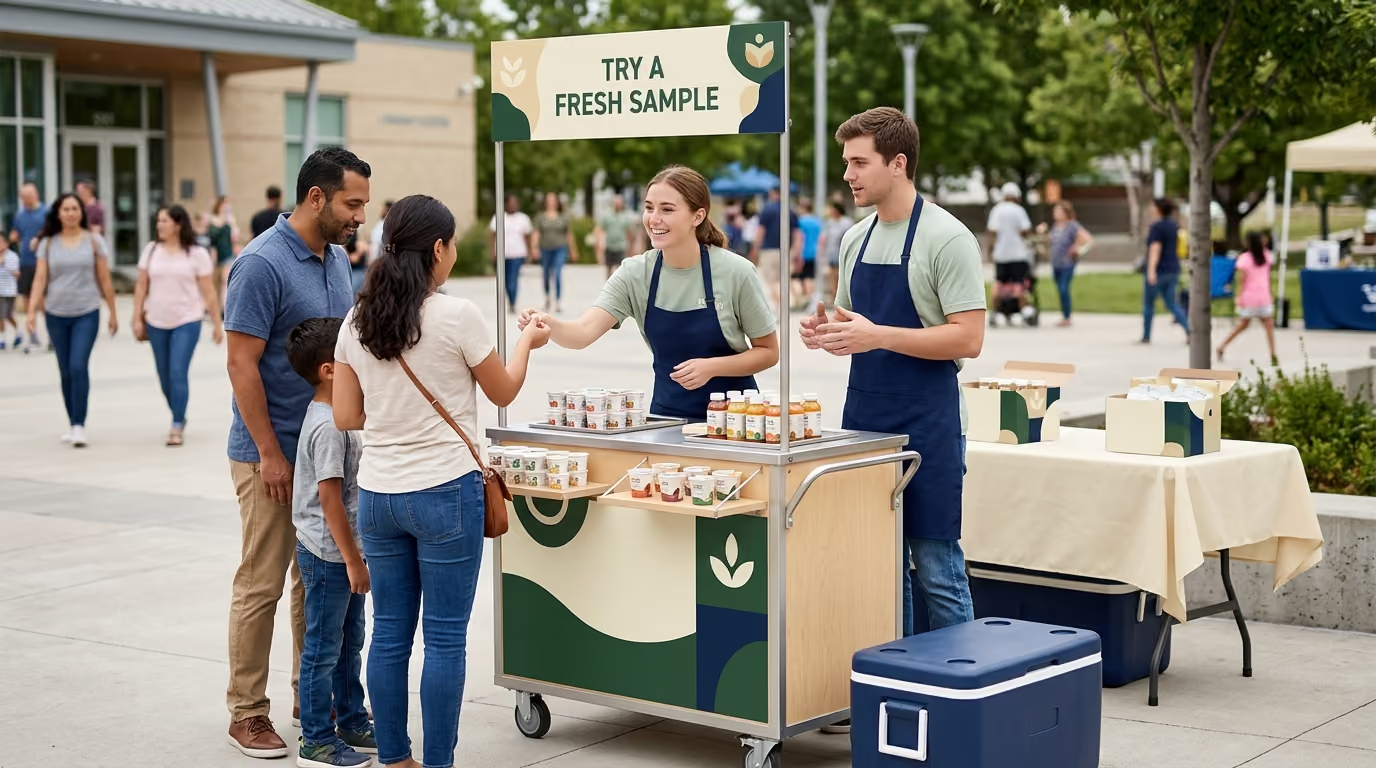
Scaling a mobile sampling program nationwide requires moving beyond single-market success to build an institutional operating system. This definitive guide details the governance models, training systems, cold-chain controls, and reporting frameworks necessary to replicate field activations across diverse regional markets without losing operational control.
Most brand teams assume that an activation that succeeded in Austin will work identically in Chicago, Atlanta, or Seattle. A pilot activation benefits from close founder attention, dedicated local staff, and compressed logistics. The pilot team handles equipment hiccups in real time, covers staffing gaps personally, and ensures pristine brand presentation.
When that same concept expands to twenty markets simultaneously, the reality changes quickly. A refrigerated truck gets stuck in transit through the Rockies, delaying morning load-in at a high-profile festival. Local staff hired through regional temp pools fail to show up, forcing remaining brand ambassadors to manage crowd flow while handling messy product prep. Health inspectors issue stop-work orders because local temporary food permits were filed under county rather than municipal guidelines. Meanwhile, field staff submit unverified headcount numbers on fragmented text threads, leaving corporate leadership blind to actual performance.
These operational breakdowns destroy campaign margins and damage retail relationships. When product displays run dry or samples are served warm, consumers form negative impressions of the product. Store managers who stocked extra inventory based on promised sampling volume find themselves sitting on unsold inventory. Achieving predictable results across dozens of cities requires moving away from improvisation toward standardized, repeatable systems.
A common mistake in experiential marketing is confusing consumer enthusiasm with operational readiness. Just because consumers loved a product sample in one city does not mean the operating model is ready for national deployment. True scalability requires proving that your unit economics, training protocols, and compliance procedures function when your founding team is not on site.
According to Event Marketer's Event Agency Business Outlook, 73 percent of respondents reported that clients primarily hire agencies for multi-event programs rather than one-off activations. Furthermore, 51 percent expected event programs to be primarily national, while 36 percent focused on local or regional activations. Demand for multi-market reach is significant, but expanding before stress-testing the operating model introduces severe financial risk.
To determine if your concept is genuinely ready to scale, evaluate it across five operational benchmarks:
Your activation must deliver the exact same brand experience regardless of who runs the footprint. A peer-reviewed study in the Scandinavian Journal of Hospitality and Tourism demonstrated that event quality is multidimensional, encompassing service quality, immersion, and hedonic factors. Furthermore, field research published in the Journal of Advertising demonstrated that perceived event quality directly increases consumer purchase intentions.
If your program depends on the charisma of a single founder, it is not scalable. Independent field teams must be able to execute the greeting, deliver product messaging, answer questions, and serve samples uniformly.
Cost inflation represents a major hurdle in multi-city expansions. In the Event Agency Business Outlook report, 85 percent of agency leaders identified transportation and shipping as their fastest-rising expense category. Fabrication and builds followed at 74 percent, while external non-union labor increased for 69 percent of respondents.
Additionally, 39 percent of respondents reported internal labor cost increases of 10 percent or more. Another 30 percent saw external labor climb by 20 percent, and 18 percent reported increases exceeding 30 percent. A program that appears profitable during a local pilot can quickly become unprofitable under nationwide labor rates, shipping fees, and regional storage costs. Your financial model must account for real-world cost volatility.
Every market must collect identical data points using standardized collection protocols. If one market counts every pedestrian walking past the footprint while another counts only completed tastings, your national reporting becomes meaningless. Standardizing definitions across every field team is necessary to evaluate true campaign performance.
Operating in multiple states means navigating complex legal jurisdictions. A compliant setup in California may violate public health codes in Pennsylvania or vehicle idling regulations in New York. A scalable program has established procedures for identifying, securing, and documenting municipal permits, health department clearances, and venue certificates of insurance well in advance of activation dates.
A scalable tour captures real-time field data to refine operations continuously. When an equipment failure, staffing drop, or inventory bottleneck occurs, the field team must log the incident centrally. This structured feedback allows operators to update manuals, adjust inventory buffers, and prevent recurring mistakes across subsequent tour stops.
We have executed over 1000 campaigns across all 50 states, bringing brands to life in every major U.S. market. From retail demos in Seattle to roadshows in Miami and events in Honolulu, our teams activate brands wherever our clients' audiences are located. In our experience, testing a concept across two structurally distinct markets before launching nationally is the most reliable way to uncover hidden operational friction.
To scale successfully across diverse markets, field operations must balance standard brand execution with regional flexibility. We use a three-tier governance architecture that clearly separates non-negotiable brand rules, approved local adjustments, and strictly prohibited practices.
These core elements remain identical across all tour stops. Every market team must adhere strictly to these operational baselines:
Local field teams require flexibility to adapt to municipal rules, cultural preferences, and seasonal weather variations. Approved adjustments include:
These actions compromise brand equity, skew analytical data, or violate public safety standards. Prohibited deviations include:
Establishing clear boundaries protects your brand while empowering field managers to solve local operational challenges efficiently. Teams planning a multi-stop program can review our annual mobile sampling strategy to see how structured planning supports long-term field consistency.
A mobile sampling tour succeeds or fails based on the quality of its front-line staff. When expanding nationwide, you cannot simply forward a briefing deck to temporary workers and hope for the best. You need an operational training and certification system that guarantees consistent performance across every shift.
Agencies report significant cost pressures and turnover in field staffing. The Event Agency Business Outlook found that agency leaders prioritized recruiting, talent development, and compensation increases to maintain execution quality. Finding and retaining reliable field staff requires structured systems rather than ad-hoc hiring.
A robust training curriculum prepares brand ambassadors for real-world field conditions before they interact with consumers:
Field staff should complete an objective certification process before working on an activation footprint. This process must verify product knowledge, customer engagement skills, and emergency protocol comprehension.
A certified supervisor should evaluate each brand ambassador using a standardized rubric. Staff who fail to demonstrate acceptable performance are reassigned or retrained before public deployment. This standard eliminates underperforming staff before they reach the activation footprint.
Maintaining execution quality across concurrent activations requires structured supervisory spans of control. For standard consumer sampling footprints, maintain one dedicated field lead for every four to six brand ambassadors.
The field lead oversees continuous inventory replenishment, verifies cold-chain temperature logs, audits data entry accuracy, and provides real-time coaching. The supervisor also manages shift rotations, breaks, and emergency logistics, allowing brand ambassadors to focus entirely on consumer engagement. To learn how field leadership impacts activation performance, review our analysis on field execution operational advantages.
Food and beverage sampling programs must manage stringent health and safety compliance across every jurisdiction. Public health violations can trigger immediate shutdown orders, brand reputation damage, and severe legal liability. Operating nationally requires strict adherence to food safety protocols.
Public health regulations require detailed operational controls during mobile sampling. For instance, the National Park Service temporary food event guidelines mandate formal permits for distributing food samples on public property. These guidelines require holding cold food at or below 41°F and hot food at or above 135°F throughout transportation, storage, and on-site distribution.
These standards also mandate verified food sourcing, commercial prep facilities, dedicated hand-washing stations, and certified food safety managers on site. Because local regulations vary across states and municipalities, national programs must implement rigorous cold-chain management systems.
To maintain safety and compliance across multi-city routes, embed verifiable control points into your daily field operations:
Every mobile footprint must feature self-contained sanitation infrastructure. Deploy commercial gravity-fed hand-washing stations complete with potable warm water, antimicrobial soap, single-use paper towels, and dedicated graywater containment.
Equip footprints with three-compartment ware-washing setups or sufficient backups of pre-sanitized utensils. Brand ambassadors must wear single-use nitrile gloves, changing them after every break, task change, or potential surface contamination.
Consumer safety requires absolute transparency regarding ingredients and potential allergens. Display prominent, clearly legible signage listing primary allergens, including milk, eggs, fish, shellfish, tree nuts, peanuts, wheat, sesame, and soybeans.
Train brand ambassadors never to guess when answering ingredient questions. Staff must provide official nutritional and ingredient documentation directly to consumers upon request. For comprehensive cold-chain protocols and compliance guidelines, consult our resource on cold chain management protocols.
Scaling nationwide requires building a reliable supply chain and vendor network. Relying on a single local warehouse or one regional freight carrier creates single points of failure that can disrupt an entire national tour.
Successful nationwide programs use a hybrid operating model that centralizes strategic oversight while utilizing vetted regional partners for local execution.
In a hybrid management structure, the central brand team manages strategy, creative assets, digital training systems, and data infrastructure. Regional partners handle localized warehousing, freight hauling, local permitting, and regional labor recruitment.
This hybrid structure provides the geographic reach of national providers alongside the market familiarity of local operators. It also establishes operational redundancy, ensuring local logistical challenges do not derail the broader campaign.
Standardize vendor performance by establishing measurable service-level agreements across all regional partners. Contracts should define explicit performance metrics:
Include financial penalties or deduction structures for missed service levels. These agreements protect campaign budgets while ensuring accountability across all operational partners.
Managing product stock across regional storage hubs, transport vehicles, and activation sites requires strict chain-of-custody tracking. Use this standard inventory reconciliation formula across every tour stop:
Opening Inventory + Received Stock - Distributed Samples - Approved Waste - Returned Stock = Closing Inventory
Every field supervisor must complete and submit a daily inventory log detailing:
This systematic tracking eliminates inventory shrinkage, identifies regional supply bottlenecks, and ensures timely product reordering. Review our operational guidance on repeatable retail roadshows and sampling programs to optimize regional inventory distribution.
Executing a multi-market mobile sampling program requires translating high-level strategy into precise daily field actions. This execution playbook details the step-by-step procedures required before, during, and after every activation.
Following this structured playbook ensures consistent brand execution across every city. For broader planning frameworks, explore our guide on multi-city mobile tour execution.
A national mobile sampling program must track concrete business metrics beyond basic distribution totals. Handing out thousands of samples provides little value if those interactions do not drive measurable retail velocity, customer acquisition, or brand equity.
According to EventTrack research by the Event Marketing Institute, 79 percent of brand marketers measure the effectiveness of experiential activations. The most common metrics tracked include total attendance at 79 percent, attendee evaluations at 55 percent, sales within a defined post-event window at 50 percent, and leads generated at 47 percent. Additionally, 45 percent of brands calculate Return on Investment (ROI) directly from event activities.
To provide clear operational and financial visibility, implement a comprehensive seven-layer measurement framework across every tour stop:
To ensure data integrity across multi-market campaigns, establish strict definitions for every reporting metric:
Event impact extends beyond the day of activation. EventTrack research revealed that 32 percent of brands track activation impact for up to one month, while 43 percent evaluate results across a two-to-six-month window. Furthermore, 47 percent of consumer-focused brands utilize a thirty-day measurement window.
Implement a structured post-event reporting cadence:
Standardizing these reporting intervals provides leadership with clear visibility into both short-term field execution and long-term commercial returns. For deeper methodologies on experiential attribution, read our analysis on measuring live marketing impact.
Evaluating a concrete consumer packaged goods scenario demonstrates how structured operating models solve real-world field challenges. Consider an emerging functional beverage brand seeking to expand its field marketing program from an initial pilot in Southern California to a multi-city tour spanning twelve major metropolitan markets.
During its regional pilot, the brand relied on founding team members to staff farmers' markets and local community events. The founding team explained ingredient sourcing personally, hand-poured chilled samples from ice chests, and restocked product from a local commercial warehouse. Conversion rates were exceptionally high, and local grocery retailers experienced immediate sales velocity increases.
When the brand attempted to scale into five additional markets without standardized operational controls, the program encountered immediate operational friction:
The brand restructured its multi-city expansion using the standardized operational framework detailed above:
This structured operating system delivered consistent results across all twelve markets:
This case illustrates that scaling field activations successfully depends on disciplined operational systems rather than sheer creative enthusiasm. To see how our teams execute multi-market programs nationwide, visit our overview of nationwide experiential capabilities.
Replicating a successful mobile sampling tour across the country requires operational discipline, verified quality controls, and consistent field execution at every single stop.

30 Years Experiential & Retail Activation Partner for CPG & Beverage Brands | Multi-Market Demos, Roadshows & Costco/Club Programs That Actually Sell