Robbie Thain
Founder, CEO

Discover how to design a multi-city retail roadshow that turns repeated stops into a learning system. Compare identical pop-ups against controlled roadshows.
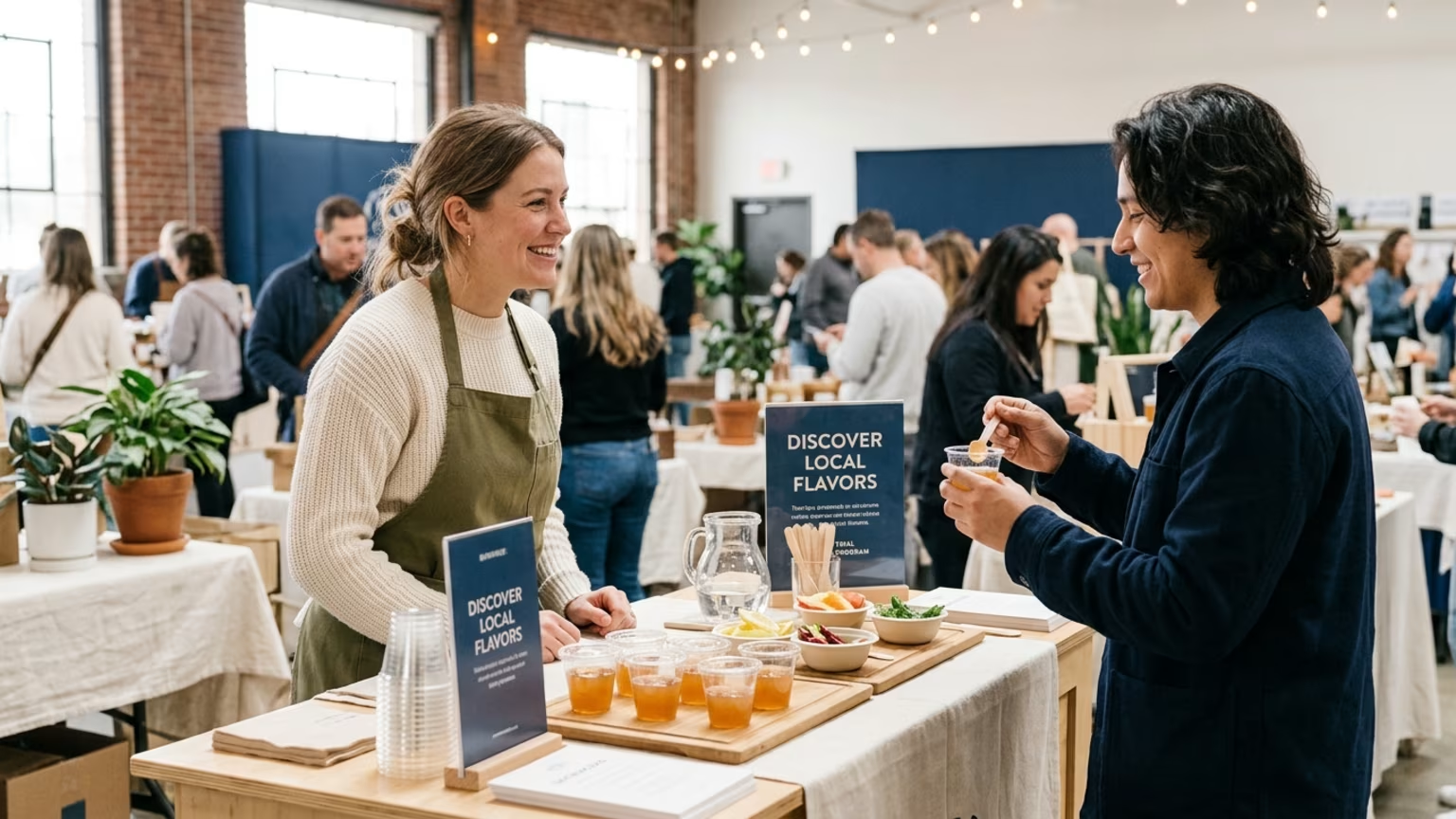
A folding table in aisle six or a retrofitted airstream in downtown Austin. The clipboard holds a tally of cups poured, but the real question is whether those sips turn into purchases. Marketing operators face a stark choice when planning a multi-city tour. They can roll out a collection of identical pop-ups that measure raw attendance, or they can build a controlled learning system.
The identical pop-up model treats a multi-city tour as a single activation duplicated across different geographies. The core mechanic relies on booking high-footfall locations, deploying the exact same booth footprint, and judging success by the volume of product distributed. Consistency applies to everything from the queue design to the opening questions asked by brand ambassadors.
The primary logistical constraint of this model is its inability to distinguish execution problems from market variables. If one city counts a handed-out sample as a trial and another counts only a tasted sample, comparing the resulting conversion rates becomes completely unreliable. Event Marketer’s research portfolio specifically identifies event measurement and Return on Investment ratios as recurring industry research areas. The research also highlights data usage, staffing costs, and operational costs as ongoing management issues.
When a tour only measures output, event marketers struggle to prove commercial value. This approach usually tracks top-of-funnel activity. A brand might track qualified foot traffic, total stops, and samples completed. A high-footfall location is not automatically a high-value location. A street team handing out samples several miles from the nearest stocked retailer may generate awareness, but making the connection to a retail basket is nearly impossible.
A nearby store might be out of stock, poorly signed, or irrelevant to the shopper. Location selection must include inventory and retailer execution checks. Without a mechanism to track consumer movement from the sampling booth to the store aisle, the identical pop-up leaves marketers guessing about actual sales impact.
The alternative approach treats the multi-city tour as a live feedback loop. Instead of running the same exact play everywhere, this model standardizes only the non-negotiables while deliberately testing local variables. The core mechanic requires standardizing product preparation, food-safety procedures, staff training, and reporting definitions.
Meanwhile, the team tests variables like venue type, audience segment, and the proximity to the retailer. The execution and footprint differ entirely from the identical pop-up because the roadshow architecture includes a specific measurement layer. A secondary summary citing PQ Media reports that global experiential spending reached approximately $138.94 billion in 2025, with U.S. spending at $64.43 billion. As budgets grow, the demand for measurable and adaptable frameworks increases.
Data capture becomes the center of gravity in a learning roadshow. Every interaction record captures the interaction type, sample completed, QR code scanned, and purchase intent. Brands use this data in a rapid learning review to improve the very next stop on the tour. If stop-to-trial rates are low, the city lead might add a second tasting point immediately.
We have been connecting brands with people through live experiences, retail programs, and national activations since 1995. Over three decades, we have built a track record of creating meaningful brand moments across the country. We know at makai that standardizing field staff training for repeatable demo success requires defining what stays fixed and what flexes based on local data.
Staff members receive a concise product briefing, standard opening lines, qualification questions, and retailer-navigation instructions. Measuring their execution through approach-to-stop rates and trial-to-offer rates creates a repeatable staffing system. The key is that every person is trained, observed, and evaluated against the same standard.
Before each stop, the team confirms inventory and identifies one or two changes to test. During the stop, supervisors observe interactions at set intervals and monitor sample waste. After the stop, the team reconciles leads and documents what changed. This rhythm ensures the program improves constantly.
A multi-city program only scales when the data structure remains consistent. The tour must operate with one campaign taxonomy, one dashboard structure, and one clear definition of a qualified lead. A single owner must manage data quality and the daily reconciliation process. This rigor prevents local teams from defining success using completely different metrics.
The purely duplicated model still has a place in specific strategic scenarios. The volume play wins during massive crowd aggregation events where immediate purchase matters less than sheer brand visibility. If a beverage company sponsors a major music festival, the goal is reaching the maximum number of people with a consistent brand impression.
This tactic is also highly effective for broad awareness stops where audience development is the primary objective. A consumer lifestyle brand may simply want to saturate a market with product sampling before a major holiday season. When the overarching goal is impressions rather than high converting retail demos, a standardized pop-up delivers the required volume.
It works best when operational simplicity outweighs the need for granular market insights. Running the same exact activation requires less daily analysis, fewer dynamic supply chain shifts, and simpler local vendor contracts. Teams deploying this model do not need complex feedback loops or real-time digital offer redemption platforms.
This setup favors brands with massive marketing budgets focused entirely on long-term brand equity. For these organizations, getting a product into hands rapidly is the sole metric of success. The lack of downstream attribution is considered an acceptable trade-off for maximizing daily output.
The controlled learning system is the unarguable winner when trial must translate into measurable pipeline. Consumer packaged goods brands need consumer interactions that link directly to retail sell-through. A retailer-adjacent activation can create a more direct path from trial to basket, especially when the shopper receives a location-specific offer.
This approach is mandatory when brands want to test new product flavors, messaging, or pricing models. A 2025 BizBash/Czarnowski Collective survey of more than 200 event professionals focused on audience engagement, personalization, AI-powered experiences, and industry challenges. Personalization and localized data are now part of the core operating environment for successful brands.
This tactic is required to secure future retail cooperation. A grocery launch relies on retailer-adjacent traffic and store-level sell-through data to prove local demand. When you can show a buyer that a specific mobile tour drove a clear percentage increase in coupon redemption at nearby stores, the conversation shifts from marketing expense to commercial partnership.
Brands must connect experiential sampling to retail media data to demonstrate true value to their retail partners. A full funnel sampling strategy measures conversion between each stage, from traffic to stop to taste to purchase. The learning roadshow provides the structure to capture these metrics consistently from city to city.
A learning roadshow tracks the full sampling funnel. The team distinguishes between people who passed the activation, those who stopped, those who had a conversation, and those who expressed purchase intent. This granular data helps operators understand exactly where the consumer journey breaks down. Teams must troubleshoot sampling programs rapidly between stops to maximize commercial impact.
The learning roadshow also outshines traditional methods because it does not rely solely on delayed feedback. Relying exclusively on broad post-event surveys can be dangerous for field programs. Delayed surveys often reflect peripheral event factors rather than moment-by-moment brand reactions. Short pulse questions and structured staff reports provide immediate behavioral signals that marketers can actually use.
The industry is shifting away from disconnected awareness stops and moving toward measurable learning systems. The identical pop-up model offers operational ease and raw volume. The controlled learning roadshow offers adaptability and the commercial evidence required to protect marketing budgets.
For brands trying to drive actual consumer behavior, the learning model provides the only clear path to proving value. Scaling a program should mean scaling the system of feedback, not just increasing the geographic footprint. The time between stops is where the program either improves or loses value entirely.
The most important report is a decision log tracking observations, evidence, and adjustments made for the next market. Start by writing the commercial job first, build a location scorecard based on retail proximity, and evaluate your field staff against a single unified standard. Define your data model and conversion definitions before you fabricate a booth, and you will transform an expense into a measurable asset.

30 Years Experiential & Retail Activation Partner for CPG & Beverage Brands | Multi-Market Demos, Roadshows & Costco/Club Programs That Actually Sell