Robbie Thain
Founder, CEO

Optimized procurement strategies for fixtures, portable equipment, and operating supplies ensure compliant, high-performing in-store brand activations.

This strategic buying guide provides a lifecycle framework for selecting durable fixtures, portable equipment, printed graphics, uniforms, packaging, and operating supplies for retail activations. Marketing leaders and field operations teams will learn how to reduce total program costs, improve store compliance, and protect long-term Return on Investment across national campaigns.
A field brand ambassador arrives at a grocery location sixty minutes before an activation begins. The cardboard display shipped directly from the printer is crushed at the base. The wheels on the stock sampling cart wobble, and the power cord cannot reach the perimeter wall outlet without crossing the main aisle. The store manager threatens to cancel the event because loose cables violate store safety guidelines. What looked polished in a digital rendering has become an operational failure on the retail floor.
Buying equipment for retail activations is not a simple merchandising exercise. When you purchase physical assets for the field, you are designing a repeatable operating system. Every fixture, uniform, graphic frame, and sample cup dictates how fast your team sets up, how smoothly they engage shoppers, and how much money your brand spends over months of execution.
The retail floor is an unforgiving operating environment. Unlike trade show booths built on flat carpet with dedicated electrical drops, retail stores offer unpredictable spaces, strict managers, and high foot traffic. Aisles are narrow, receiving doors are tight, and backroom storage is almost nonexistent.
Field teams often operate under extreme time pressure. A brand ambassador may have only thirty minutes to unload gear, assemble a counter, chill the product, and prepare food-safe samples. If a fixture requires tools, specialized bolts, or complex origami-like folding, field execution breaks down. Missing wing nuts and cracked acrylic panels lead to delayed starts, sloppy presentations, and frustrated store staff.
Retail managers have zero patience for disruptive vendors. A cart that blocks an accessible route, leaks condensation, or creates a tripping hazard will be ejected from the store immediately. Research on retail execution shows that operational leakage is common. A study from Nielsen meta-learnings estimated that only 40% of certain in-store execution budgets were deployed according to brand standards, while 60% suffered from execution failures in the market.
Equipment failure directly drives this execution gap. When gear breaks, field staff improvise with duct tape, handwritten signs, and awkward workarounds that degrade brand equity. Brands must stop buying equipment based solely on showroom appearance. Success requires buying gear engineered for the harsh realities of retail logistics, rapid assembly, and repeated physical handling.
Every piece of equipment, durable fixture, and operating supply should pass five operational tests before you issue a purchase order. If an asset fails any single test, it will create friction in the field and drain your operating budget.
The asset must actively support shopper conversion and brand recall. Ask whether the equipment creates clear line-of-sight branding across the store floor. Does the counter height invite comfortable shopper conversation? Does the physical layout guide the shopper naturally from trial to product selection? Equipment must showcase the product rather than draw attention to the hardware itself.
The asset must make daily field tasks easier rather than harder. It should reduce setup time, simplify sanitization, and streamline replenishment. Evaluate how the unit packs down at the end of a shift. If teardown takes forty-five minutes of scrubbing and disassembling small parts, labor costs will escalate across a multi-city campaign.
Can a single brand ambassador assemble the unit in under fifteen minutes without tools? Equipment must perform consistently across diverse store formats, weather conditions, and regional climates. In our experience managing live brand experiences, fixtures that rely on complex latches or delicate electronic components fail rapidly in high-volume field programs. High reliability means using color-coded parts, captive fasteners, and heavy-duty materials that survive rough handling by temporary staff.
Evaluate the total cost across the entire useful life of the item, not just the upfront invoice price. A cheap plastic table may cost $80, but if it breaks after three deployments, its effective cost per use is high. A durable $800 modular cart that lasts for one hundred activations costs only $8 per event. Factor in freight costs, storage footprints, cleaning labor, and repair expenses when comparing equipment options.
The equipment must comply with retailer rules, worker safety regulations, and public health codes. Does the cart meet food safety standards for temperature holding? Does the display maintain clear accessibility paths under the Americans with Disabilities Act? Does electrical gear carry commercial safety certifications? Choosing compliant equipment prevents shut-downs by health inspectors and store managers.
To build an efficient field kit, brands should organize their activation assets into six distinct functional groups. Each group serves a specific operational purpose and requires its own procurement criteria.
Reusable fixtures are the durable foundation of your retail activation program. These include sampling carts, demonstration counters, modular backwalls, locking storage cabinets, product risers, and banner stands.
When evaluating reusable fixtures, prioritize structural rigidity and surface durability. Food-contact surfaces must be non-porous and resistant to harsh sanitizing chemicals. Counters must support the weight of heavy inventory, ice bins, and appliances without bowing. Look for internal storage compartments that conceal extra stock, trash bins, and personal belongings from shopper view.
Portable equipment includes the functional tools required to operate off the grid of permanent store infrastructure. This category covers portable refrigeration, induction cooktops, hot-holding warmers, heavy-duty battery packs, insulated transport coolers, and commercial extension cords.
Power management is critical for portable equipment. Many retail locations do not allow brand ambassadors to plug into wall outlets, or outlets may be located fifty feet away. Selecting efficient appliances that run on self-contained battery packs eliminates cord hazards and gives field teams placement flexibility. When electrical cords are necessary, provide heavy-duty, low-profile rubber cord covers to prevent trip hazards.
Printed assets communicate your promotional offer, product claims, pricing, and brand story. These include header cards, shelf talkers, table throws, retractable banners, allergen disclosures, recipe cards, and directional signage.
Printed materials must be purchased as a modular content system. Permanent brand assets, such as primary logos and core brand colors, should be printed on durable substrates with scratch-resistant finishes. Campaign-specific details, such as limited-time pricing, promotional sweepstakes, and seasonal offers, should be designed as low-cost modular inserts. This design strategy allows you to refresh campaigns without scrapping expensive structural boards.
Uniforms establish professional credibility, distinguish staff from regular shoppers, and reinforce operational hygiene. This category includes branded aprons, moisture-wicking shirts, hats, hair restraints, name badges, and slip-resistant footwear.
Uniform procurement must balance visual identity with worker comfort. Brand ambassadors often work standing on concrete floors for six to eight hours. Select breathable, stain-resistant fabrics that withstand frequent commercial laundering. Maintain a balanced size inventory that accommodates diverse body types comfortably. Clear, professional name badges and crisp aprons create trust with shoppers, which is essential when distributing food and beverage samples.
Packaging and serviceware dictate your activation waste profile, portion consistency, and sanitation standards. These items include portion cups, tasting spoons, serving trays, paper napkins, branded product sleeves, tamper-evident transport totes, and secondary storage bins.
Select serviceware based on portion control and customer ease. Oversized sample cups waste product and drive up program costs, while undersized cups make sampling messy. Use portion-control tools such as measured pumps, standard scoops, and cavity trays to ensure every shopper receives an identical, compliant sample. Match your packaging selection with available local disposal and commercial recycling infrastructure.
Operating supplies are the invisible consumables that make safe execution possible. These include surface sanitizer, food-grade disposable gloves, paper towels, heavy-duty trash liners, cable ties, gaffer tape, markers, multi-tools, first-aid kits, and inventory count sheets.
Field activations fail when operating supplies are omitted from the initial kit budget. A brand ambassador cannot safely serve food without sanitizer spray, clean towels, and single-use gloves. Build a comprehensive bill of materials for operating supplies, and replenish these consumables automatically based on scheduled event volume.
Procurement teams often default to buying the lowest-cost hardware available. This short-term mindset ignores storage, freight, maintenance, and replacement costs. To maximize Return on Investment, brands must calculate the Total Cost of Ownership across the entire equipment lifecycle.
Total Cost of Ownership includes every direct and indirect expense associated with an asset from initial procurement to final disposal. The practical formula for calculating the total cost of an activation asset is:
Total Cost equals Purchase Cost plus Customization plus Inbound and Outbound Freight plus Storage plus Maintenance plus Cleaning plus Labor plus Loss and Damage plus Disposal minus Residual Value.
When evaluating a reusable asset, calculate the fully loaded cost per deployment by dividing the Total Cost of Ownership by the expected number of usable field deployments. A $1,200 modular counter deployed sixty times over two years costs $20 per event. A $250 temporary corrugated display used once costs $250 per event, plus the recurring labor and freight of shipping new units for every activation date.
Organizing your activation materials into three asset tiers prevents unnecessary waste and keeps your field program agile.
Core platform assets are high-durability, brand-neutral physical structures designed to last for years across dozens of campaigns. Examples include heavy-duty cart frames, folding counter bases, power distribution blocks, insulated transport cases, and commercial trash stations. These items represent capital investments that should be repaired, sanitized, and redeployed continuously.
Campaign modules are semi-durable, interchangeable components that attach to your core platform assets. Examples include magnetic graphic panels, branded header boards, customized product shelving, seasonal menu strips, and interactive tablet enclosures. When your brand launches a new flavor or pivots messaging, you replace only the Tier 2 modules while retaining the Tier 1 base.
Consumables are items used once or during a single activation weekend. Examples include sample cups, napkins, tasting forks, disposable gloves, cleaning wipes, ice, and printed coupon leaflets. Consumables should be purchased in bulk, stored regionally, and packed into standardized deployment kits to minimize local procurement costs.
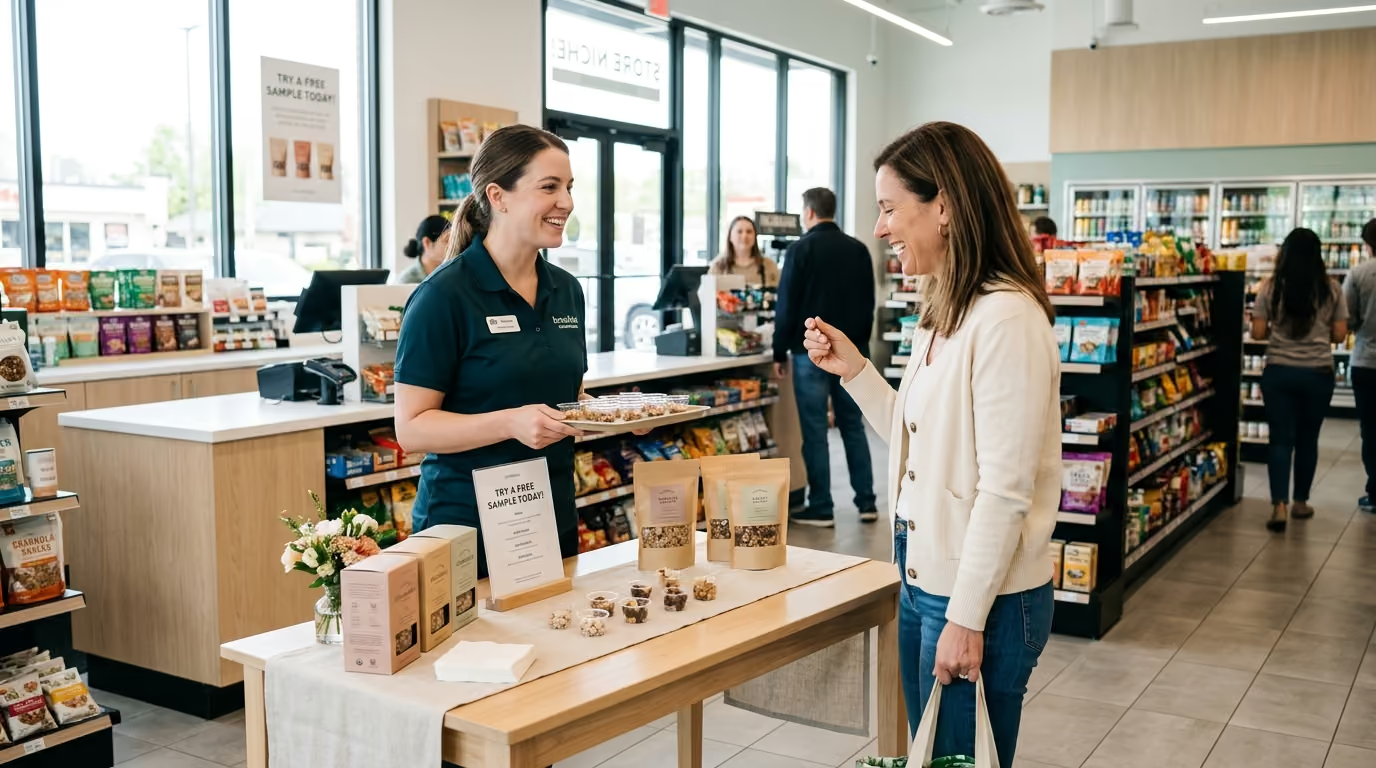
Product sampling is one of the most reliable methods for driving consumer trial and retail velocity. However, sampling activations carry unique food safety, regulatory, and economic requirements that dictate equipment selection.
For food and beverage brands, temperature integrity is non-negotiable. The Food and Drug Administration Food Code defines standards for temporary food operations to prevent foodborne illness. Equipment must maintain cold foods at or below 41 degrees Fahrenheit and hot foods at or above 135 degrees Fahrenheit throughout the activation.
Procure commercial-grade insulated transport coolers and calibrated digital probe thermometers for every field kit. Field staff should record temperatures at hourly intervals on a standardized compliance log. Design the physical sampling station to enforce a clean-to-dirty workflow. Unopened product and clean serviceware must remain physically separated from trash receptacles, used sample trays, and cleaning chemicals.
Investing in high-quality sampling fixtures pays dividends across multi-store retail campaigns. A seminal study published in the Journal of Retailing analyzed store-level scanner datasets across multiple product categories. The researchers found that in-store sampling generates both immediate sales lifts and sustained long-term sales increases. Repeated sampling events produced a multiplicative effect on product sales, expanding overall category demand rather than simply shifting brand preferences.
Additional research published by the Marriott School of Management at Brigham Young University examined the economic dynamics of product sampling. The BYU summary highlighted that the sales effects of in-store sampling were more sustained over time than end-of-aisle displays. End-of-aisle display sales typically declined after two weeks, while sampling created lasting repeat-purchase behavior. The study also observed that smaller retail stores often experienced a greater relative sales lift from sampling than larger supermarkets.
A related study reported by Retail TouchPoints indicated that sampled products experienced an average 475% cumulative sales lift on the day of the event and maintained an average 74% cumulative lift over a twenty-week post-event tracking period. The study also observed an 85% increase in cumulative new brand buyers. While these metrics reflect specific research conditions, they demonstrate the immense commercial leverage of physical product trial.
To capitalize on these economics, brands should select durable equipment that supports repeated deployments, swift restocking, and seamless execution close to the retail shelf. Trade reporting indicates that placing demonstration carts within twenty feet of the product merchandise significantly improves sales conversion compared to activations staged near store entrances. To learn more about selecting the best formats for trial programs, consult our strategic field guide on retail sampling formats.
A retail fixture is only as good as its compliance record. Equipment that violates retail floor rules or safety guidelines will be banned from the sales floor, wasting your capital investment.
Activation equipment must comply with the Americans with Disabilities Act standards for public accommodations established by the U.S. Access Board. ADA technical guidance mandates that retail displays and checkout areas provide equivalent levels of convenience and access for all customers.
Ensure that sampling counters, literature racks, and interactive screens fall within standard ADA reach ranges, typically between 15 and 48 inches from the floor. Provide a minimum clear floor space of 30 by 48 inches to accommodate shoppers using wheelchairs. Maintain clear aisle passage of at least 36 inches around your activation footprint to avoid obstructing customer traffic or emergency egress routes. For detailed regulatory guidance, review our practical compliance guide for retail activations.
The Occupational Safety and Health Administration provides retail safety and ergonomics guidance to reduce workplace injuries. Retail activation equipment must protect both brand ambassadors and passing shoppers from physical harm.
Equip all rolling fixtures with industrial locking casters to prevent accidental movement on sloped floors. Round all counter edges and display corners to eliminate sharp strike points. Weight display bases appropriately to ensure stability and prevent tip-overs if bumped by shopping carts. Ensure that packed transit cases weigh less than fifty pounds or feature built-in wheels and ergonomic handles to prevent lifting injuries during loading.
Sustainability in retail activations requires looking beyond marketing buzzwords. The Environmental Protection Agency emphasizes sustainable materials management across the entire product lifecycle. The EPA waste hierarchy ranks source reduction as the top environmental strategy, followed by reuse, recycling, and composting.
When procuring packaging and serviceware, prioritize source reduction by minimizing excess material thickness and eliminating secondary wraps. If you select compostable cups, verify that commercial composting facilities exist in the target activation markets.
The Federal Trade Commission Green Guides provide strict rules regarding environmental marketing claims. The FTC advises marketers to avoid broad, unqualified environmental claims such as "green" or "eco-friendly" because they cannot be substantiated. Furthermore, a product or package can only be labeled as recyclable without qualification if recycling facilities are available to at least 60% of consumers in the area where the item is sold. Ensure all printed environmental claims on your fixtures and packaging are fully documented and legally vetted.
Executing a successful national equipment procurement program requires disciplined project management. Follow this step-by-step playbook to specify, test, and deploy your physical activation infrastructure.
Document the exact commercial and operational scope of your retail program before contacting equipment vendors:
Classify your target retail venues into distinct operational archetypes to avoid buying a one-size-fits-all fixture that fails in the field:
Matching your hardware to specific physical environments is essential for program success. Learn more about matching retail sampling locations with shopper intent to optimize your footprint.
Create an itemized master inventory list covering every physical asset required for a single field deployment:
Draft a detailed Request for Proposal that requires suppliers to guarantee operational performance rather than just deliver static prototypes:
Before approving mass production, test pre-production prototypes under simulated field conditions:
Deploy ten to twenty prototype kits into live retail environments across diverse store formats:
Analyze pilot performance data to refine equipment specifications before authorizing full-scale manufacturing:
Measuring the performance of retail activation equipment requires tracking both commercial business results and operational field efficiency. Evaluating these dual metric sets ensures your physical assets deliver sustainable Return on Investment.
Commercial metrics evaluate how effectively your physical equipment drives trial, customer acquisition, and retail sales volume:
Operational metrics track equipment durability, logistics efficiency, and labor productivity across the campaign lifecycle:
Examining how different brand categories configure their physical activation kits illustrates how to apply this framework across varying retail environments.
A functional beverage brand launched an aggressive 500-store sampling campaign across natural grocery chains nationwide. The brand required a highly mobile, durable setup that a single brand ambassador could transport in a compact passenger vehicle.
The brand selected a heavy-duty aluminum folding cart with magnetic interchangeable side skins and an integrated ice well. The core cart frame served as a permanent Tier 1 platform asset, while the magnetic graphic panels allowed regional marketing teams to swap product messaging between energy, hydration, and immunity lines.
The cart featured captive thumb-screws that required no tools for assembly, reducing field setup time from forty-five minutes to twelve minutes. By avoiding fragile single-use cardboard displays and deploying durable modular carts, the brand reduced its equipment replacement rate to less than 2% across six months of continuous execution. For teams connecting mobile programs to retail shelves, see our insights on connecting roadshows to retail sell-through.
A premium dairy and plant-based yogurt brand required an active sampling station capable of maintaining cold-chain compliance for eight hours in high-volume club stores. The retailer prohibited external electrical cords across main traffic aisles.
The team engineered a self-contained sampling counter equipped with commercial vacuum-insulated cooler panels and integrated commercial-grade cold packs. A calibrated digital temperature display was mounted directly to the prep counter, allowing the brand ambassador and store auditor to verify product temperature without opening storage compartments.
The station utilized portion-controlled squeeze dispensers to deposit exact 0.5-ounce servings into certified compostable sample cups. This system reduced product waste by 22%, eliminated cross-contamination risks, and maintained strict 38-degree product temperatures across every six-hour demo shift.
Use this objective evaluation scorecard when comparing equipment prototypes and supplier bids. Rate each asset on a scale of 1 to 5 across these critical operational criteria:
Revisit this buying guide whenever your organization experiences a strategic transition in its retail marketing operations. Review these frameworks when planning an expansion into new retail channels, launching a national product line, preparing for high-volume club store roadshows, or negotiating multi-year fixture contracts with manufacturing suppliers.
Managing retail activation equipment as a durable, modular operating system protects your marketing budget, empowers your field teams, and ensures every in-store trial interaction converts into measurable retail velocity.

30 Years Experiential & Retail Activation Partner for CPG & Beverage Brands | Multi-Market Demos, Roadshows & Costco/Club Programs That Actually Sell