Robbie Thain
Founder, CEO

Marketers often view store floors as blank canvases, but true activation success requires designing within tight aisle clearances and operational rules.

A retail activation is not an isolated brand monument dropped onto a sales floor. It is an active operational system that must generate revenue without disrupting store logistics, violating safety codes, or annoying retail managers. Designing for store constraints means building physical experiences that respect aisle clearances, fixture guidelines, and shopper movement while maximizing conversion at the shelf.
This guide provides an operational framework for brand directors and field marketing leaders navigating physical retail limitations. You will learn how to turn spatial restrictions, regulatory clearances, and retailer rules into high-converting, compliant product experiences.
The sales floor on a Saturday afternoon is a high-density, chaotic environment. Shoppers navigate tight aisles with shopping carts, store associates wheel pallet jacks to restock inventory, and floor space is fiercely protected. When an experiential agency designs a massive, rigid booth without accounting for this reality, the activation collapses under field conditions.
In many retail environments, brand teams arrive with displays that block sightlines, extend past lease lines, or choke customer traffic. A promoter sets up a table that leaves only two feet of passing space. Shoppers form an unmanaged cluster, blocking access to adjacent category shelves. The store manager, facing customer complaints and blocked cart lanes, demands that the activation pack up and leave before noon.
Even when an activation is allowed to stay, poor spatial planning destroys performance. If a shopper accepts a food sample but cannot reach the shelf to grab the product, the marketing spend is wasted. If the brand ambassadors spend half their shift fighting for power outlets or searching for replenishment cartons hidden in distant stockrooms, customer throughput drops.
These failures happen when experiential concepts are developed in a design studio without field testing against store constraints. A successful activation does not fight the retail environment. It integrates directly into store operations, turning physical limitations into structural advantages.
Every retail activation begins with physical clearance rules rather than graphic design. If an installation impedes accessibility, it creates legal liabilities, safety hazards, and immediate friction with retail operations. Designers must treat aisle clearance as a mandatory constraint that dictates the maximum possible footprint of any display, sampling station, or staff queue.
Under the Americans with Disabilities Act (ADA) Standards for Accessible Design, an accessible route requires a continuous, unobstructed clear width of at least 36 inches. This 36-inch standard is a legal baseline that applies across commercial retail spaces. When designing an activation unit, that clearance must be maintained around the entire perimeter of the installation.
In high-volume retail environments, the practical requirements are even wider. Retail standards published by the National Park Service state that commercial aisles should accommodate two-way foot traffic and shopping carts, particularly in grocery areas, while remaining free of tripping hazards. Standard shopping carts add significant width to moving foot traffic. If an activation reduces an aisle to a single cart width, foot traffic stalls, creating bottlenecking that frustrates shoppers.
To prevent structural failure on site, brand teams must evaluate displays across three distinct operational zones:
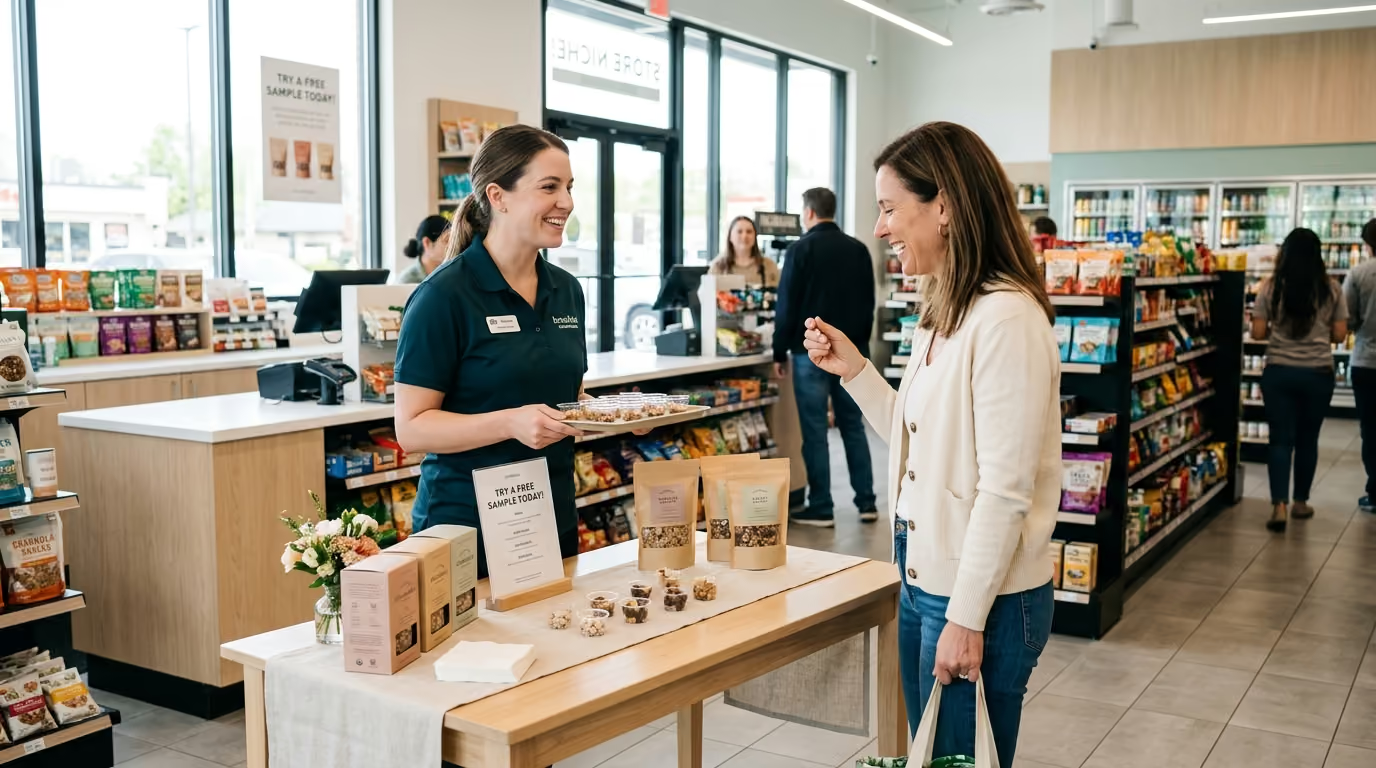
A small sampling table can create an unmanageable footprint if designers overlook human behavior. When a promoter hands out samples from behind a table, customers gather directly in front of the unit. If five shoppers stop simultaneously, the crowd expands three feet outward into the aisle.
A professional activation plan must calculate the static fixture footprint, the staff standing footprint, and the dynamic queue footprint together. Planning for all three zones ensures the entire activation system operates smoothly within required clearances.
Because retail layouts vary widely across store locations, a single rigid activation design cannot scale. A layout that works in an open endcap in a suburban warehouse club will fail in an urban grocery aisle. Brands need a modular system of standardized parts that maintains brand consistency while adapting to physical constraints.
Building an adaptive kit begins by separating non-negotiable retailer rules from core brand requirements. Retailer rules govern physical dimensions, weight limits, fire safety codes, power availability, and approved materials. Brand requirements govern visual branding, core product communication, sampling hygiene, and direct paths to purchase. Viable activation designs exist exclusively where these two requirements intersect.
To achieve scale, field marketing teams should develop four standardized physical formats within a single modular program:
This format is designed for large-format retailers, warehouse clubs, or wide concourses with high square footage. It features a freestanding counter, integrated storage for inventory replenishment, dedicated waste receptacles, and elevated brand signage visible from twenty feet away. It accommodates high-volume sampling, multiple staff members, and structured queue lines.
Built for standard supermarket center-store aisles, this format utilizes a vertical orientation with a minimal footprint. The display uses a narrow, counter-weighted stand with an ultra-compact base that hugs the shelf line. It maintains the minimum 36-inch ADA clearance in standard grocery aisles while keeping promotional messaging above eye level.
When floor space is entirely restricted, activations must integrate directly into existing store fixtures. This format uses specialized bracketry, shelf talkers, branded endcap headers, and side-wing displays. It delivers educational messaging and guided product interaction directly at the home shelf location without occupying floor space.
For high-density retail environments where freestanding tables are prohibited, the activation shifts to a wearable or handheld format. Brand ambassadors use ergonomic sampling trays with integrated disposal bins and branded apparel. This allows staff to move dynamically to approved high-dwell zones while maintaining total mobility.
When our team rolled out a multi-market program across diverse retail footprints, modular design was the decisive factor. A VP of Marketing reflected on our partnership: "Robbie, it was a pleasure working with you and your team. You turned our launch into an experience that connected with shoppers and built lasting excitement for our brand. We're already looking forward to the next project together." Our team created a launch experience that resonated with retail shoppers and generated momentum for future collaborations by engineering every fixture to adapt to store constraints.
By standardizing structural materials, color palettes, and messaging hierarchies across every tier, brands maintain visual authority in every store format. Master field marketers rely on the retailer collaboration playbook for in-store activations to ensure fixture designs gain formal approval long before materials ship to the field.
Securing prime real estate inside a store requires balancing customer foot traffic with dwell time. Academic field research indicates that product visibility from major shopper circulation paths is closely linked to higher customer engagement. In a pilot study published in Environment and Planning B: Planning and Design, researchers tracked shopper paths in a retail setting. They found that products positioned along primary circulation paths received significantly higher visual contact and physical interaction than products tucked into secondary corridors.
However, placing an activation in the highest-traffic area is not always the best strategy. In high-speed transition zones, such as the immediate entrance vestibule, shoppers move quickly and carry cognitive load as they orient themselves. If customers move too quickly to process your message, high foot traffic will not translate into trial.
The goal is identifying high-visibility areas with natural dwell opportunities. Brand teams should evaluate potential activation locations using an operational scorecard:
Eye-tracking experiments published in the Journal of Retailing and Consumer Services demonstrate that in-store visual attention varies based on store familiarity and shopping goals. Shoppers process signage differently depending on whether they are navigating the store or making category purchase decisions. Signage materially alters the direction and magnitude of visual attention during active decision phases.
This finding supports a two-layer messaging hierarchy for constrained retail activations:
The orientation layer must be legible from ten to twenty feet away, using high-contrast branding and simple imagery to draw the shopper out of the primary aisle. The conversion layer sits directly at the interaction point, communicating a single primary product benefit and clear pricing. Attempting to fit entire brand origin stories onto a single retail sign overburdens the shopper and weakens conversion.
Choosing between static and digital signage requires evaluating store constraints. A 2025 field study in the Journal of Marketing showed that digital in-store advertising increased featured product purchase likelihood by 8.1%. The study found that this sales lift was strongest when screens were placed directly adjacent to the physical product.
However, digital displays introduce operational hurdles, including power drops, equipment theft, connectivity outages, and retailer compliance approvals. If power access is unreliable, static signage with crisp typography and high-contrast visuals delivers consistent sales lift without operational risk.
Product sampling is one of the most effective tools for accelerating trial, yet its operational costs require disciplined execution. A comprehensive study published in the Journal of Retailing analyzed store scanner data across multiple product categories. The researchers found that in-store sampling generated substantial immediate sales lifts and sustained long-term sales increases over baseline levels.
The research highlighted two critical retail dynamics. First, repeated sampling events produced a compounding increase in long-term sales performance, building sustained brand equity rather than temporary volume spikes. Second, sampling drove a category-expansion effect rather than simple brand switching. This means the activation brought new buyers into the overall category, making the event highly attractive to retail category managers.
A University of Wisconsin summary of this scanner research noted that sampling consistently outperformed standalone static display enhancements. Live human engagement and sensory trial create an emotional connection that static cardboard displays cannot match.
However, sampling activations must be managed against strict operational margins. Early supermarket field research published in Marketing Bulletin examined food product demonstrations across modern retail environments. The researchers found that while sampling increased unit sales from 70% to nearly six times base levels during the event, direct labor and sampling costs could exceed immediate gross profits if conversion funnels were poorly managed.
To guarantee positive Return on Investment (ROI), brand teams must design activations that connect trial directly to purchases. When planning field operations, marketing leaders can explore designing activations for specific shopper missions to ensure sampling programs match consumer intent.
Field demonstrations must incorporate an unobstructed physical pathway from the tasting counter to the shelf. If a shopper likes a sample, the brand ambassador should hand them a cold product carton or point to a fully stocked display within arm reach. Every foot of distance between the sampling station and the product shelf increases drop-off and lowers net campaign revenue.
Executing a high-performing retail activation within store constraints requires tight operational control. Brand operators can implement this step-by-step playbook across national retail programs:
Field marketing directors who want to improve their operational rigor can study refining retail demo and sampling strategies to build consistent, repeatable field programs across regional and national retail accounts.
Measuring in-store experiential marketing requires tracking both real-time operational execution and final sales lift. Tracking both lead and lag metrics allows brands to calculate true Return on Investment while diagnosing operational bottlenecks in real time.
Lead metrics measure field execution quality and immediate consumer engagement during the activation:
Lag metrics measure the commercial, financial, and retail impact generated by the campaign:
To implement a complete reporting system across distributed retail activations, field teams can apply field measurement frameworks that track real value to prove tangible sales velocity to executive stakeholders.
A growing plant-based food manufacturer faced a difficult retail rollout across one hundred high-volume club store locations. The brand needed to drive immediate trial for a premium chilled entree. However, the retailer enforced strict operational rules: no external power drops, rigid forty-eight-inch footprint limits, zero stock cartons on the sales floor, and mandatory thirty-six-inch aisle clearances at all times.
The brand's initial demo concept failed store audits because the prep station blocked cart traffic and required dedicated electrical outlets for warming trays. Our team stepped in to re-engineer the entire activation system for tight field constraints.
We designed a custom, self-contained forty-two-inch mobile sampling cart that operated entirely off flameless, commercial-grade insulated hot-holding units. The fixture integrated internal storage compartments holding three hours of backstock, an internal trash management system, and non-marking lockable rubber casters. The vertical graphic mast kept the single product benefit visible above crowded shopping carts without extending into aisle space.
The operational results proved the value of constrained design:
By designing the activation to work within physical store constraints, the brand eliminated manager friction, protected customer safety, and delivered predictable sales velocity at scale.
Always carry a physical and digital copy of the written retailer approval agreement, including the signed floor plan schematic. If the manager on duty still requests a relocation due to unexpected floor congestion, transition the display to its secondary narrow footprint configuration. Maintaining an adaptable, modular setup allows your field team to cooperate with store staff while keeping the activation active on the floor.
Utilize self-contained, NSF-certified mobile handwashing and sanitation stations engineered for temporary retail demonstrations. Pre-portion samples in off-site commissary kitchens whenever possible to minimize active food prep on the sales floor. Always carry commercial sanitization packs, surface wipes, and sealed disposal containers within your base cart storage.
When overhead height is restricted, focus on high-contrast vertical shelf-edge banners, high-illumination battery LED counter displays, and branded staff apparel. Ensure your product packaging sits elevated on angled counter risers directly at shopper eye level. Clean product presentation and clear benefit-driven messaging will outperform bulky, oversized signage in tight retail corridors.

30 Years Experiential & Retail Activation Partner for CPG & Beverage Brands | Multi-Market Demos, Roadshows & Costco/Club Programs That Actually Sell