Robbie Thain
Founder, CEO

Learn how CPG brands use POS integration, control stores, and measurable retail demos to prove true incremental sales and trade spend ROI.
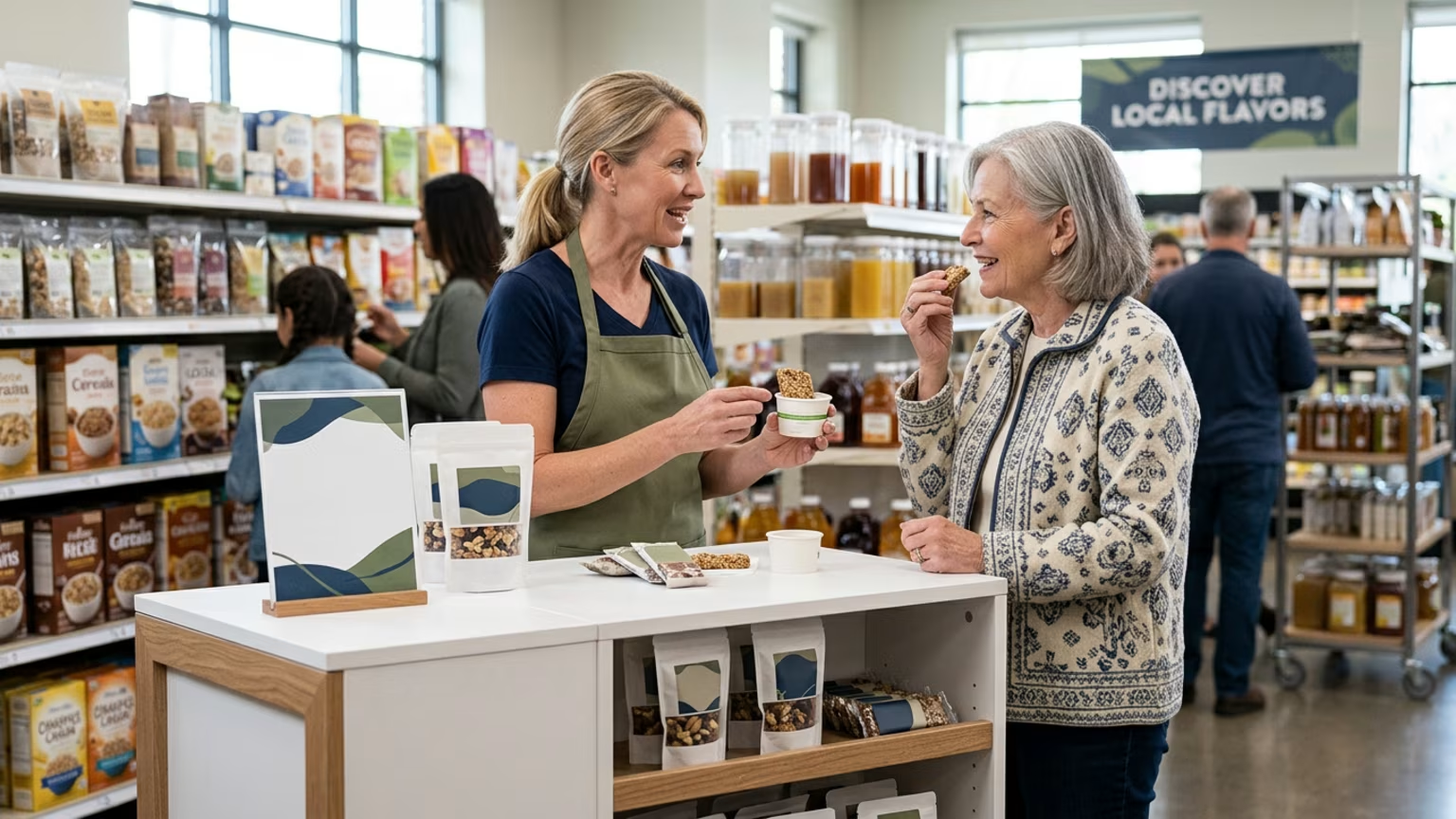
CPG shopper marketing teams are shifting away from vanity metrics to prove that retail demos drive verifiable sales lift. By linking in-store sampling with point-of-sale data and matched control markets, brands can turn experiential spend into defensible pipeline.
One field manager stands with a clipboard and zero proof. A mountain of empty sample cups sits on a folding table at the end of a long shift. The regional buyer asks for evidence that those samples actually moved product. The manager has nothing but an attendance guess to offer.
Retail execution is often messy. Field teams hand out thousands of snacks during a weekend shift. The crowds gather around the booth for free products. When Monday morning arrives, finance executives want to know if the trade spend actually worked.
Without hard data, marketers are left guessing if the activation caused the sales spike. It might have just been normal weekend foot traffic. This lack of clarity frustrates everyone from the field manager to the chief marketing officer. AnyRoad says retail media networks and privacy rules are pushing CPG field marketing leaders to prove experiential activations drive measurable sales lift at major chains.
You cannot rely on foot traffic estimates anymore. Retailers want to see how sampling interactions translate directly into sell-through at the register. The mismatch between what field teams execute and what executives measure causes immense friction. Marketers need a system that tracks exact conversions.
Finance teams view marketing expenses through a strict lens of profitability. They care whether the cost of staffing and product samples resulted in a positive Return on Investment. Without point-of-sale integration, field marketing becomes a vulnerable line item during budget season.
A strong measurement framework fixes the disconnect between activity and revenue. The goal is to isolate the exact impact of your live event from other variables. This requires moving away from basic attendance counting toward incrementality testing. Marketers must build their data architecture before deploying staff to the stores.
Alloy.ai advises CPG teams to start with the most expensive decision question and add only the data layers that help answer it. For many brands, the most expensive question is whether trade spend actually creates new buyers. Trying to measure every possible data point leads to dashboard fatigue. Teams should focus strictly on the numbers that influence financial decisions.
Alloy.ai says the highest-value analytics use cases are demand forecasting and trade promotion optimization. To optimize those promotions, you need a solid baseline. Snipp says a holdout group is required for measuring incrementality in promotional campaigns. They argue that without a holdout group, brands are estimating rather than measuring incremental impact.
A holdout market acts as a clean baseline for comparison. Snipp recommends matched control markets with similar sales trends and distribution. You must also avoid campaign spillover. When you compare an active demo store against a matched control store, the true impact becomes clear.
Alloy.ai says that once POS data is clean, brands can layer in trade, inventory, and supply-chain data to make better decisions. This unified approach gives executives a complete picture of the retail environment. The strategy transforms a simple demo into a precise financial instrument.
As digital advertising becomes more expensive, brands are looking back to physical retail for growth. They expect the same level of analytical rigor in the store as they get online. Integrating POS data with field execution provides that rigor. It bridges the gap between physical interactions and digital measurement standards.
Building a trackable campaign requires strict operational discipline. You must plan the data capture before you schedule the staff. Every interaction needs a clear path to purchase. Here is the exact process for running a measurable in-store activation.
Your first step is selecting the right control stores. Choose retail locations with similar baseline sales to your activation stores. Pull historical point-of-sale data for both groups. This historical data forms the foundation of your incrementality test.
You must ensure that the control stores do not receive any marketing support during the test window. Any media spillover will ruin the comparison. A clean baseline allows you to attribute any sales lift directly to the physical activation.
Field staff must deliver a uniform message at every location. Variations in how brand ambassadors pitch the product will muddy your conversion data. Train your teams to use the exact same offer communication. Give them clear incentives to hand out after the sample is consumed.
Shoppers need a compelling reason to put the item in their cart immediately. A digital coupon or a unique physical barcode provides a trackable mechanism for that purchase. Standardized messaging ensures that your data reflects the offer rather than the charisma of a single staff member.
Ensure product inventory is fully stocked before the event begins. Running out of stock midway through a shift destroys your conversion metrics. Gradient Experience says experiential measurement is stronger when brands use tracking codes, segmentation, distributor alignment, and post-campaign analysis. A tracking code on a coupon provides direct proof of purchase.
Your distributor must provide accurate inventory numbers for the test locations. Sales lift cannot happen if the product is stuck in the back room. Close alignment between field staff and store managers guarantees the shelves remain full.
We have executed over 1000 campaigns across all 50 states, bringing brands to life in every major U.S. market. From retail demos in Seattle to roadshows in Miami and events in Honolulu, our teams activate brands wherever our clients' audiences are located. Consistent national execution ensures your data remains clean across regions.
This consistency makes it easier to track high converting retail demos accurately. When you run identical playbooks in different markets, you can compare regional performance without worrying about execution variables. Precision execution is the key to reliable data.
Measuring the right numbers separates successful programs from expensive theater. Activity metrics like total samples distributed are no longer enough. You must track both leading indicators and lagging financial outcomes.
Leading metrics tell you how the activation is performing in real time. AnyRoad recommends measuring experiential programs with metrics such as purchase intent lift, NPS, and post-experience purchase conversion. You should also monitor the volume of verified interactions. Tracking these leading numbers helps managers adjust staffing on the fly.
If purchase intent is low during the first hour, the field manager can coach the staff to improve their pitch. First-party data capture is another powerful leading metric. Gathering emails or phone numbers allows the brand to follow up with shoppers later. These indicators show whether the audience is actually engaging with the product.
Lagging metrics prove the financial validity of the campaign. Gradient Experience recommends tracking pre- and post-activation sales, sampling-to-purchase conversion, retailer engagement, and first-party data capture. These figures tell the final story of the event. They provide the hard evidence needed for executive review.
Gradient Experience says CPG experiential programs increasingly need to demonstrate retail lift and measurable conversion. Visibility alone is no longer a valid goal. When you track actual conversions, you build a reliable model for future growth. This model dictates where the brand should deploy field teams next.
Trade-promotion guides consistently define ROI using incremental sales or incremental margin rather than gross promotional sales. You cannot claim gross sales as a victory because many of those shoppers would have bought the product anyway. The true value lies in the incremental margin generated above the baseline.
Expertise Accelerated recommends reviewing trade promotion ROI by retailer and product group. Brands should also review these metrics across different channels, regions, and promotion types. Granular reporting allows brands to identify exactly which stores deserve future investment. If you want a deeper look at evaluation methods, reviewing 5 metrics to prove retail demo ROI can help clarify your reporting strategy.
Modern beverage and snack companies apply this framework to defend their retail shelf space. The process requires treating every live event as a structured data test. Planning starts weeks in advance with deep collaboration between marketing and finance departments.
The marketing team selects specific target stores for an upcoming weekend activation. They then partner with analysts to select identical control stores in a neighboring market. The field team runs the activation using a traceable offer code. Every sample handed out is tied to a clear call to action.
Following the event, analysts compare the sales data between the two groups. The control group shows standard weekend sales volume. The activated group typically shows a distinct spike in register ring for the promoted item. The difference between those two figures is the true return on the activation.
This concrete evidence gives marketing leaders a defensible case to present to their retail buyers. Retailers respect hard data over flashy event recaps. Proving incremental value secures better shelf placement for future quarters. If you want to replicate this level of clarity, book a strategy call with makai today.
Start your next campaign by selecting two matched retail locations to serve as your control group before you pour a single sample.

30 Years Experiential & Retail Activation Partner for CPG & Beverage Brands | Multi-Market Demos, Roadshows & Costco/Club Programs That Actually Sell