Robbie Thain
Founder, CEO

Learn how to build an experiential decision matrix to choose between retail demos, campus events, and sponsorships while tracking true ROI for your brand.

Experiential budget decisions require a structured approach that weighs retailer priorities, category norms, and internal operational capacity. This guide provides a strategic framework to help marketing leaders choose the right live activation formats without burning through budgets.
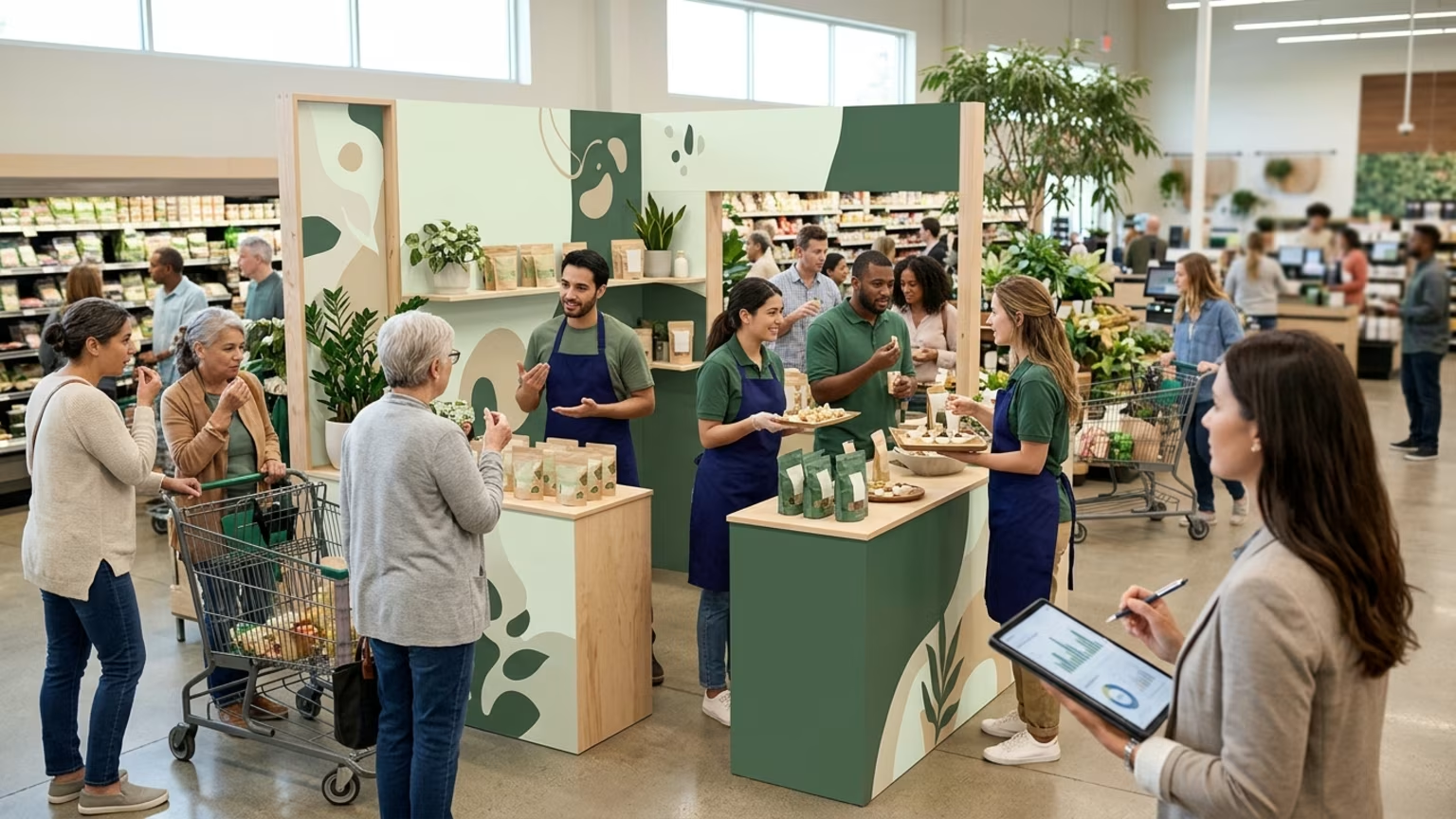
A pallet of expensive product sits abandoned behind a pop-up booth while brand ambassadors stare at their phones. Aisle traffic moves briskly past the display without a single meaningful interaction. The post-event report will eventually show thousands of passive impressions but zero incremental sales. This operational failure happens daily because brands launch activations without a clear decision matrix.
Marketers often treat live events as an afterthought or a rushed experimental expense. Binet and Field's analysis of IPA case studies, summarized by GrowthMethod, suggests that brands on average perform best with roughly a 60:40 split between long-term brand building and short-term sales activation. When budgets shrink, teams tend to cut physical activations in favor of cheap digital media. They forget that physical touchpoints build long-term brand equity in ways digital ads cannot replicate.
When a company ignores this balance, they typically overspend on performance marketing that yields diminishing returns. Digital channels become saturated quickly. Physical events offer a way to break through that digital saturation by placing a tangible product in the hands of the consumer. This tactile interaction creates a lasting memory that digital impressions simply cannot achieve.
Industry guides such as YellowHouse Events classify experiential campaigns into several main formats. These include live sampling activations, pop-ups, roadshows, and sponsorship activations. Teams might also use trade show experiences, hybrid campaigns, guerrilla marketing, or VIP launch events. Choosing the wrong format for your product guarantees a poor return on investment.
Live sampling activations work best for food and beverage products where taste is the primary selling point. Pop-ups and immersive environments suit fashion or lifestyle brands trying to manufacture exclusivity. Trade show experiences serve business-to-business companies looking to capture qualified leads in a condensed timeframe. Hybrid campaigns mix live interaction with digital broadcasting to maximize total reach.
Newbridge Marketing advises that the strongest activations revolve around a single repeatable engagement mechanic like a tasting or challenge that every participant experiences. If you sell a consumer packaged good, your audience is already in a buying mindset at the grocery store. This makes retail demos a highly logical choice for immediate sales activation. In contrast, an enterprise software product might need a quiet conference room presentation rather than a flashy trade show booth.
Brands must evaluate internal operational capacity before committing to a format. According to Newbridge Marketing, multi-market activations only hold together when teams use a documented playbook, local ambassadors, scalable logistics, and a unified measurement framework. Without these four elements, a national campus ambassador program will quickly degrade into disconnected local disasters. You need a centralized team at makai to manage the storage, tracking, and delivery of your materials.
Retail demos offer tight control and direct access to point-of-sale data. They allow field marketers to measure daily product velocity and immediate shopper feedback. Event sponsorships provide massive reach but require significant coordination to activate properly. Clarity Media Partners' venue guide argues that sponsorship touchpoints should be priced based on reach, engagement quality, exclusivity, and production cost. Active engagement spaces command much higher value than passive signage.
Campus programs require an entirely different timeframe and investment strategy. These activations take months to build trust among a specific student demographic. They are long-term affinity plays rather than quick sales drivers. Teams must match their chosen format to the realistic timelines expected by their leadership.
Brands targeting young demographics often rush into campus programs without measuring baseline awareness. They deploy street teams to hand out free products without any follow-up mechanism. This spray-and-pray approach burns through inventory while providing zero insight into future buying behavior. Structured semester campaigns solve this by introducing clear tracking phases that hold field teams accountable.
A brilliant strategy means nothing without rigorous field execution. EventStaff stresses that live experiential marketing only works when brands define a clear guest flow, train staff, and tie outcomes to business goals. This requires a specific operational playbook that removes guesswork from the field.
Your target audience should never have to guess what you want them to do. Every interaction must guide them clearly from awareness to active participation. You should design the physical space to funnel foot traffic naturally toward the product demonstration. The engagement mechanic must be frictionless and instantly rewarding.
You cannot run a national program effectively with a fragmented logistics strategy. You must use consistent event gear, predictable supply chains, and standardized training materials for every location. If a field manager in one state uses different messaging than a manager in another state, your brand loses credibility. Standardizing the operation allows you to scale up or down without breaking the core experience.
Proper logistics planning prevents last-minute panic on the showroom floor. If a permit is delayed or a truck breaks down, field teams need immediate contingency plans. The playbook must include clear escalation paths so brand ambassadors know exactly who to call. Professional event execution treats these mundane details as non-negotiable standards.
EventStaff points out that campaigns must track interactions such as QR scans, demos completed, email sign-ups, and social posts. We blend physical and digital experiences by integrating QR codes, mobile technology, and real-world activations into a cohesive layer across retail, event, and tour experiences. This digital integration is not a standalone service but an upgrade we apply to many types of experiential work to drive connected results.
Marketing leaders face intense pressure to justify their budgets to skeptical finance teams. Newbridge recommends designing measurement before an activation launches and focusing on behavioral metrics like lead capture, redemption, sales lift in activation areas, and repeat purchase. If you wait until after the event to collect data, you will only have vanity metrics to share. You must build your tracking systems before the first product sample is ever poured.
Lead capture systems should integrate directly into your primary customer relationship management software. If your field staff writes names on paper clipboards, you will lose valuable data before the event ends. Digital redemption codes allow you to track exactly how many samples converted into actual sales at specific retailers. Measuring sales lift in activation areas helps you prove that your field presence directly influenced regional revenue.
Student audiences require specialized tracking to gauge genuine affinity over time. AnyRoad's campus activation guide highlights NPS, purchase intent, brand affinity lift, and redemption rate as four defensible KPIs for semester-long college programs. These metrics track how brand perception shifts as students interact with ambassadors across multiple weeks. Consistent measurement prevents teams from abandoning successful programs prematurely.
When tracking brand affinity lift, marketers should conduct pre-event and post-event surveys to measure shifts in consumer sentiment. Redemption rate acts as the ultimate truth teller for any sampling campaign. If thousands of students take a sample but nobody redeems the follow-up coupon, your product failed to resonate. Identifying these failures early allows you to pivot your strategy before wasting the rest of your budget.
Event sponsorships often suffer from lazy reporting and inflated attendance figures. Clarity Media Partners proposes a dual-mandate sponsorship Return on Investment (ROI) framework. This tracks sponsor fulfillment outcomes and member experience metrics through specific stages. These stages include pre-deal goal alignment, metric architecture, and activation design. The process concludes with unified reporting and a thorough portfolio review.
Sponsorship portfolios require ruthless review cycles to weed out underperforming venues. A pre-deal goal alignment ensures that both the sponsor and the venue agree on what success looks like. The metric architecture must dictate exactly how and when data will be collected during the event. Unified reporting allows leadership to compare different sponsorships side by side using the exact same criteria.
AnyRoad's sponsorship ROI guide outlines the requirements for measurable sponsorship packages. They depend on tiered benefits and robust data capture throughout the event. Teams must also deliver post-event reporting on KPIs like opt-in rate, NPS, and purchase intent. Additional required metrics include lead volume and attributed conversions.
A premium beverage brand attempting to enter a crowded regional market cannot rely on digital ads alone. Shoppers need to taste the product before they commit to a full-price purchase. The brand leadership decides to allocate budget using the 60:40 rule to ensure both long-term brand awareness and short-term sales velocity. They prioritize retail demos and roadshows over massive festival sponsorships because they need immediate retail validation.
The brand builds a standardized playbook focused on a single repeatable engagement mechanic. Field ambassadors pour a measured sample, deliver a tight three-sentence pitch, and hand the shopper a trackable coupon. This process repeats flawlessly across fifty retail locations. The brand avoids passive banners entirely because active engagement spaces command much higher value than passive signage.
The marketing team uses targeted digital tools to capture exact redemption rates and email sign-ups. Bizzabo promotes the SPAN™ Sponsorship Method for aligning sponsors with the right opportunities. This framework features a four-stage process covering Segment, Prepare, Activate, and Nurture. By applying similar rigorous staging to their retail program, the brand tracks the customer from the initial tasting through to the final purchase. This clear attribution data proves the program's value directly to wholesale buyers.
Experiential marketing only succeeds when it is treated with operational discipline. You must weigh retailer priorities against your own internal capacity to execute cleanly. Treat every live event as a measurable pipeline engine rather than a creative vanity project. Book a strategy call with our team to start turning your physical activations into verifiable revenue.

30 Years Experiential & Retail Activation Partner for CPG & Beverage Brands | Multi-Market Demos, Roadshows & Costco/Club Programs That Actually Sell