Robbie Thain
Founder, CEO

Consumer brands are increasing product sampling and retail activations to defend market share. Learn how field teams use live events to drive measurable B2B ROI.
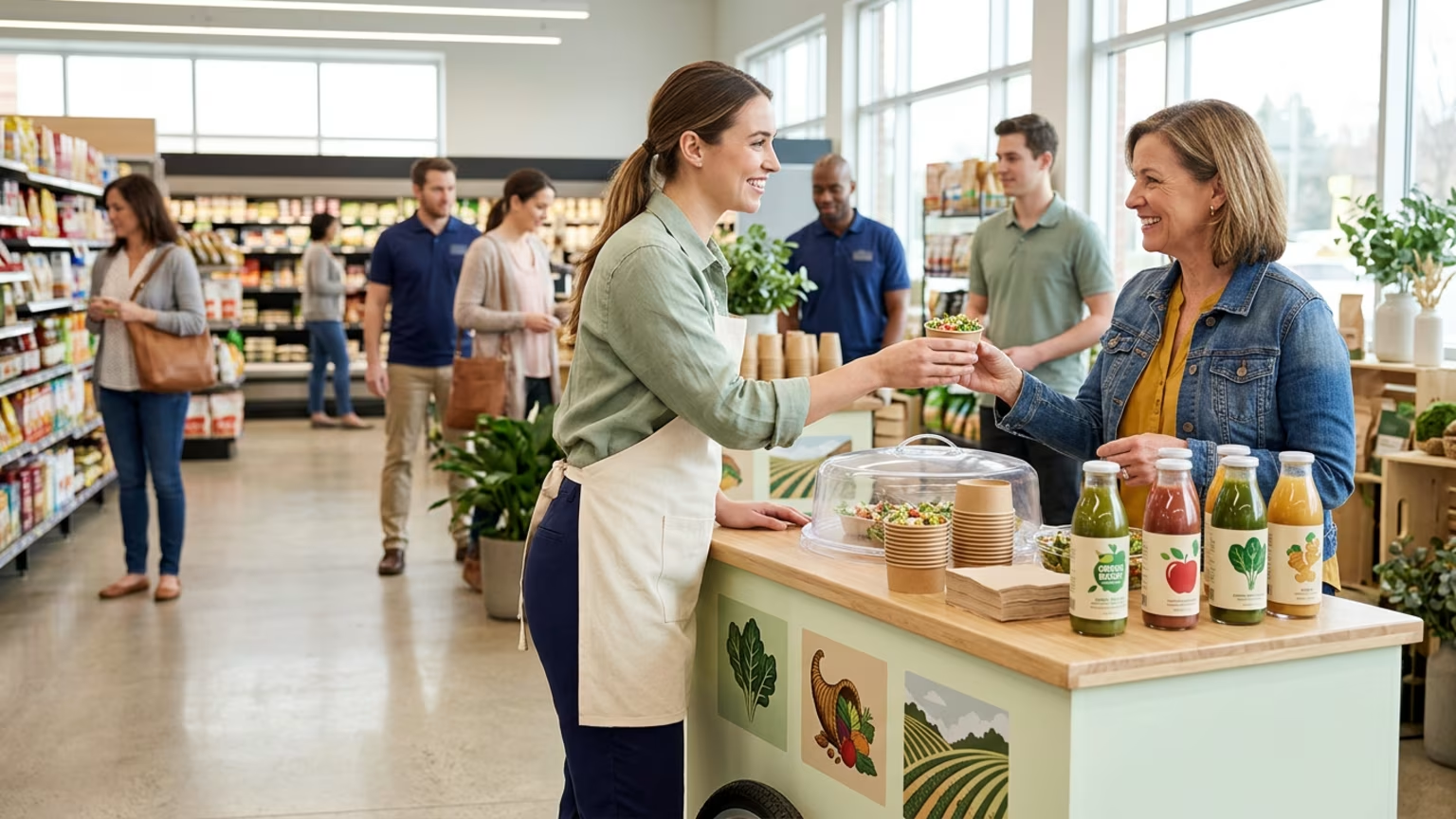
Consumer brands face a challenging environment where shoppers are trading down, seeking more value, and expecting unprecedented convenience. One market forecast projects that the private label and discount retail segment will grow from $724.79 billion in 2024 to nearly $1,348.91 billion by 2032 at a 7.94% CAGR. This massive shift toward value puts intense pressure on premium branded goods to defend their market share. In response, consumer brands are actively increasing physical product sampling to prove their worth at the shelf.
Consumer brands are aggressively increasing retail activations to drive product trial and defend market share during periods of soft demand. By integrating physical sampling with connected digital strategies, field marketing teams can turn fleeting in store impressions into measurable commercial pipeline.
The scene inside a major expo or retail warehouse is often a beautiful mess. A brand ambassador pours samples into tiny cups while a disorganized crowd forms, completely blocking the main aisle. Visitors grab a taste, nod politely, and walk away without ever engaging with the core brand message. The field manager watches the inventory vanish but has no real way to track metrics that prove retail sampling impact beyond counting empty cups.
This disconnect happens when brands treat live events as standalone theater rather than commercial conversion engines. We have been connecting brands with people through live experiences, retail programs, and national activations since 1995. Over three decades, we have built a track record of creating meaningful brand moments across the country. Our experience shows that pouring thousands of samples means absolutely nothing without a clear, engineered path to purchase.
When demand softens, these chaotic activations become a massive liability for marketing leaders under pressure to prove results. Retail buyers want to see organized programs that pull foot traffic to specific aisles and lift category sales. If an activation just creates a mess and zero attributable data, the brand loses credibility with both the consumer and the retail partner. The stakes on the floor are simply too high to rely on hope and unstructured product distribution.
To survive softer demand, marketing teams must stop treating live events as isolated awareness plays. The solution is creating effective retail activation and tasting programs that connect online product research directly with offline conversion. According to Floor Covering Weekly, brands must pair a strong digital shopping experience with a helpful, confidence building in store experience. This structured approach prevents wasted spend and ensures every interaction supports larger distribution goals.
Implementing this framework requires aligning field marketing efforts with retail distribution and connected commerce platforms. Analysts note that the boundaries between digital and physical retail are blurring rapidly. Shoppers might start their product research on social platforms, but they need that physical tasting moment to validate the purchase. A unified framework ensures every tasting program directly supports B2B relationships and targeted point of sale metrics.
Integrating local relevance into physical retail activations ensures the brand message resonates with the specific store demographic. Industry commentary suggests that social and creator content are common starting points for product evaluation. However, the ultimate goal is getting your product on the shortlist the customer carries into the dealer. The framework connects that initial social spark to the tangible reality of the retail floor.
A retail strategist points out that being legible to search algorithms, maintaining accurate listings, and keeping a current web presence is a critical defensive move. Experiential programs must align with this digital foundation. When a shopper tastes a sample and later searches for the product, the digital footprint must immediately reinforce the physical experience.
Translating a coordinated strategy into a live activation requires operator grade discipline. Field marketing teams must execute precisely to protect market share against growing discount alternatives. A proper activation connects digital evaluation with physical proof while giving retail partners exactly what they need to move inventory. The goal is to build an activation that operates like a well oiled machine.
Here is how to deploy retail demos that actually convert:
Proving Return on Investment requires shifting focus from vanity metrics to hard commercial outcomes. Experiential teams must track the exact data points that retail buyers care about most. A stack of business cards or a high sample count will not justify next quarter budgets. Experiential leaders need concrete evidence that their events are actually moving product off the shelf.
Lead metrics indicate the immediate health of the activation while the field team is still on the floor. These include the total number of qualified B2B engagements, the volume of digital data captures, and the sample to purchase conversion rate on site. A high volume of qualified engagements shows that your ambassadors are successfully moving shoppers from passive awareness to active consideration. Catching weak lead metrics early allows the field manager to adjust the pitch in real time, saving the activation from failure.
Lag metrics measure the lasting B2B and consumer impact of the campaign after the event ends. Field teams should monitor the rate of sale lift during the activation window versus prior weeks. They must also track new buyer penetration and the retention rate of customers acquired through the retail tasting program. Tying these lag metrics directly to the activation proves that the field marketing spend actually moved the needle.
Presenting these numbers clearly to retail partners is just as critical as gathering them. When you show a buyer that your tasting program lifted the entire category by a measurable margin, you secure better shelf space for the future. Data turns a simple sampling day into an undeniable business case.
The need for physical proof is most obvious in fast moving consumer goods and sensory driven beverage categories. The Globe and Mail reports that creating effective retail activation and tasting programs is a core pillar for emerging spirit brands seeking nationwide distribution. These brands simply cannot rely on digital advertising to explain a complex flavor profile to a skeptical buyer.
Instead, these companies position retail activations alongside distribution, public relations, and connected commerce strategies. A shopper might see a creator reviewing the spirit on a popular social platform. That same shopper later encounters a well executed tasting program at their local retailer. The physical sample settles the decision, directly lifting retail sales and building long term retailer confidence.
This B2B and consumer alignment works across food, snacks, health, and wellness categories. When a premium snack brand faces intense pressure from a cheaper store brand, the taste test is the only weapon that works instantly. The physical interaction breaks through the hesitation caused by softer market demand. It proves the value proposition on the spot.
The threat of private label expansion creeping toward a $1.34 trillion valuation is real. Brands cannot fight this shift with digital ads alone while hoping for the best. To win the shelf, marketing leaders must step out of the digital fog and return to the physical retail floor.
When you give a customer a tangible reason to believe in your product, you create loyalty that discount brands cannot replicate. Turn your next live event from a chaotic sampling station into a measurable pipeline engine. Book a strategy call with makai today.

30 Years Experiential & Retail Activation Partner for CPG & Beverage Brands | Multi-Market Demos, Roadshows & Costco/Club Programs That Actually Sell