Robbie Thain
Founder, CEO

A new Turing Labs report shows 70% of CPG brands are losing the race to shelf. Learn how experiential marketing can serve as a real-time R&D engine.
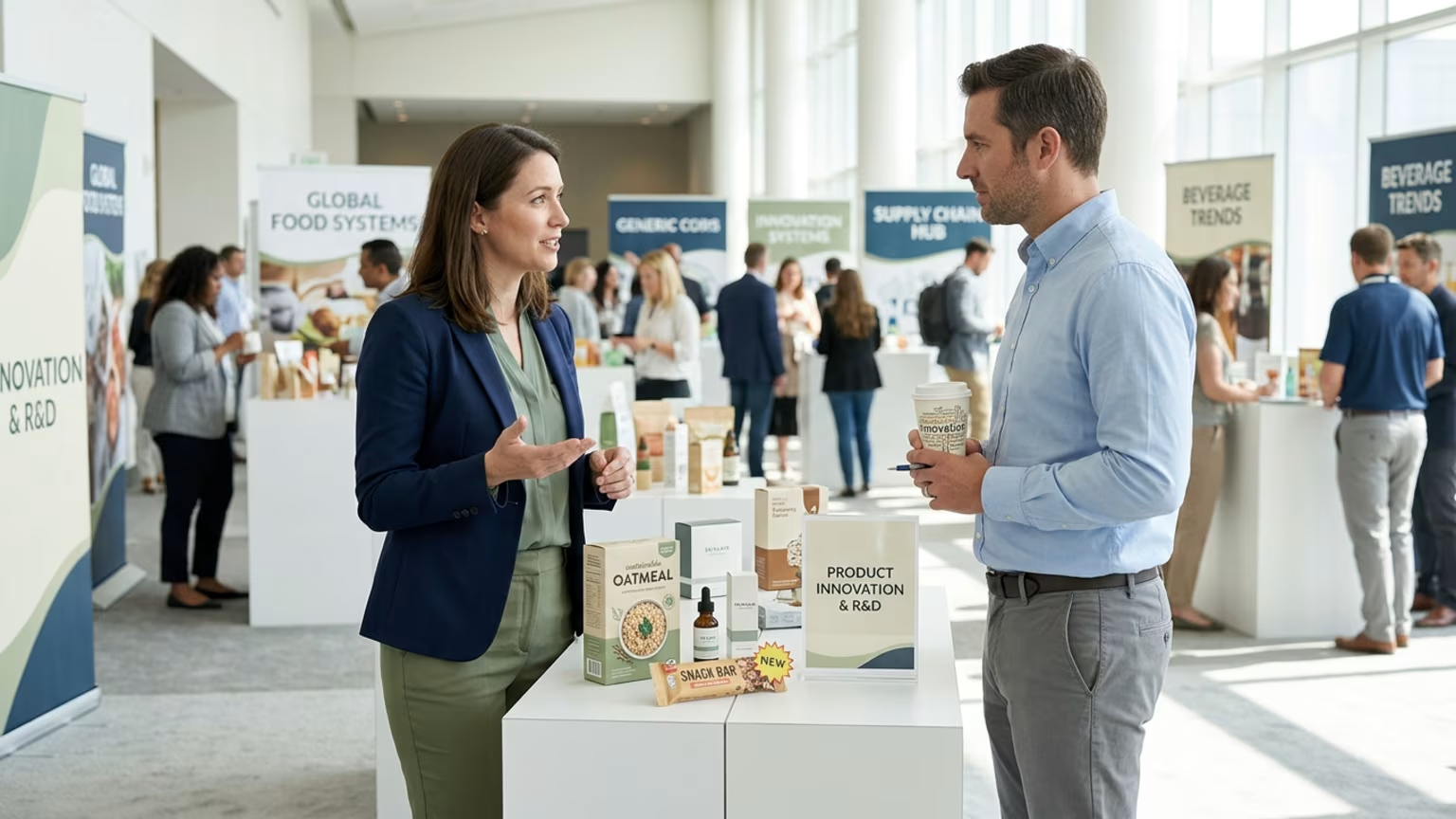
Most consumer goods companies think product testing ends the moment a pilot batch leaves the laboratory. A recent benchmark report shatters that assumption completely by revealing a massive disconnect between scientific confidence and retail reality.
A new Turing Labs report shows that 70 percent of consumer packaged goods brands are failing to win at the shelf due to slow and inefficient innovation cycles. Experiential marketing must evolve into a real time research and development engine to test products before national rollouts drain budgets.
Research teams spend millions perfecting formulations in pristine facilities. They run focus groups behind two way mirrors and declare a product ready for scale. Then the product hits a noisy Costco floor or a crowded trade show. Suddenly the flavor profile falls flat, the packaging confuses shoppers, and the price point feels entirely wrong.
The new Turing Labs report quantifies this exact failure in the market. Based on a survey of 290 senior leaders at U.S. and European food and beverage companies, 70 percent of consumer packaged goods brands lose the race to shelf while competitors launch first in the same trend spaces. The data paints a picture of massive waste across the industry. Worse, 52 percent of respondents report that changes are required within the first year of launch.
This staggering metric includes 49 percent who make adjustments between six and twelve months post launch. These numbers prove that brands are effectively doing their real product testing in the market at full scale. Waiting for retail sales data to reveal a formulation error is the most expensive possible way to gather consumer feedback. Pulling a product from national distribution for an emergency recipe change destroys retail buyer trust.
The gap between branded items and store brands is also shrinking fast. In the Turing Labs survey, 60 percent of respondents say the quality gap between branded and private label products has reduced over the past three years. Another 3 percent say it has disappeared entirely. Brands can no longer rely on their name alone to cover for slow development cycles.
We specialize in creating retail demos, product sampling programs, and roadshows that bring brands face to face with their audiences. Each program is designed to drive trial, build consumer relationships, and accelerate retail velocity across multiple locations. We see firsthand how shoppers react to products that look great on paper but fail to connect in a live environment.
The traditional approach to new product development isolates the consumer until the very end. The strategic fix is treating live shopper activations as real time research and development labs. Instead of just handing out cups of liquid, experiential marketers must use events to rapidly test concepts before scaling nationally.
Turing Labs notes that more than 9 in 10 respondents cannot consistently launch successful products without compromising on speed, timeline, or feasibility. To fix this structural problem, brands must adopt a fast learning operating system. Every festival footprint or mobile tour must double as a structured data collection point. Waiting for a perfect product simply takes too long.
Artificial intelligence is often touted as the magic fix for slow development cycles. However, the survey shows 20 percent of artificial intelligence initiatives are never implemented, and 14 percent are implemented and later abandoned. Only 24 percent are still in use but delivering minimal or no business impact. Nine out of 10 research executives in large companies are using artificial intelligence at work in some capacity, but just 19 percent have embedded it into routine workflows.
Field activations bridge this digital execution gap perfectly. Physical events feed accurate consumer sentiment back into predictive models. This offline data layer makes product innovation much more grounded in reality. It gives decision makers the exact proof they need to adjust a formulation early.
Retail partners have also raised the bar for new product acceptance. Retailers want products that turn quickly and require fewer costly resets or delistings. When a manufacturer asks a grocery chain to stock an untested product, they are asking the retailer to host a massive experiment. Brands that bring evidence from real world tests will easily win premium shelf space over competitors relying solely on laboratory data.
Transforming an event into an innovation laboratory requires operator grade discipline. The goal is gathering structured insights without slowing down the consumer experience. Here is the exact methodology to capture high value feedback on the floor.
These operational steps help brands stop on site event failures through supply chain strategy and structured reporting. By standardizing the data collection process, brands can identify required formulation changes in weeks rather than months. Avoiding the 5 biggest mistakes brands make after getting into retail starts with this rigorous field testing.
Return on Investment from live events requires strict metric tracking. Vanity metrics like total samples distributed will not help a research team refine a recipe. You need hard numbers that prove financial viability and shopper intent.
Lead metrics predict future performance and guide immediate adjustments. Track the stop rate to see if the booth design or packaging actually captures attention. Measure the sample to purchase conversion rate to determine if the product delivers on its promise. Monitor specific messaging variant performance to see which pitch generates the most trial.
Lag metrics validate the long term success of the experiential campaign. Track average units per basket to understand volume potential. Review the percentage of qualitative negative feedback to anticipate the likelihood of future reformulations. Compare these event metrics against your baseline retail velocity.
Brands refine trade show strategies to drive sales outcomes when they prioritize these exact data points. Solid metrics provide the necessary ammunition to secure retail placements and justify full scale production. Before launching your next major campaign, you should book a strategy call with our makai team to align your measurement framework.
Consider the launch phase of a new functional beverage category. A marketing department might intend to position a new drink strictly around its immunity benefits. The laboratory formulates the product and the creative team designs the packaging around health claims.
During a weekend roadshow, brand ambassadors document a surprising pattern in consumer feedback. Shoppers appreciate the health benefits but are overwhelmingly drawn to the nostalgic flavor profile. They buy the product because it tastes like a childhood treat, not just because it contains vitamins.
The experiential team feeds this data back to headquarters on Monday morning. The brand immediately adjusts its secondary packaging and retail display copy to highlight the flavor. This rapid adjustment prevents a costly mistake and allows the product to turn quickly once it hits the grocery shelf.
The gap between a brilliant idea and a profitable retail staple is measured in real human reactions. Data models and laboratory tests provide a foundation, but the true test happens under the bright lights of a physical store. When a product finally meets the public, the truth always comes out.

30 Years Experiential & Retail Activation Partner for CPG & Beverage Brands | Multi-Market Demos, Roadshows & Costco/Club Programs That Actually Sell