Robbie Thain
Founder, CEO

Higher in-store conversion rates and reduced aisle friction result from tailoring retail brand activations to shopper missions, dwell time.

Designing retail activations around a generic shopper profile wastes labor, budget, and foot traffic. High-performing brand activations match their execution to the specific shopper mission, store traffic density, dwell time, and product familiarity.
Saturday at 1:15 PM in a high-volume grocery store is pure operational chaos. A mother steering a double cart navigates around an endcap display while checking a digital grocery list on her phone. Behind her, a fitness enthusiast on a post-workout replenishment run moves at a brisk pace toward the cold beverage vault. Three paces away, a weekend entertainer inspects artisanal cheeses, completely unhurried and looking for something new.
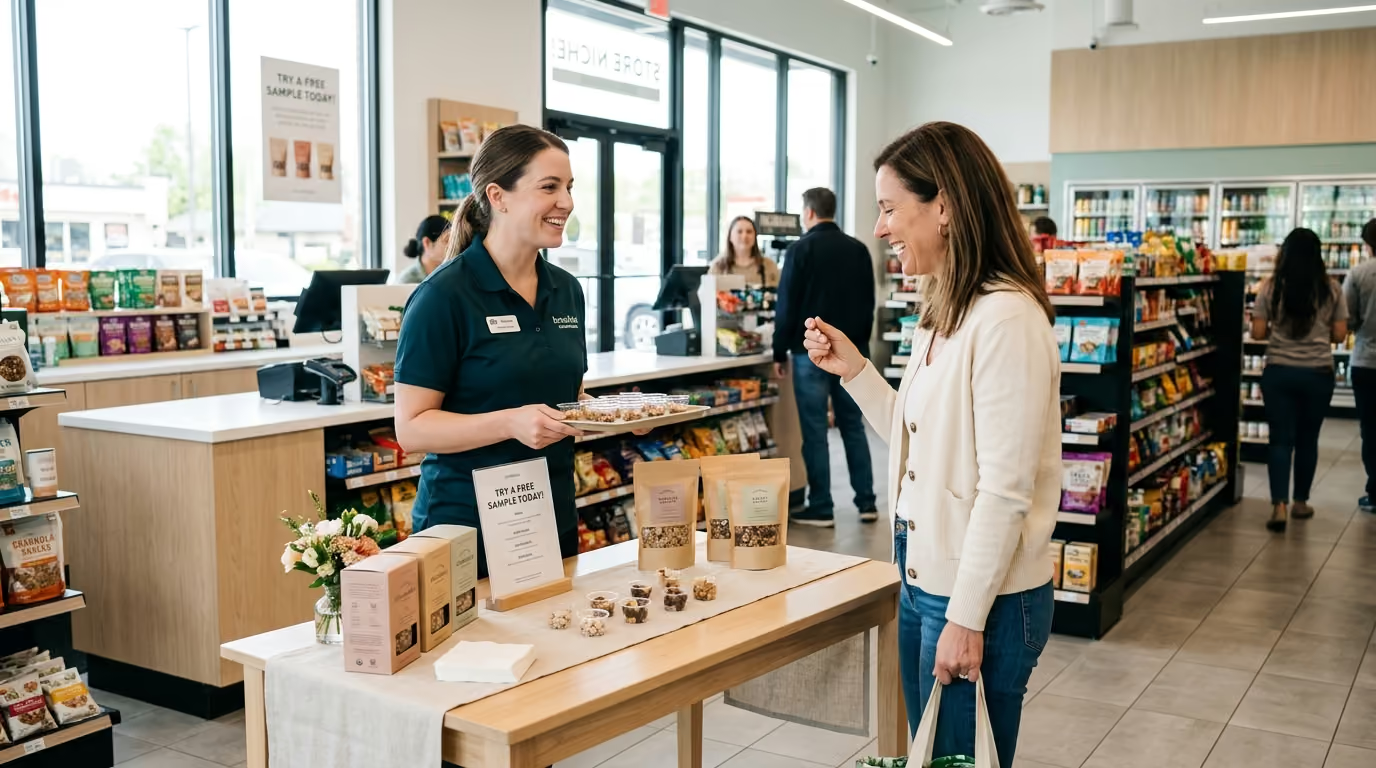
In the middle of the main power aisle stands a standard brand sampling table. Two brand ambassadors hand out identical two-ounce beverage cups to every person who passes. They repeat the exact same twelve-second script regardless of whether the shopper is sprinting, browsing, or managing children.
The hurried runner ignores the table completely. The mother avoids the activation entirely because the crowd around the table blocks her cart path. The weekend entertainer takes a cup, sips it, but receives zero context about food pairings or serving suggestions before moving on without buying.
This scenario plays out thousands of times every weekend across retail stores nationwide. Brands invest significant capital into retail demonstrations and field marketing tours, yet they treat the sales floor as a homogeneous crowd. When field teams deploy a single, rigid interaction format, they fail to convert both the fast shopper who wants convenience and the deliberate shopper who wants education. The result is high product giveaway volume, low shelf conversion, congested store aisles, and frustrated store managers.
Shoppers do not enter a retail environment with uniform levels of attention, time, openness, or category knowledge. Research into retail shopping behavior shows that customers visit only a fraction of store departments during a typical trip. They inspect a tiny subset of available products, often making purchasing decisions in a matter of seconds.
Category affinities and basket data reveal distinct shopping missions. A mission is the practical and emotional objective governing a specific shopping trip or category visit. Identifying these missions allows brands to tailor physical engagement points rather than relying on one-size-fits-all product distribution.
To solve this systematically, our framework balances four operational variables:
The practical goal of the trip shapes customer receptivity. A shopper completing a planned stock-up trip values speed and frictionless validation. An exploratory shopper browsing for inspiration welcomes conversation, comparison, and storytelling.
High-density store aisles require rapid throughput, pre-portioned units, and immediate proximity to the shelf. Low-density specialty environments allow for guided tastings, structured education, and deeper objection handling.
The seconds or minutes a customer spends in a retail zone dictate the permissible complexity of the activation. Forcing a two-minute brand story into a ten-second transit zone guarantees operational friction.
Unfamiliar products require risk reduction and clear use-case demonstration. Highly familiar brands require novelty, line-extension excitement, or multipack trade-up rationale.
Applying this strategic approach requires an intentional architecture built from five distinct layers:
By designing field operations around this five-layer system, brands replace random giveaways with predictable retail velocity. Field marketing leads can review our guide on understanding shopper psychology and activation design to see how physical layout directly shapes consumer decision-making.
Shopper missions require distinct operational formats. When deploying field staff and physical fixtures, brand teams must align their setup to the six dominant shopper missions described below.
The urgent replenisher knows precisely what they need, moves rapidly through the store, and possesses minimal tolerance for interruption. Their attention span is narrow. Their purchase decisions are driven by stock availability, habit, immediate convenience, and clear pricing.
For this shopper, field teams must deploy a micro-activation format. The physical setup must allow pass-by trial without requiring the customer to stop their physical momentum.
Key execution rules for the urgent replenisher include:
The planned category evaluator enters the aisle intending to buy within the product category, but has not finalized their brand choice. They are actively comparing nutritional panels, package sizes, price points, and ingredients. They possess moderate dwell time and welcome relevant advice that simplifies their decision.
This mission requires a guided comparison activation. Rather than offering a passive sample, the brand ambassador acts as a knowledgeable category guide.
Key execution rules for the planned category evaluator include:
The discovery browser wanders the retail environment looking for inspiration, indulgence, or novelty. They have broader visual attention and an open schedule. Academic studies show that activating broad visual attention encourages consumers to explore physical store environments and increases unplanned purchases.
This shopper mission responds best to experiential tasting journeys, pairing bars, and immersive displays.
Key execution rules for the discovery browser include:
The occasion shopper is solving a specific event need. They are shopping for a weekend barbecue, a children's birthday party, a holiday dinner, or a weeknight meal solution. They think in terms of complete baskets rather than individual items.
This mission requires a solution bundle activation. The demo station should showcase how the product fits into a wider entertaining or meal scenario.
Key execution rules for the occasion shopper include:
The social shopper visits stores with partners, children, or friends. Decisions in this mission are shared, but attention is fragmented. Parents must manage children while evaluating products, making long lines or complex interactions an immediate deterrent.
This mission requires a multi-participant, low-friction setup.
Key execution rules for the social shopper include:
The brand loyal shopper already purchases the brand regularly. Standard brand awareness pitches are completely wasted on them. However, they represent the highest-converting audience for premium line extensions, new flavor launches, and larger pack formats.
This mission demands an innovation preview activation.
Key execution rules for the brand loyal shopper include:
Designing an effective retail engagement requires tuning physical operations to three operational variables: dwell time, store traffic velocity, and consumer product familiarity.
Dwell time defines the operational boundary of what field staff can accomplish. Brand teams must engineer their interaction scripts to match the physical dwell reality of the target retail zone.
This window occurs in checkout approaches, high-traffic perimeter aisles, and urban convenience stores.
This window is typical for center-store grocery aisles, club store endcaps, and mass-retail race tracks.
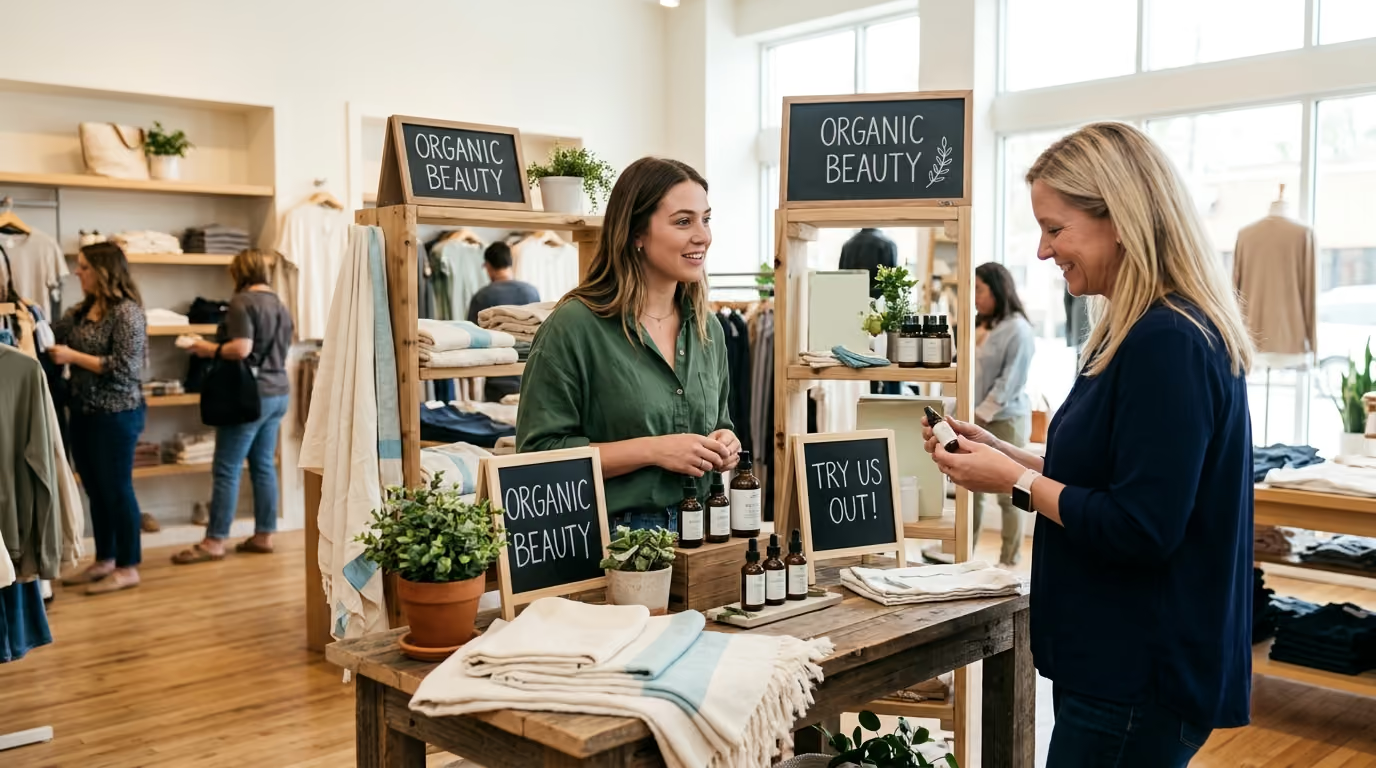
This window exists in natural grocery stores, specialty food halls, and premium beauty aisles.
This window applies to pop-up activations, flagship retail takeovers, and brand roadshows.
A activation layout that succeeds on a quiet Tuesday morning will cause total gridlock during a Saturday afternoon rush. Field operations must be engineered with dynamic capacity controls.
In low-traffic stores, foot traffic is sparse, but shoppers possess extended dwell time.
Moderate-traffic retail spaces offer the ideal balance between volume and engagement quality.
High-density store conditions demand strict crowd management and rapid throughput.
For national campaigns, aligning these staffing models across diverse retail partners requires a clear management framework. You can read our analysis on operating models for multi-market activations to standardize field quality across regions.
Consumer hesitation changes based on how well the shopper understands the category and brand. Field messaging must adapt accordingly.
When launching a novel category or innovative product format, the shopper's primary barrier is cognitive uncertainty. They do not know how the product fits into their daily routine.
When the category is established but the brand is unknown, the consumer barrier is habitual purchasing. Shoppers default to legacy market leaders out of comfort.
When an established brand introduces a new flavor, pack size, or functional variation, education is unnecessary. The goal is excitement and expansion.
Executing a mission-aligned retail campaign across regional or national store networks requires structured operational discipline. The following step-by-step playbook outlines the implementation process from planning through post-event reconciliation.
CPG teams scaling this across multiple regions can examine our guide on modular roadshow and trade show designs to build adaptable physical assets that thrive across varied store footprints.
Sampling is one of the most reliable sales-promotion mechanisms in retail marketing, but academic research highlights that trial does not automatically lead to commercial conversion. Understanding the underlying behavioral data ensures field teams invest in strategies that generate genuine sales lift rather than empty product giveaways.
A seminal study published in the Journal of Advertising Research demonstrated that while sample acceptance rates are routinely high across demographic segments, direct conversion and purchase rates are substantially lower.
The researchers discovered that sampling exerts almost no lasting influence on consumer purchasing unless the recipient actively uses the sample, perceives a clear personal benefit, and connects that experience directly to a purchase occasion. Handing out hundreds of samples to untargeted passersby generates high operational activity, but minimal economic value. High Return on Investment requires targeting qualified shoppers whose current mission aligns with the product.
Research published in the Journal of Consumer Research examined how visual attention breadth influences in-store exploration and unplanned buying. The authors found that when retail environments stimulate broad visual attention, consumers explore a significantly wider variety of store aisles and inspect more products.
This exploration directly increases unplanned purchasing. For retail activation designers, this proves that visually dynamic discovery stations do not merely sell the sampled product. They activate an open mindset that increases basket size across adjacent merchandise categories.
A comprehensive retail study published in the Journal of Retailing analyzed the long-term sales effects of in-store product demonstrations. The research confirmed that sampling generates immediate sales lift during the event, but also identified substantial carryover effects over four-week and eight-week post-event windows.
Crucially, the researchers found that repeating sampling activations in the same store creates a compounding, multiplicative effect on long-term sales velocity. Single, isolated demonstrations produce temporary spikes that fade quickly. Structured campaigns that revisit retail locations establish permanent baseline gains by converting trial consumers into habitual repeat purchasers.
Academic analysis summarized by the Wisconsin School of Business revealed that in-store sampling frequently expands total category sales rather than merely cannibalizing existing competing brands. When a brand introduces an engaging demonstration, it draws dormant category consumers back into active purchasing.
However, research in the Journal of Retailing and Consumer Services shows that sampling can also boost sales of competing products within the same aisle if the focal brand suffers from inventory stockouts or pricing friction. If a shopper is inspired to enter a category through trial, but cannot find the featured item on the shelf, they will readily purchase a competitor product sitting next to it. Flawless on-shelf stock coordination is mandatory.
For a deeper look at closing retail attribution gaps, read our breakdown on fixing fragmented retail execution.
To evaluate field activations accurately, marketing leaders must separate vanity engagement numbers from verifiable retail performance metrics. Tracking both lead and lag indicators across a structured funnel enables clear reporting to retail partners and internal finance stakeholders.
Lead metrics evaluate operational execution quality, audience targeting accuracy, and on-floor engagement efficiency during the live activation.
Lag metrics measure commercial conversion, revenue generation, retailer category health, and long-term Return on Investment.
Brand teams should use standard formulas to evaluate activation performance across territories:
To ensure data integrity, field teams must evaluate these metrics against control groups. Compare activated retail locations against matched control stores in the same market that share similar shopper demographics, foot traffic density, and historical base sales, but received no activation support. Learn more about establishing accurate control groups in our guide on measuring retail sales lift and attribution.
A national premium plant-based dip brand faced plateauing velocity across 140 regional supermarket locations. Despite strong distribution and endcap positioning, retail scan data showed that mainstream grocery shoppers hesitated to purchase due to unfamiliarity with plant-based dairy substitutes.
In our experience managing high-volume retail demos and product sampling programs, overcoming this hesitation requires matching the activation directly to the shopper's current occasion. We designed a dual-track activation strategy focused on two distinct shopper missions: weekday meal planners and weekend entertainers.
Rather than deploying standard dry crackers and plastic sample cups, our team structured the activation around complete occasion solutions.
For Tuesday through Thursday deployments, the station targeted busy afternoon meal planners. Brand ambassadors sampled the dip warm over roasted vegetables and grain bowls, presenting the product as an instant five-minute dinner sauce. Messaging focused strictly on speed, clean ingredients, and ease of preparation.
For Saturday and Sunday deployments, the activation shifted to party entertaining. The station featured a complete party board showcasing the dip alongside artisanal chips, fresh crudites, and sparkling beverages. Ambassadors engaged shoppers with quick entertaining tips and portion recommendations for hosting groups.
By aligning preparation formats and conversational messaging with shopper missions, the campaign delivered exceptional commercial outcomes across the 140-store network:
Even well-funded field campaigns can fail if basic operational realities are neglected. Brand managers must actively guard against these common execution mistakes.
Setting up a large footprint in a narrow power aisle creates severe customer bottlenecks. Rushed shoppers become irritated, store managers issue reprimands, and overall aisle sales decline.
Evaluating brand ambassadors solely on how many sample cups they hand out encourages indiscriminate distribution. Staff end up handing samples to children or hurried passersby who have zero purchase intent.
Driving high trial interest is completely pointless if the retail shelf runs out of stock forty minutes into a four-hour activation. Unstocked shelves send frustrated shoppers directly to competing brands.
Ambassadors who recite a memorized sixty-second brand history alienate shoppers. Customers want to know how the product tastes and how it solves their immediate need, not hear corporate positioning statements.
A messy sampling station featuring dirty prep surfaces, overflowing trash cans, or warm beverage containers destroys brand credibility in seconds.
Specialty product categories and unique retail formats require custom operational safeguards to ensure safety, regulatory compliance, and seamless execution.
Activations involving common allergens like nuts, dairy, soy, or gluten require rigorous controls.
Certain products cannot be sampled out of a cold package and require heating, baking, or blending.
Supplements, functional wellness beverages, and personal care products do not provide immediate sensory payoff. A consumer cannot feel the benefit of a joint supplement in a thirty-second tasting.
Urban convenience and micro-retail stores possess narrow aisles, extremely high traffic velocity, and zero room for standard six-foot banquet tables.
Field marketing leads can use this structured checklist to align operational planning before deploying field teams to retail:
Revisit this framework whenever your brand prepares to launch a new product line, expands distribution into a new retail channel, experiences plateauing in-store sales velocity, or designs an annual field marketing tour.
Designing physical retail activations around distinct shopper missions transforms product sampling from an unpredictable expense into a reliable, repeatable engine for retail growth.

30 Years Experiential & Retail Activation Partner for CPG & Beverage Brands | Multi-Market Demos, Roadshows & Costco/Club Programs That Actually Sell