Robbie Thain
Founder, CEO

Three operational layers help national mobile tours maintain experiential consistency, unified messaging, and regulatory compliance across diverse live.

A national sampling tour is not a single promotional event repeated in several cities. It is a distributed operating system where a centrally defined brand experience must be reproduced by different staff, vehicles, venues, and local conditions without losing its core identity. This guide provides brand leaders with an operational framework to maintain visual, experiential, and regulatory consistency across dozens of markets while managing unavoidable field exceptions. By implementing a three-tier operating model, standardized quality audits, and clear decision rights, marketing teams can protect brand integrity and turn real-world interactions into measurable commercial pipeline.
Every multi-city experiential campaign faces the challenge of distributed human execution. When an activation travels from Atlanta to Denver and Seattle, local realities constantly threaten brand standards. The difference between a high-performing tour and a disjointed brand presence lies in whether you standardize your entire experience architecture or merely distribute a static deck of creative guidelines.
The reality of a live activation floor is chaotic, unpredictable, and physically demanding. In a crowded festival lot or retail parking zone, a local field team unloads heavy flight cases under heavy rain, competing for space against adjacent vendors and navigating unexpected venue restrictions. Generators can fail, regional health inspectors can arrive unannounced with conflicting interpretations of temporary handwashing guidelines, and part-time brand ambassadors may show up thirty minutes late without the proper uniform layers. Under the stress of live crowds, field staff naturally default to the path of least resistance.
When friction peaks, staff often abandon scripted key messages in favor of casual banter. They may serve unmeasured portions to clear long lines or arrange visual assets haphazardly to fit into awkward physical footprints. A banner placed backward, a warm beverage served instead of an ice-cold sample, or an unapproved nutritional claim spoken to a customer can quietly derail months of strategy. When multiple markets operate simultaneously, these small localized compromises compound into significant brand drift.
The central management problem is not that field teams lack motivation. Rather, central marketing teams frequently give them impossible mandates by treating consistency as visual perfection instead of operational discipline. When local operators lack pre-approved contingency plans, they are forced to improvise in real time. The resulting execution looks fragmented to consumers and produces incompatible performance data for corporate stakeholders.
In our experience managing live consumer programs since 1995, unaddressed operational ambiguity is the primary root cause of field failure. When rules are vague, every city manager invents their own operating standards. Over three decades of national field work, our team has learned that maintaining brand control requires building structured systems that absorb live disruptions without breaking the brand promise.
Brand consistency is an operational, financial, and legal discipline. Marketers often treat brand identity purely as an aesthetic exercise overseen by creative teams. In a multi-city mobile tour, however, execution consistency directly dictates data integrity, legal compliance, and customer conversion.
The International Organization for Standardization outlines the core mechanics of brand evaluation in ISO 20671. This standard establishes that brand value depends on evaluating inputs, outputs, and sample indicators through consistent, repeatable methods over time. When applied to field marketing, the standard demonstrates that your field data is only as reliable as your execution consistency. If a field team in Dallas records an engagement as a completed three-minute product demonstration while a team in Chicago records an engagement as a quick handed-out sample to a passerby, your national dataset becomes statistically useless.
The commercial impact of physical trial is well documented across the experiential industry. According to industry research published in the EventTrack executive summary from the Event Marketing Institute, 85 percent of consumers indicate they are likely to purchase a product after participating in live brand experiences. Furthermore, over 90 percent of participants report feeling more positive about a brand after engaging in person. These high conversion and sentiment figures only materialize when the live interaction delivers on the brand promise accurately. A poorly executed sample, served at the wrong temperature or paired with inaccurate product claims, creates the opposite effect by eroding consumer trust at the point of trial.
To maintain comparable results across cities, organizations must adopt standard definitions supported by industry bodies like the Experiential Marketing Measurement Coalition. Every consumer who encounters the mobile tour must experience the same essential value proposition, visual hierarchy, safety protocols, and calls to action. Standardizing these operational dimensions allows executives to calculate an accurate Return on Investment across markets.
Managing a multi-city activation requires dividing operational authority into three distinct, interconnected layers. When organizations fail to separate strategic ownership from local operational authority, decision-making stalls and field execution collapses.
The central brand team or lead marketing agency owns the strategic foundation. This layer defines the strategic boundaries that govern all public expressions of the product.
Key responsibilities within the central brand system include:
The experiential agency or touring production team operates as the operational bridge between central brand leadership and live field markets. This layer translates strategic rules into practical tools, logistical schedules, and repeatable field processes.
Key responsibilities within the tour production system include:
To scale programs successfully across multiple territories, many organizations partner with dedicated mobile sampling tour services to manage these complex logistical and production workflows.
The local execution system belongs to market managers, field leads, and local brand ambassadors. This layer is responsible for day-to-day tactical execution on the ground within pre-approved parameters.
Key responsibilities within the local execution system include:
Each layer must have clear decision rights. Local teams should never be forced to make strategic brand choices under pressure, and central brand directors should not be bogged down approving minor physical adjustments on site.
A distributed tour cannot function if field teams rely on outdated PDF attachments, messy email threads, or fragmented cloud folders. The entire tour ecosystem must access a single, version-controlled digital repository that serves as the definitive reference for all operational standards.
The repository must host direct downloads of production-ready vector logo files, approved color palettes with exact PMS values, and clear typography rules. It must detail minimum clear space requirements, approved co-branding guidelines for retail partners, and explicit examples of prohibited asset configurations. High-resolution product packaging renders and approved lifestyle imagery must be organized by stock-keeping unit. This structure ensures field staff never rely on low-resolution graphics downloaded from web searches.
This section documents the step-by-step consumer journey across every approved activation format. It contains full interaction scripts, mandatory opening lines, approved product benefit statements, and clear closing calls to action. It defines exact sample preparation procedures, approved glassware or sampling vessels, portion sizes, and napkin presentation methods. Digital engagement mechanics, including QR code destinations, contest landing pages, and point-of-sale locator links, must be documented alongside accessibility standards for guests with physical limitations.
Local teams require explicit physical instructions to execute daily operations safely and efficiently. The repository must house step-by-step setup diagrams, pack-out schematics, vehicle parking parameters, and electrical power load calculations. It must detail sanitation schedules, inventory storage protocols, trash disposal procedures, and end-of-shift site restoration checklists. An updated emergency contact sheet with clear phone numbers for production leads, brand directors, and insurance underwriters must remain permanently pinned at the top level.
All mandatory regulatory documentation must be accessible instantly on mobile devices during field inspections. This folder contains approved food handling standard operating procedures, allergen declaration sheets, certificates of insurance, and copies of secured municipal permits. It must host standardized incident report forms, consumer injury logging templates, data privacy consent disclaimers, and a tiered issue escalation matrix.
To preserve national data integrity, the repository must include a standardized data dictionary. This document defines the exact boundaries of terms like consumer reach, product trials, qualified leads, and brand interactions. It must include links to daily digital reporting forms, mandatory shift photo submission portals, mystery shopping scorecards, and consumer survey questionnaires.
One central operations manager must own this repository. When changes occur, the manager must log the revision date, archive obsolete versions, and push an update alert across all regional communication channels.
A field execution playbook is not a high-level brand strategy deck. It is an operational manual designed for a field lead or brand ambassador working under physical time constraints. To be effective, the playbook must translate abstract brand ideas into concrete physical actions.
Field ambassadors cannot memorize complex corporate scripts while managing fast-moving lines. The playbook must organize verbal messaging into three clear tiers:
Staff must know exactly what claims are legally prohibited. For instance, staff must never promise health outcomes, weight loss benefits, or medical cures when discussing food and beverage products.
The playbook must map the customer experience into discrete, measurable phases that remain consistent across every footprint size:
Written rules leave too much room for subjective interpretation by third-party field agencies. Every visual rule in the playbook must feature side-by-side photographic examples of correct and incorrect execution.
Each visual standard must state the underlying reason for the rule. When field ambassadors understand that misaligned product displays reduce visual recognition from a distance, they are far more likely to maintain the standard throughout an eight-hour shift.
Building this level of operational discipline into daily workflows prevents common multi-stop brand tour pitfalls that typically undermine national experiential campaigns.
Executing a national food or beverage sampling tour introduces serious regulatory complexity. A common misconception among marketing teams is that distributing small sample portions exempts an activation from local health codes. In reality, municipal and county health departments across the United States enforce strict, varied regulations based on the FDA Model Food Code.
Local health inspectors possess legal authority to shut down unpermitted or non-compliant activations immediately. In Chester County, Pennsylvania, for example, local health guidelines require pre-approval for all temporary food sampling or cooking demonstrations. The department enforces strict adherence to the FDA Model Food Code, requiring dedicated handwashing stations with running potable water, soap, and single-use towels wherever food is handled. The same guidance mandates that foods requiring temperature control for safety must remain at or below 41 degrees Fahrenheit for cold holding, or at or above 135 degrees Fahrenheit for hot holding. Furthermore, food samples are strictly restricted to one ounce or less, while beverage portions cannot exceed two ounces.
Similarly, regulatory agencies in Monroe County, New York, require official temporary food service permits for any sampling involving temperature-controlled items, alongside on-site documentation for shelf-stable goods. In Fairfax County, Virginia, health regulations dictate that all food must originate from commercially approved sources. Produce must be washed under continuous running potable water before cutting, and self-contained handwashing facilities must collect wastewater safely without ground discharge.
To safeguard consumer health and avoid costly operational shutdowns, every national tour must maintain a rigorous sampling standard operating procedure:
When developing complex multi-market programs, deploying a structured field execution playbook helps maintain continuous compliance across diverse regulatory environments.
Quality assurance cannot be treated as a post-campaign review. It must function as an active, daily monitoring mechanism capable of identifying and correcting execution drift in real time.
A fundamental management mistake is conflating foot traffic with execution quality. A disorganized footprint at a major sports stadium can easily distribute thousands of samples due to sheer crowd volume, despite staff butchering key messaging and leaving trash on the counter. Conversely, an immaculate activation on a rainy Tuesday may achieve flawless execution scores despite missing sample distribution targets.
Track these dimensions independently on daily scorecards:
Scores falling between 90 and 100 receive a Green rating. Scores between 75 and 89 trigger an Amber warning, requiring corrective actions before the next shift. Any score below 75 earns a Red rating, initiating an immediate operational review and potential suspension of live service.
To maintain staff alignment across multiple markets, brand leaders must invest in comprehensive field staff training programs before dispatching teams into live environments.
No national tour runs from start to finish without encountering operational friction. Vehicles experience mechanical failures, extreme weather forces sudden layout changes, and local supply chains run out of primary sampling materials. Standardizing execution does not mean banning adjustments; it means pre-programming how field teams respond to disruptions.
When an asset or consumable item becomes unavailable in the field, teams must not improvise with unapproved retail substitutes. The playbook must include a clear substitution schedule:
Every approved exception must be documented in a central cloud log within two hours of occurrence. The record must capture the exact date, market location, nature of the issue, authorized decision-maker, chosen substitution, and root cause. At the end of each tour wave, production leadership reviews this log to identify recurring equipment failures, problematic supply vendors, or ambiguous playbook instructions. This practice transforms daily operational headaches into structured institutional learning.
To justify multi-market experiential budgets, brand directors must prove clear commercial impact. Demonstrating a tangible Return on Investment requires establishing consistent measurement methodologies across every stop of the campaign.
Lead metrics track whether the field engine is operating efficiently and adhering to brand standards. These indicators are captured daily by field leads and regional auditors:
Lag metrics quantify the business results generated by real-world consumer trial. These data points demonstrate whether physical brand experiences move consumers along the path to purchase:
Establishing rigorous tracking mechanisms for these metrics is central to measuring field sampling Return on Investment across complex retail and experiential landscapes.
A leading national plant-based snack brand prepared to launch a multi-city mobile tour spanning twenty-two major metropolitan markets over six months. The campaign aimed to drive trial for a new line of extruded savory snacks while supporting new distribution gains across regional grocery chains. In previous years, the brand had struggled with fragmented field execution. Third-party staffing agencies in different markets had altered product messaging, ignored visual footprint standards, and submitted inconsistent daily reports that made national performance analysis impossible.
To resolve these challenges, the brand partnered with an experienced experiential operations team to build a centralized brand execution system before launching the tour.
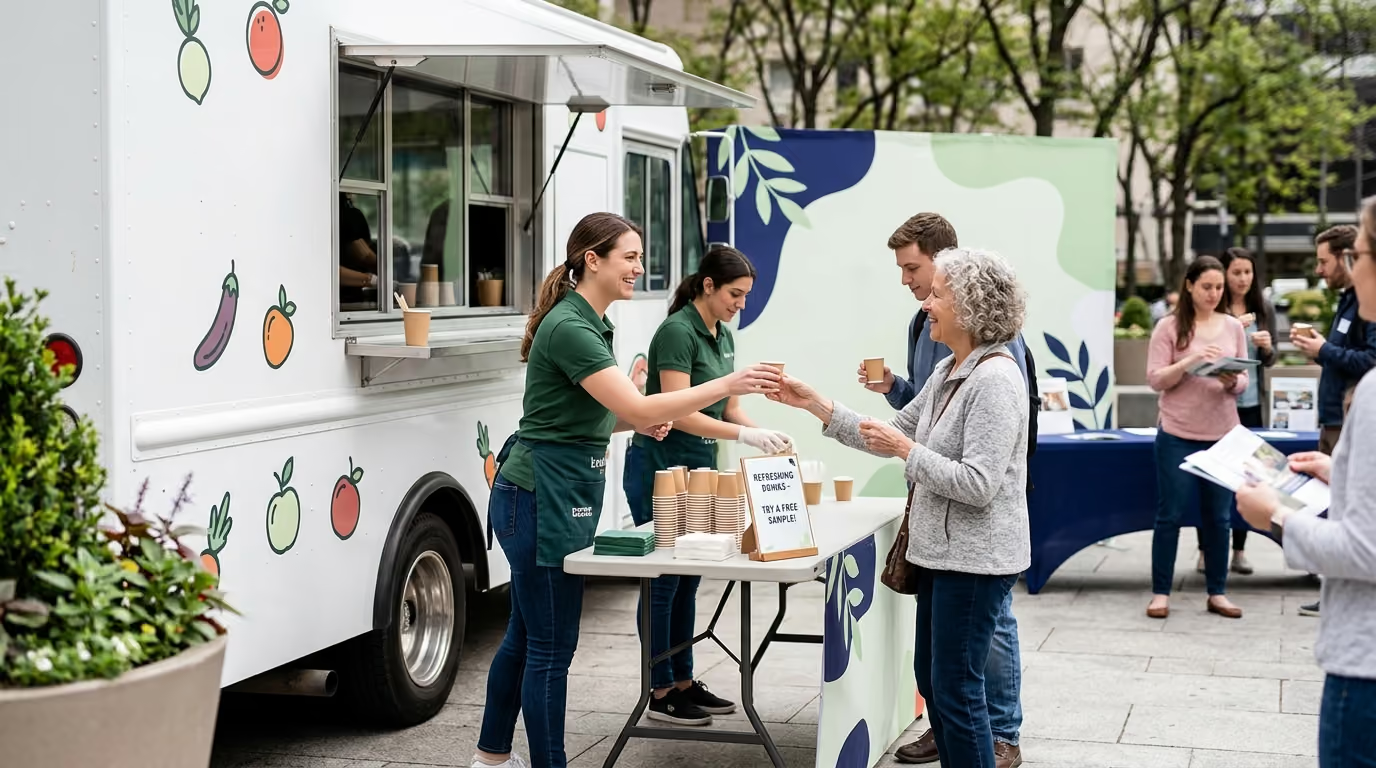
The team developed a modular footprint architecture consisting of three pre-approved layouts: a full vehicle activation for major community festivals, a compact canopy footprint for urban street settings, and a self-contained mobile cart configuration for high-traffic retail parking lots. Every footprint variant preserved the identical Tier 1 visual identity, product portioning standards, and seven-stage consumer journey.
All field staff completed a mandatory live certification program. Rather than simply reviewing slide presentations, ambassadors participated in practical role-playing exercises, practiced sanitary portioning techniques, and completed emergency scenario drills. Regional quality managers conducted unannounced Level 2 audits twice weekly, scoring execution against a strict 100-point rubric.
Over twenty-six weeks of live operations, the standardized tour delivered exceptional operational and commercial results:
By standardizing operational systems, training regimens, and quality auditing, the brand proved that high-touch experiential activations can scale nationally without sacrificing brand consistency or data integrity.
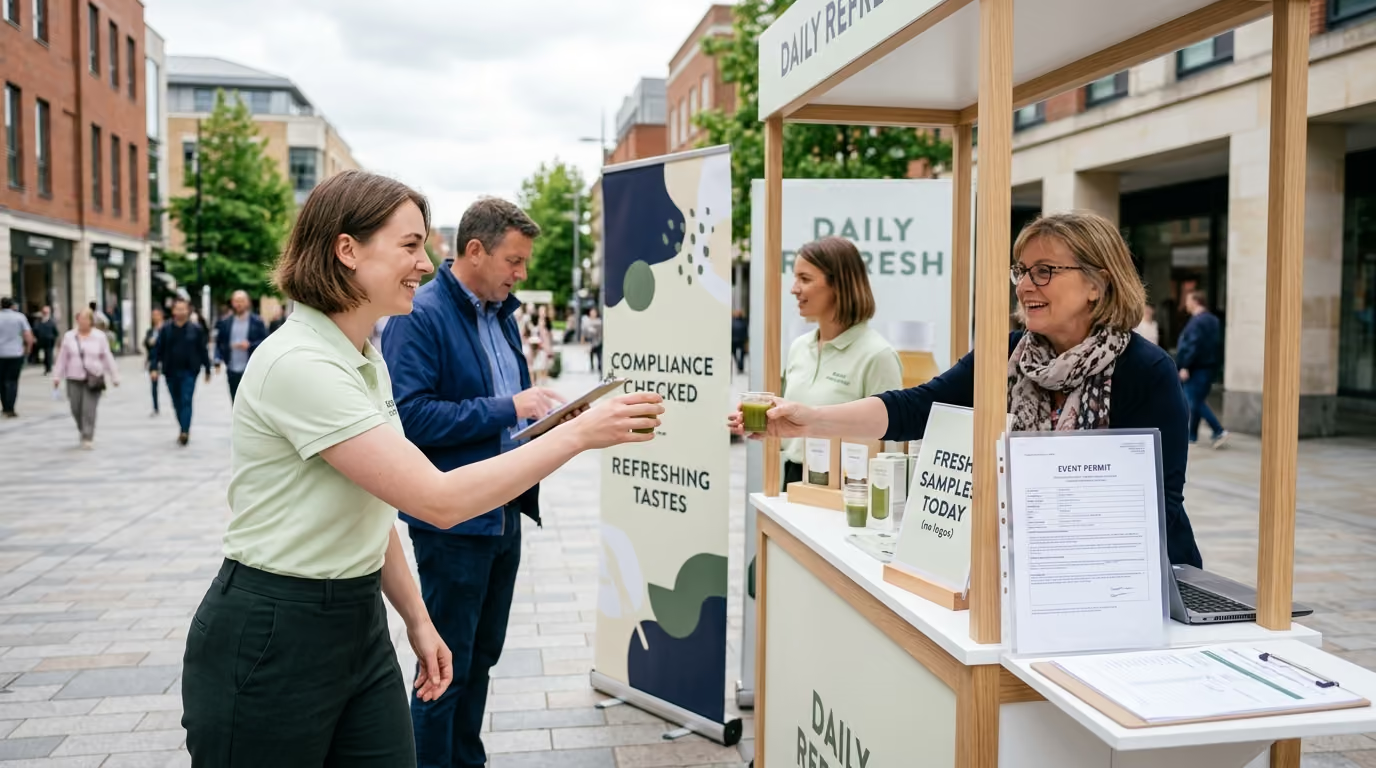
Every footprint must maintain a physical, water-resistant compliance binder alongside an electronic repository on team tablets. This binder contains copies of local temporary food permits, vendor business licenses, commercial commissary agreements, product supplier invoices, staff food handler certifications, and daily holding temperature logs. When an inspector arrives, the team lead steps forward immediately, introduces themselves calmly, and presents the binder. Staff pause active food service if requested, allowing the inspector to inspect handwashing facilities, sanitizing solutions, and cold storage units without interference.
Staff messaging drift is prevented by implementing brief, mandatory shift-start huddles and simplifying verbal expectations. Rather than forcing brand ambassadors to memorize lengthy marketing paragraphs, train them on a single Tier 1 core sentence and three modular proof points. Team leads must conduct quick role-playing warmups during the morning huddle, testing staff on objection handling and claim restrictions. Additionally, factoring message delivery into unannounced audits keeps teams focused on verbal precision throughout long shifts.
The master playbook must outline pre-approved weather contingency protocols triggered by specific physical thresholds. If sustained winds exceed thirty miles per hour, overhead canopies, hanging banners, and vertical feather flags must be struck immediately to protect guest safety. In the event of heavy rain or lightning, the team activates an approved indoor fallback layout or transitions to a mobile sampling cart format under permanent venue overhangs. Field leads must log the operational format change in the daily reporting app, noting the weather trigger and the exact duration of the modified setup.

30 Years Experiential & Retail Activation Partner for CPG & Beverage Brands | Multi-Market Demos, Roadshows & Costco/Club Programs That Actually Sell