Robbie Thain
Founder, CEO

Shoppers facing premium retail decisions require evidence-based product demonstrations that resolve functional, economic.
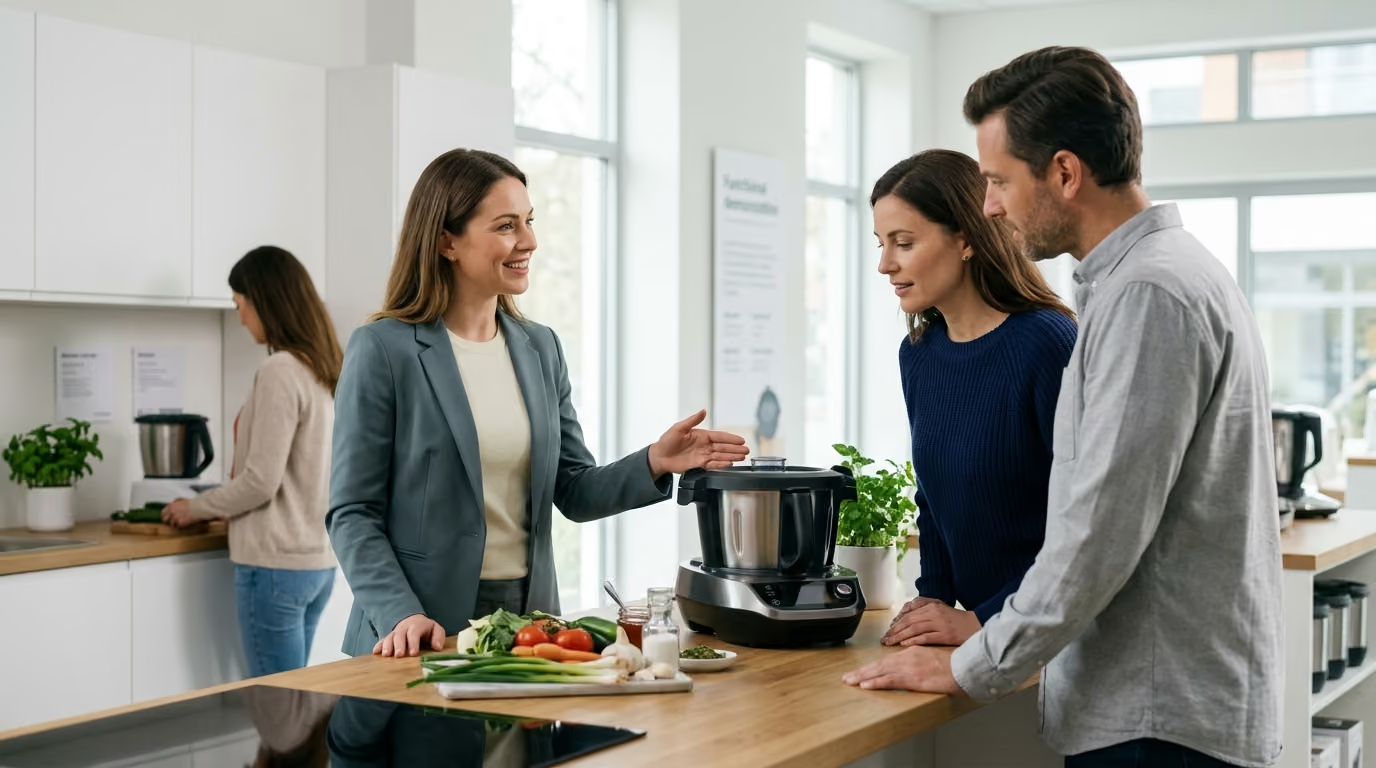
A high-consideration product demonstration serves as a structured evaluation system designed to lower perceived consumer risk and clarify complex purchasing trade-offs. Brands that replace aggressive sales theater with objective proof mechanisms generate measurable immediate trial alongside sustained long-term retail velocity.
A shopper stands in front of an appliance display, holding a smartphone in one hand and staring at three competing premium blenders. A demonstrator approaches, starts reciting motor wattage numbers from a memorized spec sheet, and offers a generic cup of mixed berries. The shopper glances down at their phone screen, nods politely, and walks away to read third-party forum reviews in the parking lot. This scenario repeats across retail floors daily because traditional product sampling models fail when buyers face high-friction, high-consideration decisions.
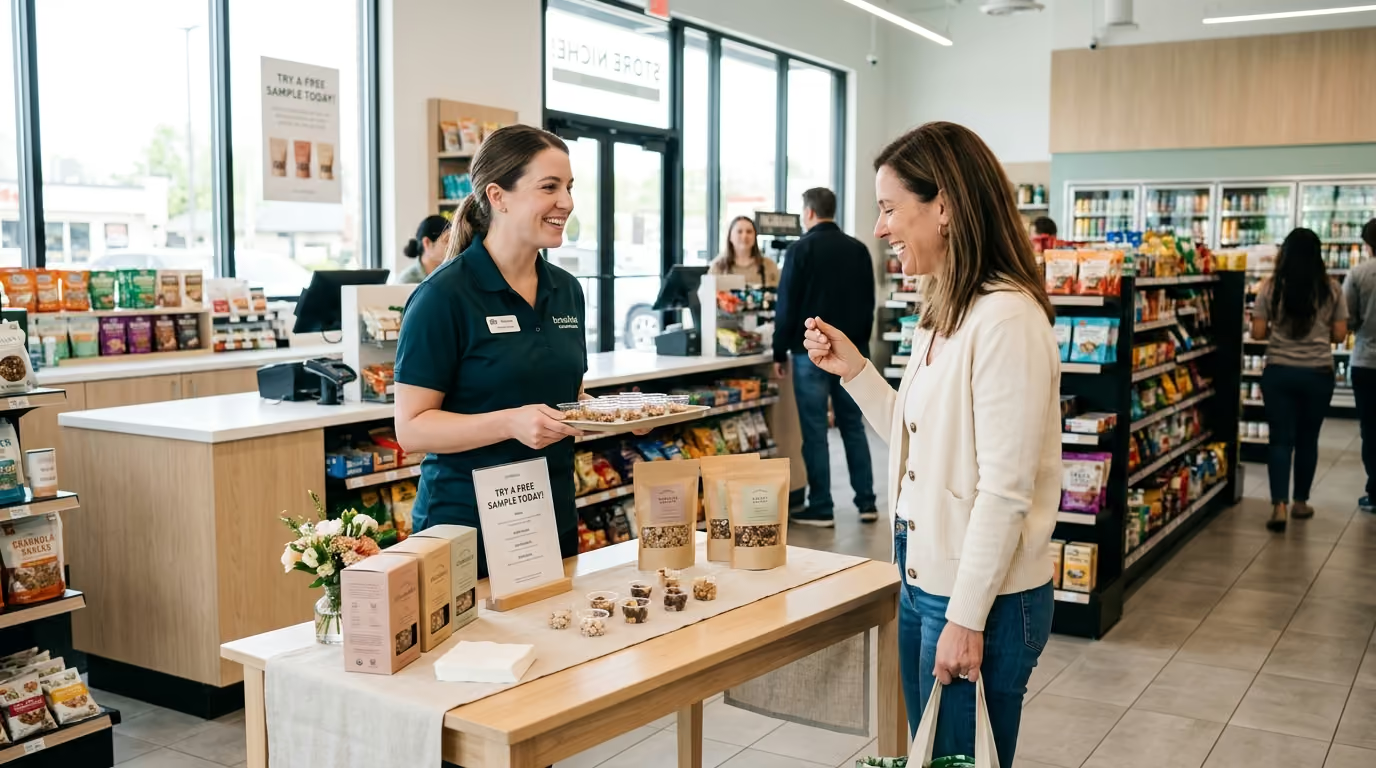
In standard fast-moving consumer goods, sampling functions primarily as an impulse trigger. A shopper tastes a chip, experiences immediate sensory gratification, and drops a four-dollar bag into their physical cart.
High-consideration retail operates under an entirely different psychological reality. When perceived financial, functional, or personal risk escalates, shoppers do not make impulse decisions based on basic exposure. They enter what Google researchers identify as the "messy middle," an active space of evaluation and comparison where consumers loop between exploring options and evaluating specific attributes.
Google research notes that eight in ten online purchase journeys involve multiple touchpoints across digital spaces and physical stores. Furthermore, Google identifies critical "which-one-is-best" moments where shoppers actively seek out specifications, trusted reviews, and price-value validations before committing funds.
High-consideration categories extend far beyond high-ticket consumer electronics or major home appliances. A forty-dollar functional wellness tincture, a specialized organic baby formula, a clean-ingredient skincare serum, or an artisanal olive oil all represent high-consideration purchases. In each case, the consumer worries about efficacy, physical tolerance, routine compatibility, and whether the premium price tag translates into demonstrable value.
When field teams execute demonstrations in these retail environments, standard promotional pitches create friction. Shoppers already feel overwhelmed by technical jargon and contradictory claims. Demonstrations must therefore shift from promotional performance to decision-support systems that deliver concrete, observable proof.
Understanding this dynamic requires defining the core concepts that govern high-consideration activations:
A live or guided physical experience where a prospective buyer handles, tests, compares, configures, or observes a product in action. The sole objective is turning an abstract marketing claim into an observable, verified reality.
A specialized form of demonstration where a consumer receives a physical trial portion or direct personal application of a product. In high-consideration categories, sampling answers critical pre-purchase functional questions rather than acting as a simple free handout.
Purchasing environments characterized by elevated consumer friction. This friction stems from premium pricing, technical complexity, potential health or safety implications, or heavy post-purchase dissatisfaction risk.
A deliberate consumer interaction where a prospective buyer engages with the product's primary value proposition. This interaction must be substantive enough to resolve their primary buying doubt.
The proportion of qualified demonstration participants who complete an immediate or directly attributable purchase. It is calculated by dividing attributable buyer counts by total qualified participants, expressed as a percentage.
The net unit or revenue increase generated within an activated retail location relative to a verified, un-activated baseline control group over an identical time horizon.
The measurable secondary sales volume generated across non-demonstrated stock-keeping units within the parent brand portfolio, sparked by the focal product's live demonstration.
The net growth of total retail category sales resulting from an activation that brings entirely new buyers into the segment, rather than simply cannibalizing existing competitor volume.
High-consideration shoppers do not walk retail aisles looking for entertainment. They enter stores seeking risk mitigation, validation, and clarity.
Research published by Google and The Behavioural Architects demonstrates that consumer decision-making relies heavily on behavioral heuristics during active consideration. Specifically, buyers lean on authority bias, social proof, and simplified category heuristics to escape analysis paralysis. A well-designed live demonstration operationalizes these exact behavioral mechanisms right at the retail shelf.
Every high-consideration purchase decision involves a dominant point of consumer hesitation. Field marketers must identify this specific doubt before planning booth layouts or scripts.
Functional doubt centers on basic efficacy: "Will this product actually solve my specific problem?" A skincare buyer wonders if a barrier cream absorbs without greasy residue. A home chef wonders if an induction cooktop maintains a low simmer without scorching delicate sauces. Demonstrations resolve functional doubt by staging clear before-and-after tests or controlled operational tasks that isolate the product's core utility.
Economic doubt questions the price-to-value relationship: "Does this premium formulation justify twice the cost of the standard option?" Simply repeating that ingredients are premium fails to persuade analytical shoppers. Demonstrations resolve economic doubt by visualizing total cost-per-use, concentrated serving efficiencies, durability metrics, or long-term operational savings.
Compatibility doubt revolves around ecosystem fit: "Will this supplement interact poorly with my existing wellness routine?" or "Does this attachment fit my existing kitchen appliance base?" Field representatives eliminate this friction by conducting personalized diagnostic intake questions before introducing product trials.
Sensory doubt involves direct human experience: texture, scent, acoustic output, weight distribution, and tactile feedback. Packaging cannot communicate how a vacuum cleaner handles around tight corners or how a premium beverage finishes on the palate. Physical trial provides unassailable sensory data that no digital review can replicate.
To explore how these psychological principles translate into operational store layouts, review our guide on optimizing retail engagement through shopper psychology.
Designing an effective retail demonstration requires a disciplined six-stage methodology. Teams must avoid jumping straight to aesthetic choices or promotional scripting.
Begin by identifying the exact commercial behavior the activation must alter. Are you attempting to switch loyal users away from an established market leader? Are you introducing an unfamiliar product format that requires consumer education? Are you upselling existing brand buyers from a core line to an ultra-premium tier? Each commercial objective requires distinct proof points and engagement timing.
Construct a comprehensive doubt matrix for the target retail environment. Interview retail store associates, analyze digital product returns, review customer service tickets, and read three-star online reviews. Group consumer hesitation into functional, economic, sensory, or operational buckets, then isolate the single largest barrier to purchase.
Select the operational demonstration format tailored to your primary doubt:
Design the demonstration to deliver incontrovertible proof in under ninety seconds. Lengthy technical explanations induce cognitive fatigue and cause retail shoppers to disengage. The proof must be immediate, visible, and self-evident. If demonstrating a plant-based protein powder, do not spend five minutes explaining cold-filtration manufacturing. Instead, shake the product in cold water for five seconds to prove complete solubility without clumping, then offer an immediate taste trial.
Passive observation yields weak consumer recall and low purchase commitment. The shopper must become an active participant in the evaluation process. Place the applicator, measuring tool, or control interface directly into the consumer's hands. When the shopper executes the test themselves, psychological ownership forms, and skepticism toward promotional staging drops dramatically.
Never separate the physical trial location from immediate product inventory. If a shopper must walk three aisles over to locate the demonstrated item, conversion rates plummet. Position sellable stock immediately adjacent to the activation table, clearly display current retail pricing, ensure promotional discounts ring correctly at checkout, and provide physical takeaway bridges for shoppers who require extended consideration.
To build structured launch programs that incorporate these steps, consult our comprehensive resource on building retail product launch activations.
Flawless execution requires translating strategic frameworks into disciplined retail floor habits. Our team regularly coordinates live sampling tours and retail demonstrations across regional and national retail footprints. In our experience, operational consistency separates high-converting activations from expensive, noisy brand theater.
Use this operational sequence to manage live retail demonstrations:
To prepare field teams for high-traffic environments, utilize our standardized retail demo and event checklist to verify all operational parameters prior to floor launch.
The business case for structured in-store product demonstrations rests on rigorous empirical retail research rather than vanity metrics.
Research published in the Journal of Retailing by Chandukala, Dotson, and Liu analyzed six distinct store-level scanner datasets across multiple consumer packaged goods categories. The researchers found that structured in-store sampling generates substantial immediate sales lifts alongside persistent long-term volume gains. Notably, the study revealed that executing repeated sampling sessions within the same retail doors generated a multiplicative increase in sustained product sales performance.
A comprehensive retail industry analysis published by Retail TouchPoints evaluated multi-category sampling programs, revealing substantial immediate and extended baseline improvements:
These findings demonstrate that demonstrations should not be evaluated as single-day transactional events. High-consideration products frequently involve extended buying cycles. A shopper who experiences a compelling functional demonstration may wait two weeks, discuss the purchase with a spouse, and return to the store to execute the transaction.
However, retail brands must monitor commercial efficiency rigorously. A widely cited benchmark derived from the Journal of Retailing research indicates that sampling programs often become unprofitable when the fully loaded cost of an activation exceeds fifteen times the retail unit price.
While this rule of thumb provides a useful baseline for standard grocery items, high-consideration brands must evaluate margins holistically. Premium wellness, consumer technology, and personal care brands operate with higher gross margins, substantial customer lifetime values, and consistent subscription or accessory attachment rates.
Furthermore, field marketers must understand competitive market dynamics. Research documented in the Academy of Marketing Studies Journal demonstrates that in-store sampling initiatives exert significant demand effects on both focal brands and direct category competitors.
Because live sampling raises general consumer interest in an entire product class, a poorly differentiated demonstration can educate a shopper on their needs only for that shopper to purchase an adjacent competitor on the shelf. The demonstration must therefore explicitly link product proof to unique, proprietary brand advantages.
For additional insight into structuring high-converting sampling campaigns, explore the complete guide to retail product sampling programs.
A product demonstration is only as effective as the field representative managing the floor. In high-consideration retail, aggressive promoters destroy credibility. Brands require consultative product specialists who embody both interpersonal warmth and strict operational discipline.
To dive deeper into the behavioral dynamics of representative selection, read our analysis on balancing warmth, competence, and operational discipline in retail demonstrations.
Field personnel must be trained to recognize and adapt to distinct shopper profiles instantly:
This shopper has read digital forum threads and technical data sheets. They approach the activation table seeking validation of specific attributes, such as active ingredient percentages or warranty coverage. Representatives must skip basic marketing slogans, provide precise technical details, acknowledge trade-offs openly, and direct them toward verified third-party lab documentation.
This consumer has experienced disappointment with previous category purchases that failed to deliver on marketing claims. They often stand back, observing the activation with arms crossed. Representatives should acknowledge common industry shortcomings, avoid pushy sales tactics, and invite the skeptic to run a controlled product trial with zero obligation to buy.
This buyer is managing a strict schedule and navigates the store with clear physical urgency. Long consultative diagnostics will cause them to walk away immediately. Staff must deliver a concise fifteen-second proof point, hand over a physical sample or takeaway informational bridge, and highlight immediate shelf availability.
This consumer is gathering information on behalf of a partner, family member, or broader household. They rarely purchase high-ticket items on the spot without consulting others. Representatives should focus on delivering clean comparative literature, explaining return policies, and providing scannable digital assets that simplify household discussions.
Field teams must also be strictly trained on regulatory boundaries and compliance standards. Representatives must never fabricate performance claims, invent off-label applications, or make unauthorized health claims. Credibility collapses the moment a brand specialist offers unverified assertions.
For strategies on sourcing, onboarding, and managing field teams at scale, reference our guide on retail staffing solutions for roadshows and launches.
High-consideration retail activations cannot operate as disconnected physical silos. Modern consumer decision-making fluidly traverses digital research, physical handling, mobile validation, and omnichannel fulfillment.
Physical demonstrations serve as an ideal catalyst for digital engagement. By integrating mobile touchpoints into physical displays, brands capture valuable zero-party data and support shoppers who require extended consideration periods.
Field marketers should integrate four primary digital bridges into physical demonstration environments:
Equip display fixtures with distinct QR codes directing shoppers straight to curated, mobile-optimized landing pages. These pages should feature third-party video tutorials, laboratory verification certificates, searchable customer reviews, and clear usage guides. Google research confirms that shoppers rely heavily on mobile search and digital video across every stage of the purchase journey, particularly when validating high-consideration items inside physical retail stores.
For complex categories such as premium skincare, nutritional supplements, or modular smart-home products, provide tablet-based diagnostic tools at the activation table. Consumers input specific concerns, routines, or spatial dimensions to receive an instant, personalized product configuration delivered directly to their mobile device via SMS or email.
Do not let physical out-of-stock conditions terminate a successful customer interaction. When on-shelf inventory sells through during high-volume activation windows, field staff must possess tools to route purchases through alternative retail channels. Enable shoppers to purchase items via the retailer's mobile application, schedule ship-to-home delivery, or reserve stock at an adjacent regional location.
For premium products characterized by multi-week buying cycles, design the demonstration to capture permission-based leads. Offer prospective buyers detailed implementation guides, direct access to product specialists, or limited-time promotional financing codes in exchange for contact information. This enables brands to deploy automated post-trial educational sequences that address remaining consumer doubts over time.
For an extensive examination of data-driven retail execution, review our retail data playbook for national product launches.
Proving the commercial viability of high-consideration retail demonstrations requires a rigorous measurement methodology. Tracking same-day register receipts alone provides an incomplete, misleading picture of program performance.
Field marketers must establish a multi-tiered measurement hierarchy that tracks pipeline progression across four distinct levels:
To calculate true Return on Investment, field operators must isolate incremental financial contribution against fully loaded costs:
$$\text{Net Incremental Contribution} = (\text{Incremental Units} \times \text{Unit Contribution Margin}) + \text{Incremental Attachment Margin} - \text{Total Program Cost}$$
$$\text{Return on Investment} = \frac{\text{Net Incremental Contribution}}{\text{Total Program Cost}} \times 100$$
Fully loaded costs must include staff wages, travel logistics, display production, fixture freight, retailer demonstration fees, consumed product inventory, and post-event reporting software.
For a comprehensive breakdown of measurement metrics, explore our definitive guide to retail product sampling KPIs.
A rapidly expanding functional nutrition company launched an ultra-premium, plant-based meal replacement powder across two hundred upscale grocery locations. The product commanded a premium retail price point fifty percent higher than established category competitors. Initial retail sell-through remained sluggish because consumers hesitated to spend premium funds on a product they feared would taste chalky or fail to blend smoothly in cold water.
The brand partnered with our field operations team to design a structured retail demonstration program across seventy-five targeted high-volume retail locations.
Rather than offering pre-blended smoothie cups from behind a hidden prep station, the team constructed a transparent, sixty-second "Proof Challenge."
Field specialists engaged passing shoppers by asking: "What is your biggest frustration with clean plant protein?" When shoppers cited poor mixability and chalky texture, the demonstrator handed them a transparent shaker bottle containing cold water and a single scoop of the product. The shopper shook the bottle three times, observed complete solubility through the clear container, and tasted the product immediately.
The structured proof-based intervention delivered dramatic performance gains across all seventy-five activated retail stores compared to a matched seventy-five-store un-activated control group:
By transforming an abstract marketing claim into an observable, customer-led physical proof point, the brand established immediate retail velocity and justified its premium positioning.
To explore how these execution models apply across larger retail formats, read our complete guide to retail roadshows and in-store demonstrations.
Executing successful demonstration programs requires avoiding recurring operational missteps that drain marketing budgets:
Handing out hundreds of tiny sample cups to passing children or uninterested shoppers creates impressive distribution logs but zero sustainable commercial pipeline. Measure qualified product trials where real decision-makers experience your core value proposition.
Elaborate visual booth builds that lack clear, customer-led functional tests generate temporary foot traffic without driving purchase confidence. Focus display design entirely on enabling rapid, unassailable product proof.
Bombarding consumers with exhaustive spec sheets induces cognitive fatigue. Structure consumer conversations around a strict hierarchy: diagnose the primary need, demonstrate the single most relevant feature, prove the benefit physically, and explain the transaction path.
Conducting demonstrations away from shelf inventory introduces massive friction. Always position sellable units directly adjacent to the trial station, ensure pricing is clearly marked, and confirm store inventory levels prior to activation.
Judging high-consideration activations exclusively by register receipts captured during a four-hour window ignores multi-touchpoint buying journeys. Measure sustained retail baseline lifts, brand halo effects, and post-trial digital engagement across multi-month windows.
Review this framework whenever your brand prepares to launch a premium product line, enters a new physical retail channel, experiences decelerating sell-through on high-ticket inventory, or seeks to audit field marketing Return on Investment.
Executing high-consideration product demonstrations requires treating the physical retail floor as an active evaluation environment where clear, customer-driven proof transforms consumer hesitation into sustained brand growth.

30 Years Experiential & Retail Activation Partner for CPG & Beverage Brands | Multi-Market Demos, Roadshows & Costco/Club Programs That Actually Sell