Robbie Thain
Founder, CEO

Successful retail launch activations align field staff, store displays, and clear commercial targets to generate customer trials and boost ongoing sales velocity.
Building a retail product launch activation requires turning a physical store presence into a predictable engine for product trial, immediate conversion, and long-term brand equity. This guide details the complete commercial framework for aligning retail partners, designing high-converting sampling journeys, managing operational compliance, and measuring incremental baseline sales lift.
Many brand managers enter retail launches with vague intentions to generate buzz or drive general awareness. Without clear commercial targets, field teams execute disjointed demonstrations that fail to move inventory off shelves. A successful in-store activation functions as a disciplined commercial system that links shopper footfall directly to register scan data.
Before designing displays or booking brand ambassadors, your team must translate top-line brand goals into hard operational targets. A target cannot be an abstract creative aspiration. It must state the required store count, expected trial volume, target conversion percentages, and the baseline sales velocity needed to maintain distribution.
A launch program generally pursues one of several core commercial objectives. Each objective requires different field behaviors, distinct point-of-sale materials, and separate tracking mechanisms.
To govern these objectives, establish a three-tiered measurement architecture before stepping onto the retail floor.
Activity metrics track operational output and labor compliance across every target store. These numbers verify that the planned field hours, staff headcounts, and product assets were deployed correctly.
Shopper metrics capture behavioral responses at the point of contact. They show whether the on-site engagement successfully moved the consumer from passive foot traffic to active consideration.
Business metrics quantify the financial return and commercial impact on the retail account. These numbers determine whether the activation generated profitable volume for both the supplier and the retailer.
Retail activations fail when brands treat all passing foot traffic as a single homogeneous audience. A busy grocery aisle contains shoppers on distinct missions, ranging from hurried stock-up trips to leisurely browsing. To maximize conversion, field teams must categorize consumers by their specific barriers to purchase.
We design mobile activations and roadshows that accelerate consumer trial, build trust, and boost retail velocity during 90-day product launch windows. Our structured approach transforms initial product trial into sustained consumer confidence and retail performance. Understanding why a shopper hesitates allows brand ambassadors to deliver the exact proof point needed to close the sale.
Every retail launch must satisfy three distinct audiences with different motivations.
Shoppers encounter predictable psychological and physical friction points when encountering a new product on the shelf. The activation mechanic must directly neutralize the specific barrier preventing trial.
When shoppers do not understand what a product is or how to use it, sampling tables must feature simple, visual demonstrations. Comparative diagrams and concise verbal explanations demystify novel preparation methods or uncommon ingredients.
When consumers doubt functional benefits, brand ambassadors must provide tangible proof. Point-of-sale assets should highlight certifications, clinical backing, third-party awards, or transparent ingredient lists.
When taste, texture, or scent is the primary purchase driver, live sampling is mandatory. Letting the consumer experience the product removes all sensory risk before they commit their personal budget.
When a product sits at a premium price tier, staff must communicate cost-per-use, pack size efficiency, or superior ingredient quality. Introductory coupons or temporary bundle promotions can bridge the initial value gap without permanently cheapening the brand.
When shoppers cannot locate the item in the aisle, secondary merchandising displays and floor decals provide clear directional guidance. Positioning sampling stations close to the home shelf eliminates friction between trial and cart placement.
A retail activation cannot succeed in isolation from store operations. The retailer controls inventory flow, floor placement, compliance verification, and point-of-sale data access. Treating the retailer as a passive venue rather than an active commercial partner guarantees operational friction and stockouts.
Securing retail buyer buy-in requires framing the launch as a driver of category value rather than a zero-sum brand promotion. Research from the Wisconsin School of Business shows that in-store product sampling can create a category expansion effect, lifting total category sales instead of merely cannibalizing existing shelf staples. Presenting this dynamic to category managers secures better display locations and dedicated inventory allocations.
To execute efficiently across diverse store footprints, organize your launch across three distinct operational tiers. For teams managing complex multi-market expansions, applying a structured retail data playbook for national product launches ensures that inventory staging and labor scheduling match store-level demand profiles.
Before deploying teams into stores, align on operational parameters with regional retail management.
In a retail store, brands compete against ambient noise, time poverty, and visual clutter. A launch proposition must communicate the product value proposition within seconds. If a passing shopper must decipher a complicated message, they will walk past the station without engaging.
Structure all visual and verbal communication into three clear layers. This hierarchy moves the consumer logically from initial sensory interruption to checkout execution.
The stop message captures attention from ten to fifteen feet away. It relies on bold, high-contrast visual cues and simple phrasing that signals immediate relevance.
Once the shopper pauses, the explain message delivers the single most compelling reason to purchase. This message is delivered through concise front-of-pack copy, banner callouts, or the brand ambassador opening line. Avoid listing multiple secondary features. Focus entirely on the primary functional or sensory differentiator.
The buy message tells the consumer precisely what to do next. It eliminates ambiguity around price, shelf location, and immediate value incentives.
The physical sampling table is not an isolated fixture. It is the centerpiece of a carefully orchestrated shopper journey. Every physical touchpoint must guide the consumer toward the cash register with minimal effort.
A study highlighted by Supermarket News found that sales conversion increases significantly when product demonstrations are positioned within twenty feet of the primary shelf merchandise. Forcing a consumer to hunt down an unfamiliar product in a distant aisle causes immediate cart abandonment.
Selecting the appropriate physical activation mechanic depends on your category, product form, and educational complexity. Many expanding brands benefit from integrating mobile tours with retail locations. Reviewing how Bud Light's mobile tour drives retail demand illustrates how exterior parking lot activations can funnel high-intent foot traffic directly into store aisles.
When designing high-velocity sampling programs for club store environments, specialized operational rules apply. You can review specific club execution strategies in our breakdown of BJ's Wholesale Club weekend sampling events.
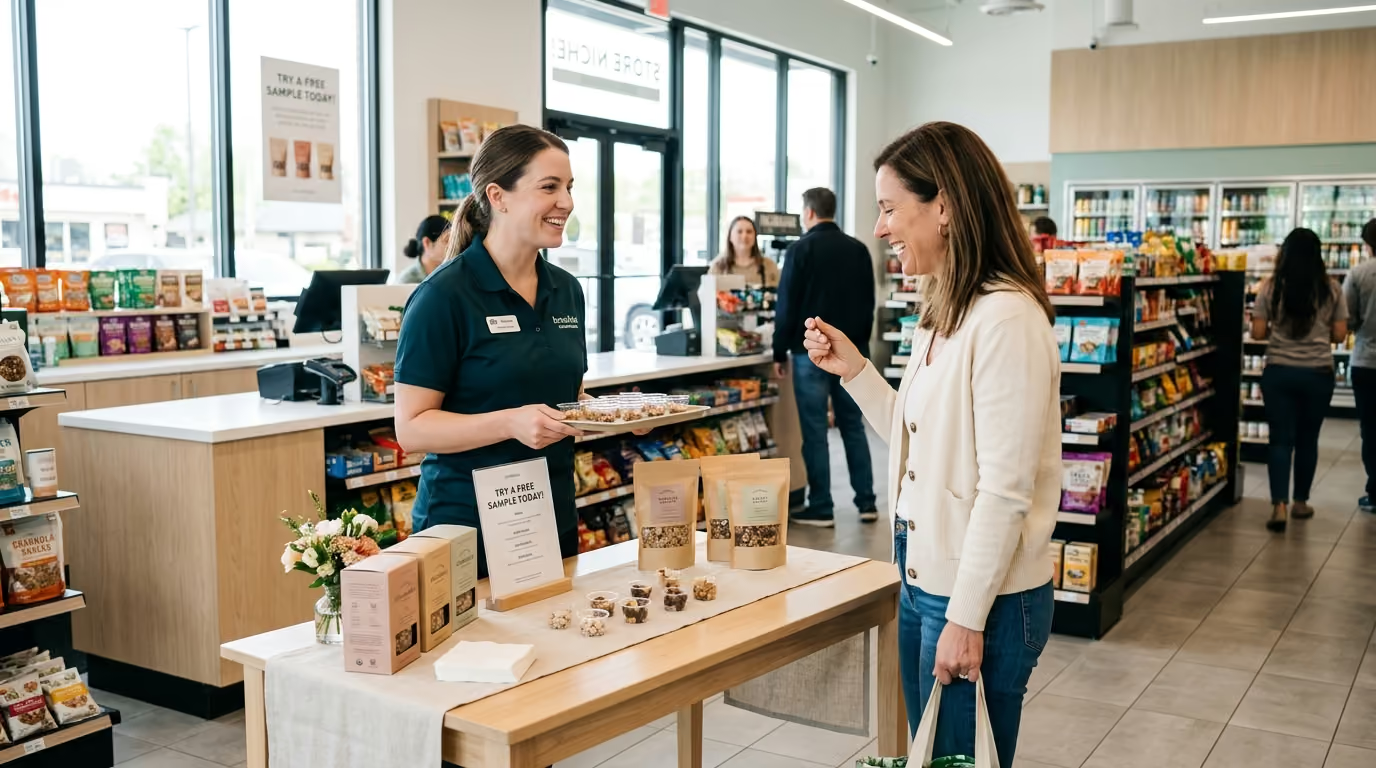
Brand ambassadors must be trained on a modular conversation guide rather than a rigid, robotic script. Staff should know how to open conversations naturally, present clean samples, highlight the core value proposition, and hand the product directly to the shopper.
Generating a free trial is an intermediate step, not the end goal. A launch activation must convert product interest into a verifiable register transaction. Converting a trialist into a buyer requires strategic pricing, effective point-of-sale merchandising, and risk-reversal mechanics.
According to a working paper published by the National Bureau of Economic Research (NBER), approximately 28.7% of product volume in United States retail markets is sold on promotion. However, excessive price reductions can erode margins and damage long-term price integrity. NielsenIQ (NIQ) research warns that poorly managed price discounts can lead to category price erosion without building sustained brand loyalty.
Deploy promotional levers strategically to incentivize first-time basket placement while protecting baseline margin economics.
Flawless field strategy collapses if operational logistics fail on site. Managing a national or regional retail launch requires strict coordination across inventory warehousing, display logistics, labor scheduling, and regulatory compliance. Brands frequently suffer when field teams arrive at stores only to find zero inventory in the stockroom or display materials damaged in transit.
Addressing logistical friction early prevents wasted marketing spend. When planning multi-region retail rollouts, brands often face significant execution challenges. You can examine practical solutions to these operational hurdles in our analysis on how to fix retail fragmentation across CPG activations.
For consumable products, adherence to food safety protocols is mandatory. The United States Food and Drug Administration (FDA) provides extensive guidelines under its Retail Food Protection program to prevent cross-contamination and foodborne illness. Demonstrators must follow strict operating standards during live preparation.
Field labor execution demands equal rigor. Managing specialized talent across multiple retail accounts requires disciplined staffing models. For deeper insights into managing field personnel, consult our guide on retail staffing solutions for roadshows and product launches.
To prove commercial viability to executive leadership and retail category managers, you must isolate true incremental sales from standard baseline trends. Simply reporting total units sold on the day of an activation provides misleading data. That total includes organic sales, seasonal spikes, and competitor stockout effects that would have occurred without your field team.
Research from Knowledge Networks and PDI, summarized in trade literature, revealed that in-store product sampling drove an average cumulative trial increase of 58% over 20 weeks for sampled items. The research also documented an average event-day sales lift of 475%, with line extensions experiencing up to a 919% lift on the day of execution. Capturing and validating these results requires an incrementality measurement framework.
Calculate your commercial returns using clear, unambiguous formulas that account for baseline trends and total operational expenditures.
Academic research published in the Journal of Retailing demonstrates that the commercial impact of in-store sampling is moderated by store-specific characteristics, and that repeated sampling schedules create a compounding effect on long-term velocity. Evaluating activations over four-week, eight-week, and twelve-week post-event windows provides a true picture of consumer repeat purchase patterns.
Use this structured operational checklist to deploy your retail launch activation systematically over the coming business week.

30 Years Experiential & Retail Activation Partner for CPG & Beverage Brands | Multi-Market Demos, Roadshows & Costco/Club Programs That Actually Sell