Robbie Thain
Founder, CEO

Rhode's Paris café pop-up drove Sephora retail traffic by swapping immediate free samples for an in-store redemption card. Here's why the logistics matter.
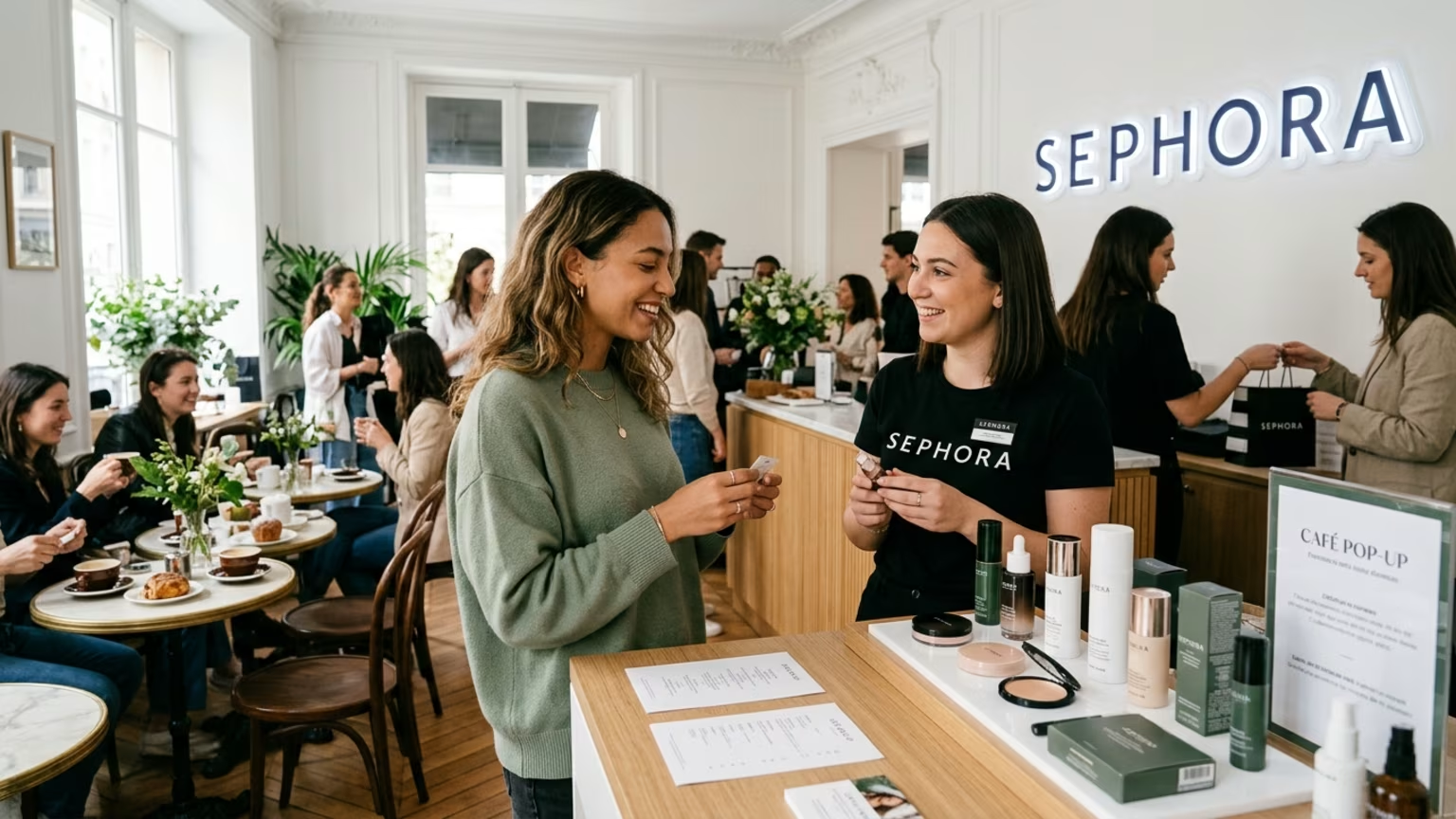
On September 30, 2026, Rhode opened a five-day café pop-up in Paris to support its Sephora launch across Europe. The activation took place at Le Bonaparte in the 6th arrondissement and ran through October 4. Fashion Times reported the event coincided with Rhode's expansion to Sephora online and more than 500 stores in 19 new European markets. Prior to this rollout, European consumers could only buy Rhode products through the brand's own website.
This temporary installation served as the physical introduction to a permanent retail presence. The brand paired its café experience with new product announcements. Fashion Times noted that Pocket Bronze and Highlight Milk joined the in-store range during the launch. The campaign also offered early access in Europe and the UK to the Pretzel Peptide Lip Tint.
The logistics of the Paris activation shifted the point of product sampling from the pop-up event directly to the retail floor. Rhode products were not sold at the café itself. Instead, the venue offered food alongside custom postcards and a specific Rhode Metro card. Visitors could not collect a skincare sample at the café.
To receive the sample, a visitor had to take the Metro card to a participating Sephora store and make any Rhode purchase by October 5. Fashion Times named three participating Paris locations for this redemption process: Sephora Paris Rivoli, Opéra, and Forum des Halles. The physical handoff meant attendees had to navigate a separate store visit and clear a purchase threshold before redeeming the offer.
The Champs-Élysées Sephora flagship also received a Rhode takeover during this period. The promotion was strictly bounded by time and inventory limits, as samples were only available while stocks lasted. The available reporting describes these offer mechanics in detail but provides no attendance, redemption, conversion, or sales figures.
The mechanics of this campaign highlight a significant shift in experiential marketing strategy. Most traditional product launches rely on immediate gratification by handing a free sample directly to the consumer. Rhode inverted this model by withholding the primary physical product at the initial touchpoint. Diners received a branded Metro card that functioned as a physical voucher rather than a direct sample.
This approach inherently qualifies the audience by filtering out visitors who only want free items without purchasing intent.
We appreciate campaigns that demand more than just passive attendance from a crowd. This activation forces marketers to distinguish the experience metric from the actual outcome metric. Giving away free coffee builds goodwill, but tying a physical item to a retailer purchase builds measurable pipeline. For CPG marketers and beverage brands, this is a clear lesson in designing auditable paths from live events to retail execution.
Pop-up events often fall into the trap of becoming pure theater without generating verified retail lift. Many CPG and beverage brands struggle to measure Return on Investment from their physical marketing efforts. They host elaborate events and record thousands of impressions but fail to document a corresponding spike in retail sales. This disconnect happens when the physical activation is isolated from the retail environment.
Rhode's decision to link the Paris café directly to Sephora purchases solves this structural problem. It forces the event to serve the retail channel rather than competing with it. When a brand is under pressure to prove that activations lead to sales lift, every interaction must funnel toward a transaction. We consistently advise marketing leaders to evaluate physical marketing performance through the lens of retail sell-through.
Most field marketing teams are judged on the sheer volume of products they hand out during a shift. This outdated metric encourages brand ambassadors to distribute items to anyone walking past the booth, regardless of their actual interest in the brand. Rhode avoided this volume trap entirely. By requiring a Sephora purchase to unlock the sample, the brand ensured that every converted interaction represented an actual paying customer. This precision fundamentally changes how marketing leaders should evaluate field performance.
If an experiential campaign does not move inventory at a targeted retail partner, its overall value remains questionable. A campaign must secure verified consumer insights from live product trials to justify the logistical investment. At Makai, we design mobile activations and roadshows that accelerate consumer trial and boost retail velocity during 90-day product launch windows. Our structured approach transforms initial product trial into sustained consumer confidence and retail performance.
Pushing traffic from a custom branded environment to a major retail partner like Sephora requires highly disciplined field logistics. The brand experience must be warm and engaging while the conversion mechanism remains strict and trackable. Operators must stop confusing a busy room with a profitable campaign. Creating a high converting retail sampling strategy requires treating every event guest as a prospective retail buyer.
The goal is not just to hand out a card. The objective is to secure an in-store purchase and prove that the physical activation generated immediate retail volume.
Using a non-retail pop-up to drive in-store traffic creates immediate operational constraints for the field team. A five-day activation with timed booking releases limits the total footprint flow. When a sample requires a separate retail visit, field teams must plan for intentional friction in the consumer journey. Marketing directors must ensure that participating locations have enough inventory and clearly understand the redemption rules.
This operational rigor is why leading operators rely on a structured launch ready retail demo plan to align field teams with store managers. The strategy requires cross-channel coordination to track cards distributed versus actual participating store redemptions. Brands that invest in connecting these touchpoints can successfully bridge the gap between event marketing and verified retail transactions. A poorly briefed store team can instantly derail a high investment field campaign.
Fashion Times noted that the European rollout included France and Germany alongside Italy and Spain. The report also named Poland, Sweden, and Switzerland as expansion markets. While the café was limited to Paris, scaling a multi-region program introduces complex permitting and staffing requirements. Clear communication of stock limits and purchase deadlines becomes a critical priority for field staff.
The inventory management aspect of this activation also requires precise execution. Sephora store managers at Rivoli, Opéra, and Forum des Halles needed accurate forecasts of how many Metro card holders might arrive each day. If the participating stores run out of promotional stock on the second day, the remaining café visitors will experience immediate frustration. Field marketing directors must establish real-time communication channels between the pop-up staff and the retail floor managers to monitor supply levels.
The downstream effects on field staffing are considerable when executing a multi-location handoff. Brand ambassadors stationed at the café must be trained to clearly explain the Sephora redemption process. Simultaneously, retail staff at the participating Sephora stores must be briefed on the Metro card mechanics and stock limitations. If a consumer arrives at Sephora Opéra and the staff is unaware of the promotion, the entire brand experience collapses.
Consistent messaging across both the experiential and retail teams is strictly required. Furthermore, managing footprint flow becomes a delicate balancing act for the operations team. Timed booking releases at Le Bonaparte ensured that the café did not become dangerously overcrowded. However, this strict capacity management directly capped the maximum number of Metro cards the team could distribute.
Marketers must calculate these throughput limits when projecting potential retail lift at the partner stores. If the venue only accommodates a few hundred people per day, the resulting retail impact will reflect that bottleneck. Brands must consider choosing the right physical environment for CPG activations to ensure the audience will actually convert. Paris provides a dense urban layout where walking from a café in the 6th arrondissement to a Sephora is viable.
Replicating this strategy in a sprawling or transit poor market would likely depress redemption rates significantly. Planners must evaluate local transit infrastructure when asking consumers to travel between an event space and a retail store.
How will your next field activation prove that it actually moved product off a retail shelf instead of just gathering a crowd?
Directing pop-up visitors to complete a purchase at a retail partner requires a completely auditable consumer journey. Makai solves the problem of low quality leads from crowded trade shows by keeping every interaction focused on measurable action. Through our Mobile Sampling Tours, we deliver your brand directly to audiences through on-the-go experiences that drive trial and awareness.

30 Years Experiential & Retail Activation Partner for CPG & Beverage Brands | Multi-Market Demos, Roadshows & Costco/Club Programs That Actually Sell