Robbie Thain
Founder, CEO

Profitable roadshows demand disciplined floor logistics, strict store compliance and structured inventory management to drive immediate sales velocity.
A retail roadshow is a dedicated, temporary field marketing deployment designed to convert physical shoppers into immediate buyers, whereas ordinary sampling is merely the distribution of free trial units. This guide provides the operational framework, compliance blueprints, inventory formulas, and measurement models required to scale high-converting in-store demonstration programs across warehouse clubs, grocery chains, mass retail, and specialty stores.
Trade show floors and retail warehouse aisles share an unforgiving environment where friction quickly breaks theoretical marketing plans. On an active Saturday morning, a field team faces crowded aisles, delayed inventory unboxing, and store department heads who may not know an activation is scheduled. Pallets arrive mislabeled in the warehouse racking, electrical drops fail to supply power to demonstration units, and store foot traffic bottlenecks within minutes.
When field teams operate without rigid processes, retail activations quickly become chaotic. Brand ambassadors arrive without mandatory health certificates, backroom stock remains trapped behind secondary freight, and staff focus on handing out product rather than converting buyers. Without structured inventory tallies and disciplined manager check-ins, brands burn through marketing budgets while leaving retail buyers skeptical about true brand velocity.
Winning on the retail floor requires treating every activation as a controlled operational exercise. In our experience across more than 1,000 campaigns in all 50 states, field teams succeed only when logistics, regulatory compliance, script execution, and inventory tracking operate in lockstep. From retail demonstrations in Seattle to roadshows in Miami and specialty activations in Honolulu, physical retail demands operational discipline before creative presentation.
To eliminate chaos, brands must replace fragmented tactics with an integrated retail operating system. This guide establishes the operational standards needed to protect margins, maintain compliance, and prove commercial value to retail category managers.
Retail roadshows, in-store demonstrations, and basic product sampling serve distinct strategic roles across retail channels. Confusing these formats leads to mismatched budgets, inaccurate labor forecasts, and flawed performance measurement.
A retail roadshow is a temporary, retailer-approved selling event conducted inside selected stores or warehouses over multiple consecutive days. Costco defines its roadshows as limited-time special events held inside selected warehouses. Roadshows integrate product demonstration, active selling, temporary merchandising fixtures, strict daily inventory reconciliations, and full booth setup and breakdown.
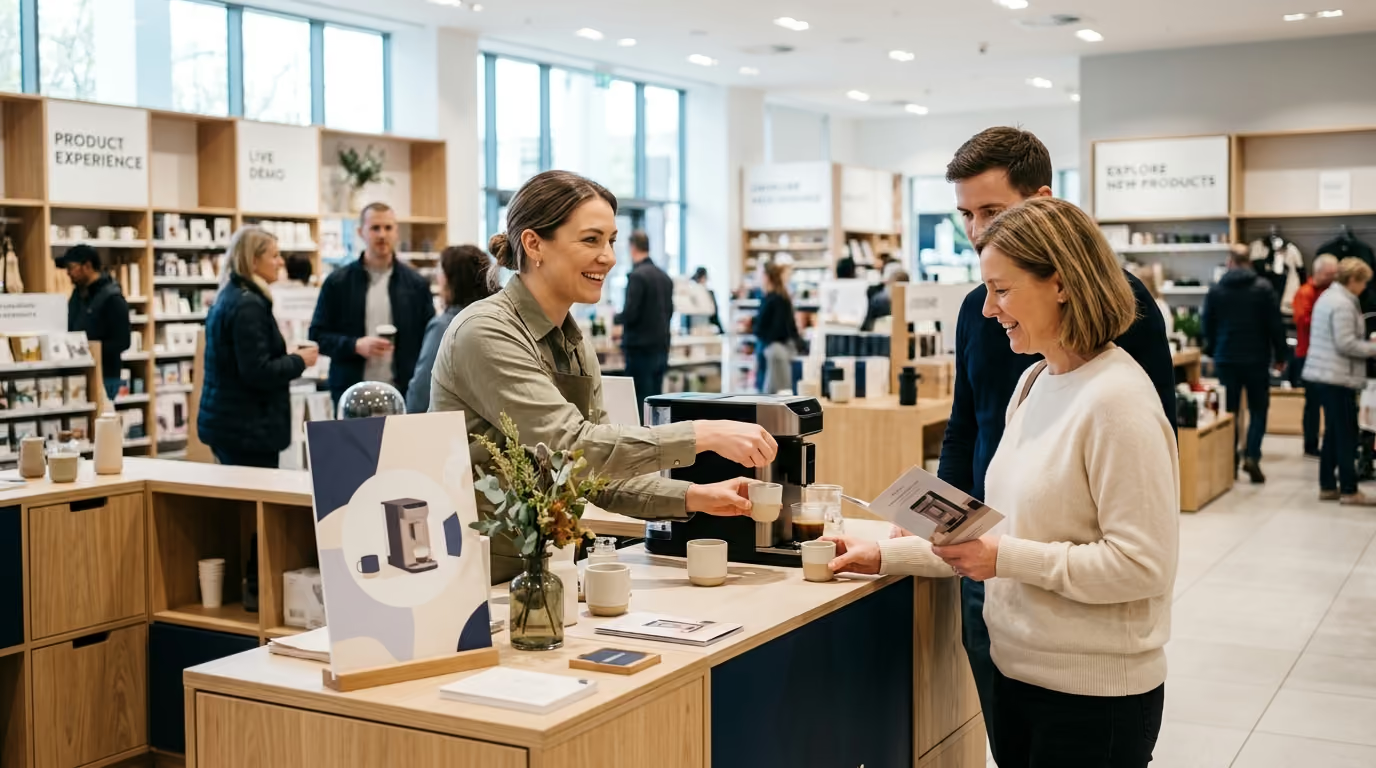
An in-store demonstration focuses on an interactive brand experience where a specialist shows how a product works, answers questions, and addresses consumer objections. These activations operate during specific high-traffic shifts, typically running four to six hours per day in grocery or mass retail environments. Demonstrations may feature culinary preparation, appliance operation, beauty applications, or technical hardware tutorials.
Product sampling is the focused distribution of small trial portions intended to allow a shopper to taste, test, or experience a product before purchasing. While sampling represents a tactical component of many demonstrations, it does not constitute a full demonstration program on its own. Passive sampling tables hand out product without sales education, missing the conversion step that justifies retail labor costs.
A successful field program functions as a temporary retail operating system built upon five interconnected pillars:
Every activation requires formal category buyer approval, master scheduling, store-level confirmations, insurance certificates, and retailer-specific credentialing. Without rigorous governance, field teams face store-level turnaways and compliance penalties that compromise retailer relationships.
Field staff must stop aisle traffic, educate shoppers on core value propositions, overcome purchasing hesitations, and guide consumers directly to checkout. High-performing programs track engagement rates rather than vanity distribution numbers.
Product visibility, price point communication, secondary fixture placement, and shelf adjacency dictate overall volume. An active demonstration located away from product stock fails to convert interest into physical units in the cart.
Field teams must track opening inventory, warehouse replenishment, damaged goods, sample consumption, and closing stock on a daily basis. Accurate stock management prevents out-of-stock events that destroy activation margins.
Programs must capture qualitative customer feedback, test competing messaging scripts, rank store locations by velocity, and analyze post-event repeat purchase behavior. Brands must use these insights to refine store selection and staffing models over time.
Navigating retail channel rules requires a clear understanding of chain-specific standards, regulatory frameworks, and credentialing protocols. Executing across diverse retail environments means field managers must adhere to strict operational guidelines.
Warehouse club roadshows require specialized operational discipline due to high foot traffic, pallet-sized merchandise displays, and multi-day commitments. Costco operating standards require roadshow staff to remain on site during all open warehouse hours, engage members actively, record daily opening and closing tallies, and dismantle displays at the event close.
For vendor-performed roadshows not executed through Club Demonstration Services, Costco operating materials state that vendors may incur a $35-per-day administrative charge. This covers a $20 space-rental fee and a $15 scheduling, monitoring, reporting, and collection fee. Vendor staff must complete Costco Level 1 Food Safety Training, submit verification to the buyer, and maintain the original certificate on site throughout the show.
Operating procedures mandate that brand teams locate the warehouse manager upon arrival, photograph pallets before unboxing, verify signage, and retain empty demonstration packaging for repackaging. Promotional signage and collateral must receive advance warehouse approval, and products must feature accurate price placards throughout the show. Vendor teams scheduling events should reference strategic Costco roadshow planning guidelines to ensure all operational prerequisites are completed at least two weeks before planned launch dates.
Grocery demonstrations demand strict adherence to state and municipal health department regulations, cross-contamination prevention, and cold-chain integrity. Standard food-sampling requirements dictate that hot foods remain held above 140°F and cold foods remain stored below 40°F. Staff must maintain active food-handler certifications, practice continuous glove changing, and use single-serve utensils or portion cups.
Many supermarket chains require field marketing agencies and brand personnel to clear credentialing platforms like RangeMe, UNFI, or KeHE before gaining store floor access. Retailers enforce strict policies regarding table dimensions, designated footprint locations, electrical drop limits, and backroom waste disposal. Clear allergen disclosure signage must remain visible to protect shoppers from undeclared ingredients.
Mass retailers focus on standardizing floor layouts and keeping main aisles clear. Field teams must operate within approved fixture footprints to avoid blocking primary traffic lanes or obstructing sightlines to staple categories. Signage must match corporate brand guidelines, and product inventory must remain fully stocked on primary shelves.
The primary risk in mass retail is operational inconsistency across regional districts. Brand managers must implement uniform training, verified digital check-ins, and consistent fixture setups to ensure identical brand presentation across hundreds of store locations.
Specialty retail environments, including consumer electronics, beauty, and specialty wellness stores, prioritize consultative product education over high-volume sampling. Field specialists must possess deep technical knowledge to walk shoppers through complex product features, setup instructions, or personalized regimens.
In specialty stores, performance metrics shift toward consultation completions, digital lead captures, warranty attachments, and qualified basket sizes. Field staff must act as authorized product specialists who integrate smoothly with full-time retail store associates.
Selecting field activation locations solely based on gross store sales often wastes marketing capital. A high-volume warehouse or supermarket may generate significant foot traffic but lack the specific customer demographics or shelf inventory needed to support a premium product.
To build a balanced field marketing portfolio, brand managers should evaluate every target location against an objective scoring rubric:
Evaluate the store or warehouse by historical sales volume within your specific product category. High category volume demonstrates an established shopper base actively purchasing within your vertical.
Assess the alignment between store shopper demographics and your target consumer profile. Evaluate local household income, household size, and lifestyle preferences to verify purchasing power for your price tier.
Analyze baseline product movement in the location during standard weeks without promotional support. Stores with solid baseline velocity yield higher conversion rates during live demonstrations.
Confirm that the retailer consistently maintains adequate safety stock and replenishes primary shelves. A location that frequently experiences stockouts will fail during high-volume demonstration weekends.
Evaluate aisle widths, available demonstration spaces, sightlines from main entrances, and electrical infrastructure. Generous physical floor layouts prevent aisle congestion and allow smooth consumer engagement.
Review customer foot traffic distributions across days of the week and operating hours. Align activation schedules with local payday cycles, regional holidays, and peak shopping windows.
Calculate the geographic proximity between target stores to minimize travel expenses and optimize supervisor routing. Clustering stores within defined metro markets maximizes management oversight.
Factor in historical store management cooperation, backroom access, and willingness to support secondary merchandising placements. Supportive store managers make a measurable difference in activation success.
A structured field marketing program groups store networks into four operational archetypes:
High-volume conversion stores feature substantial category traffic and strong baseline velocities. These locations are ideal for driving raw unit volume, exhausting seasonal inventory, and testing field labor efficiency under heavy foot traffic.
High-fit discovery stores over-index on specific target consumer demographics, such as natural food shoppers or tech enthusiasts. While gross foot traffic may be lower, these locations provide higher conversion rates, valuable qualitative feedback, and long-term brand trial.
Operational test locations serve as pilot environments to validate new demonstration scripts, training modules, and merchandising displays. Running pilot tests in accessible metro areas allows field directors to fix operational issues before rolling out national campaigns.
Control benchmark stores share matching demographic and volume characteristics with test stores but receive no live demonstration support. Maintaining a control group of 10% to 20% of locations enables brands to isolate true incremental sales lift from broader market trends.
Physical demonstration spaces require intentional design to catch the shopper's eye, encourage product trial, and direct traffic toward purchase. A disorderly demonstration station creates bottlenecks, causes hygiene concerns, and fails to convert passing shoppers.
Research in retail merchandising shows that positioning demonstrations within 20 feet of the product's primary shelf space produces higher sales conversion. Forcing shoppers to search for an item down distant aisles leads to abandoned purchases before checkout.
Demonstration stations must provide clear visual brand identification, a clean preparation surface, and an accessible presentation tray. Stations must never block primary warehouse aisles or grocery endcaps. Teams must position trash receptacles to capture used sample cups immediately, maintaining a clean and professional space.
Field leads should establish target engagement caps per hour based on foot traffic patterns. Rushing shoppers through demonstrations lowers educational quality and conversion rates, while overly slow pacing creates unnecessary aisle congestion.
Field marketing managers must track shopper progression across five distinct stages to identify execution problems:
Visual exposure occurs when passing shoppers see the branded setup, staff, and product presentation from down the aisle.
Approach and proximity happen when a shopper slows their walking pace and moves within conversational distance of the table.
Active engagement begins when the shopper answers an opening question, asks about ingredients, or physically holds the product.
Product trial involves the shopper tasting a food sample, testing a cosmetic formula, or watching a live equipment demonstration.
Purchase conversion takes place when the consumer picks up a sellable product unit and places it directly into their shopping cart.
Brand ambassadors must avoid long, generic product monologues. High-performing teams use a structured five-part conversation framework:
The open invitation welcomes the shopper with an easy, low-friction question rather than an aggressive sales pitch. Staff should ask questions like, "Would you like to try a quick taste of our slow-steeped cold brew?"
The problem frame highlights a common consumer frustration that the product directly solves. For instance, the demonstrator might note, "Most ready-to-drink coffees taste overly bitter or hide behind added sugars."
The physical proof delivers immediate sensory or functional evidence during the trial. The demonstrator highlights key attributes: "Notice how smooth this tastes without added dairy, thanks to our twelve-hour cold extraction process."
The objection turn addresses common purchasing hesitations regarding price, ingredients, preparation time, or dietary limits. Staff proactively explain: "Each multi-serve bottle provides five full servings, making it half the cost of your daily coffee shop run."
The conversion cue gives the shopper a clear, direct path to purchase. The demonstrator hands the customer a package and says, "Our multi-packs are on a promotional discount this week, located right here on this front pallet."
Field leaders can explore how this conversational structure fits into broader field marketing programs by reviewing our guide on designing high-conversion retail product sampling programs.
Executing consistent retail activations across dozens of locations requires a clear operational playbook. Field teams must follow a disciplined, chronological execution checklist:
Measuring in-store demonstration success requires looking beyond simple day-of-event sales spikes. True performance evaluation demands tracking leading operational indicators, lagging commercial outcomes, and verified post-event sales lift.
A comprehensive field reporting system organizes event data into five clear performance levels:
Level 1 monitors operational compliance, including verified staff attendance, on-time arrivals, completed inventory tallies, and adherence to food safety standards.
Level 2 tracks shopper engagement efficiency, measuring passing foot traffic, verbal interactions, completed product trials, and sample-to-engagement ratios.
Level 3 measures immediate commercial performance, calculating total register units sold, gross dollar volume, units sold per labor hour, and stockout downtime.
Level 4 evaluates true business incrementality, analyzing sales velocity compared to matched control stores, first-time buyer acquisition, and repeat purchase rates over 20 weeks.
Level 5 assesses program financial efficiency, determining total cost per sample, customer acquisition cost, incremental gross profit margins, and net Return on Investment.
Field managers must track performance daily using standardized inventory and productivity formulas:
Total Units Sold:
Opening Sellable Inventory plus Stock Replenishments minus Closing Sellable Inventory minus Documented Damages minus Consumed Sample Units equals Total Units Sold.
Sell-Through Percentage:
Total Units Sold divided by Total Units Available multiplied by 100 equals Sell-Through Percentage.
Labor Sales Productivity:
Total Register Units Sold divided by Total Staffed Labor Hours equals Labor Sales Productivity.
Sample Conversion Efficiency:
Total Observed Purchasing Shoppers divided by Total Distributed Sample Units multiplied by 100 equals Sample Conversion Efficiency.
Stockout Loss Rate:
Total Hours with Zero Shelf Stock divided by Total Scheduled Activation Hours multiplied by 100 equals Stockout Loss Rate.
A published Cornell University survey revealed that 94% of retail executives identify in-store demonstrations and shipper displays as critical promotional tools. However, measuring real return requires isolating true incremental purchases from shoppers who planned to buy anyway.
A comprehensive 20-week retail sampling study published by Retail TouchPoints reported an average day-of-event sales lift of 475% for sampled items across diverse consumer categories. The study revealed a 177% day-of-event sales lift for mature products, compared to a 919% lift for new line extensions. The broader brand family experienced an average 107% sales increase on demonstration days, proving that live sampling lifts overall brand visibility.
Research highlighted in Supermarket News indicates that 86% of consumers prefer shopping in stores that offer product samples, and 90% want to try new items before purchasing. The same research noted that engaged shoppers spent 10% more time in the store and showed an average 10% increase in total shopping-basket spend. Furthermore, the 20-week study showed that sampled products maintained a 74% average sales lift over the full 20-week period, with first-repeat purchases rising 11% for the product and 6% for the wider brand franchise.
To isolate true incremental sales, brands must measure performance against matched control stores over extended post-event windows:
Brands refining their field budgeting models can reference our guide on retail sampling budgeting and cost planning strategies to build predictable financial forecasts.
A growing organic plant-based protein brand faced slowing sales across 48 regional club warehouse locations. Despite earning warehouse distribution, the brand struggled with low consumer awareness, high price resistance, and risk of category de-listing. The brand launched a structured, multi-store field demonstration program to restore product velocity.
The marketing leadership prioritized operational discipline, strict cold-chain compliance, and active sales conversations. Rather than relying on passive third-party sampling tables, the company deployed trained brand specialists across targeted weekend schedules.
During the initial six-store pilot, the team tested two distinct demonstration scripts and ironed out blender sanitization routines. The winning script focused on afternoon energy slumps and highlighted that each serving delivered 20 grams of clean protein with zero chalky aftertaste.
The company then rolled out the program across all 48 warehouses over four consecutive weekends. Teams maintained strict cold-chain logs, performed daily inventory reconciliations with store managers, and tracked hourly sample-to-purchase conversion rates.
The program delivered an average 312% sales lift on active demonstration days across the 48 target warehouses. Over the following 16 weeks, baseline sales velocity settled 34% higher than pre-activation levels, driven by a 14% increase in first-time repeat purchases. By proving steady sell-through and strong margins to the warehouse buyer, the brand preserved its distribution footprint and expanded into two additional regional divisions.
Even well-funded field marketing campaigns can fail if brand teams make basic operational and analytical errors.
A common mistake in field marketing is assuming that every unit sold during a live demonstration represents a brand-new customer. Regular brand buyers frequently purchase their usual items during demonstration events. Brands must use matched control stores to measure true incremental volume above baseline sales.
Handing out hundreds of samples per hour means little if those interactions fail to generate register sales. Programs that reward staff solely on sample volume encourage rushed, unengaging handoffs. Demonstrators must focus on high-quality product education and clear purchase prompts.
Generating consumer excitement at the demonstration table is useless if primary shelves and display pallets run out of stock mid-afternoon. Brand ambassadors must monitor shelf inventory hourly and coordinate with backroom staff to restock items before displays run empty.
Shoppers visit warehouse clubs, natural grocery stores, and mass retailers with entirely different shopping goals, time constraints, and basket sizes. Using a single script across all channels leads to missed connections. Teams must adapt opening hooks and value propositions to fit each retail environment.
Submitting demonstration requests without sufficient lead time creates inventory shortages, missed scheduling windows, and staffing issues. Club Demonstration Services guidelines recommend booking requests at least two weeks in advance, with earlier reservations preferred during peak quarters. Booking early ensures proper freight delivery and staff preparation.
Research shows that in-store product demonstrations continue to drive customer trials, new buyer acquisitions, and repeat purchases for up to 20 weeks after the event. Brands that stop tracking performance on event day understate their true long-term Return on Investment. Field managers should track post-event sales data to evaluate the lasting impact of their activations, as outlined in our report on how CPG brands prove retail demonstration Return on Investment.
Brands should begin planning warehouse club roadshows eight to twelve weeks before the target launch date. This window allows teams to secure buyer approvals, coordinate inventory production, book demonstration dates, pass food safety certifications, and finalize staffing logistics. Submitting requests at least two to four weeks in advance is necessary to lock in preferred dates within high-traffic stores.
For vendor-performed roadshows not executed through Club Demonstration Services, Costco vendor guidelines state that suppliers may incur a $35-per-day administrative fee. This charge consists of a $20 space-rental fee and a $15 scheduling, monitoring, reporting, and collection fee. These costs must be factored directly into gross margin and break-even calculations.
Food demonstrators must hold a current state-approved food-handler or food-manager safety certificate. For warehouse clubs like Costco, staff must complete Costco Level 1 Food Safety Training, submit documentation to the category buyer, and keep original copies on site. Some locations also require local county health department permits.
Safety stock calculations must balance expected sales volume, sample consumption, potential shipping damage, and store replenishment schedules. Total required stock should equal expected sales units plus sample units and damage allowances, backed by a 20% safety stock buffer. Maintaining this buffer protects the program against stockouts during unexpected traffic surges.

30 Years Experiential & Retail Activation Partner for CPG & Beverage Brands | Multi-Market Demos, Roadshows & Costco/Club Programs That Actually Sell