Robbie Thain
Founder, CEO

A Thanksgiving meal-tasting report puts staffing, merchandising, waste and basket measurement at the center of holiday sampling plans.
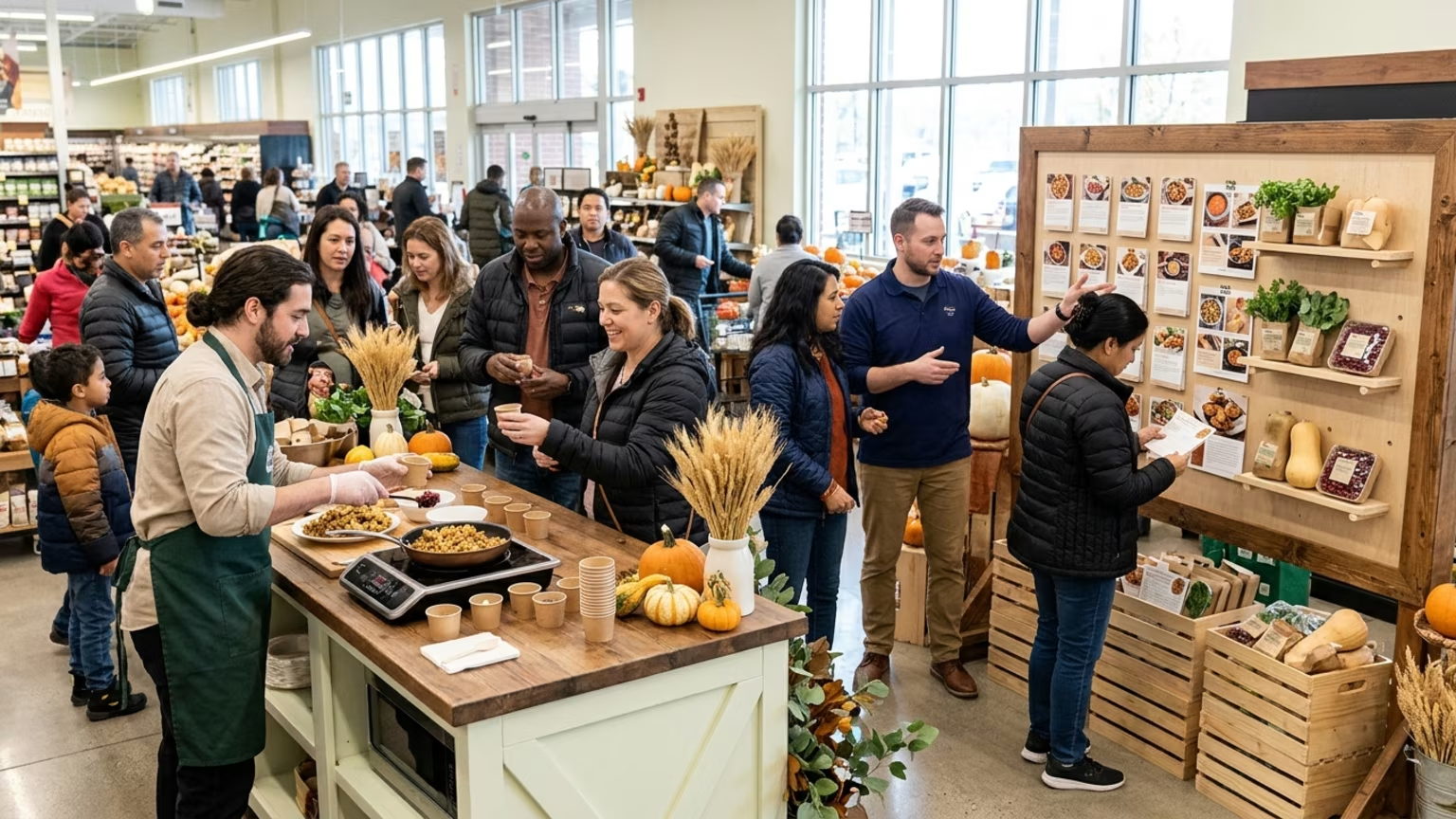
On November 16, 2026, Food Trade News published Michael Rathburn’s account of an unnamed retailer inviting shoppers to sample a complete Thanksgiving meal. His argument was practical: tasting could give shoppers a reason to visit and buy the ingredients needed to serve it.
For CPG and beverage marketers, the invitation raises an operational question beyond what goes on the sample tray. A complete meal brings product placement and staff knowledge into the same brief as trial and sales.
Rathburn’s central proposal is to present an occasion rather than an isolated product. Pair the tasting with the ingredients or prepared options shoppers need to complete the meal. Make those related products easy to find. The logistical shift is from managing a sample handoff to connecting that handoff with a broader shopping mission.
That idea sits within a holiday market already promoting complete meals and value. Target announced a $30 Thanksgiving meal for six and said it maintained the prior year’s $5-per-person value. Food Lion announced a Thanksgiving Meal Deal for 10 people for under $40. These are meal-value offers, not evidence of sampling performance, but they provide relevant context for an occasion-led tasting.
Rathburn also suggests using tasting to introduce private-label products that shoppers might hesitate to serve to guests. His reasoning is that trying an unfamiliar food gives shoppers information that a shelf description alone does not provide. For the activation brief, that puts product explanation alongside the taste itself.
The Food Trade News article is a practitioner’s argument rather than a disclosed performance case. It provides no campaign results, staffing levels or controlled measurement design. Treat the meal tasting as an activation hypothesis, not proof of added basket value.
At Makai, our stance is aloha with discipline: welcome the shopper and make the next step clear. Hospitality gives the interaction its human value. Operational precision gives the brand a way to connect that interaction with a commercial objective.
We specialize in retail demos, product sampling programs and roadshows that bring brands face to face with their audiences. Our retail demonstrations use trained brand ambassadors to drive in-store sales through real conversations and product trials. For this holiday brief, we believe the conversation should connect taste with preparation and complementary choices.
The product still needs to remain clear within the larger meal story. Our view is that an occasion-led presentation should give a shopper more reasons to understand the featured item, not bury it beneath a general holiday message. The brand’s contribution to the meal should be easy to explain.
That is the balance behind welcoming conversations backed by operational discipline. A friendly interaction and a commercially useful interaction should not be competing assignments. The tasting needs a purpose beyond getting someone to accept a portion.
Our experience also reinforces the value of separating activity from purchase response. We managed a four-week, multi-market Costco sampling program for Pulmuone’s PlantSpired line. The program delivered more than 65,000 samples and recorded an 18 percent sold-to-sale rate. Those measures describe different parts of the program: the volume of trial and the recorded sales response.
For leaders accountable for sales pipeline, that distinction matters. A retail purchase is not the same outcome as a qualified trade show lead. Our position is that both programs need a defined commercial objective before a busy physical space can be called a productive one.
Rathburn identifies labor, food safety, waste and space as constraints. He also argues that not every product or store justifies a demonstration. Our operational reading is straightforward: a bigger meal story deserves a feasibility review, not an automatic expansion of the demo footprint.
Rathburn’s recommendation to explain preparation and pairings gives the demonstrator a broader assignment than distributing samples. The person presenting the product needs to connect what shoppers taste with how it fits the occasion. That is a product-knowledge requirement within the proposed format.
For food and beverage teams, the staffing brief should reflect that conversational work. A meal-focused tasting may involve questions about the featured item and the complementary choices presented with it. Our view is that the planned interaction should shape the staffing discussion rather than being added after the labor decision.
The research does not call for a bigger team everywhere. It calls for targeted demonstrations. The useful decision is whether the proposed staff can support the experience the brand is actually promising at that location.
Rathburn recommends nearby complementary products while flagging space as a constraint. Those two points belong in the same layout discussion. A meal concept is incomplete if its tasting location and its product presentation are planned as unrelated pieces.
Our view is that the footprint should support a clear physical sequence: understand the meal idea, try the product and find the relevant purchase options. That does not automatically mean more furniture or a larger branded display. It means giving the available space a defined commercial job.
For a beverage or CPG brand participating in a broader meal presentation, that job includes keeping the featured product visible within the occasion. The shopper should not have to reconstruct the brand’s role after leaving the tasting. This is the practical purpose of connecting the tasting to a purchase, rather than treating the table as the finish line.
Labor and waste belong in the go/no-go discussion before a seasonal idea becomes a calendar commitment. Rathburn’s recommendation is to target the products and stores that justify a demonstration. A complete-meal concept should earn its place on that basis rather than becoming the default holiday format.
Food safety belongs in the same feasibility decision. Our position is that a compelling creative idea does not override the operating demands of serving food. The proposed menu must be evaluated alongside the labor and waste burden it creates.
This is also where restraint has value. If the full occasion cannot be supported within the location’s practical constraints, the marketing objective needs another format. The discipline is choosing a supportable experience instead of treating the largest possible tasting as the strongest idea.
Rathburn recommends looking beyond units sold during the demonstration. His proposed evaluation includes:
These are distinct questions. A sampled-product sale addresses the featured item. A complementary purchase addresses another part of the meal mission. Counting portions served does not answer either question by itself.
At Makai, we report reach and trials alongside leads and sales. Our measurement approach tracks awareness, engagement and conversion. Applied to this brief, our view is that the reporting objective should be settled while the occasion and merchandising plan are being defined.
That is how a marketing team can separate activity from commercial impact. A report about trial volume answers a different question from a report about purchase response. Neither should be presented as a substitute for the basket outcomes Rathburn proposes examining.
The distinction matters when leadership asks about Return on Investment (ROI). Our standard for the discussion is clarity about which outcome was measured. A meal-led activation deserves a measurement brief that matches its meal-led ambition.
Rathburn suggests extending the occasion-based approach to Christmas Eve appetizers and New Year’s Eve entertaining. The planning lesson is not to fill the calendar with more tasting dates. It is to decide which occasions justify the operational work and which commercial questions each activation should answer.
The Thanksgiving invitation is a useful starting point because it puts a complete meal in front of the shopper. The next brief needs to connect that invitation with a supportable field plan.
As a CMO or VP of Marketing planning your next holiday activation, will the shopper invited to taste a complete meal find a clear path to buying it and will your team be able to measure that path?
Holiday meal tastings give field marketing managers a daily execution assignment; when Makai runs the demonstration, trained ambassadors lead the tasting and purchase conversations. Makai’s retail demonstration service centers on personal product experience as a way to support sales inside the store.

30 Years Experiential & Retail Activation Partner for CPG & Beverage Brands | Multi-Market Demos, Roadshows & Costco/Club Programs That Actually Sell