Robbie Thain
Founder, CEO

Learn how to measure retail sampling ROI by tracking true customer acquisition costs, localized sales baselines, and commercial outcomes over vanity metrics.
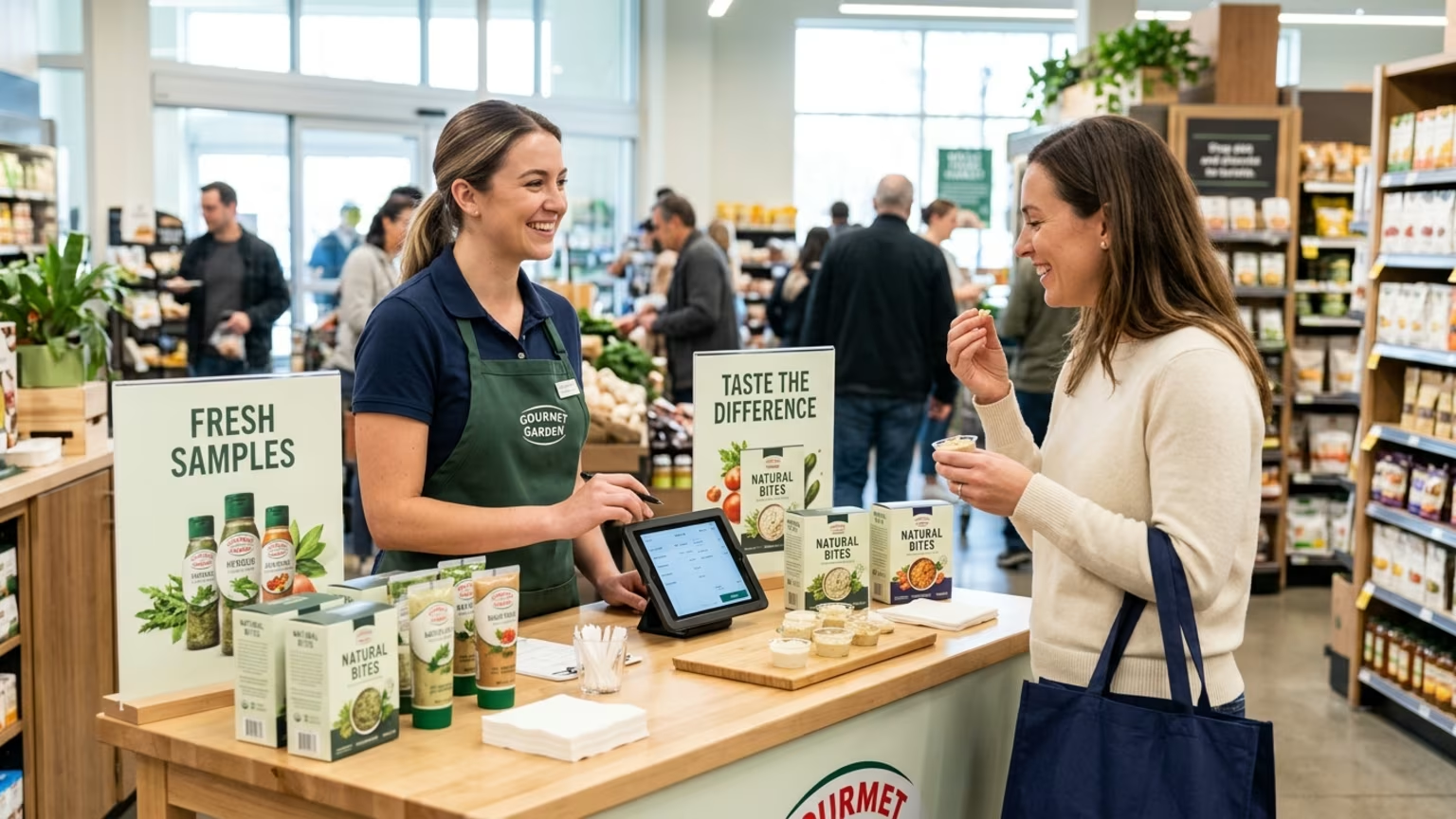
Counting empty cups at the end of a retail demo is not a measure of Return on Investment. It is simply a measure of physical activity. Brands that judge physical activations by total interactions or samples distributed are flying blind. True experiential marketing must generate measurable pipeline and incremental purchases. If a campaign cannot prove that it created new buyers, it functions as expensive theater rather than a commercial engine.
Evaluating physical activation requires a structural shift away from simple distribution counts. Demo Wizard recommends a reliable measurement framework that relies on four specific retail metrics. Their framework tracks units sold per hour and baseline sales lift. They also measure the cost per demo and samples distributed relative to units sold. This approach forces marketing teams to evaluate commercial outcomes rather than execution delivery alone.
Measuring units sold per hour provides a direct look at activation velocity. This metric strips away the illusion of a busy booth by focusing strictly on register rings. It allows brands to compare the efficiency of different store locations accurately. If foot traffic is high but units sold per hour remain low, the activation is failing to convert.
Demo Wizard defines customer acquisition cost for retail sampling through a strict formula. Brands must divide their total program spending by the number of new buyers converted at the shelf. This total cost base must include staffing, product, materials, and coordination overhead. Including every expense provides an accurate picture of true campaign efficiency.
Tracking samples distributed relative to units sold grounds the campaign in reality. This ratio reveals whether the product experience is actually compelling enough to drive a purchase. A high distribution count paired with low sales indicates a severe disconnect in the trial experience. It shows that consumers are willing to take something for free but unwilling to open their wallets.
Relying on activity metrics creates a false sense of security for field marketing teams. Handing out thousands of units might look fantastic in a post-event recap presentation. However, if those interactions do not translate into measurable shelf movement, the budget was effectively wasted. Teams must learn to view distribution metrics strictly as operational proof of life.
For a VP of Marketing managing a fragmented trade budget, this strict definition of customer acquisition cost changes everything. Treating retail demos as a vague awareness play often hides inefficient spending across multiple retail locations. When you isolate the actual cost of converting a new buyer, you can objectively compare experiential activations against other marketing channels. This clarity is exactly what retail executives need when evaluating retail product sampling KPIs.
We provide clear reporting on reach, trials, leads, and sales to guide next steps in campaign optimization. Our measurement approach tracks awareness, engagement, and conversion, turning brand moments into actionable data that demonstrates business impact. This level of rigor prevents brands from wasting budget on locations that drive heavy foot traffic but zero incremental sales. Teams can finally allocate dollars based on proven performance rather than anecdotal field reports.
Ignoring coordination overhead and material costs artificially deflates the perceived cost per acquisition. When a brand only calculates staffing hours against sales, the resulting return on investment looks artificially high. A true financial assessment demands that every operational cost is factored into the final calculation. This honest accounting protects marketing leaders during rigorous quarterly financial reviews.
Integrating total program costs into the acquisition model forces brands to rethink their geographic targeting. If coordination and logistics costs outweigh the localized sales lift, that specific market may be unviable. This is why refining retail demo and sampling strategy requires a ruthless look at actual profitability. Brands can then shift their resources toward retail partners that yield the highest conversion rates.
While perfect attribution is challenging in physical retail environments, actionable measurement is entirely possible. Many organizations freeze when they realize they cannot track every physical interaction perfectly. However, establishing clear baselines allows marketers to prove impact without perfect data sets. Progress requires focusing on localized lift rather than waiting for absolute attribution granularity.
This shift toward hard business outcomes forces a significant change in how brands execute physical marketing today. Operators can no longer rely on simple before-and-after sales snapshots to prove their success. Demo Wizard describes using recent non-demo sales at the exact same store as a baseline. Teams then compare the specific demo-window performance directly against that localized baseline.
Measuring against a highly localized baseline isolates generic store traffic from campaign impact. We specialize in creating retail demos, product sampling programs, and roadshows that bring brands face to face with their audiences. Each program is designed to drive trial, build consumer relationships, and accelerate retail velocity across multiple locations. By isolating the exact store environment, brands can clearly see the net impact of their physical presence.
When executing at scale, rigorous measurement becomes even more critical to overall campaign health. We managed a four-week, multi-market Costco sampling program for Pulmuone's PlantSpired line. The program delivered more than 65,000 samples and recorded an 18 percent sold-to-sale rate, giving us a concrete example of how structured retail sampling can connect trial with purchase. This kind of scale requires meticulous coordination and strict adherence to localized performance baselines.
Operating inside retail environments introduces variables that directly impact your final data readouts. Store managers often impose specific regulations regarding booth dimensions, product handling, and staff conduct. If a brand fails to comply with these rules, the retailer may shut down the activation prematurely. This operational failure immediately invalidates any planned financial measurements.
A sudden spike in register rings means very little if the brand cannot prove the activation actually occurred. Field compliance verification acts as an insurance policy for your marketing data. Brands must confirm that their ambassadors arrived on time and executed the required messaging perfectly. Without this operational proof, attributing a sales lift to a specific field marketing event remains purely speculative.
The ultimate goal of connecting data to the floor is creating a repeatable trial experience. A VP of Marketing reflected on our partnership: 'Robbie, it was a pleasure working with you and your team. You turned our launch into an experience that connected with shoppers and built lasting excitement for our brand. We're already looking forward to the next project together.' Our team created a launch experience that resonated with retail shoppers and generated momentum for future collaborations.
Isolated sampling events rarely provide the sustained lift required to change long-term buying habits. A structured measurement framework encourages brands to think in terms of sequential consumer touchpoints. Deploying a full-funnel sampling strategy guarantees that initial awareness transitions into active trial. Data from the event floor must feed directly into subsequent retail marketing decisions.
Measuring experiential return on investment requires separating operational delivery from commercial impact. Marketing operators should immediately adjust their KPI dashboards to reflect total program costs against actual units sold. Sample counts and interactions should remain visible as execution indicators rather than substitutes for real business outcomes.
When a brand holds its physical activations to strict financial standards, field marketing becomes a proven growth engine. The days of accepting anecdotal success stories from the event floor are permanently over. Brands must demand clear baselines, strict cost accounting, and measurable sales lift from every activation. This disciplined approach guarantees that experiential marketing earns its place in the modern retail playbook.
Shifting a retail sampling strategy to prioritize true customer acquisition cost over basic activity counts requires precise operational control. Makai takes over this execution burden, solving the low quality leads from crowded trade shows that often plague poorly tracked campaigns. Through our Mobile Sampling Tours, we deliver your brand directly to audiences through on the go experiences that drive trial and awareness.

30 Years Experiential & Retail Activation Partner for CPG & Beverage Brands | Multi-Market Demos, Roadshows & Costco/Club Programs That Actually Sell