Robbie Thain
Founder, CEO

Sephora’s September 2026 Beauty Challenge packaged product testing into a strict promotional window. Learn how CPG brands must adapt physical sampling.
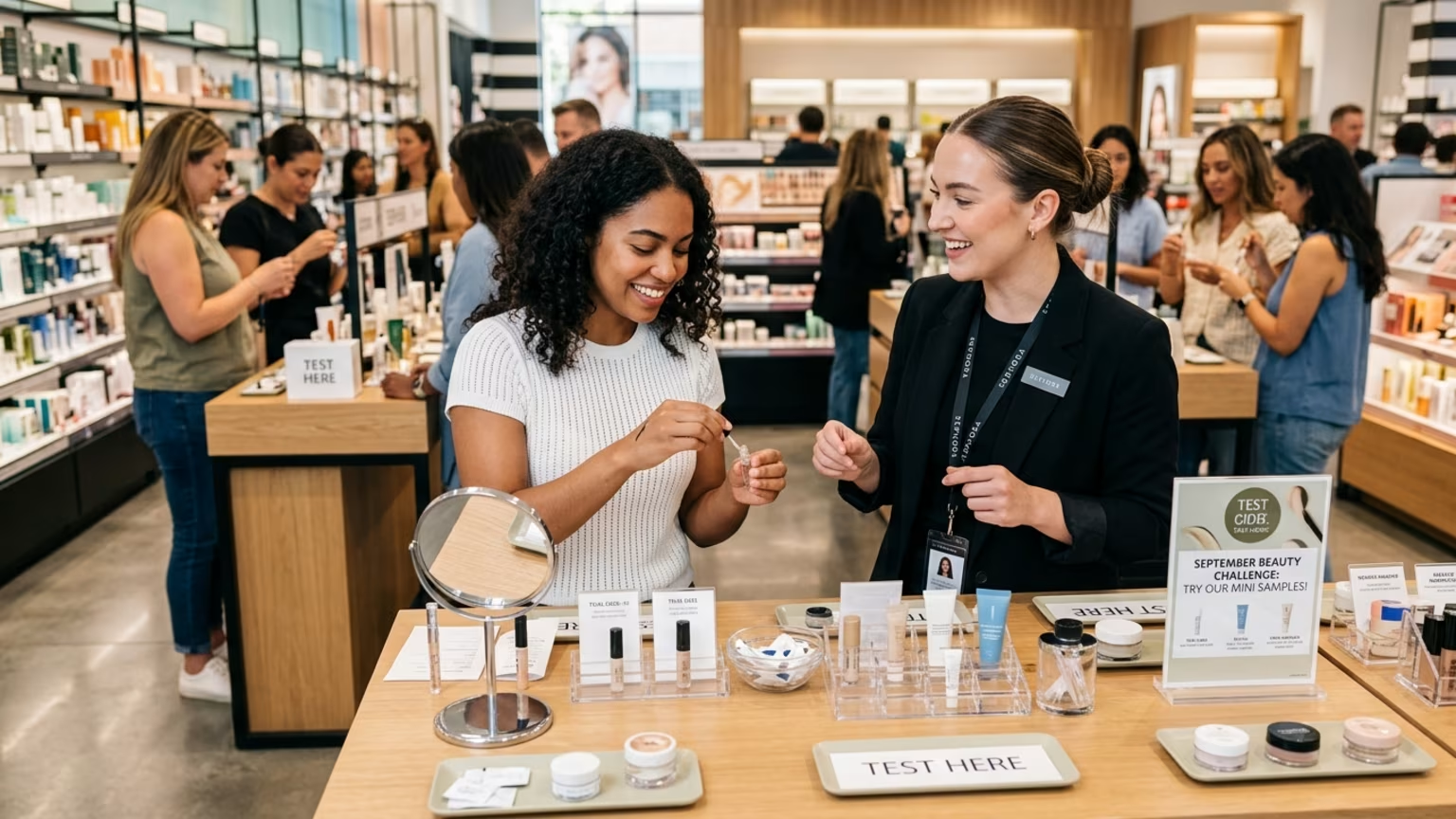
In September 2026, Sephora published a dedicated September 2026 Beauty Challenge page for both the United States and Canada to promote deals, trial sizes, and sample sets. The retail strategy packaged specific product testing into a strict promotional window. Sephora designed this program to route consumer traffic toward selected cosmetics and skincare items through controlled trial experiences. The event established a formal retail architecture for distributing smaller product formats to a massive audience.
The U.S. challenge page advertises 50 percent off select beauty and free shipping for Beauty Insiders, subject to terms. Sephora says its free samples and trial sizes let shoppers try products before committing to a standard size. The Canadian search listing says customers can complete the challenge to earn Beauty Insider points. This integrates physical product trial directly into a digital loyalty loop.
Sephora’s promotional pages show that some trial-size offers require a minimum purchase and may be available only while supplies last. The mechanics move product trial away from random aisle giveaways into a conditional transaction. A trade publication covering Sephora reported that Beauty Insider Challenges launched in 2023 and claimed a 30 percent participation rate among enrolled members. By attaching point systems and inventory constraints to trial sizes, the retailer forces brands to align their physical sampling with rigid corporate calendars.
Logistically, brands participating in these structured promotions must plan their inventory and fulfillment months in advance. The shift means that a product sample is no longer just a marketing expense but a specific retail SKU requiring stock allocation. Sephora Canada’s organization includes a Senior Manager, Loyalty, Promotions & Sampling role responsible for Beauty Insider programming and retail and e-commerce growth. This dedicated staffing proves that managing trial sizes is an operational discipline rather than an informal store-level decision.
When a major retailer dictates the format of a product trial, brands lose the ability to deploy casual field marketing. Every sample distributed must map back to a defined promotional code or loyalty profile. Glossy reported that Sephora’s loyalty efforts include gamified activities, extra points on selected brands, and an increased emphasis on experiential activities. This system requires backend alignment between the brand producing the sample and the retailer distributing it.
Brands cannot merely ship thousands of sachets to a distribution center and hope for the best. They must forecast the exact rate of depletion tied to the purchase thresholds. When samples are conditional on a minimum transaction, the brand reaches shoppers who already exhibit purchase intent. The logistics team must ensure that signage and store shelves reflect real-time availability to avoid frustrating those high-intent buyers.
Many retail partnerships fail at this exact intersection of marketing ambition and physical inventory control. Sephora’s decision to limit some offers while supplies last acknowledges the friction inherent in moving physical goods. If the sample runs out prematurely, the gamified loop breaks and the consumer experience degrades immediately.
This structured approach to sampling is exactly what we advocate for at Makai when executing field marketing programs. We specialize in creating retail demos, product sampling programs, and roadshows that bring brands face to face with their audiences. Each program is designed to drive trial, build consumer relationships, and accelerate retail velocity across multiple locations. You cannot generate reliable pipeline if your trial method relies on unmeasured aisle handouts.
Food, beverage, and wellness brands must treat product sampling as a trackable commercial event. A mini pack or demo dose should be large enough to communicate the product benefit while keeping the cost of trial manageable. We managed a four-week, multi-market Costco sampling program for Pulmuone’s PlantSpired line. The program delivered more than 65,000 samples and recorded an 18 percent sold-to-sale rate.
When you look at Sephora packaging its trial formats into a specific monthly challenge, the strategy mirrors how premium consumer goods must operate. A brand cannot measure the impact of a physical interaction if the trial size is separated from a purchase path. The path must be explicit and bounded by a strict timeframe to generate urgency. That is why structured in-store product sampling requires a unified plan that connects the initial taste directly to the cash register.
The traditional approach to consumer packaged goods sampling relied on overwhelming volume. Brands believed that pushing as many free units as possible would naturally result in higher sales. Sephora’s approach flips that logic by making the sample a scarce resource tied to a specific action. This scarcity model completely changes how consumers perceive the value of the free item.
When a trial size is difficult to obtain, the shopper treats the interaction with much higher regard. They are more likely to actually test the product rather than throwing it into the bottom of their bag. This attention to the physical product is exactly what brands need to build genuine trust with a new demographic. A highly engaged product trial always outperforms a disinterested giveaway.
Brands often waste their budgets on isolated pop-up spectacles that produce high visibility but zero actionable retail data. A challenge format forces the consumer to follow a specific behavioral path to secure the product. This removes the variable of random store traffic and replaces it with a deliberate audience seeking a reward. For consumer goods companies trying to break through crowded grocery aisles, this kind of discipline is mandatory.
The cost of acquiring a new customer through physical trial is entirely dependent on how tightly you manage the engagement space. If a brand ambassador simply hands out units to anyone walking past, the conversion rate plummets. When the trial requires a digital opt-in or a minimum basket size, the audience qualifies itself. We consistently design our activations to prioritize verified shopper engagement over pure volume distribution.
Marketers outside the beauty sector can learn a massive operational lesson from this packaging of trial formats. By tying the sample to an overarching calendar event, the retailer creates a destination mindset for the consumer. When brands adapt this model for warehouse club environments, they must demand similar structure from their retail partners. This ensures that their physical investment translates into measurable velocity lifts.
When sampling becomes a gamified loyalty mechanic, the downstream effects on field operations are severe and immediate. Brands must configure their physical booths and roadshow footprints to verify and track every single interaction. Demo Wizard recommends tracking trial-to-purchase conversion and cost per converted shopper. The agency also measures average basket size against a matched control day while recording repeat purchase rates and ambassador productivity in staffed retail demonstrations.
Trade show operations also feel the pressure as buyers demand to see the same data discipline from massive brand activations. We designed and managed a 40 by 20 foot trade show environment for Glanbia at Natural Products Expo West 2025. This activation brought think! and Isopure alongside Optimum Nutrition and Amazing Grass into one coordinated space. We handled the concept, operations, staffing and breakdown while distributing more than 14,000 recorded product samples across the stations.
The operational reality is that measuring trial conversion rates is impossible if the physical environment is chaotic, destroying your Return on Investment (ROI). Field staff must be trained to transition a consumer from a brief product experience into a documented action. If a brand is distributing 14,000 samples, a failure to track those units means forfeiting thousands of potential CRM entries. This is why our Storage & Logistics service focuses so heavily on coordinating exact delivery schedules for event gear.
When a trial program scales nationally, the logistical complexity multiplies exponentially. Managing a single store activation is relatively straightforward, but coordinating a multi-market rollout requires centralized control. If a retailer applies a challenge mechanic across hundreds of locations, the participating brands must guarantee inventory parity in every market. A failure to stock the trial size in a regional distribution center means consumers in that territory cannot participate.
We solve these exact bottlenecks when deploying mobile tours and large-scale roadshows for our clients. Every region requires tailored logistics planning to ensure the physical assets arrive before the promotional window opens. This is particularly vital when executing a 90-day product launch window where early velocity targets dictate future shelf space. Without a synchronized supply chain, a brand will simply run out of product during the most critical phase of the activation.
The most difficult aspect of executing a structured trial program is bridging the gap between physical inventory and digital redemption. A consumer might receive a product sample in a retail aisle but interact with the loyalty prompt on their mobile device. The physical brand ambassador must guide that digital behavior without slowing down the flow of foot traffic. If the barcode fails to scan, the entire interaction stalls.
Field managers must build redundancies into their footprints to handle these exact operational bottlenecks. This often means designing secondary engagement zones where consumers can complete digital tasks without blocking the main sampling station. Brands must audit their proposed layouts to ensure that the physical space supports the required digital actions. A failure in footprint flow will immediately degrade the consumer experience and ruin the data collection effort.
Retailers are increasingly demanding that consumer goods partners prove the incremental value of their physical activations. By comparing participating stores against matched nonparticipating stores, brands can isolate the exact revenue lift generated by the trial program. Tracking these variables correctly is the only way of turning trial into long-term purchases. Operational precision on the floor directly dictates the accuracy of the financial reporting in the boardroom.
The packaging of trial sizes into retail-commerce calendars fundamentally changes how physical marketing must be executed and measured. Consumers expect their product interactions to be seamless, rewarding, and integrated with their digital profiles. The operational burden falls entirely on the brand to ensure their field teams, inventory systems, and physical footprints can support that expectation.
In September 2026, Sephora used a dedicated challenge page to pull consumers toward specific trial formats and loyalty rewards. The initiative proved that free samples are most effective when confined within a structured, conditional framework. When physical trial operates with this level of discipline, it ceases to be a scattered marketing expense. It becomes a verifiable engine for securing retail velocity.
If your brand relies on physical product trial to generate retail movement, how are you currently tracking the conversion of those individual samples into verified consumer purchases?
Connecting in-store product samples directly to a digital loyalty transaction requires flawless physical execution. Makai solves the difficulty measuring real ROI from live events by ensuring every interaction maps to a specific consumer behavior. Through our Retail Demonstrations service, trained brand ambassadors drive in store sales through real conversations and product trials.

30 Years Experiential & Retail Activation Partner for CPG & Beverage Brands | Multi-Market Demos, Roadshows & Costco/Club Programs That Actually Sell