Robbie Thain
Founder, CEO

SharkNinja uses its Boston test kitchen to capture live feedback and creator content. Learn why controlled physical trials require strict event logistics.
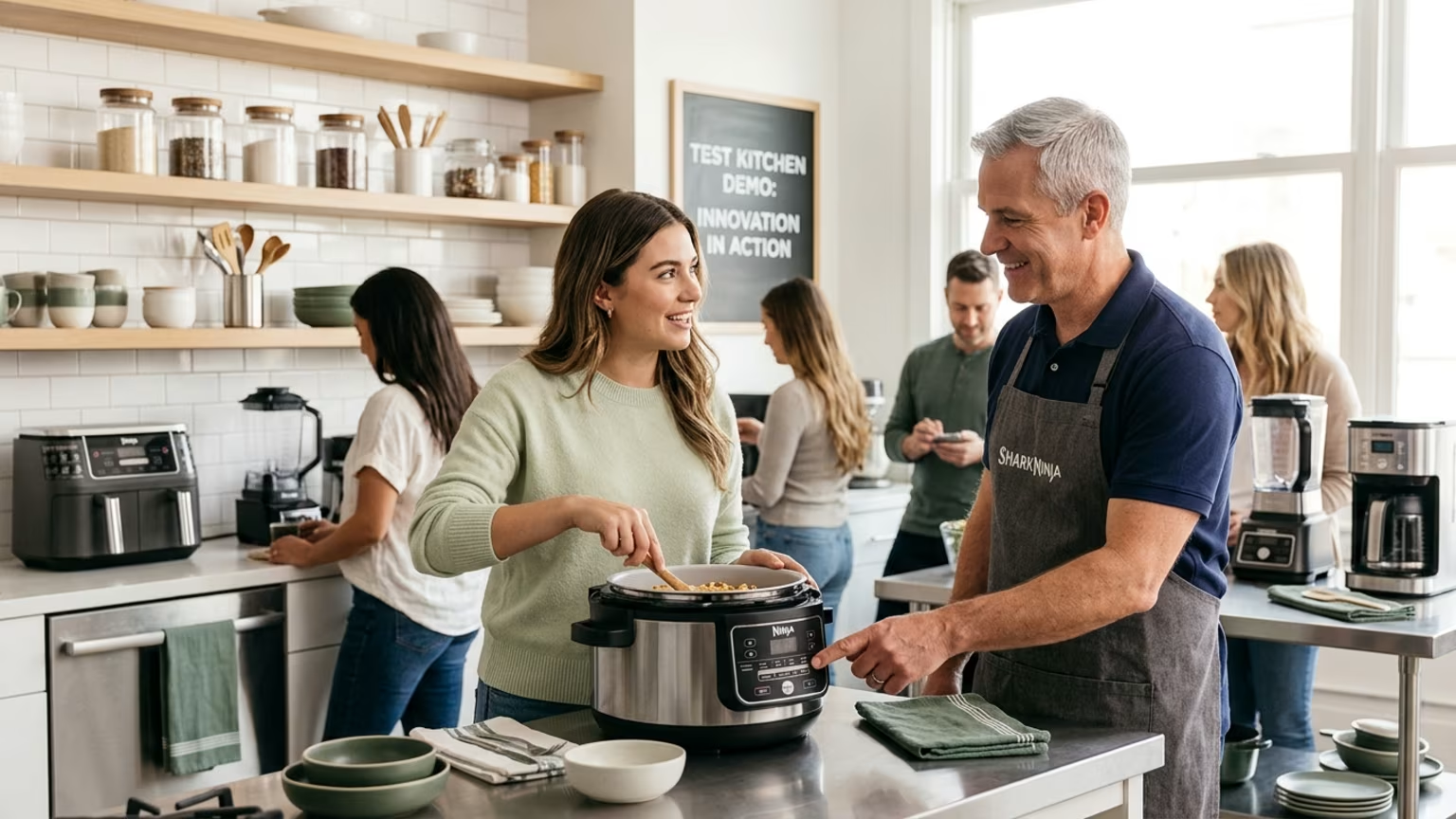
On October 1 and October 2, 2026, Digiday and Modern Retail reported that SharkNinja invites creators to its Boston-area headquarters test kitchen to sample products. The company brings these individuals in to give feedback and record content directly within its corporate facilities. The coverage details how this hands-on product exposure directly informs setup videos, unboxings, and product demonstrations.
This shift moves content production from isolated home studios into a highly controlled physical environment. SharkNinja produces 25 new products a year. Managing the rollout for two dozen distinct items requires immense logistical precision. Modern Retail reports that the company develops a dedicated creator plan for every single launch. The logistics center entirely around this physical test kitchen space where creators interact with the appliances in person. The sheer volume of new releases means the test kitchen must operate constantly. Brands trying to match this pace must secure massive storage facilities for their prototypes and sampling inventory.
When companies try to replicate this exact setup, they must follow a strict operations checklist for multi-location product sampling to maintain quality control. Instead of simply shipping products to external partners, the company controls the initial trial environment from start to finish. The reporting notes that this workflow turns a basic product trial into an active feedback loop. By bringing partners into its Boston-area headquarters, the brand manages exactly how the product is first presented and tested.
This centralized approach changes the standard operating procedure for product launches. The company does not just distribute units and wait for content to return. It structures a physical interaction where creators try the products and offer comments before filming their material. This guarantees that the final demonstration videos reflect real experiences grounded in a company-managed environment.
For CPG and beverage brands, this operational choice proves a critical point about physical marketing. A controlled product trial should not just result in a consumed sample. It needs to generate usable insights and actionable content for future campaigns. At Makai, we believe structured physical spaces give brands more authority over how their story is told in the broader market.
We specialize in creating retail demos, product sampling programs, and roadshows that bring brands face to face with their audiences. Each program is designed to drive trial, build consumer relationships, and accelerate retail velocity across multiple locations. We know that when a brand controls the physical interaction, it captures much better data. This hands-on method builds retail confidence because the resulting demonstrations show genuine, real-world utility.
Measuring marketing performance becomes straightforward when the trial occurs in a structured space. Marketers often struggle to measure the exact return on their live activations because they rely on fragmented field reports. SharkNinja’s test kitchen approach illustrates how physical marketing can serve multiple business functions simultaneously. It operates as a product sampling event, a content production studio, and a research facility all at once. We design mobile activations and roadshows that accelerate consumer trial, build trust, and boost retail velocity during 90-day product launch windows. Our structured approach transforms initial product trial into sustained consumer confidence, which remains the core of a modern product sampling playbook. Brands that want to scale product sampling consistency must adopt a similar operational mindset.
We managed a four-week, multi-market Costco sampling program for Pulmuone's PlantSpired line. The program delivered more than 65,000 samples and recorded an 18 percent sold-to-sale rate, giving us a concrete example of how structured retail sampling can connect trial with purchase. Our operations teams understand that every physical touchpoint must serve a specific commercial purpose. If a physical activation fails to produce measurable pipeline or documentable feedback, it is nothing more than expensive brand theater.
Bringing product demonstrations into a controlled setting forces a major shift in event logistics. When a brand integrates product testing with content creation, every downstream operation must adapt. Field operations can no longer operate in a silo away from the core marketing strategy.
Field teams must build physical environments that support multiple operational needs at the same time. A standard sampling table is no longer sufficient for complex product launches. Brands need a layout that handles storage, preparation, demonstration, and recording without creating bottlenecks. Creating clear flow paths ensures that product testers do not interfere with the camera crews or the culinary preparation teams. Managing food and beverage appliances also requires strict adherence to compliance and safety for trade show sampling and demonstrations.
We designed and managed a 40 by 20 foot trade show environment for Glanbia at Natural Products Expo West 2025. We brought think! and Isopure together with Optimum Nutrition and Amazing Grass in one coordinated space. This setup accommodated high-volume sampling alongside specific brand interactions. We handled concept, operations, staffing, and breakdown, with more than 14,000 recorded product samples distributed across the activation stations. That level of spatial planning is required when your physical space serves as a primary marketing engine. If a venue layout is poor, the entire feedback loop collapses.
Operations teams must focus heavily on matching the person demonstrating the product to its specific use case. According to Modern Retail, SharkNinja specifically considers which creators can best tell a product's story during the planning phase. The brand considers how much content is competitive for a category before assigning individuals to specific product launches. This ensures that the person operating the appliance actually understands its consumer value.
This means experiential marketing managers cannot simply hire generic brand ambassadors. They must recruit specialized talent who understand the exact mechanics of the product they are showcasing. A demonstrator must know how to troubleshoot an appliance or explain the nutritional profile of a new beverage instantly. Teams must build an in-store product sampling execution playbook that dictates how these specialists interact with the items. Brands must also ensure these demonstrators receive comprehensive training before they ever step onto the activation floor. When you hand over the keys to a product demonstration, the physical preparation must be flawless.
Brands must also prepare their operations teams to process and catalog real-time reactions. A test kitchen only generates value if the host company actually records what happens inside it. SharkNinja's official careers listing describes consumer research work that includes qualitative testing, culinary testing, and recording test results. They synthesize these findings for product and brand strategy. When a brand adopts this model, staffing requirements change immediately.
Event teams need personnel who can manage culinary setups, handle recording logistics, and accurately capture consumer objections. This introduces a heavy data management requirement into the field. Measuring a test kitchen or a high-volume retail activation means tracking exactly who tried the product and what questions arose. Marketing leaders need to train their field staff to operate as precise data collectors. When brands rely on hands-on product demonstrations to generate consumer insights, the daily reporting protocol must be completely airtight.
The commitment to this centralized, physical approach is clearly championed at the executive level. Marketing leadership must buy into the heavy logistics required to make this work. Modern Retail reported that chief brand and experience officer Michelle Crossan-Matos called creators the company's "magic sauce."
Crossan-Matos also told Modern Retail that creators produce 70% of the company's content. She explained that the brand carefully evaluates the competitive landscape for each category before deciding on its creator plans. This highlights how an executive views the direct connection between a physical test kitchen trial and sustained brand visibility. It shows that managing the initial physical interaction is viewed as a primary driver of broader marketing success. For CPG brands looking to replicate this strategy, securing executive alignment on the physical costs of these test environments is mandatory.
For marketing leaders mapping out their next launch calendar, the question is no longer just how many units your field team can distribute. Think back to that Boston-area test kitchen where trial, feedback, and content all happen in one controlled room. Are your physical sampling environments structured to capture the exact consumer feedback needed to train your next wave of retail demonstrators?
Securing verified consumer insights from live product trial requires a completely controlled physical footprint. To eliminate the difficulty of navigating complex event logistics, permits, and staffing, Makai manages the entire supply chain. Through Storage & Logistics we store your sampling product and event gear, then ship, track, and coordinate delivery nationwide so every activation stays on schedule. Request a proposal

30 Years Experiential & Retail Activation Partner for CPG & Beverage Brands | Multi-Market Demos, Roadshows & Costco/Club Programs That Actually Sell