Robbie Thain
Founder, CEO

Compare single-store demos, multi-market sampling and roadshows by shopper context, staffing and retail goals to choose a practical activation footprint.

Single-store demos and multi-market sampling programs address different retail decisions: concentrate trial inside one shopping environment or coordinate it across several locations. The trade-off is local focus versus broader coverage, with roadshows and retailer events adding requirements that geographic scale alone does not explain.
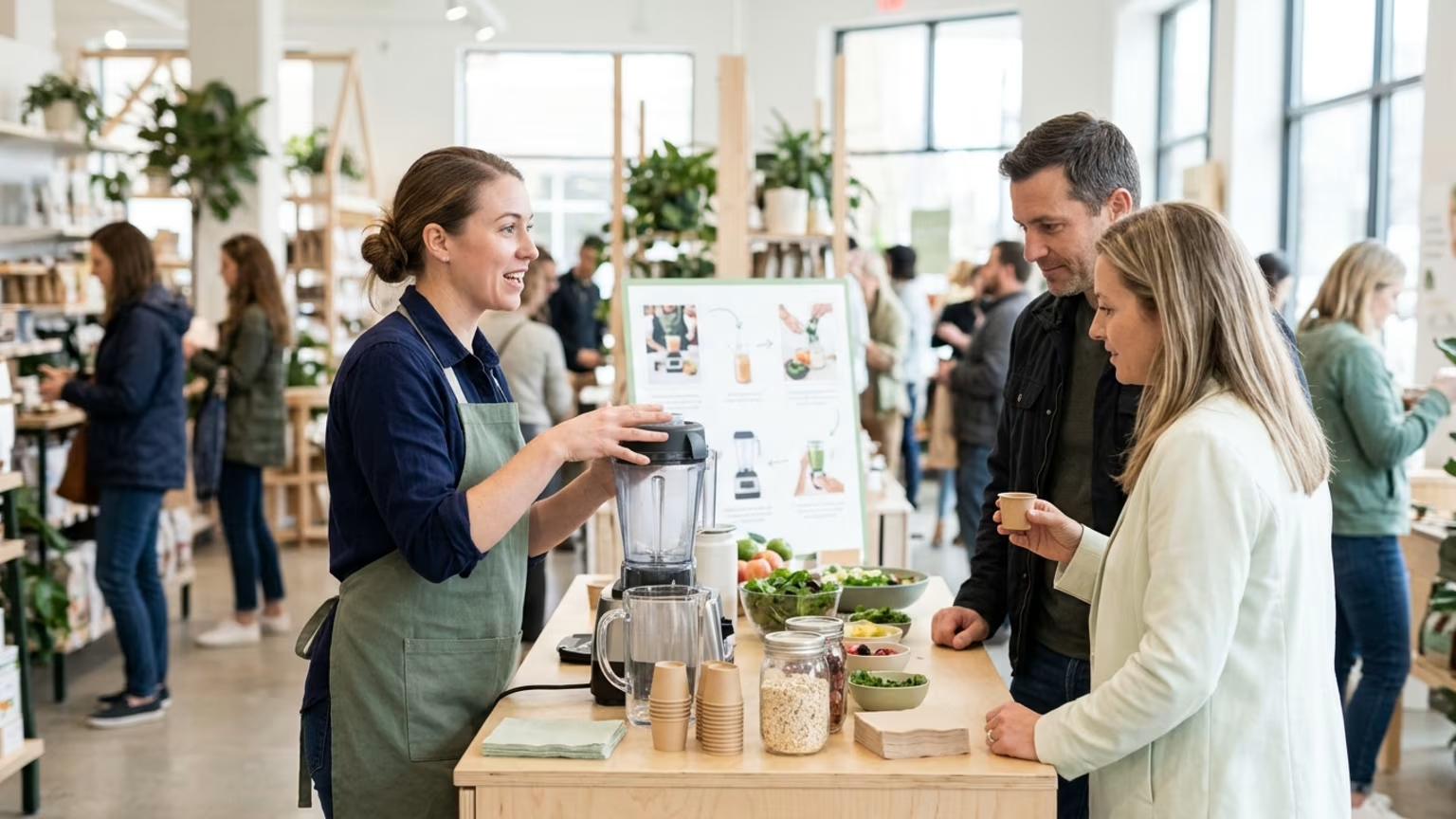
A single-store demo puts a product trial inside a specific shopping trip. Its primary job is to help shoppers evaluate the product while they are already in a retail environment. It is also a practical setting for examining product appeal or how a message works at that location.
At Makai, we specialize in retail demos, product sampling programs and roadshows that bring brands face to face with their audiences. Our retail demonstrations use trained brand ambassadors to connect product trial with real shopper conversations and in-store sales.
The footprint may be limited to one store, but execution still requires coordination. Retailer approval, product availability and product handling need to fit the setting. Staffing must support the interaction the product requires rather than simply put someone beside a sample tray.
A practitioner guide to in-store activation suggests that a short sampling shift may use one trained ambassador. That is a planning example rather than a fixed staffing formula. The product and the execution still determine the work.
The strategic advantage is purchase proximity. The shopper can evaluate the product within the retail context instead of being asked to connect an off-site experience with a later shopping trip. Choosing to match the venue to shopper intent keeps that distinction central to the brief.
A multi-market program repeats sampling across selected locations. The consumer interaction may resemble a single-store demo, but the operating task changes: the team must coordinate multiple store relationships and deployments while keeping execution comparable enough to interpret.
The practitioner guide describes store and date coordination alongside staff recruitment and deployment. It also identifies check-ins and photo confirmation as execution checks. Those details make the difference between planning a collection of dates and managing a coordinated program.
A roadshow adds another dimension. It can operate within a retailer-specific selling environment and require coordination around serving products and retailer operations. A multi-day roadshow may need a small team with backup coverage and more detailed instructions, according to the same guide.
Roadshow and multi-market are therefore not interchangeable labels. One describes an execution format; the other describes geographic coverage. A retailer-based program can use a roadshow format across several locations while retaining purchase proximity.
“Retailer event” is broader still. The useful description is the actual setting: an in-store demo, an in-warehouse roadshow or a retailer-hosted event. The event label should not substitute for a clear account of where trial happens and what shoppers can do next.
We ran a four-week Dole Whip summer sampling program across San Francisco, Boston, Tampa, and Orlando. The activations distributed more than 64,000 servings, and we built the creative assets so the concept could be reused in future campaigns. For this comparison, the useful lesson is that geographic coverage and reusable creative are separate planning decisions from the retail setting.
The available evidence does not provide a controlled ranking of formats or their cost efficiency. Vendor guidance and campaign results are examples rather than forecasts. The ANA finding discussed below comes from a public summary whose full methods are not publicly available on that page.
A single-store demo is the clearest fit when the commercial question is local. These conditions favor a focused footprint:
This is not an argument for making every program small. It is an argument against buying coverage when the decision concerns one store or one retail context.
The shelf connection also needs to be real. A sampling plan should connect trial with product availability, not treat the presence of a demo station as proof that the purchase route is clear.
Broader execution becomes relevant when the objective itself extends beyond a single location. The strongest conditions are specific:
We managed a four-week, multi-market Costco sampling program for Pulmuone's PlantSpired line. The program delivered more than 65,000 samples. That experience illustrates a useful distinction: geographic scale and retail purchase proximity are not opposing choices. A coordinated retailer-based program can combine both.
For launches built around participation, the interaction deserves as much attention as the footprint. The ANA's public summary reports that a study of 2,000 live-event attendees found hands-on participation nearly doubled purchase intent. That finding supports keeping hands-on participation central to the experience brief.
Purchase intent still belongs in a different reporting field from recorded purchases. Likewise, a desire for sharing or a large crowd is not a complete reason to add markets. The brief needs to identify what people will participate in and which retail objective that participation serves.
Over: Back the larger footprint when audience coverage or market-level learning requires coordinated execution. Use a roadshow when the retailer-specific selling environment supports it and the operating requirements are clear.
Under: Keep the footprint focused when the question concerns one store, one shopper context or one message. More locations should answer a broader business question, not merely make the activation look larger.
Before either decision, define the outcome. Trial volume, event purchases and shopper feedback describe different things. Sales change requires a stated baseline or comparison and a measurement window. New-to-brand reach and purchase consideration belong in their own categories.
The same discipline applies to reporting across formats. Sample counts document distribution; they do not establish sales impact. A multi-market total should not erase location-level differences, and a busy retailer event should not be judged by a metric selected after it ends.
Build staffing roles and execution documentation into the plan before scaling. Check-ins and photo confirmation can document delivery, while commercial reporting addresses what happened beyond delivery. Keeping those questions separate makes it easier to define business impact before selecting scale.
The operator's verdict is straightforward: choose the smallest footprint that answers the retail question. Expand when the objective requires broader coverage and the operating plan supports it. Keep product trial and the shopper's purchase route at the center of either choice.
Sampling format decisions sit with field marketing managers; Makai brings trained brand ambassadors into retail demonstrations centered on product trial and shopper conversation. For CPG teams also facing inefficient post-event follow-up and CRM routing, Makai's experiential campaigns are designed to turn brief consumer interactions into qualified leads rather than leave event activity disconnected from pipeline.

30 Years Experiential & Retail Activation Partner for CPG & Beverage Brands | Multi-Market Demos, Roadshows & Costco/Club Programs That Actually Sell