Robbie Thain
Founder, CEO

Define the commercial job of a retail demo before choosing its format, then match trial and sales measures to the outcome that matters.
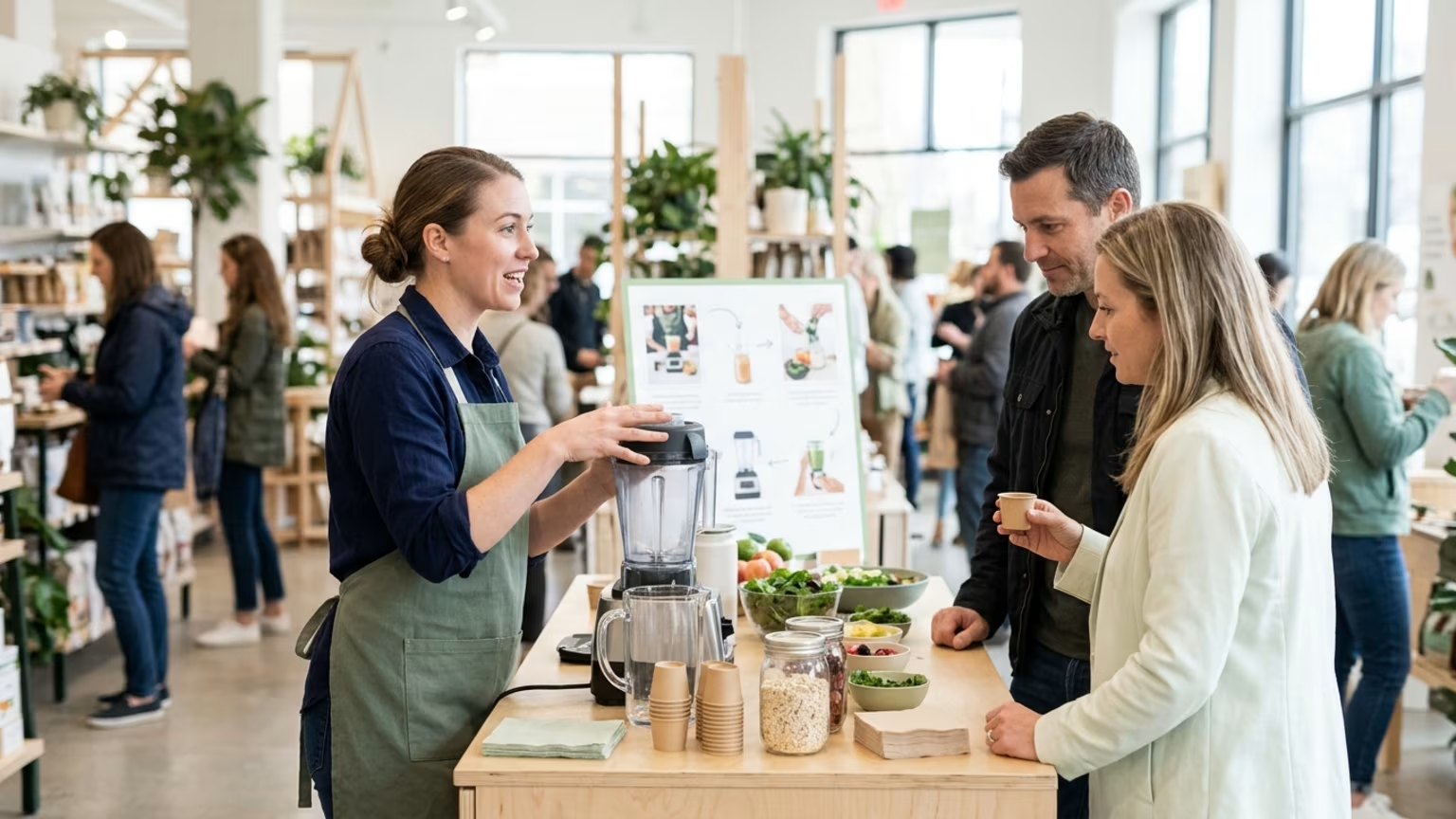
A beautiful retail demo with no defined commercial job is expensive decoration. The sampling cart is not the strategy. Neither is the custom build or the branded roadshow.
Start with the format and the team can spend the entire planning cycle defending something that never answered the business question. What must this interaction accomplish? Introduce an unfamiliar product? Give shoppers a reason to reconsider its taste? Support a retail promotion?
Those are different assignments. They should not automatically receive the same experience or the same definition of success.
Our position is simple: creative work should answer to the commercial job. A welcoming experience matters. But a busy activation should earn its place in the budget through purposeful execution rather than attractive photographs.
Format-first planning makes production decisions look like strategic progress. A footprint gets approved. Graphics move forward. Staffing gets discussed. Meanwhile, nobody has settled whether the program exists to generate trial or produce a measurable sales outcome.
That ambiguity eventually reaches the report. Samples distributed become evidence of engagement. Engagement becomes shorthand for purchase intent. Then a full event recap lands on the CMO's desk without a clear account of commercial progress.
That is the anxiety behind a major activation budget: plenty of visible activity and no defensible sales story. At a trade show, it can mean a crowded space with no qualified pipeline. In retail, it can mean an impressive giveaway total with no useful comparison against normal sales.
An experiential-marketing consultancy's guidance recommends matching the format to the objective. It points toward sampling or demos for first trial when taste or feel matters. For established-product velocity, it also identifies displays and endcaps alongside in-store media and offers.
The practical implication is uncomfortable but useful: a demo is not automatically the right answer. The format should have to justify its role before the team starts polishing it.
Makai's alternative starts with a belief: human warmth and operational rigor belong together. Aloha is not an excuse for loose execution. It is an approachable way of treating people while taking the work seriously.
A shopper should feel welcome to try a product and ask an honest question. The commercial purpose should still be clear. Hospitality does not require turning the interaction into a performance with no purchase relevance.
We specialize in retail demos, product sampling programs and roadshows that bring brands face to face with their audiences. These programs are designed to drive trial and build consumer relationships while supporting retail velocity across locations.
The operational side deserves equal weight. Makai's services extend from permitting to CRM reporting. Our team also stores sampling products and event gear, then ships and tracks deliveries nationwide. Those capabilities address the physical work behind an experience rather than just its appearance.
The same consultancy identifies retailer approval and staffing as execution considerations. It also points to supply and shelf availability. A persuasive concept still has to work within those conditions.
We managed a four-week, multi-market Costco sampling program for Pulmuone's PlantSpired line. It delivered more than 65,000 samples and recorded an 18 percent sold-to-sale rate. The useful detail here is the bounded assignment: a specific product line operating across markets within a defined period.
The sample volume was part of the account of performance, not the entire account. A reported sales-related measure sat beside it. That is a more useful basis for commercial discussion than treating distribution volume as the finish line.
We also design mobile activations and roadshows to build trial and trust during 90-day product launch windows. For us, that planning horizon should sharpen the assignment rather than replace it. A launch still needs a clear job for each interaction.
This is why execution quality across locations belongs in the strategic conversation. Warmth gives the interaction human value. Discipline keeps the program connected to its intended outcome.
The brief should name the change the program is meant to support before describing the experience. Based on the objective-to-format guidance, we would frame the main assignments this way.
If the job is first trial, make product experience the center of the brief. The consultancy specifically recommends demos or sampling when taste or feel matters.
Trial counts or trial rate may be relevant primary measures for that assignment. Sales can remain part of the report without silently replacing the stated objective. The team should know whether it is being asked to create first contact or demonstrate purchase impact.
An objection-focused brief should identify what the product experience needs to address. A generic giveaway does not describe that job clearly enough.
A trial count records participation. It does not establish that the objection changed or that the shopper purchased. If the commercial assignment is sales, retain a sales measure rather than letting the number of product interactions stand in for it.
The point is not to make the conversation colder. It is to give the conversation a relevant purpose.
A promotion is operating context, not a result. Define whether the demo's contribution is intended to increase trial or support unit sales during the promotional period.
The consultancy recommends tracking promotions as part of measurement. That matters when interpreting results because the offer and the demo may be operating together. The report should preserve that context instead of awarding the entire sales change to sampling.
These objectives can sit near each other in a presentation while asking different questions. Trial asks whether people experienced the product. Velocity asks about product movement through retail.
Choose the primary measure accordingly. The consultancy's examples include trial rate and unit sales per store per day. For an established product, its format guidance also leaves room for options other than a staffed demo.
A useful brief therefore names both the desired outcome and why a live product interaction is suited to pursuing it. It does not begin with a preferred piece of equipment.
The consultancy recommends choosing one primary outcome and comparing test stores with comparable controls against a pre-activation baseline where feasible. Its examples include unit sales per store per day and incremental dollars as well as trial rate.
A separate sampling operations guide recommends comparing demo-day sales with the same store's typical sales on the same weekday. It also warns that restocking can distort estimates based on shelf counts.
These are practitioner recommendations rather than a validated universal protocol or a guarantee of causation. Our reported Pulmuone result is also specific to that engagement rather than a forecast for another brand.
The practical guidance is to agree on the comparison before reporting the outcome. A busy day has limited meaning if the team has not defined what normal performance looks like.
Keep the reporting categories separate:
One primary outcome does not mean the report contains only one number. It means the team knows which result answers the assignment. Supporting measures explain what happened without competing to become the headline after the event.
The consultancy also recommends looking during the activation and in the following weeks, along with repeat purchase. Those windows should follow the question being asked. The event-day report and the later purchase question are not interchangeable.
For a first-trial assignment, report trial directly. For a sales assignment, use sales evidence. If the assignment is retail buyer development at a trade show, track qualified conversations and meetings booked rather than borrowing consumer sample volume as pipeline evidence.
This is the discipline behind measuring sampling against business outcomes. A Return on Investment discussion should not begin by relabeling attention as revenue. It should begin with the outcome the program was commissioned to pursue.
Core takeaway: A retail demo should have a commercial job before it has a format. Human connection makes the experience worth having, but operational discipline keeps that experience tied to a useful outcome. Demand a clear assignment and a relevant measure. Then judge the work by how well it executes that assignment, not by how impressive the activation looks or how quickly the samples disappear.
For activations measured by qualified leads, Makai manages sampling-product and event-gear storage alongside nationwide shipping, tracking and delivery coordination. For CPG marketers dealing with weak contacts from crowded shows, Makai builds experiential campaigns and trade show activations around generating qualified leads rather than counting badge scans.

30 Years Experiential & Retail Activation Partner for CPG & Beverage Brands | Multi-Market Demos, Roadshows & Costco/Club Programs That Actually Sell


