Robbie Thain
Founder, CEO

Handing out thousands of samples at crowded events turns into sustained retail sales through structured commerce bridges, digital follow-ups.
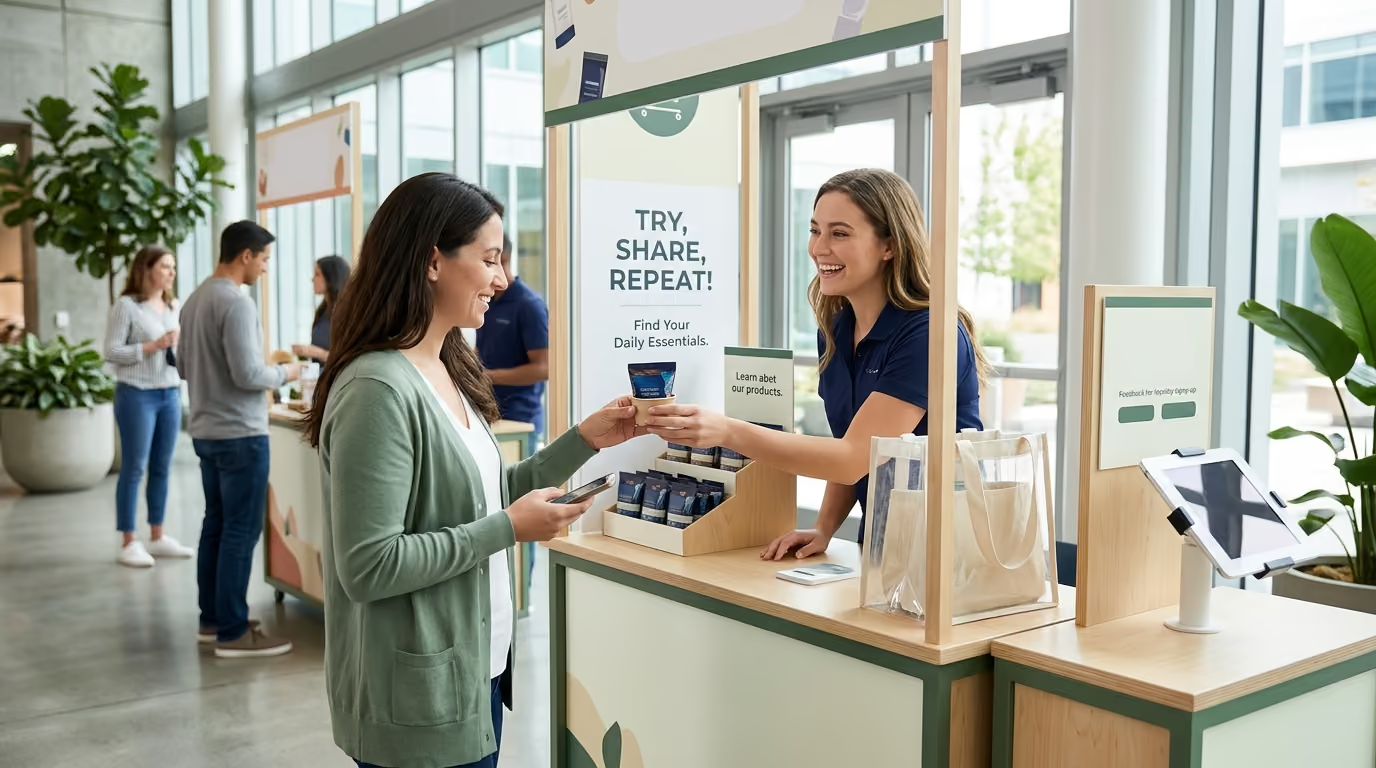
Mobile sampling programs succeed commercially only when product distribution connects directly to a structured, measurable retention engine. This resource outlines the operational frameworks, retail bridges, and data architectures required to turn initial physical trial into sustained repeat purchase volume.
Handing out thousands of free products on a city street or event plaza is easy. Building a system that compels a consumer to visit a grocery store seven days later to pay full price is exceptionally difficult. Most brand activations treat the physical handover of a product sample as the finish line of marketing. In reality, that first interaction is merely the opening second of an extended commercial relationship.
Imagine a typical Saturday activation footprint outside a regional shopping center or festival venue. Brand ambassadors rush to empty coolers, shouting taglines over loud music while handing out hundreds of units per hour to anyone walking past. Passersby grab the cold can or snack pack, consume it within thirty seconds, toss the packaging into a nearby bin, and disappear into the crowd. The marketing dashboard logs five thousand samples distributed, yet retail registers inside nearby stores see zero measurable lift the following week.
This breakdown occurs because field execution is frequently isolated from retail reality and post-trial engagement. Marketing teams celebrate massive distribution numbers, confusing foot traffic with customer acquisition. When the activation ends, the brand retains no contact information, no consumer feedback, and no bridge directing the shopper to local store shelves. The immediate day-of excitement evaporates without leaving a trace in the brand's sales pipeline.
A successful program requires discipline, data collection, and tight coordination across retail partners. Product trial must serve a specific diagnostic function that introduces the product, demonstrates value, and removes purchase friction. To turn a mobile tour into a profitable pipeline, brands must replace random distribution with a structured science of turning trial into repeat sales.
To build long-term volume, brands must view mobile sampling as an integrated customer acquisition system. This system moves a target shopper systematically from initial sensory exposure to unassisted, full-price purchase. Research confirms that physical sampling can alter consumer buying habits when executed with precision.
A landmark Knowledge Networks and PDI study evaluated frequent-shopper data across more than 16 million households. The research revealed that sampled products achieved an average 475 percent sales lift on the day of the event. More importantly, sampled households were 11 percent more likely to repurchase the specific item over the following 20 weeks. Those same households were also 6 percent more likely to buy another product from the broader brand portfolio.
Academic findings reinforce these retention dynamics. Research published in the Journal of Retailing analyzed store scanner datasets across multiple consumer packaged goods categories. The researchers found that sampling creates both immediate and sustained sales effects over extended periods. Furthermore, repeated sampling exposures within the same market produced a multiplicative increase in long-term sales performance.
A global survey on new product discovery by Nielsen found that 70 percent of consumers identify free samples as a primary source of product awareness. The same study noted that personal recommendations from friends and family remain the single most persuasive purchase factor at 77 percent. Mobile sampling operates at the intersection of these two forces by delivering hands-on product discovery alongside positive, human peer interactions.
To translate these principles into consistent results, field teams should organize their activations around a seven-stage flywheel.
Do not chase raw footfall. Focus on consumers who fit the category need, consumption occasion, and geographic proximity to distribution points. Academic research on sampling programs demonstrates that shoppers with moderate prior platform experience show the highest post-trial adoption rates. Passing out premium functional beverages to children or uninterested passersby burns inventory without building pipeline.
A sample should educate the consumer on product utility, flavor profiles, and distinct brand advantages. The interaction must clarify which specific problem the item solves and show how to integrate it into daily life. For functional foods or personal care items, explanation from trained staff is just as critical as the physical product trial itself.
Give the consumer a singular, intuitive path to complete their initial commercial transaction. This bridge can take the form of an instant digital coupon, a direct retail navigation link, or a store locator. The call to action must match the immediate context of the activation site.
Offer an immediate incentive in exchange for consumer contact details and marketing consent. Useful incentives include digital recipe books, exclusive retail savings, or entries into regional giveaways. Keep data capture light to prevent queue delays and respect consumer privacy standards.
Send a digital communication while the memory of the product interaction remains fresh. This message should reinforce key benefits, provide clear local retail locations, and deliver the promised promotional incentive. Tailor the content based on the consumer segment and the specific sample variant they received.
Map communication schedules to the natural consumption cycle of the product. A single-serve beverage requires a follow-up message within three days, while a multi-serve food package may require seven to ten days. Prompt the user to restock before their trial experience fades from memory.
Once a consumer completes their first retail purchase, transition them into standard brand loyalty workflows. Invite them to leave product reviews, refer friends, or join retailer-specific rewards programs. Rewarding customer advocacy transforms trial recipients into active brand ambassadors within their personal communities.
Executing a high-retention sampling tour requires operational cohesion across multiple departments. Field marketing, digital media, shopper marketing, and e-commerce teams must synchronize their efforts prior to tour launch. We structure our campaigns using a three-layer operating architecture that connects live consumer interactions with ongoing retail sell-through.
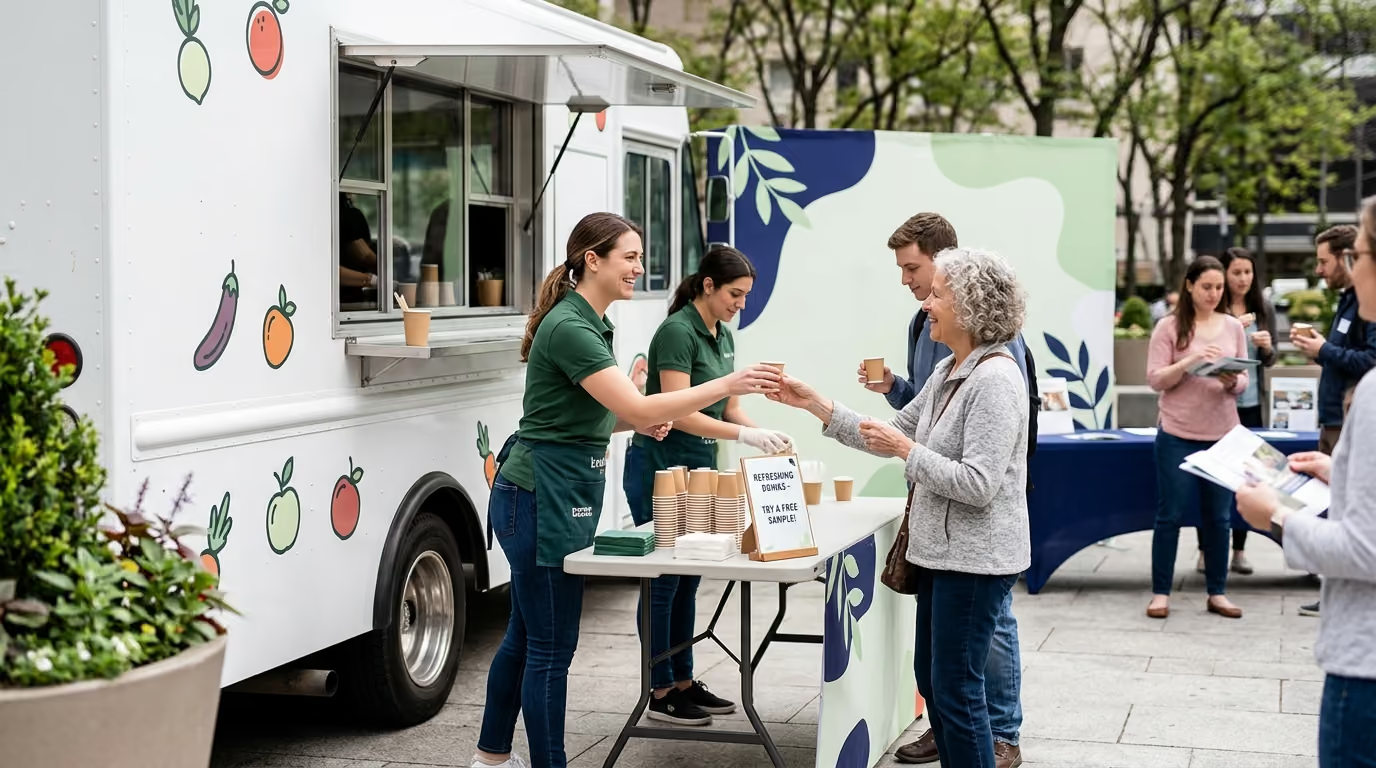
The physical layer represents the consumer touchpoint in the field. This includes the mobile vehicle, staging footprints, cold chain storage, sanitation protocols, and brand ambassador teams. Every physical element must convey quality and invite participation. In our experience, high-conversion mobile tours require disciplined field logistics, strict temperature controls, and highly trained staff who can communicate brand positioning in thirty seconds or less.
We design mobile activations and roadshows that accelerate consumer trial, build trust, and boost retail velocity during 90-day product launch windows. Our structured approach transforms initial product trial into sustained consumer confidence and retail performance.
The commerce layer transforms trial interest into a tangible retail transaction. This mechanism connects the physical event footprint directly to local retail shelves or digital store checkouts. Tools include dynamic QR codes linked to store locators, mobile wallet coupons, and digital circular integrations. The goal is to eliminate confusion regarding where and how to purchase the full-size item locally.
According to a grocery shopper study by Progressive Grocer, 95 percent of respondents reported shopping at physical supermarkets during the preceding month. Even as digital shopping options expand, physical store shelves remain the dominant fulfillment channel for consumer goods. The commerce bridge must direct foot traffic to specific local retailers that maintain adequate inventory of the sampled items.
The retention layer manages ongoing consumer communication after the field activation closes. This ecosystem includes customer relationship management platforms, marketing automation sequences, and retail loyalty integrations. It ensures that collected first-party records receive timely, relevant follow-up messages tailored to product preferences and local retail availability.
A mobile tour that lacks a retention layer is merely an expensive awareness exercise. A retention system without a compelling physical experience struggles to capture qualified consumer records. High-performing brands activate all three layers simultaneously to maximize their commercial Return on Investment.
Executing a conversion-focused mobile sampling tour requires operational discipline before, during, and after field deployment. Teams must avoid improvising engagement strategies on site. Follow this structured execution playbook to turn everyday field operations into consistent retail velocity.
Route each participant through one of three specific post-activation journeys:
To understand how high-growth food and beverage brands deploy similar structured routes nationwide, review our analysis of multi-city mobile sampling tours.
To evaluate sampling investments accurately, marketing leadership must separate operational vanity metrics from true commercial outcomes. Distributing fifty thousand units proves operational endurance, but it does not prove enterprise value. Brands must implement a rigorous measurement framework that balances real-time field performance against verified retail sales lift.
Industry measurement standards separate campaign reporting into three distinct levels:
Evaluating campaign efficiency requires clear denominator discipline across every stage of the activation funnel.
$$\text{Engagement Rate} = \frac{\text{Engaged Visitors}}{\text{Qualified Foot Traffic}}$$
$$\text{Trial Rate} = \frac{\text{Samples Distributed}}{\text{Engaged Visitors}}$$
$$\text{Capture Rate} = \frac{\text{Opted-in Consumer Records}}{\text{Samples Distributed}}$$
$$\text{First Conversion Rate} = \frac{\text{Verified Initial Purchases}}{\text{Opted-in Records}}$$
$$\text{90-Day Repeat Rate} = \frac{\text{Consumers Making Two or More Purchases}}{\text{Total Acquired Purchasers}}$$
True incrementality represents sales volume that would not have occurred without the marketing intervention. To prove incrementality, brands must establish rigorous baseline comparisons.
Compare activated retail store clusters against non-activated control stores with matching historical sales volumes and demographic profiles. Track sales velocity across both groups for four weeks prior to activation, during the tour window, and for twelve weeks following the event.
A comprehensive review of experiential measurement methodologies highlights that measuring baseline sales trends is critical to isolating marketing lift from macro market fluctuations. By utilizing matched-panel controls, field operators can definitively isolate consumer demand generated by live product interactions.
Financial viability depends on customer lifetime value rather than single-transaction profits. A mobile tour may generate a negative return on immediate first purchases due to staging and travel logistics. However, when those acquired consumers transition into habitual repeat buyers over twelve months, the program delivers strong cumulative returns. For an in-depth breakdown of field evaluation models, explore our guide on CPG sampling programs that drive sales.
Different product categories and retail environments require distinct sampling models. Designing a program for a club-store food product demands different mechanics than launching a direct-to-consumer functional beverage. Below are four proven field patterns designed for long-term retention.
Field activations operate in unpredictable environments. Weather fluctuations, technical failures, supply chain delays, and demographic variations require clear contingency planning. Brands that prepare for operational edge cases protect their campaign efficiency and brand reputation.
A successful morning activation can quickly clear nearby store shelves. When local retail inventory runs out, brand ambassadors must immediately pivot their messaging.
Staff should direct consumers to alternative retail banners in the area or switch the digital bridge to an e-commerce checkout page offering free shipping. Never distribute physical coupons for nearby stores when shelf inventory is completely depleted.
Community festivals and public parks frequently attract families with children. Field marketing teams must enforce strict consent protocols when interacting with minors. Brand ambassadors should never collect digital contact data or distribute food samples to children without explicit parental permission.
Regulatory standards established by data protection authorities state that electronic marketing requires clear, informed, and affirmative user consent. For family events, design brand engagement activities that welcome children while focusing digital registration and commerce bridges exclusively on parents.
Food and beverage sampling requires rigorous safety and ingredient transparency protocols. Prominently display clear ingredient boards and allergen warnings on vehicle counters and digital sampling stations.
Train field staff to ask consumers about dietary restrictions prior to handing over consumable samples. Maintain separate prep zones and utensils for products containing dairy, nuts, soy, or gluten to prevent cross-contamination.
Rain, extreme heat, or high winds can rapidly disrupt outdoor sampling operations. Mobile vehicles must carry commercial-grade shade canopies, waterproof digital signage covers, and weighted ballast gear.
For high-temperature activations, ensure backup generator capacity to maintain cold chain product safety. Maintain flexible routing permits that allow teams to pivot into covered transit plazas or indoor partner spaces during adverse weather. For a complete guide to operational safety, read our resource on designing mobile activations for real conditions.
Inevitably, consumers who already buy the product will approach the sampling footprint. Do not waste standard trial offers on existing brand advocates.
Train staff to recognize existing consumers and pivot the interaction. Offer them samples of new product line extensions, invite them to join referral programs, or reward them with exclusive brand merchandise. Leveraging existing consumers as authentic on-site advocates creates immediate social proof for surrounding prospective buyers.
Many experiential campaigns underperform because they repeat common operational mistakes. Eliminating these friction points ensures that your budget drives long-term customer acquisition rather than temporary theater.
Focusing strictly on total units distributed is the fastest way to waste marketing spend. High sample counts frequently mask poor audience targeting, untracked waste, and low product engagement.
Shift your key performance indicators from total units handed out to cost per qualified conversation, capture rate, and 90-day repeat purchase velocity. Quality of interaction consistently outperforms raw volume in driving retail sell-through.
Handing someone a sample without explaining what it is or where to purchase it creates a commercial dead end. Every sample must feature clear packaging branding and an immediate digital call to action.
Ensure brand ambassadors deliver a concise, fifteen-second verbal bridge that highlights the primary product benefit and identifies the nearest retail stockist.
Requiring consumers to fill out extensive forms on a smartphone screen in a crowded public setting destroys conversion rates. Lengthy forms cause long lines, frustrate consumers, and reduce total program throughput.
Limit data capture fields to a mobile phone number or email address alongside a single flavor preference selection. Deliver deeper profiling surveys during subsequent digital follow-up interactions once the consumer is in a relaxed home environment.
Offering massive initial discounts can undermine a premium brand's perceived value and attract deal-seekers who will never purchase at regular retail pricing. Continuous deep discounting obscures whether the product itself is building organic consumer demand.
Utilize value-add incentives, such as recipe guides, complimentary merchandise, or loyalty points, alongside moderate retail discounts. Focus consumer attention on product performance and lifestyle utility rather than price concessions.
Field agencies frequently gather event leads that never reach the brand's central marketing automation platform. Similarly, shopper marketing teams often negotiate retail endcaps without informing mobile tour dispatchers.
Establish shared reporting dashboards and data integration pipelines across agency partners, field managers, CRM administrators, and retail marketing directors prior to tour launch. Unified data systems ensure that every field interaction receives automated, timely commercial support.
Designing a mobile sampling tour for repeat purchase transforms experiential marketing from an untracked expense into a predictable, scalable retail growth engine.

30 Years Experiential & Retail Activation Partner for CPG & Beverage Brands | Multi-Market Demos, Roadshows & Costco/Club Programs That Actually Sell