Robbie Thain
Founder, CEO

Standing in busy expo aisles while attendees ignore your graphics signals that you must align physical booth architecture with deliberate buyer psychology.

Most trade show exhibits are built as decorated real estate rather than disciplined conversion systems. Building an exhibit that reliably generates revenue requires aligning your physical space, staff choreography, demonstration structure, and qualification criteria around a single commercial promise.
The common assumption across event marketing is that higher booth traffic automatically creates more revenue. In practice, packed aisles and endless badge scans often dilute pipeline quality, exhaust booth staff, and create an illusion of commercial momentum. Trade show floors are noisy, chaotic environments where hundreds of exhibitors fight for fleeting attention. Unprepared visitors wander between aisles, distracted by bright screens, aggressive sales pitches, and bags full of promotional giveaways. Booth staff frequently huddle near the back wall, stare at mobile devices, or barrage passersby with open-ended, low-value questions like "Can I help you?" or "Would you like some free swag?"
When hundreds of companies present identical claims of industry leadership, attendees experience sensory fatigue within their first hour on the show floor. Every brand claims to be an innovative partner, yet few explain what problem they solve within the three seconds a walking prospect glances at their fascia board. The result is a high volume of accidental interactions, long queues of unqualified visitors collecting novelty items, and a stack of contact scans that never turn into active sales opportunities.
Converting trade show attendance into pipeline requires treating the exhibit as a structured physical funnel. Every square foot of flooring, every graphic panel, and every staff action must guide high-intent buyers through a deliberate psychological progression from initial visual contact to an agreed commercial next step.
A successful booth functions as an architectural sequence that shapes human behavior. Rather than attempting to close a transaction in the aisle, the exhibit must move a target buyer across six distinct stages.
The first stage is visibility. A prospect must isolate your booth from adjacent exhibits across a crowded hall. Visibility relies on contrasting light, elevated structural elements, clean geometry, and uncluttered negative space. If a visitor cannot identify your brand and core category from thirty feet away, they will keep walking.
The second stage is relevance. Within two to three paces of approaching the threshold, the visitor must recognize an explicit role, operational problem, or desired commercial outcome that applies to their business. Freeman attendee research indicates that 87% of event attendees cite discovering new products, solutions, and partners as their primary reason for attending exhibitions. Furthermore, 80% of participants view in-person events as the most trusted marketing channel available. Relevance bridges trust and discovery by answering the unspoken question every buyer asks: "Is this built for someone like me?"
The third stage is curiosity. Once an attendee recognizes relevance, they require an immediate reason to pause their journey down the aisle. Curiosity is generated through observable activity. A visible product demonstration, a side-by-side comparative test, or a real-time diagnostic display pulls the buyer from the aisle into the booth perimeter.
The fourth stage is confidence. Once inside the environment, the prospect seeks proof that reduces the risk of adoption. This is where verified performance data, reference architectures, industry certifications, and knowledgeable subject-matter experts validate the claims made on the overhead graphics.
The fifth stage is commitment. A qualified visitor must agree to a concrete commercial next step before exiting the booth footprint. This is not a request for generic contact details. It is a scheduled technical consultation, an on-site facility audit, a pilot agreement, or a customized pricing review.
The final stage is continuity. The physical experience must transition seamlessly into digital sales execution. Data published by the International Association of Exhibitions and Events (IAEE) reveals that properly qualified event leads achieve an average conversion rate of 40%, compared to just 11% for unqualified event contacts. Continuity ensures that specific contextual data collected on the show floor routes instantly to account executives for immediate, relevant follow-up.
A trade show booth cannot communicate your entire product catalog or corporate history. It must articulate one primary strategic positioning idea tailored specifically to the target audience attending that specific event.
Begin by drafting a clear positioning statement before approving structural designs or graphic layouts. Define the exact buyer persona, their core operational bottleneck, the category you are disrupting, the primary quantifiable benefit you deliver, and the reason they should believe your claim. If your positioning statement contains more than twenty words or relies on corporate jargon, it will fail on the exhibit floor.
Once your core positioning is locked, deploy a multi-layered messaging hierarchy across your spatial footprint. This hierarchy governs what an attendee reads, processes, and understands at varying physical distances from your booth.
Overhead hanging signs, towers, and upper wall graphics must answer two fundamental questions: What is this, and is it for me?
Use bold typography with high visual contrast against the convention hall background. Avoid generic slogans like "Empowering Tomorrow's Solutions." Instead, state the category and audience directly. Clear examples include "Quality Inspection Systems for High-Volume Bottling Lines" or "Fleet Management Telematics for Regional Logistics Providers." A prospect walking the main aisle should understand your domain without stopping.
As the prospect nears your booth perimeter, their gaze drops to eye level. The mid-tier graphic surfaces on the back wall and perimeter kiosks must explain why the visitor should invest their time.
Focus this layer entirely on the primary business outcome you deliver. Replace vague feature lists with direct commercial results. Statements such as "Reduce Unplanned Line Stoppages by 34%" or "Cut Batch Certification Time from Days to Minutes" give the attendee a compelling financial and operational reason to halt their stride.
At the threshold of your booth, the visitor evaluates whether your approach differs from their existing vendors. This layer articulates your unique mechanism or proprietary architecture.
Highlight specific structural advantages, such as "Installs Over Existing Conveyors Without Rewiring" or "Direct Integration with Legacy ERP Systems." This messaging equips the prospect to understand your technical advantage before they engage in conversation with your booth staff.
Once the visitor steps onto your carpet, they require validation. This messaging tier lives on demonstration pedestals, digital interfaces, and customer validation panels.
Display named customer metrics, regulatory accreditations, and third-party laboratory verifications. Avoid ambiguous claims of market leadership. Present concise proof points, such as "Validated across 1,200 production facilities" or "Certified ISO 9001 and FDA 21 CFR Part 11 Compliant."
The final layer prompts immediate participation. CTAs must appear alongside every product station and demonstration zone.
Eliminate passive signage that merely directs visitors to "Learn More." Use actionable, value-focused invitations such as "Run Your Line Data Through Our Three-Minute Throughput Calculator" or "Request Your Custom Packaging Compatibility Audit."
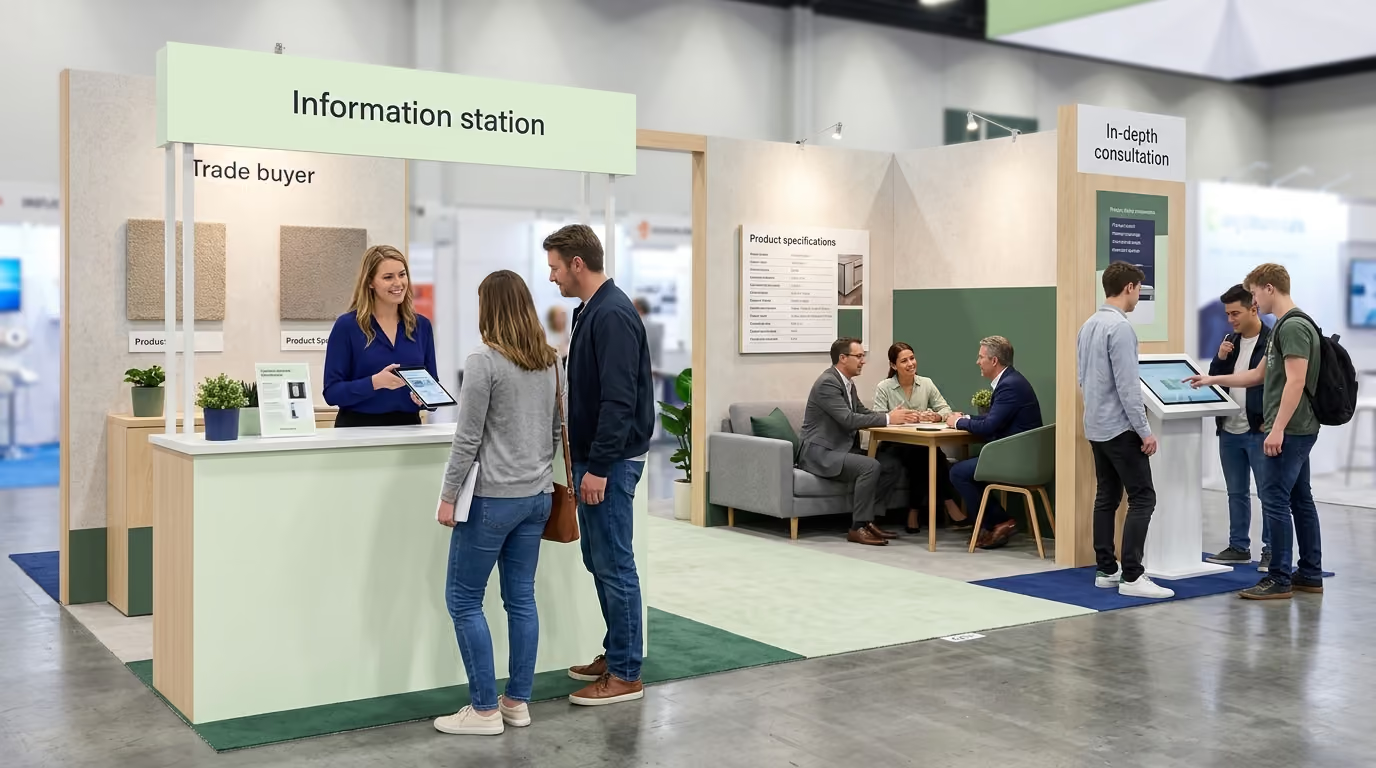
Exhibition design is an exercise in applied ergonomics and behavioral psychology. High-performing booths prioritize open sightlines, intuitive circulation paths, and clear spatial separation between casual observers and deep commercial consultations.
To build an environment that converts, avoid the temptation to fence off your space with counters, perimeter literature racks, or bulky structural barriers. Barriers create psychological friction that deters aisle traffic from stepping inside. Maintain clear entry portals on all open sides, ensuring visitors can view live demonstrations from the aisle without feeling trapped.
Divide your floor plan into three dedicated functional zones:
The Engagement Zone occupies the perimeter facing the primary aisles. This area features high-contrast visual displays, interactive micro-stations, and active product demonstrations. The purpose of this zone is rapid discovery and qualification. Visitors should be able to touch a product, view a ten-second process demonstration, or interact with a benchmark screen within two paces of the aisle.
The Demonstration Zone sits immediately behind the engagement perimeter. This space houses semi-private demo pods, technical workstations, or physical equipment displays where pre-qualified prospects spend three to seven minutes examining product workflows with an application specialist. Design these stations with adequate standing room for small groups, integrated screen mounts, and clean cable management to avoid operational clutter.
The Consultation Zone is positioned toward the rear or center core of the booth footprint. This area should provide acoustic separation, comfortable seating, charging ports, and dedicated surfaces for reviewing architectural diagrams, operational data, or contract terms. By isolating deep business discussions from the bustling perimeter, you protect high-value sales conversations from floor noise and visual distractions.
When planning your layout, evaluate how demo-centric booth designs drive qualified conversions by keeping active demonstrations front and center. Incorporating proper branding details on the show floor ensures every graphic and structural asset reinforces your core message rather than adding decorative noise.
Lighting plays a crucial role in directing attendee focus. Standard hall lighting is diffuse, flat, and unflattering. Utilize directional warm spotlights to illuminate product hero areas, graphic messaging, and demonstration zones. Highlighting your focal points with double the foot-candles of the surrounding aisle naturally draws the human eye toward your key assets.
Product demonstrations are the most powerful mechanism for building buyer conviction on the trade show floor. Guidance from the Center for Exhibition Industry Research (CEIR) shows that product presentations and live demonstrations represent the single most preferred engagement method for attendees. Research from Exhibit Surveys further confirms that structured presentations and live demonstrations increase exhibit recall by 51% compared to static displays.
A demonstration should never be an unstructured, comprehensive walkthrough of your software navigation or mechanical engineering. It must be structured as a disciplined, repeatable narrative designed around three precise durations.
The ten-second demonstration targets passing foot traffic. Its sole objective is to interrupt the attendee's stride and secure their permission for a longer conversation.
This micro-demo showcases a single dramatic action and an unmistakable visual result. In software, this might be a single-click data transformation that eliminates hours of manual data entry. In industrial equipment, it could be a rapid mechanical cycle illustrating extreme operating speed. The staff member executes the action, points to the quantified output on a display monitor, and delivers a concise summary hook: "That automated routine replaces sixteen hours of manual spreadsheet reconciliation every single week."
The three-minute demonstration is designed for an interested visitor who steps into the booth perimeter. It follows a rigid narrative arc that moves rapidly from problem to business resolution.
The fifteen-minute demonstration is reserved for pre-booked accounts or thoroughly vetted decision-makers who enter the booth with active buying intent.
This deep session takes place in the Consultation Zone. It allows the technical specialist to load the prospect's real-world operational parameters, explore edge-case configurations, review integration pathways, and address security or regulatory criteria. The session concludes with a defined commercial commitment, such as an agreed proof-of-concept timeline or an on-site facility trial.
To maintain complete reliability during live events, your team must prepare for common operational failures:
Planning these contingencies protects your brand credibility and prevents expensive floor downtime.
Enterprise and commercial buyers operate under intense professional risk. Recommending a new vendor, changing an established operational process, or committing capital expenditure can impact careers. Your booth experience must function as a risk-reduction machine by presenting clear, verifiable proof points at every touchpoint.
Align your evidentiary assets directly against the primary objections your sales team encounters in the field.
When buyers question whether your system can reliably perform in complex environments, abstract marketing claims fall flat. You need tangible, accessible evidence.
Deploy live stress tests directly inside your space. Feature side-by-side comparative displays that pit your solution against traditional methods under identical operating conditions. Provide printed technical white papers and accredited laboratory reports that rigorous engineering buyers can review and take with them.
Prospective clients frequently worry that implementing a new solution will disrupt existing workflows or require extensive custom engineering.
Display clear visual systems architecture diagrams that outline native connectors, data flows, and legacy hardware compatibility. Use case cards that document exact deployment timelines, such as showing how an existing client integrated your platform across twelve facilities in thirty days.
Mid-market and enterprise buyers must confirm your organization has the financial stability, compliance framework, and support capacity to deliver long-term value.
Highlight your regulatory certifications, data privacy accreditations, and long-standing customer retention rates prominently on your proof walls. Display recognizable customer logos categorized by vertical market, accompanied by brief, attributed quotes detailing realized Return on Investment.
Organize your evidence in a clear hierarchy that matches the visitor's depth of engagement:
By providing multiple layers of validation, you empower your team to neutralize skepticism quickly and steer conversations toward strategic value.
Even the most sophisticated booth architecture will fail if your floor staff behaves passively. Staff members are the human interface of your brand. Their job is not to deliver generic corporate spiels, but to diagnose visitor fit, establish relevance, and guide qualified buyers toward commercial commitments.
Eliminate unstructured booth staffing. Assign every individual a single operational role with defined responsibilities during every floor shift.
Positioned at the outer perimeter of the booth, the engagement lead watches aisle traffic, identifies target badges, and initiates initial contact.
This role never uses closed, low-value questions like "How is the show going?" Instead, they use diagnostic opening scripts that immediately isolate business challenges.
These diagnostic questions prompt meaningful responses from target buyers while allowing non-prospects to walk past without consuming valuable staff time.
The demo specialist stays positioned at the primary workstation or equipment station. Their sole focus is delivering high-energy ten-second and three-minute demonstration narratives with mechanical precision.
When an engagement lead brings a qualified visitor to the station, the handoff is crisp and contextual: "Sarah, this is Mark from Horizon Logistics. They are currently managing sixteen distribution centers and are looking to cut their dispatch latency." The demo specialist immediately tailors the opening narrative to that specific operational scale without repeating introductory questions.
Senior technical specialists and product engineers handle deep architectural reviews in the Consultation Zone. They step into the conversation when a prospect presents complex integration requirements, regulatory hurdles, or advanced operational specifications.
Their presence provides immediate credibility, ensuring technical buyers receive definitive, authoritative answers to high-stakes questions on the spot.
For large exhibits, designate a shift commander to oversee booth operations. This individual monitors aisle congestion, manages staff rotation schedules, ensures demonstration stations remain supplied and operational, and monitors lead-capture data integrity in real time. The shift commander prevents staff from clumping together in conversation, ensuring maximum coverage across all active aisles.
Staff consistency is maintained through mandatory pre-show training. Every team member must memorize the one-sentence positioning statement, master the three-minute demo flow, understand the qualification criteria, and execute the exact technical handoff procedure before stepping onto the show floor.
Converting high-value prospects requires disciplined execution across every phase of the event lifecycle. Use this systematic playbook to prepare, operate, and follow up with commercial rigor.
In our experience designing activations across competitive markets, a structured engagement model transforms initial product trial into sustained consumer confidence and retail performance. We design mobile activations and roadshows that accelerate consumer trial, build trust, and boost retail velocity during 90-day product launch windows. Applying that same operational discipline on the trade show floor ensures that brief visitor encounters translate directly into measurable retail and distribution pipelines.
To expand your strategic framework beyond the convention hall, explore how to bridge trade show booths with high-conversion roadshows to sustain buyer interest long after the expo ends. You can also review methods for turning trade show chaos into structured pipeline through focused, interactive booth architecture.
Measuring exhibition performance solely by total badge scans is one of the most common mistakes in experiential marketing. Scans measure traffic volume, not commercial success. To justify marketing investments and improve year-over-year performance, marketing leaders must track a comprehensive framework of lead and lag metrics that clearly demonstrate Return on Investment (ROI).
Lead metrics provide immediate visibility into how effectively your booth architecture and staff choreography engage the target market during the show.
Lag metrics evaluate the financial return generated by the exhibition over your standard sales cycle.
Use a standardized mathematical model to evaluate your event performance and forecast future exhibitions:
Calculate your event Return on Investment by subtracting your total event investment from the attributed gross profit sourced from the activation:
When calculating your total event investment, account for every direct and indirect cost. Include booth space leasing, design, fabrication, logistics, shipping, technology rentals, staff travel, entertainment, pre-show promotion, and post-show marketing automation workflows. Calculating accurate financial returns proves the true commercial value of experiential activations to executive leadership.
If you are planning specialized product rollouts, examine how designing booths for product trials and retail buyer meetings accelerates retail velocity. For brands exploring full-service operational execution, our dedicated trade show experience services deliver end-to-end management that aligns live strategy with revenue performance.
Translating strategic brand objectives into physical conversion environments requires tailoring your approach to specific product categories, technical complexities, and footprint constraints.
Consumer packaged goods, functional food, and beverage brands face unique operational challenges on the trade show floor. The primary objective is driving rapid, high-volume sensory trial while isolating retail buyers, category managers, and distribution partners from general attendees.
To convert at high volume, split your booth into two distinct zones:
The Front-Facing Trial Bar: Position high-speed sampling stations directly on the aisle perimeter. Staff these stations with energetic brand ambassadors trained to deliver a five-second taste trial alongside the core brand differentiator: "Zero added sugar, sweetened entirely with organic fruit puree."
The B2B Commercial Lounge: Conceal a semi-private meeting area behind the sampling counter. When a retail buyer, broker, or distributor pauses at the trial bar, the ambassador executes an immediate handoff: "Let me introduce you to our VP of Retail Sales to discuss our regional distribution margins and promotional calendar." This structure prevents high foot traffic from disrupting critical buyer conversations.
For brands planning regional expansions, review how trade show experiences drive trial onsite and spill into retail to maximize velocity across retail distribution channels.
Organizations marketing intangible services, enterprise software, or complex operational consulting cannot rely on physical products to draw attention. They must make their invisible value visible through interactive tools.
Deploy interactive benchmark diagnostics on large touch displays facing the aisle. Allow prospects to input three operational parameters, such as facility count, annual shipment volume, and average delay hours, to generate an on-screen efficiency score. The demonstration specialist reviews the diagnostic score, highlights where the prospect falls relative to industry standards, and offers a comprehensive benchmarking report delivered directly to their inbox. This strategy transforms an abstract service into a quantifiable business review.
Exhibiting in a compact 10x10 or 10x20 inline space requires rigorous discipline. Clutter is the primary reason small booths fail to convert.
Small booths that focus on a single message, one compelling demonstration, and disciplined staff engagement frequently out-convert massive island exhibits that lack clear positioning.
Executing a high-converting trade show booth requires aligning your spatial design, brand positioning, demonstration narrative, and staff choreography into a single, focused commercial engine that turns brief floor interactions into sustained revenue.

30 Years Experiential & Retail Activation Partner for CPG & Beverage Brands | Multi-Market Demos, Roadshows & Costco/Club Programs That Actually Sell