Robbie Thain
Founder, CEO

Isolated student promotions often waste budget, whereas integrating ambassadors, events, media networks, and club partnerships builds measurable college.
Selecting the right mix of campus marketing channels requires treating tactics as integrated operational layers rather than isolated media buys. When brands align student ambassadors, live activations, campus media, student organizations, paid social, and agency orchestration against distinct consumer behaviors, they build a measurable pipeline that converts student curiosity into long-term customer value.
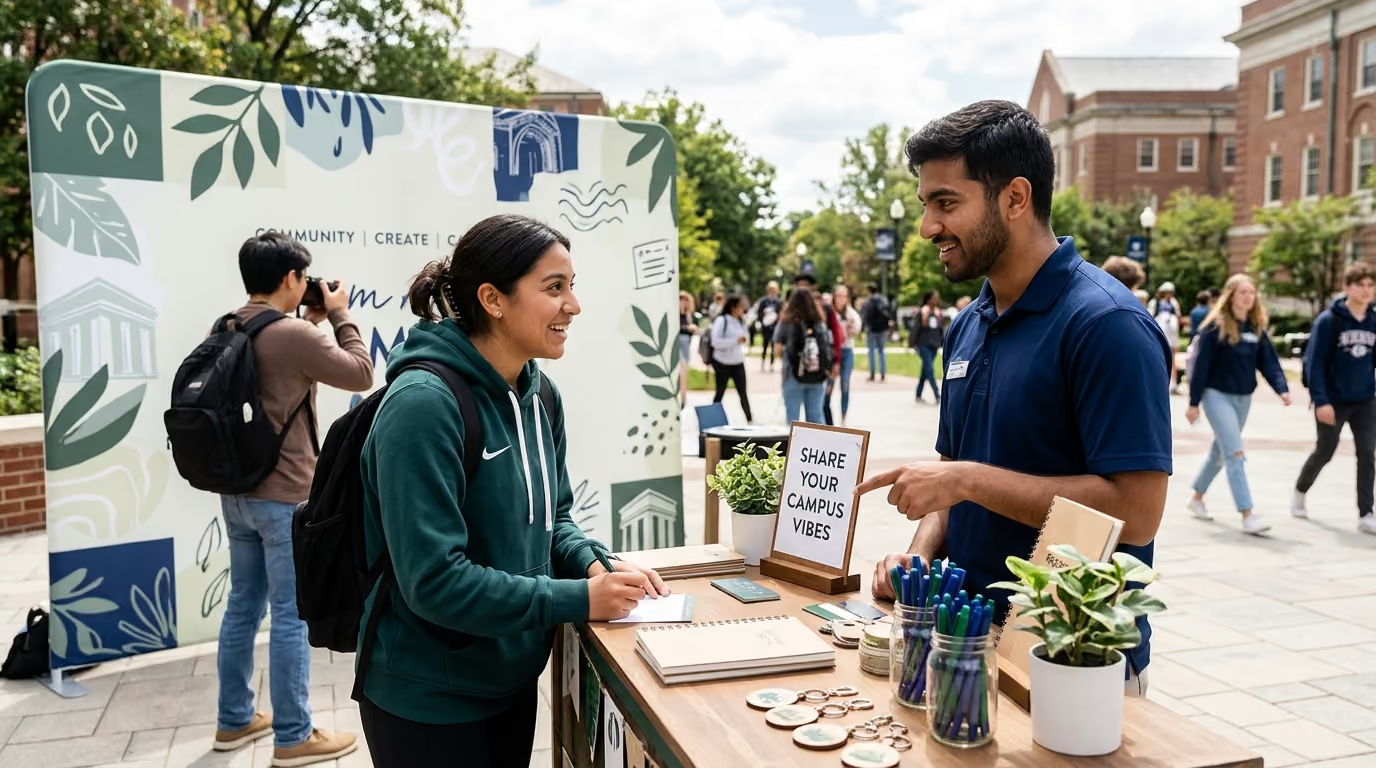
A high-traffic student plaza during the second week of the fall semester is chaotic. Three different beverage brands set up folding tables within twenty yards of each other. One team blares loud dance music from a portable speaker while handing out lukewarm cans to passing students who grab the free product without breaking stride. Across the walkway, a student ambassador team in branded t-shirts attempts to convince rushed undergrads to download an app on their way to chemistry lecture. Meanwhile, the campus digital signs cycle through static display ads that nobody looks at, and flyers blow across the concrete into recycling bins.
Field marketing directors and brand managers recognize this costly scene. Brands routinely deploy five-figure and six-figure campus budgets into disconnected tactics that produce high impression estimates but zero measurable pipeline. The field team reports that they handed out ten thousand units. The social dashboard shows two million geotargeted views across campus coordinates. Yet, when the quarter closes, local grocery sell-through shows no lift, app engagement drops within forty-eight hours, and executive leadership questions the true Return on Investment (ROI).
Campus activations fail when leadership treats student marketing as a generic demographic bucket rather than a distinct operational environment. College campuses are self-contained ecosystems with complex administrative rules, tight social hierarchies, and fragmented attention spans. Handing a box of samples to an untrained student or booking a banner ad in a digital school paper without an integrated conversion path creates brand fog. To build sustainable market share among younger consumers, marketing operators must replace random acts of marketing with an intentional channel architecture.
The central question in campus marketing is never about finding a single best channel. The real challenge is determining which combination of channels matches your business objective, product category, and operational capacity. A successful college activation requires five distinct operational layers working together in a clear sequence.
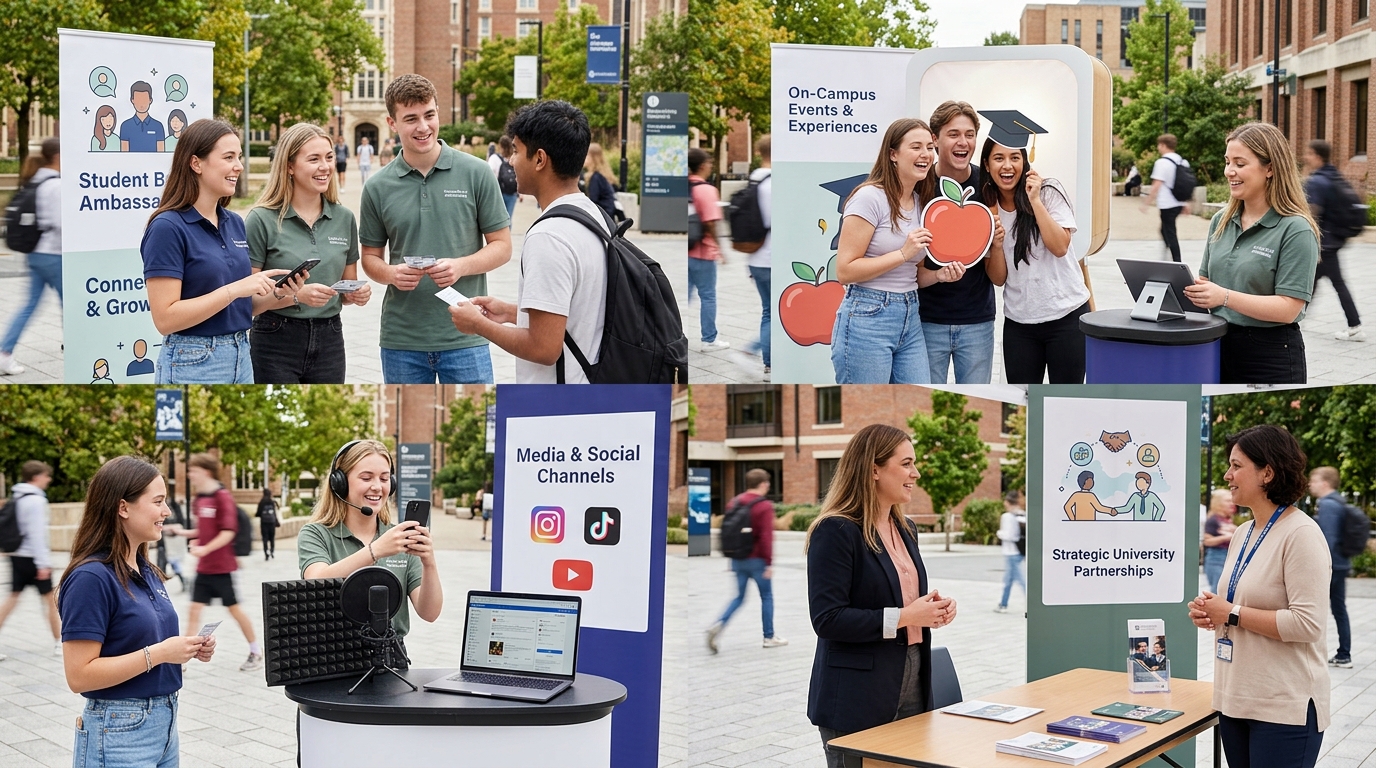
The human layer provides interpersonal trust and conversational context through peer ambassadors or organization leaders. The physical layer delivers tangible product trials, sensory demonstrations, and face-to-face interactions. The distribution layer creates predictable reach through student publications, digital campus networks, and student group communication threads. The performance layer tracks real consumer actions through custom promo codes, localized landing pages, and geofenced digital retargeting. Finally, the operating layer provides the staffing, logistics, permitting, and compliance management required to execute nationwide campaigns smoothly.
Campus marketing objectives fall into six strategic categories. Each objective requires a distinct combination of primary and supporting channels.
When introducing a new product or expanding into a regional territory, your primary goal is broad visibility and repeated exposure. Campus media, geotargeted paid social ads, and high-visibility physical activations serve as the primary engines for rapid reach. Student ambassadors and campus clubs provide valuable local reinforcement by echoing the core brand message in their peer groups.
For complex value propositions, premium goods, or unfamiliar concepts, students seek validation from trusted peers. Student ambassadors, recognized campus group leaders, and organic editorial placements carry far more weight than standard corporate messaging. Paid social and experiential event footprints support this stage by confirming the brand's legitimacy through polished visual proof.
Physical consumer packaged goods, specialty foods, functional beverages, and beauty items require sensory verification before purchase. Live sampling events, interactive pop-ups, and ambassador-led product demonstrations are the most effective primary channels to drive initial trial. Campus organizations and digital ad campaigns act as supporting channels to notify students about when and where trials will happen.
Digital services, mobile applications, subscription platforms, and direct-to-consumer goods demand explicit consumer actions such as app installations, account registrations, or immediate checkouts. Paid social campaigns, affiliate ambassador referral programs, and trackable event activations drive these direct conversions. Campus publications and institutional sponsorships play a secondary role by establishing foundational trust.
Building lasting customer loyalty requires ongoing presence rather than one-time promotional stunts. Retaining consumers over their four-year collegiate journey relies on recurring ambassador interactions, sustained organization partnerships, and consistent event series. Owned community channels, SMS programs, and segmented email workflows maintain active dialogue after the initial event concludes.
Campuses serve as rapid testing environments for messaging, pricing structures, packaging designs, and product formulations. Brand ambassadors, club focus groups, and live intercept surveys capture qualitative feedback directly from target consumers. Digital analytics and social listening tools complement this field research by identifying broader behavioral patterns.
To allocate budgets effectively, brand directors must understand the operational mechanics, advantages, and limitations of each campus marketing vehicle.
A student ambassador is a matriculated student hired to represent a brand across their campus network. Rather than selecting students based solely on public follower counts, the best programs recruit students who have high relationship density within dorms, academic majors, sports clubs, or cultural groups.
Ambassadors can serve as peer educators who explain complex products, field representatives who manage sampling, or content creators who document real student routines. They can also act as community connectors who coordinate club partnerships or event hosts who drive live attendance.
The core strength of the ambassador model is authentic peer trust and continuous local presence. Ambassadors understand the unique social calendar, cultural nuances, and unwritten rules of their specific school. However, managing distributed student teams creates real administrative challenges. Student schedules fluctuate during midterms and finals, graduation causes regular turnover, and message quality can vary widely without rigorous operational oversight.
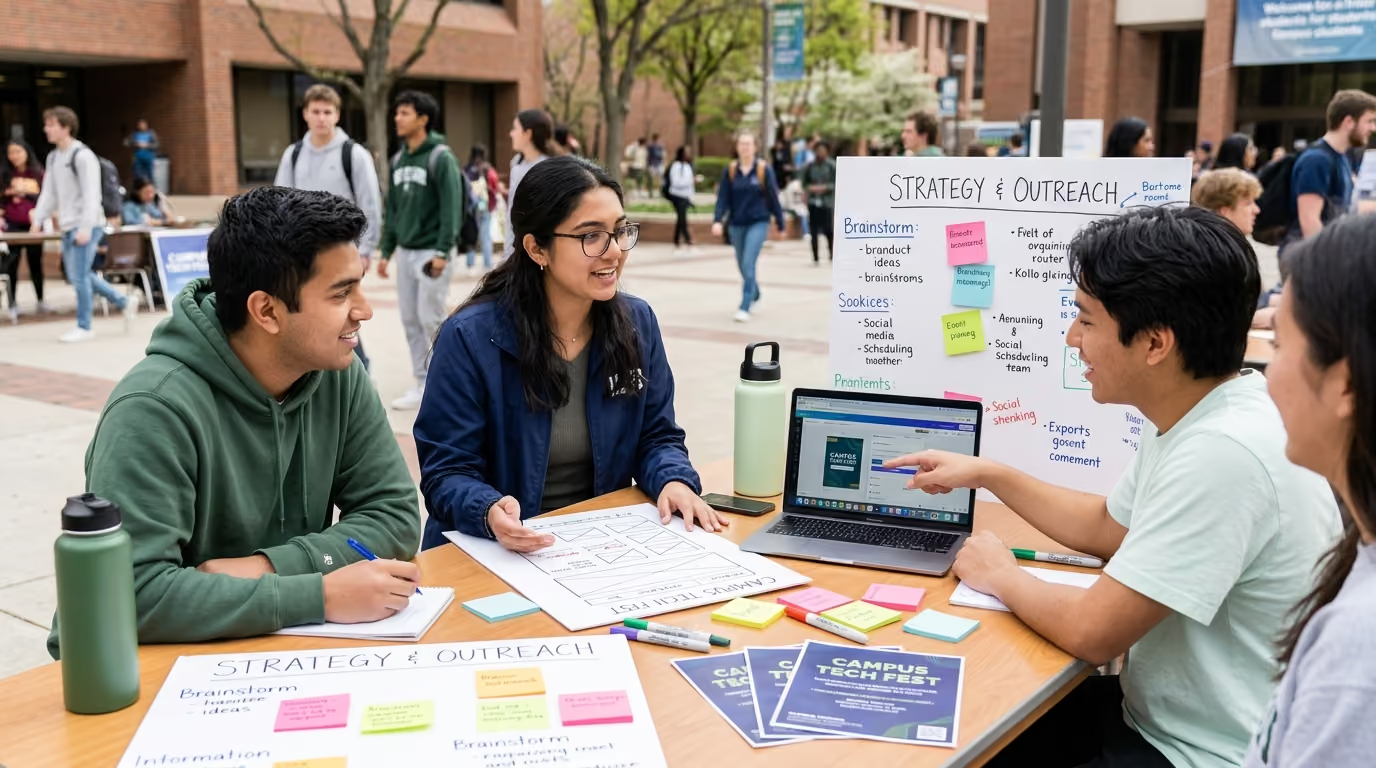
To build a high-performing ambassador program, brands must design clear compensation structures, provide structured training modules, and maintain daily communication channels. For deeper planning on staffing models, review our guide on how to build a campus marketing strategy that drives measurable results.
Live activations range from compact sampling stations on public campus perimeters to large interactive footprints in student centers, athletic tailgates, and orientation festivals. Experiential events turn passive consumers into active participants by combining sensory engagement with face-to-face product demonstrations.
Physical events provide immediate, focused attention that digital channels cannot match. When a student tastes a beverage, tests a skincare formula, or interacts with a product demo, friction disappears. The primary drawback of live events is their physical and temporal limitation. Weather conditions, facility availability, campus permitting rules, and production costs require careful risk management.
To turn physical foot traffic into lasting business value, marketers must connect live trials to concrete digital actions. For a structured approach on turning live sampling into sustained grocery velocity, explore how to connect campus marketing to retail sell-through.
Campus media encompasses student-run newspapers, lifestyle magazines, digital campus portals, campus radio, podcasts, and centralized outdoor digital screens. These outlets provide controlled, predictable reach across the broader student population.
Campus media gives brands institutional legitimacy and structured message control. It is ideal for announcing major brand initiatives, seasonal promotional windows, or campus tour dates. However, student attention across traditional campus media can be fragmented. Placing print ads or banner placements without an interactive hook rarely drives direct product trials or conversions. Campus media performs best as a top-of-funnel awareness multiplier that reinforces on-the-ground ambassador and event activations.
Student organizations include professional fraternities, academic associations, cultural groups, club sports, and recreational societies. Partnering with these established groups gives brands direct access to tight-knit communities with built-in meeting schedules and high internal trust.
Partnerships can take the form of meeting sponsorships, product drops for study sessions, funding for student projects, or co-branded campus initiatives. The primary benefit is immediate cultural relevance and access to audiences who may ignore traditional advertising. The challenge lies in administrative coordination across dynamic student leadership teams. Brands must offer genuine value to the organization rather than treating the group as a simple ad network.
To master these collaborative initiatives, read our detailed framework on how to create effective student organization marketing partnerships.
Paid social media targeting young adults relies heavily on video platforms. According to research from the Pew Research Center, 90 percent of teens use YouTube, approximately six in ten use TikTok and Instagram, and 55 percent use Snapchat. Furthermore, 73 percent use YouTube daily, while roughly six in ten use TikTok daily. While these figures focus on teenagers, they highlight the dominant media environments shaping incoming college cohorts.
Paid digital campaigns provide exceptional geographic precision through geofencing, demographic filtering, and retargeting capabilities. Brands can run paid campaigns to build anticipation before an on-campus event and retarget attendees who interacted with an ambassador. However, standard corporate ads often suffer from low engagement among younger audiences. Digital media budgets deliver the highest return when used to amplify organic, student-generated content produced by real campus ambassadors.
An experiential agency serves as the operational engine that unifies these diverse marketing channels. Managing multi-campus campaigns internally often overwhelms in-house teams with legal compliance, logistics, student payroll, and field reporting.
Agencies bring specialized infrastructure to handle university permit negotiations, field staffing, physical asset warehousing, multi-market shipping, and centralized data aggregation. Working with an experienced field team allows brand directors to scale programs across dozens of universities while maintaining strict quality control. To explore how our agency executes integrated field campaigns across regional and national footprints, visit our brand activation services page.
Relying on a single marketing channel produces fragile campaigns. High-performing campus programs combine multiple channels into coordinated operating models tailored to specific business outcomes.
This model combines campus media, geotargeted paid social ads, and high-impact physical pop-ups. It is designed for regional brand launches, major product reformulations, and entertainment releases.
Campus media outlets publish launch announcements and sponsor content across student news sites. Geotargeted video ads run across local campus coordinates to build interest. Simultaneously, a branded activation in a high-traffic student hub delivers physical product interaction. The brand retargets all digital users within the campus footprint with promotional offers, driving strong top-of-funnel recall.
This model pairs student brand ambassadors with student organization sponsorships and structured product sampling. It is the optimal strategy for functional beverages, snack brands, personal care items, and consumer electronics.
Ambassadors connect with student organization leaders to supply product samples for regular chapter meetings and study sessions. The ambassador explains the product benefits, answers peer questions, and distributes exclusive trial incentives. This approach removes retail purchase friction by combining personal peer recommendations with direct physical product trial.
This model integrates referral-focused ambassadors, paid social spark ads, and dedicated mobile conversion pathways. It fits mobile applications, fintech tools, streaming subscriptions, and e-commerce platforms.
Student ambassadors share unique referral links and custom QR codes across their social channels and campus networks. The brand identifies the top-performing organic student content and amplifies it via paid social ads targeted to that specific campus. Students who click through land on a school-specific landing page that makes downloading the app or completing registration fast and simple.
This framework links student organizations, recurring campus event series, and student media documentation. It is designed for brands seeking multi-year cultural credibility, employer branding, or mission-driven engagement.
The brand sponsors ongoing student initiatives such as design competitions, entrepreneurial incubators, or athletic tournaments. The brand provides funding, equipment, and mentorship over the academic year. Student media covers the initiatives, creating organic brand integration that establishes authentic goodwill across the student body.
This enterprise structure combines an experienced experiential agency, regional ambassador cohorts, mobile sampling units, and centralized paid digital support. It is built for national brands executing simultaneous campaigns across dozens of collegiate markets.
The agency manages campus permitting, warehouse logistics, inventory fulfillment, and student manager training. Student ambassadors drive grassroots foot traffic to the mobile tour vehicle while gathering consumer feedback. The agency aggregates field data, sales velocity, and digital conversions into real-time reporting dashboards for executive leadership.
Executing an integrated campus marketing program requires disciplined operational execution. Follow this structured roadmap to bring multi-channel activations to life on the ground.
Marketing leaders must prove business value using concrete behavioral metrics rather than vanity impression counts. Campus programs should track clear lead and lag indicators across every activation touchpoint.
Lead metrics track live operational efficiency and student engagement quality during the campaign. Key lead indicators include qualified peer conversations, sampling handoffs, event dwell time, QR code scans, and survey completion rates.
Lag metrics quantify bottom-line business impact and financial Return on Investment. Key lag indicators include attributed retail sales lift, new app registrations, subscription renewals, promotional code redemptions, and long-term customer acquisition cost.
To maintain complete attribution clarity, assign unique digital identifiers across every operational variable.
Create separate trackable identifiers for every campus, individual student ambassador, distinct event activation, and media placement. When an ambassador shares a promotional offer, the link must contain parameters identifying their specific university and ambassador ID. When hosting a live sampling pop-up, use unique QR codes displayed on signage that direct consumers to a location-specific offer page.
Avoid using a single global discount code across an entire regional campaign. Global codes obscure channel performance and make it impossible to determine whether sales came from student ambassadors, campus media ads, or physical sampling events.
Some marketing vendors combine digital impressions, social views, sample handoffs, and estimated foot traffic into a single composite impact score. Marketing operators should reject these blended metrics. Combining verified product trials with passive billboard impressions hides weak performance. Keep operational output metrics, consumer engagement data, and validated financial outcomes distinctly separate in all executive reporting.
Operating in collegiate environments involves strict regulatory, legal, and privacy considerations. Violating institutional policies or federal standards can damage brand reputation and trigger costly fines.
When student ambassadors receive compensation, free merchandise, event access, or financial stipends, they enter a material connection with the brand. The Federal Trade Commission (FTC) requires that all sponsored endorsements clearly and conspicuously disclose this business relationship.
Disclosures must be prominent, immediate, and easy to understand. Ambassadors must place tags like #Ad or #Sponsored at the beginning of social posts, captions, and video descriptions. Relying exclusively on a social media platform's built-in disclosure tool is not always sufficient under FTC guidelines. Furthermore, verbal disclosures are required during live presentations and ambassador-hosted events. Brands must provide written compliance guidelines and actively monitor student posts to enforce compliance.
Partnering with collegiate athletes under Name, Image, and Likeness (NIL) rules requires specialized operational oversight. The NCAA requires that NIL agreements represent legitimate business arrangements with defined promotional deliverables. Compensation cannot be tied to athletic performance or school enrollment decisions, commonly known as pay-for-play.
Brands must navigate individual university policies, state legislation, and athletic department conflict-of-interest guidelines. For example, some universities prohibit student-athletes from promoting specific commercial categories, such as sports gaming, alcoholic beverages, or unapproved nutritional supplements.
Collecting student contact details during live activations requires strict adherence to privacy regulations. The Family Educational Rights and Privacy Act (FERPA) protects student education records maintained by educational institutions. Marketers cannot access, store, or utilize official institutional student directories or university databases for direct commercial marketing without proper legal authorization.
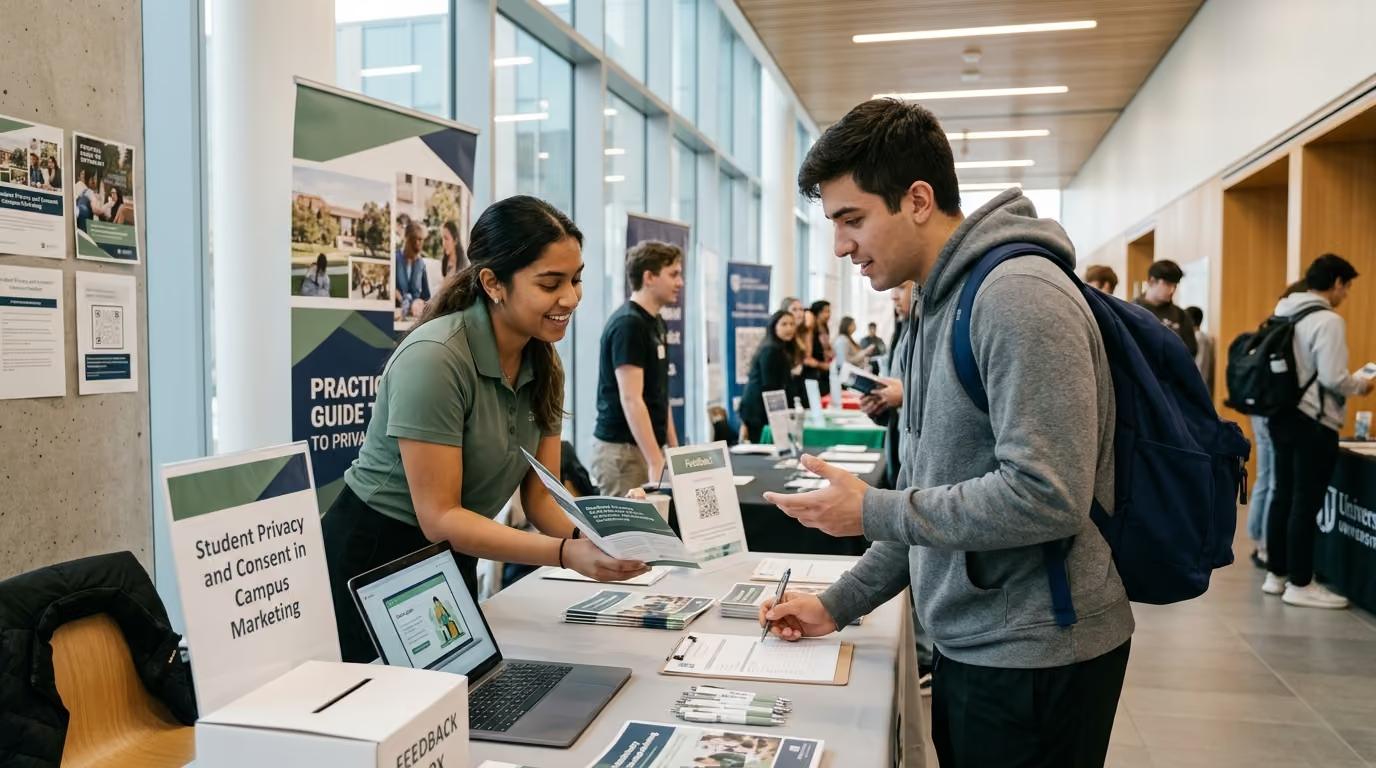
When collecting consumer information at field events, always gather explicit, consented opt-ins directly from the individual student. Explain clearly how their data will be used, store information in secure systems, and provide immediate opt-out mechanisms. For a deeper examination of compliance protocols, consult our detailed guide on student privacy and consent in campus marketing.
A marketing strategy built for a traditional residential campus will struggle in other academic settings. Large commuter colleges require shifting focus from residential dining halls to transit hubs, commuter parking structures, digital student networks, and morning coffee locations.
Similarly, graduate institutions require professional networking alignments and career development contexts rather than late-night social themes. Marketers must evaluate campus transit habits, housing patterns, and student schedules before finalizing their operational plans.
Examining successful multi-channel campus marketing campaigns highlights the power of integrated field execution.
Consider an illustrative example, not a client result. A cosmetics brand runs a multi-campus campaign that combines targeted product sampling with student organization partnerships. Sampling events are scheduled around class-change traffic, campus groups host the activations, and every unit handed out is paired with a short peer conversation. The point of the model is that sampling and peer advocacy reinforce each other: the conversation, not the unit count, is what carries intent to recommend and repeat purchase at retail.
In the fast-moving consumer goods apparel sector, an international fashion brand ran a nationwide ambassador initiative across collegiate markets. The program deployed high-performing student ambassadors who created over 53,000 pieces of organic social content, generating over 103 million impressions. By equipping ambassadors with personalized conversion codes, the program generated $2.2 million in directly attributed sales without traditional paid media buys.
Our team applies this integrated operational focus to every field program we build. A VP of Marketing in the CPG beverage category told us: "Robbie, your leadership and vision turned our campaign into something truly special. The Makai team brought our new drink to life with energy, creativity, and flawless execution. Thanks to you, our brand isn't just tasted, it's remembered." Our team's approach transformed their product launch into a memorable brand experience.
Even well-funded marketing campaigns can underperform if operators fall into common execution traps. Avoid these tactical errors when planning your next campus initiative.
Hiring student creators based purely on large social followings often backfires. A student with fifty thousand followers may have an audience spread across the globe with zero influence on their local campus. Prioritize campus connectivity, club leadership roles, interpersonal approachability, and reliability over raw social metrics.
Handing out a product sample is only the first step in the customer journey. A student accepting a free energy drink does not guarantee they will buy one next week at the grocery store. Every sampling touchpoint must include a trackable bridge to retail, such as a localized coupon, a digital scan code, or an invitation to a loyalty program.
Student clubs are mission-driven communities, not free advertising space. Approaching organization leaders with demands for social posts without offering tangible value will alienate the group. Offer meaningful financial sponsorships, valuable event supplies, career workshops, or product support that enriches their member experience.
Campus environments vary significantly by region, climate, academic calendar, and local culture. An activation format that succeeds at a sunny southern university during spring tailgating may fail at an urban campus in the Northeast during winter exams. Build a modular marketing framework that gives field teams the flexibility to adapt to local realities.
Managing decentralized student teams requires constant oversight. Relying entirely on unsupervised student self-reporting leads to inflated numbers and inconsistent field execution. Implement regular check-ins, require timestamped photo verification, conduct surprise field audits, and hold weekly performance reviews.
Revisit this campus marketing framework whenever you plan an upcoming product launch, prepare for seasonal back-to-school campaigns, or expand your retail distribution into new regional college markets. Aligning your operational layers, selecting the right channel combinations, and enforcing rigorous conversion tracking ensures your brand turns campus foot traffic into measurable business growth.

30 Years Experiential & Retail Activation Partner for CPG & Beverage Brands | Multi-Market Demos, Roadshows & Costco/Club Programs That Actually Sell