Robbie Thain
Founder, CEO

Campus marketing partnerships run smoothly when brands collaborate directly with recognized student clubs on genuine campus events instead of relying on intrusive pop-up tents.
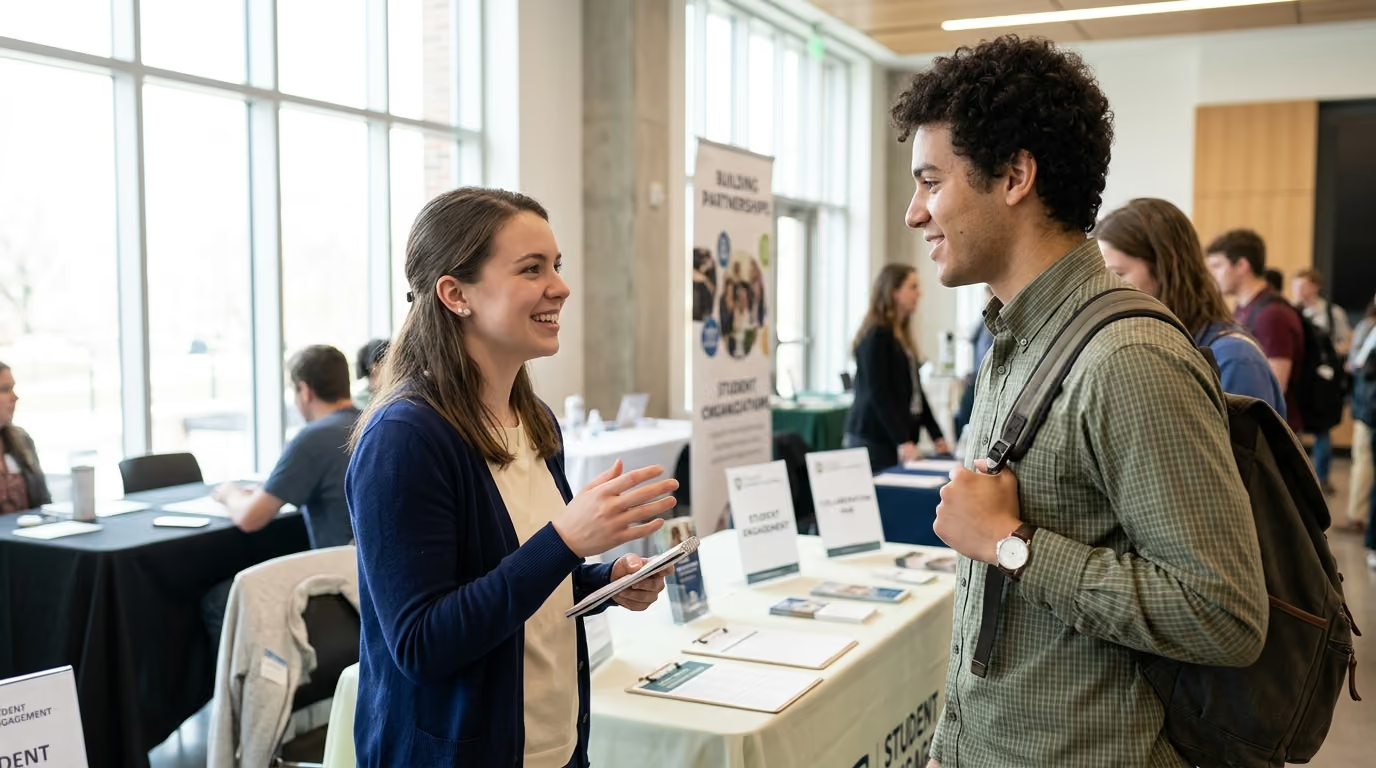
Many marketing leaders search for how to partner with college clubs without getting shut down by campus administration or ignored by students. You want access to engaged collegiate demographics. Cold outreach to student leaders often vanishes into inbox voids or triggers campus compliance roadblocks. This guide provides the operating framework to identify aligned student groups, secure institutional permissions, structure equitable agreements, and build live activations that drive measurable brand equity.
Student organization partnerships succeed when brands replace transactional sponsorship with co-created student experiences that advance the club mission. Marketing operators who implement structured governance, verify institutional compliance, and execute high-utility activations build measurable peer-to-peer advocacy across collegiate markets.
Collegiate field activations often look simple on paper but unravel rapidly on site. Brand teams frequently treat a university campus like an open public square. They send street teams with branded pop-up tents, boxes of unchilled samples, and stackable banners directly onto the campus quad. Within thirty minutes, campus security or student life administrators arrive to halt the activation because the team lacked municipal permits, university facility approvals, or recognized student group sponsorship.
Even when brands work directly with student clubs, execution friction can derail the campaign. A consumer goods brand might wire sponsorship funds directly to an eager club president, expecting prominent signage and sustained social media promotion. On event day, the brand arrives to find their pull-up banner hidden in a dark corner of a lecture hall. The student officers forgot to announce the sponsor, and the agreed social posts were never published because the club leaders were studying for midterm exams.
These breakdowns happen because marketing teams mistake student organizations for commercial media channels. A collegiate club is not a digital ad network where capital buys guaranteed delivery. Student organizations are volunteer communities governed by academic calendars, departmental regulations, and rapid leadership turnover. When a brand fails to account for institutional policy, student capacity, and authentic value exchange, campus initiatives collapse into wasted budget and administrative friction.
A student organization partnership is a structured collaboration between a brand and a recognized campus group. The organization contributes community access, peer credibility, event programming, and authentic communication. In exchange, the brand provides capital, professional services, physical equipment, product donations, or operational support.
Research demonstrates that active event sponsorship builds stronger brand perceptions and consumer attitudes than passive advertising placements. When a brand meaningfully integrates into an experience, students view the sponsor as a supportive partner rather than an intrusive advertiser. Academic research on student event sponsorship published in the VNUHCM Journal of Economics, Business and Law reveals that sponsor-event fit is the single most influential driver of brand awareness among students. That same research confirms that sponsor ubiquity, or plastering logos across every surface without purpose, creates negative brand sentiment.
To evaluate potential collegiate partners systematically, field marketing teams should apply the PARTNER framework.
Every outreach initiative must begin with the student organization's core mission. Identify what the organization is trying to achieve during the current academic term. A pre-medical society might need funding to transport members to a regional clinical conference. A campus programming board might need production support to host an outdoor cinema night.
When your brand solves an existing operational or budgetary obstacle, the partnership starts on solid ground. Brands that begin by proposing an arbitrary marketing stunt alienate student leaders. Aligning your brand resources with their defined purpose establishes immediate credibility.
Audience evaluation requires looking past vanity metrics. A student club Instagram account might boast ten thousand followers, yet their weekly meetings attract fewer than fifteen members. Conversely, an engineering design team might have a small social following while maintaining two hundred active members who spend thirty hours a week working in a shared lab.
Analyze audience composition across academic majors, class standing, residential status, and active meeting attendance. Determine whether the organization reaches demographics that your retail or digital channels miss. Prioritize high-engagement communities over passive broadcast audiences.
Evaluate the natural connection between your product category and the student group across four operational layers:
High relevance eliminates consumer friction. When a healthy snack brand supports a student athletic club during tournament weekend, the interaction feels natural. When a financial services company attempts to sponsor a cultural arts showcase without educational context, students reject the integration.
Student leaders operate as trusted peers within their campus networks. Investigate whether the organization's executive board communicates transparently with its members. Review their historical track record with prior corporate sponsors to ensure they do not over-promote competing products.
A credible partnership relies on peer trust. If an organization promotes five different energy drinks in a single month, their endorsement loses all persuasive power. Select partners that maintain selective, high-integrity relationships with external supporters.
An eager student group cannot succeed without operational capacity. Assess whether the leadership team has experience securing room reservations, managing campus sound permits, and directing crowds. Evaluate their responsiveness during initial email communications.
If a student officer takes three weeks to reply to an introductory note, they will struggle to manage event logistics under tight deadlines. Choose organizations with strong faculty advisors, organized committees, and established production workflows.
Campus marketing requires strict compliance with institutional governance. University policies dictate how student groups can interact with commercial entities. Before signing agreements or shipping materials, check institutional rules regarding corporate sponsorships, campus solicitations, and category restrictions.
Many universities enforce strict exclusivity contracts with soft drink bottlers, dining contractors, or bookstore operators. If your product category conflicts with a master campus vendor agreement, the student organization cannot host your activation. Verifying eligibility early prevents costly compliance shutdowns.
One-off campus events rarely justify the administrative cost of university approval and onboarding. The most efficient collegiate strategies develop repeatable platforms that endure beyond a single semester. Look for programs that occur annually, such as orientation fairs, hackathons, business plan competitions, or charity runs.
Building an enduring relationship with an organization allows your brand to integrate into the campus culture year after year. As student leaders graduate, an established institutional partnership ensures seamless transitions between outgoing and incoming executive boards.
Navigating university administrative structures requires diligence and professional execution. Marketing teams often assume that college students possess the legal authority to sign commercial contracts or grant campus access. In reality, most educational institutions restrict the commercial activities of registered student organizations.
Top universities enforce centralized sponsorship review processes. Dartmouth College requires prior approval from campus leadership before student organizations engage external commercial entities. Their institutional policy prohibits student groups from signing corporate agreements or selling corporate access directly. Columbia Business School requires student clubs to route all sponsorship proposals through their Office of Development and Alumni Relations before initiating contact.
Marketing operators must ask student leaders about required administrative clearances during initial discovery. Attempting to bypass the Office of Student Life, Campus Activities Board, or University Advancement creates operational risk. If administrators discover unapproved commercial branding on campus property, they will shut down the activation, confiscate collateral, and sanction the hosting student organization.
Institutional policies regularly restrict specific marketing practices that brands take for granted in retail environments:
The University of Pennsylvania outlines strict boundaries for student organization support. Their policies permit corporate contributions for goods used during an event or tied to specific mission expenses. However, they prohibit sponsorships conditioned on the student group advertising commercial products or driving sales transactions. Understanding these nuances protects your brand reputation and keeps your student partners in good standing.
Never ask a student organization to provide a roster of member email addresses. Academic institutions strictly protect student directory data under privacy regulations. Purchasing or receiving student contact lists directly from a club creates severe compliance liability.
Instead, design clean, voluntary digital interaction points. Direct attendees to an on-site experiential touchpoint where individuals choose to engage. Use physical QR codes on activation displays that lead to secure brand landing pages. Offer clear value, such as entering a legitimate scholarship drawing, receiving educational resources, or redeeming product coupons, in exchange for voluntary opt-ins.
When student leaders or campus organizations receive funding, free merchandise, travel subsidies, or product samples, a legal material connection exists. The Federal Trade Commission requires clear, conspicuous disclosures on all promotional posts, endorsements, and social content.
Disclosures must appear prominently within the initial text of a post rather than buried behind a "more" link or hidden among hashtags. Student partners must use clear phrasing such as "Paid partnership with [Brand]," "Sponsored by [Brand]," or "This event was supported by [Brand]." Furthermore, student endorsers must only share authentic personal experiences. Federal trade regulations prohibit asking students to make performance, technical, or wellness claims that lack verifiable substantiation.
Designing a sustainable collegiate partnership requires moving away from arbitrary, generic sponsorship tiers. Bronze, Silver, and Gold packages with vague promises of "brand exposure" provide little value to either party. High-performing brand teams structure agreements around defined operational deliverables, documented resource exchanges, and clear performance expectations.
Structure partnership categories according to the depth of experiential integration and resource commitment:
Every collegiate agreement should be formalized in a clear, written memorandum of understanding or institutional contract. Essential clauses include:
Passive marketing fails on modern college campuses. Students walking between classes ignore static tables covered in corporate brochures and promotional pens. Effective experiential campaigns rely on interactive, utility-driven moments that reward students for their attention and enhance their daily campus experience.
Our team approaches collegiate activations with the operational discipline required of high-impact field marketing. By integrating real-world touchpoints with natural consumer behaviors, brands can spark meaningful connections that translate into measurable retail velocity. Marketers seeking broader frameworks for physical engagements can examine our experiential marketing services to align campus activations with comprehensive national execution standards.
Utility activations solve a physical, immediate need for students. College students constantly navigate packed schedules, heavy backpacks, low phone batteries, and tight budgets. Providing genuine functional utility builds instant goodwill.
Deploy high-speed mobile device charging lounges, hydration refilling stations, comfortable study seating, or healthy, ready-to-eat breakfast stations during morning exam periods. When your brand provides real comfort during a stressful day, the student forms a positive emotional connection with your product.
Modern students prioritize career readiness, skill development, and portfolio enhancement. Brands that provide educational value achieve high participation rates and deep engagement.
A consumer packaged goods brand expanding into retail can host interactive workshops demonstrating product formulation, sustainable packaging design, or modern supply chain logistics. Providing real industry insights transforms a simple sampling campaign into a professional development opportunity for student attendees.
Engagement increases when students participate in collaborative, gamified experiences. Design high-energy competitions that encourage teamwork, creativity, and friendly rivalry among campus housing units, clubs, or academic departments.
Incorporate live product tastings, culinary preparation challenges, hackathons, or physical fitness circuits. Keep rules straightforward, provide meaningful prizes such as educational scholarships or industry mentorship sessions, and ensure participation remains voluntary and accessible to all students.
Sampling remains a primary driver of product trial for emerging food and beverage brands. Distributing samples through student organizations ensures your product reaches target consumers through trusted peer hands.
Maintain strict cold-chain integrity, food safety protocols, and clear ingredient labeling for allergens. Provide organized waste and recycling infrastructure alongside the sampling station to maintain clean campus facilities. Connecting sampling initiatives with local retail availability reinforces the broader path to purchase. Brands executing these initiatives can read our analysis on connecting experiential touchpoints to retail shopper strategy to turn campus sampling moments into sustained grocery store velocity.
Executing an impactful collegiate partnership requires disciplined project management. Marketing operators must maintain an extended timeline that accommodates student academic calendars, exam schedules, and university administrative reviews.
Begin outreach at least three months prior to the target event date. Initial communications should focus on operational discovery rather than commercial pitches.
Collaborate with student leaders to design the activation concept and secure required administrative permissions.
Coordinate physical supplies, product inventory, and operational logistics to ensure flawless execution on event day.
Maintain active field communication and operational oversight during on-site execution.
Close the operational loop with comprehensive reporting, financial settlement, and renewal planning.
Evaluating the Return on Investment (ROI) of campus partnerships requires tracking a balanced scorecard of lead and lag indicators. Relying solely on estimated foot traffic or unverified social media impressions obscures the real commercial impact of the activation. Marketing leaders must implement disciplined tracking across five distinct measurement tiers.
Delivery metrics confirm whether the agreed operational commitments were fulfilled by both parties. These operational indicators establish baseline contractual compliance:
Participation metrics quantify how actively students engaged with the live activation footprint:
Response metrics capture deliberate, measurable actions taken by students during or immediately following the event:
Perception metrics measure changes in brand awareness, sentiment, and peer trust across the collegiate audience. Use short digital pre-event and post-event survey instruments to evaluate:
Commercial metrics connect on-campus engagement to measurable financial returns and retail velocity:
Operators seeking granular measurement models for field engagements can review our guide to metrics for field pop-up activations to standardize reporting across campus deployments.
Examining real-world operational models illustrates how consumer packaged goods brands can execute effective student organization partnerships while maintaining high compliance standards.
A high-growth functional beverage brand wanted to accelerate retail sell-through across twenty university markets ahead of a major convenience store expansion. Rather than deploying uncoordinated street teams to hand out warm cans on public sidewalks, the brand established structured partnerships with recognized student running clubs, intramural sports leagues, and outdoor recreation societies.
The brand addressed a critical funding gap for these student groups by underwriting their annual regional race entry fees and supplying high-performance hydration gear. In exchange, the student organizations integrated the brand's cold-chain sampling bars into weekly training runs, campus 5K races, and weekend intramural championship tournaments.
Each sampled can featured an integrated scratch-off QR code directing students to claim a digital coupon redeemable exclusively at the on-campus student union convenience store and nearby grocery locations. Across the semester, the campaign delivered thirty-two thousand chilled samples, generated an 18% digital opt-in rate for product updates, and drove a 24% sustained sales lift at retail stores within a two-mile perimeter of the partner campuses.
A VP of Marketing reflected on our partnership: "Robbie, it was a pleasure working with you and your team. You turned our launch into an experience that connected with shoppers and built lasting excitement for our brand. We're already looking forward to the next project together." Our team created a launch experience that resonated with retail shoppers and generated momentum for future collaborations.
Brands looking to build broad collegiate ambassador networks can explore our analysis on how Gen Z student ambassador programs connect live activations with measured retail velocity.
A plant-based snack brand sought to build brand affinity among environmentally conscious students while avoiding perceptions of corporate greenwashing. The brand partnered with campus sustainability alliances and student-run community agriculture clubs across twelve major university campuses.
Instead of paying for standard logo placement on flyers, the brand funded zero-waste composting infrastructure for the student groups' campus events and supplied bulk compostable snack packs for volunteer workdays. The brand also coordinated interactive culinary workshops where student leaders demonstrated simple, healthy plant-based meal preparation using the brand's product line.
The partnership maintained strict compliance by routing all support through the university sustainability offices. The student coalition produced authentic, FTC-compliant social media video recaps showcasing the community gardens and composting initiatives, with the brand credited as an enabling partner. Post-campaign surveys revealed an 84% brand favorability rating among participating students and an 11% increase in local grocery market share within target college zip codes.
Marketing operators preparing to launch a collegiate student organization campaign should execute these action items to establish solid governance and drive measurable results.

30 Years Experiential & Retail Activation Partner for CPG & Beverage Brands | Multi-Market Demos, Roadshows & Costco/Club Programs That Actually Sell