Robbie Thain
Founder, CEO

Propshop Events & Exhibitions is expanding internationally. Learn the harsh truths of executing turnkey trade show booths and converting foot traffic to pipeline.
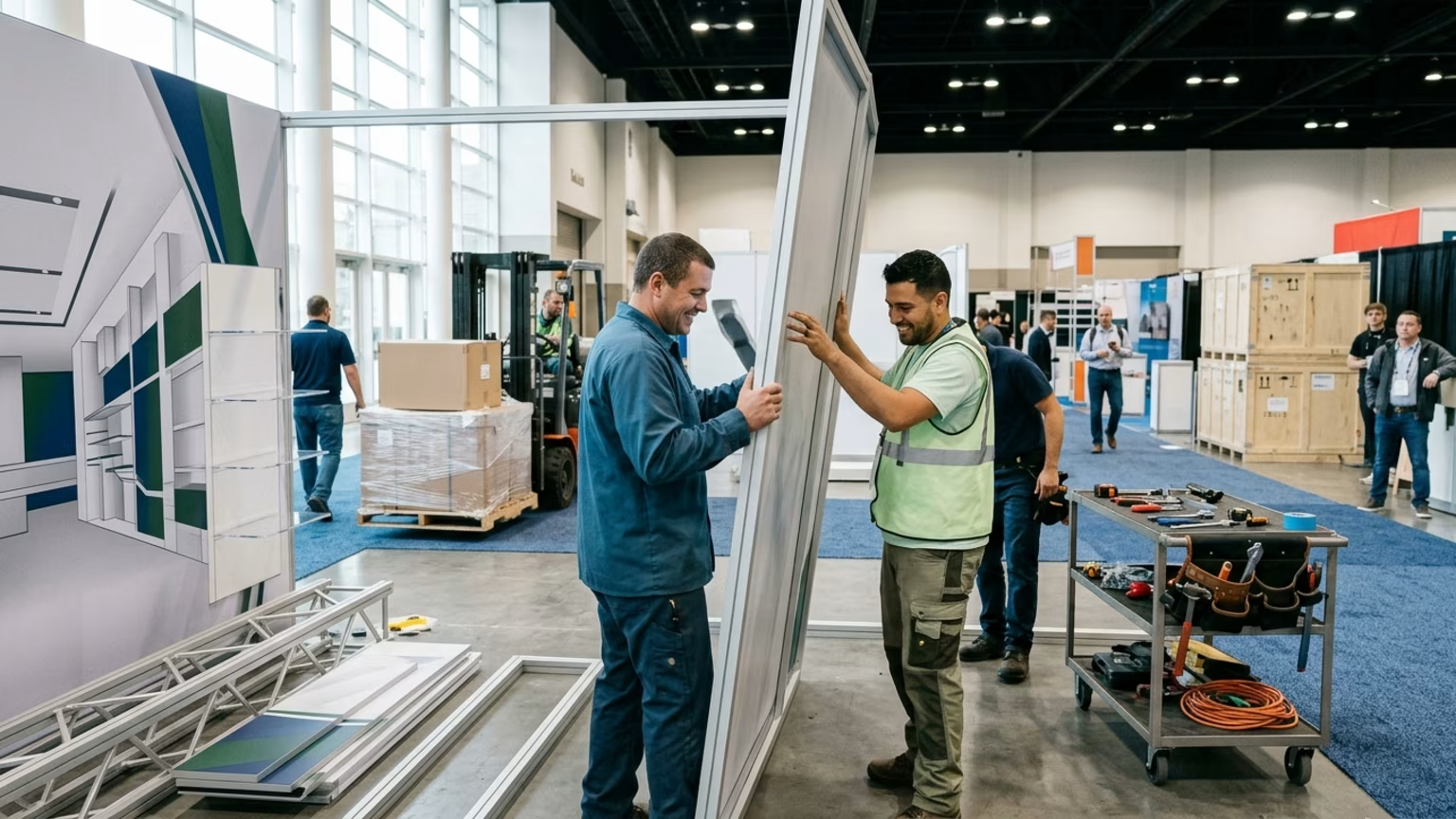
Propshop Events & Exhibitions Limited announced on August 25, 2026, that it is accelerating expansion across the United States, Europe, and the UAE. This international growth exposes four harsh truths about managing physical trade show execution.
Marketers often assume that hiring an end-to-end provider eliminates all pre-event logistics. The reality is that building a measurable customer acquisition environment requires rigorous preparation long before the venue doors open. Propshop Events & Exhibitions Limited describes itself as India’s first NSE-listed pure-play exhibition stand-build company. The company trades under the NSE symbol PROPSHOP-SM and aims to function as a globally trusted platform connecting businesses across borders.
The company offers exhibition stand construction combined with turnkey exhibition solutions, experiential marketing, and broader brand experiences. This stated service range runs from booth concept and design through fabrication, logistics, installation, supervision, and dismantling. For a brand marketing leader, integrating these capabilities demands aggressive pre-brief alignment. You must define target buyer profiles, product demonstration flows, and data capture rules before approving any structural designs.
Setting up proper CRM routing to catch leads instantly is just as critical as approving the booth rendering. Asset ownership also dictates logistical workflows on the show floor. Business Standard describes Propshop as using an asset-light model that outsources fabrication while retaining control over design and execution. This approach requires brands to heavily scrutinize local vendor vetting, union labor rules, and freight staging timelines.
We have executed over 1000 campaigns across all 50 states. We know firsthand that maintaining strict brand standards relies on managing these localized variables. If a supplier does not own physical production capacity, your logistics plan must account for extended communication chains. Navigating large scale events managed by massive organizations requires precise permitting and structured vehicle staging.
Propshop also reports strategic empanelments with several exhibition and industry platforms. These platforms include Informa Markets, ABEC, BTTF, and CMPL. The company lists additional empanelments with HGH India, MATECIA, and Messe Muenchen International. A beautiful booth is useless if your freight gets stuck at the loading dock because of missing paperwork.
Teams must secure all structural permits and finalize exact installation windows months in advance. To map out how these efforts translate to actual sales, smart operators rely on proven ROI frameworks for events early in the process.
The expansion of companies like Propshop shows a shift toward treating the trade show booth as a commercial system rather than just rented floor space. UFI recently questioned whether exhibition success is still primarily about booth size, pointing toward the outcomes generated by the event and the quality of the experience. To convert a polished footprint into measurable business outcomes, you must follow a deliberate operating method.
The step-by-step method requires absolute discipline on the floor. First, stage your vehicles and product inventory before the union labor shift ends. Second, run a mandatory pre-shift briefing with all brand ambassadors to lock in the lead qualification script. Third, deploy a staggered break schedule so your most critical demonstration stations never go dark during peak aisle traffic.
Fourth, verify that the lead capture devices are syncing to the cloud every single hour. The company was established in 2019. It has developed capabilities to execute projects in the United States, United Kingdom, and Germany. It also reports execution capabilities in Dubai, Spain, Singapore, and India.
Propshop says it has relationships with major brands across multiple sectors. These include Bosch, Hyundai, Cello, Polycab, and Tata Technologies. The company also lists Reliance, Mahindra, HCLTech, Pidilite, and Larsen & Toubro. Additional relationships include Astral Pipes, Panasonic, Haier, Borosil, TVS Mobility, Yokohama, and JSW Energy.
While these are company-reported relationships, they highlight the volume of major players seeking systematic execution. Propshop reports a 98% client-retention rate. The company attributes this metric to execution quality and timely delivery.
Amateur teams consistently confuse visual design with operational effectiveness. A larger or more immersive booth footprint does not automatically improve sales, conversion, or revenue. Industry publications citing CEIR data report that only 23% of B2B exhibitors have a formal process for measuring trade show Return on Investment. Without defined lead qualification rules and meeting-booking processes, brands lose valuable prospects.
Far too many companies still rely on bad clipboards and scattered business cards instead of real-time CRM routing. The second failure point is trusting an international footprint without verifying local operating depth. A supplier might list operations across the United States, Europe, and the UAE. However, that does not guarantee they maintain permanent staff or warehouse capacity in those regions.
Underestimating crowd flow and localized labor restrictions will derail an activation within hours. When brands assume that turnkey service implies direct asset ownership everywhere, they leave themselves vulnerable to unmanaged outsourcing risks. Our team has witnessed brands scramble on the floor because they did not clarify who was accountable for emergency response. When fabrication is handled by external partners rather than in-house facilities, quality control can slip rapidly.
Marketing teams must identify who specifically holds accountability when an installation timeline falls apart on the show floor. Failure to establish a proper guide for trade show activations leaves field teams blind when logistics break down. Relying on vanity metrics like total badge scans is another massive mistake. Collecting five hundred random scans provides zero value if the sales team cannot identify which contacts actually requested a follow-up.
Experiential marketing must invite people to try the product and take a measurable next step. Operators must filter out casual booth visitors from genuine retail buyers. Another major failure point is relying purely on digital follow-up without a physical hook. Brands send generic emails to a list of exhausted attendees and wonder why their conversion rates collapse.
The best operators integrate physical sampling directly into the data capture moment. This ensures that the prospect associates the brand's flavor or feel with the follow-up meeting.
The business-events sector generates massive economic momentum, pushing exhibition suppliers to scale aggressively. The Events Industry Council’s 2026 report estimated that trade shows generated US$179 billion in direct spending globally in 2025. This activity involved 318 million participants globally. This incredible volume illustrates exactly why exhibition infrastructure attracts massive international suppliers.
According to IPO-related reporting, Propshop’s revenue rose from ₹30.57 crore in 2024 to ₹51.59 crore in 2025. Over the same period, reported profit increased from ₹2.19 crore to ₹6.32 crore. To fund its operations and expansion, IPO coverage said Propshop raised ₹28.57 crore. The coverage noted plans to allocate ₹16.62 crore to working capital.
Propshop founder Prathamesh Pusalkar said the company was “born in India with a global vision”. He stated the goal is to build “a globally trusted platform connecting businesses, industries and opportunities without borders.” However, entering the public market comes with immediate pricing realities. The company’s shares debuted on the NSE SME platform at ₹55.20, compared with an IPO price of ₹69, a 20% discount.
These financial figures highlight the complex capital requirements of funding international event logistics. A rapidly expanding partner must manage intense cash flow demands to keep hundreds of global freight shipments moving on schedule. For those seeking advanced tactics on managing massive physical builds, analyzing the 2026 award-winning booths offers a deeper look into the architecture of conversion.
The true test of any experiential stand build occurs after the venue clears out and the dismantling begins. Marketers must rigorously monitor the transition from on-site interactions to qualified commercial next actions. Event Marketer’s coverage recommends using a broader measurement framework that includes experience, sentiment, next actions, and ROI.
Watch your pipeline to see how many product trials, retailer conversations, and opt-ins actually advance into formal follow-up commitments. An international expansion by an exhibition partner provides the structural stage, but your internal follow-up mechanisms dictate the final business value. Evaluating these data-driven metrics for roadshows ensures that your field marketing investments translate to hard pipeline.
Stay vigilant on post-show reporting and ensure every badge scan routes properly into your CRM for immediate action. Do not wait weeks to qualify the leads generated from a massive international event presence. Track the speed to contact, the quality of the immediate meetings booked, and the actual retail sell-through generated in the weeks following the show.
Coordinating turnkey exhibitions across multiple markets forces marketers to balance high-impact design with rigid logistical execution constraints. Makai resolves the risk of low quality leads from crowded trade shows by deploying our Expo / Trade Shows capability. We plan and manage trade show spaces that attract attention, start conversations, and convert visitors into customers.

30 Years Experiential & Retail Activation Partner for CPG & Beverage Brands | Multi-Market Demos, Roadshows & Costco/Club Programs That Actually Sell


