Robbie Thain
Founder, CEO

New eMarketer data reveals slowing everyday spend, making targeted promotions and loyalty offers crucial for experiential marketing and retail sales conversion.
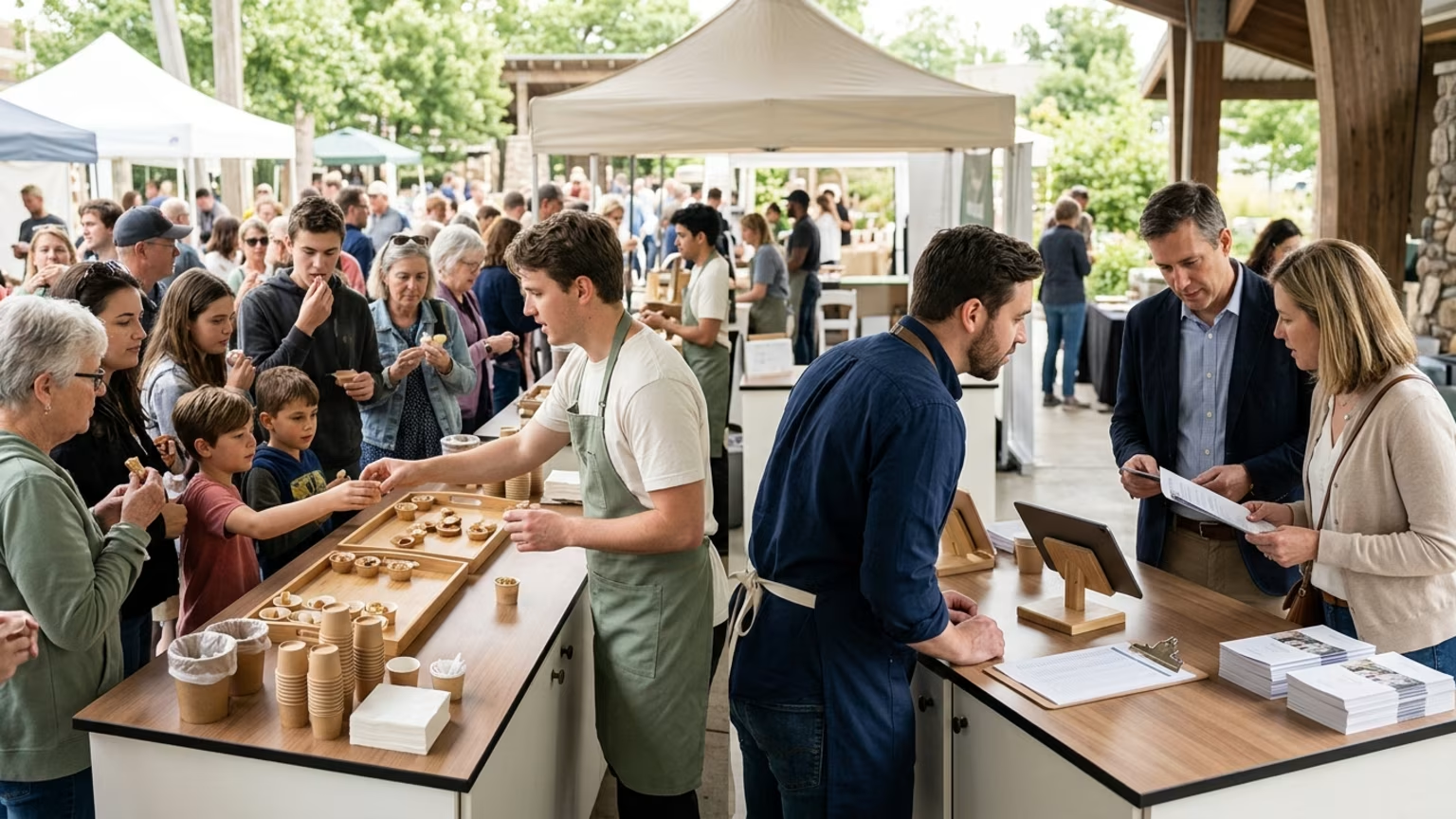
Retail demo programs get judged on empty sample cups instead of incremental pipeline. A busy tasting station looks like a massive win on a Friday afternoon. Then the actual register data arrives on Monday morning. The brand simply subsidized consumers who were never going to buy at full price.
Your unverified blanket discount strategy at the demo table is destroying your margin. Experiential marketing teams often treat product trial as an isolated awareness tactic. They hope a friendly conversation will naturally lead to a purchase. In reality, handing out free product without a connected digital offer is just expensive charity.
If a brand cannot link a physical sample to a specific loyalty mechanic, they are wasting their event budget. Shoppers today are actively hunting for value in every single aisle. If your field marketing program ignores this macroeconomic reality, you will fail. You need a disciplined approach that forces the issue at the shelf.
Right now, retail revenue growth is masking a severe weakness in consumer demand. Shoppers are paying more but buying less frequently. The August Fiserv Small Business Index, based on point-of-sale data from approximately 2,000 U.S. small businesses, found that sales increased 1.3% year over year. However, that gain came entirely from a 3.0% increase in average ticket size.
Actual transactions declined 1.8% during that same exact period. The same Fiserv data showed gas-station sales up 15.1% during this tracking window. Meanwhile, food and beverage sales actually declined 1.4% according to that same report. This indicates that mandatory costs can severely crowd out everyday discretionary purchases.
According to AAA data cited by eMarketer, the national average gas price reached $4.14 on September 3, 2026. That represents a painful 29.9% increase from a year earlier. Alimentation Couche-Tard CEO Alex Miller noted that shoppers were buying fewer gallons on average. He stated they were more deliberate in what they put in their baskets.
This selective behavior weighs heavily on packaged carbonated soft drinks, salty snacks, packaged sweets, and other center-store categories. Marketing leaders panic when they see this unit volume dropping across their primary retail channels. Their default reaction is often a broad price cut to drive immediate shelf movement. But separate Circana data showed overall U.S. retail sales revenue down 1.0% year over year in July.
Unit sales also dropped 2.0% during that same timeframe. For the four weeks ending August 1, nonedible CPG dollar sales declined 0.9% and unit sales fell 3.6% year over year. Discretionary general-merchandise dollar sales decreased 4.3%, while unit demand declined 3.9%. Blanket price cuts erode margin without building any long-term category growth.
Circana’s Kiara Barrett said broad discounts alone were generating less incremental demand. CMOs are spending six figures on retail activations and getting zero qualified pipeline in return. They launch a national sampling tour to push a new beverage or snack brand. The field teams report thousands of engagements and interactions to the executive suite.
Yet the brand sees absolutely no measurable lift in store-level velocity. The activation becomes a beautiful disaster because it lacks precision and tracking.
The solution is not to stop sampling or interacting with shoppers in physical stores. In our experience, physical retail demonstrations still hold incredible conversion power. The key is blending warm human authenticity with brutal operational discipline. A friendly conversation must pair directly with a targeted promotional mechanic.
We have executed over 1000 campaigns across all 50 states, bringing brands to life in every major U.S. market. From retail demos in Seattle to roadshows in Miami and events in Honolulu, our teams activate brands wherever our clients' audiences are located. Through this nationwide execution, we see that modern shoppers require precise incentives. eMarketer argues that targeted promotions, bundles, and loyalty offers may help shoppers see value.
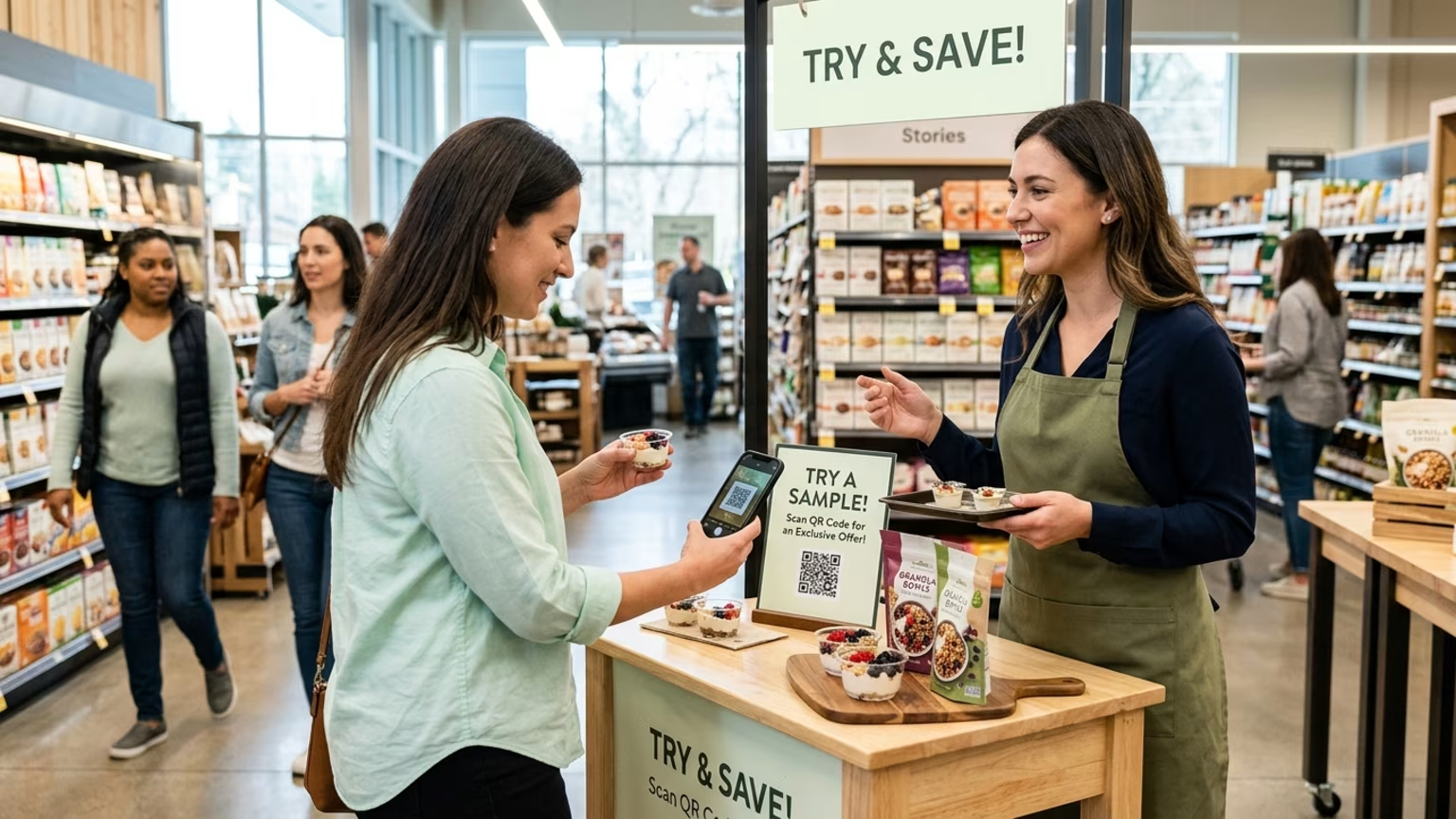
This strategy puts far less pressure on operating margins than blanket price cuts. Field teams must treat every physical activation as a strict offer-delivery system. When an ambassador explains a product benefit, they should immediately provide a loyalty-linked coupon. This connects the physical trial directly to a trackable digital redemption system.
A brand could use a buy-one-get-one offer for high-frequency categories to drive immediate volume. The primary goal is to make the economic value clear right at the point of decision. Timing and relevance matter significantly more than the raw size of the discount. NRF data also found that 48% of seasonal purchases were driven by coupons, sales, or promotions.
Shoppers are actively waiting for the right deal before they commit to a purchase. NRF data cited by eMarketer found that shoppers had completed an average of 44% of their back-to-school lists in early August. This suggests that many consumers were waiting before completing purchases entirely. A well-timed demo that delivers a targeted bundle can capture that delayed demand.
A practical segmentation model must guide your field execution at all times. Brand ambassadors should identify whether a shopper is a new prospect or a lapsed buyer. They can then deliver the appropriate multi-unit or reactivation message on the spot. This level of operator discipline completely prevents wasted promotional spend.
The retail environment remains completely uneven rather than uniformly depressed. Circana reported that food and beverage revenue rose 0.5% during their four-week tracking period. Unit sales for that category actually increased 1.6% alongside that revenue growth. Consumers are prioritizing products that offer clear value, convenience, or highly affordable enjoyment.
Marketing leaders need to shift their focus away from tracking generic impressions. The true measure of an activation is its direct impact on tangible business outcomes and Return on Investment (ROI). You must track samples distributed against actual retailer meetings booked and units moved. Even affluent shoppers are scrutinizing their receipts and actively cutting back.
eMarketer reports that Costco’s U.S. comparable sales, excluding gasoline-price effects, increased 5.6% year over year in August. However, that marked the retailer’s fourth consecutive month of decelerating growth and its smallest increase since February. If growth is slowing at value-driven retailers, broad awareness metrics are useless. Brands must establish a clear pre-campaign baseline for their SKU velocity.
Industry measurement guidance recommends testing in-store campaigns against matched control stores. This holdout testing approach is a stronger way to evaluate in-store retail-media impact than relying only on attributed-sales dashboards, as noted by CMO Magazine. It proves definitively whether a specific activation actually caused an incremental sale. Teams must measure the exact cost per incremental unit rather than the cost per impression.
A high redemption rate is a failure if the brand simply subsidized a guaranteed purchase. Marketers need first-party shopper data to inform their strategy accurately. This data allows brands to segment their offers by specific shopper occasion. It separates new buyers from loyalists who might respond better to premium bundles.
Every physical touchpoint must feed into a broader and cohesive retail media strategy. If a shopper receives a physical sample, they should later receive a replenishment SMS message. Brands should use highly targeted retail demonstrations to increase basket size. These integrated mechanics prove to major retailers that the brand can drive true foot traffic.
That measurable pipeline is exactly what secures long-term retail partnerships and premium floor space. A unified conversion journey requires coordinating physical field execution with digital tracking mechanisms. Investing in advanced event measurement platforms is required because manual tracking is no longer sufficient. Brands need robust tracking to isolate the impact of their targeted promotions.
Marketing operators must carefully calculate the gross margin after the promotion is applied. They should also evaluate the repeat purchase rate following the physical event. This data-driven approach protects your margin while managing multi-stop brand roadshows. Education combined with an immediate offer secures the sale without destroying profitability.
Demanding execution over aesthetics is the only way to survive a pullback in consumer spending. Experiential campaigns that look stunning but lack targeted conversion mechanics will fail. Field marketers must wire every physical interaction into a precise promotional offer. The priority is generating qualified pipeline instead of temporary brand theater.
Before funding your next retail sampling tour, require your field team to establish matched control stores to measure actual sales lift.
Generating measurable conversion from targeted in-store offers requires absolute precision behind the scenes. Makai eliminates the difficulty measuring real ROI from live events by deploying our Storage & Logistics capability. We store your sampling product and event gear, then ship, track, and coordinate delivery nationwide so every activation stays on schedule.

30 Years Experiential & Retail Activation Partner for CPG & Beverage Brands | Multi-Market Demos, Roadshows & Costco/Club Programs That Actually Sell