Robbie Thain
Founder, CEO

Discover how U.S. CPG brands use first-party shopper data and retail media networks to optimize in-store sampling and prove live activation ROI.

Most in-store sampling programs are expensive guesses disguised as marketing strategy. A modern retail media approach uses first-party shopper data to make physical activations precise. Brands can now target audience segments and measure Return on Investment with clear accuracy.
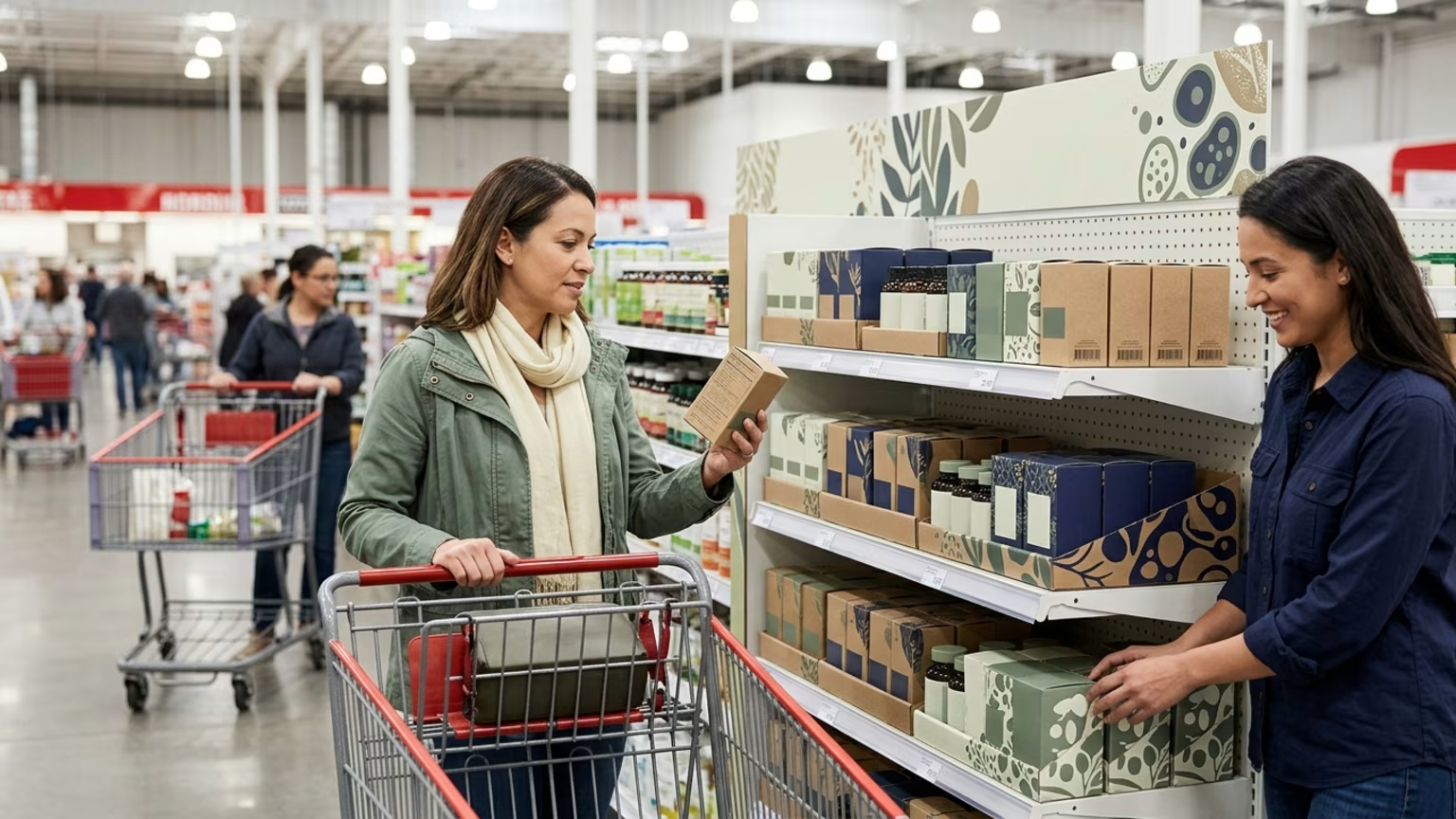
Imagine a weekend at a major big-box retailer. Your brand ambassador stands behind a folding table with a tray of new protein bars. They hand out hundreds of samples to random people walking by. The brand manager gets a report claiming thousands of impressions and depleted inventory.
The actual business impact remains entirely unknown. Did these shoppers buy the product today? Will they buy it next week? You have no idea if you intercepted a loyal competitor buyer or just someone wanting a free snack.
Marketing leaders are under massive pressure to prove live activations create measurable sales lift. You cannot run a profitable business on fog and blind hope. Experiencing fragmented execution and inconsistent staffing drains your budget rapidly. These chaotic events look busy but produce zero evidence of sustainable pipeline growth.
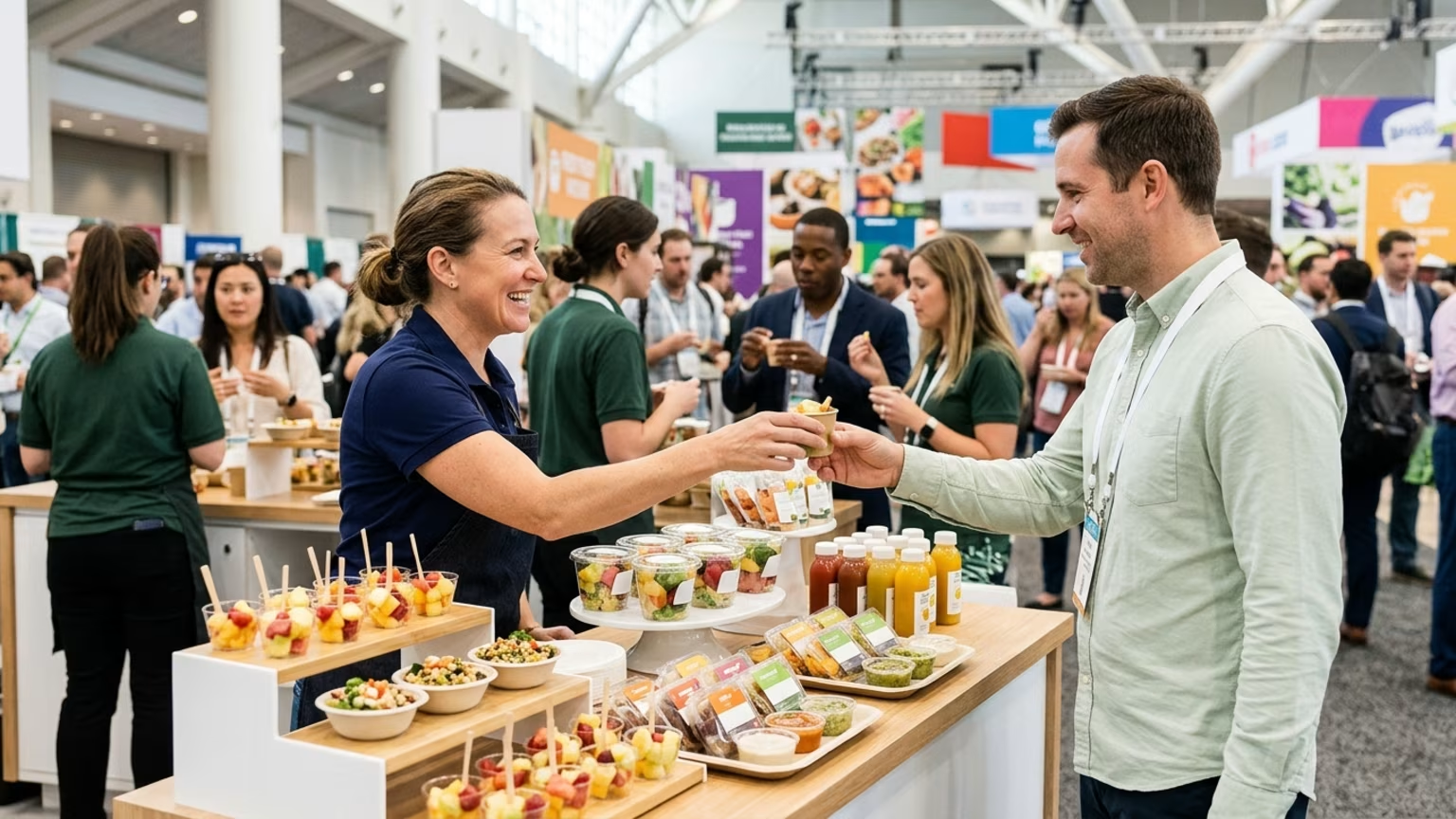
Trade show environments present an equally frustrating scenario for marketing leaders today. Hundreds of competitors fight for attention in massive convention halls with bright lights. Attendees wander aimlessly through aisles without any clear purchasing intent. Your booth staff wastes valuable energy scanning badges of unqualified prospects.
This scattered attention creates incredibly poor booth flow and miserable engagement rates. Field marketers spend months planning an activation only to watch visitors grab free pens and run away. The lack of targeted engagement means your post-event CRM routing becomes a nightmare. Sales teams complain about the low quality leads and refuse to follow up properly.
Brand managers constantly worry about their in-store presentation quality. Third party staffing agencies often send untrained representatives who know nothing about the core product messaging. These ambassadors might wear wrinkled uniforms and set up sloppy promotional displays. The consumer walks away with a negative impression of a premium brand.
Managing complex event logistics takes attention away from meaningful consumer connections. The marketing department needs operational excellence to replace this persistent ambiguity.
Retail media in 2026 serves as core growth infrastructure. Forward thinking brands use retailer data and clean rooms to make physical events targetable. Physical store locations represent some of the richest sources of first-party data available today. This generates contextual signals that digital channels simply cannot match.
Seventy one percent of brands and agencies are currently growing their first-party datasets. They use store traffic data, mobile app signals, and loyalty IDs to plan their activation zones. This allows brands to link experiential sampling to retail media data for complete visibility. If your brand demo is not wired into this data fabric, you leave performance proof behind.
Industry analysts project U.S. retail media ad spend will reach seventy one billion dollars by 2026. Forward looking companies are diversifying beyond major platforms to partner with retailers holding strong first-party data. Marketers no longer get credit for busy events. They get credit for data backed programs that prove incremental impact.
Many organizations still struggle with basic data collection and limited cross-channel capabilities. The bottleneck lies in infrastructure and activation rather than simple data volume. The incremental value comes from better identity resolution and smart experimentation. It is time to book a strategy call and align your field activations with modern retail media networks.
Retail media networks are shifting from pure conversion to full funnel measurement. Brand building has overtaken conversion as the top advertiser objective in recent studies. This forces retail media networks to support upper funnel metrics alongside closed-loop sales. Your sampling programs can now act as full funnel assets that build awareness and prove trial.
Predictive modeling pushes audience segmentation directly into the physical retail store. Retailers now score shoppers based on purchase history and brand switch likelihood. Machine learning targeting uses these first-party signals to prioritize high value prospects accurately. You can build experiential zones that attract category-curious shoppers or high value switchers.
Privacy concerns often arise when discussing this level of detailed shopper tracking. Retail media relies on data collected directly via transparent retailer relationships. This approach is generally more privacy compliant than outdated cross-site digital tracking. Brands must maintain clear consent and offer a transparent value exchange to protect consumer trust.
You need a structured plan to implement this strategy in a live retail setting. This step by step framework turns abstract concepts into real world precision. Your team must abandon the outdated habit of spraying samples across random crowds. Every action on the floor must tie back to a central strategic objective.
We must establish clear lead and lag metrics to report Return on Investment accurately. Your measurement design requires a structured approach to validate field success. Recent studies show a campaign using deterministic retail loyalty data in a clean room delivered massive gains. It achieved 600 percent higher unit sales growth than the category average.
Track your lead metrics carefully during the event. Measure the total number of qualified engagements against your specific target audience segment. Monitor sample distribution rates against historical benchmarks for that exact store demographic. Track the dwell time of shoppers in your activation footprint using traffic counters.
Lag metrics tell the final story of your business impact. Measure the incremental unit lift versus a set of matched control stores. Track the new-to-brand customer acquisition rate over a specific time window. Analyze repeat purchase behaviors and cross-category basket impacts in the following weeks.
Make test-and-learn designs a mandatory part of your evaluation process. Treat each physical activation as a mini experiment feeding a central knowledge base. Determine which audiences, messaging frames, and demo formats drove the highest returns. This modern methodology shows how AI and first-party data turn live demos into growth engines effectively.
Your optimization loop relies entirely on accurate data collection during the event. Run iterative waves to test different promotional offers like buy-one-get-one deals. Compare high value coupons against simple product samples to see which drives better conversion. Test different messaging frames like health benefits versus pure convenience.
Compare different physical activation formats to find the most efficient operational setup. A chef-led demonstration might outperform a simple self-serve kiosk in premium grocery chains. Mobile sampling teams could generate higher engagement than static endcap displays. Let the closed-loop sales data dictate your future experiential marketing investments.
A major beverage brand recently applied this data-driven framework for a national product launch. They moved away from generalized weekend sampling and partnered with a top retail media network. The brand targeted health conscious shoppers who frequently purchased premium fitness products. They placed trained brand ambassadors in fifty specific stores with high concentrations of this target segment.
They faced an aggressive timeline to prove retail viability to their primary distributors. The traditional approach would have required a massive nationwide blitz with zero targeting. Instead, they isolated fifty prime locations using the retailer loyalty program data. They matched their ideal customer profile against the exact foot traffic patterns of those stores.
The campaign focused heavily on educating the consumer through a highly trained brand ambassador. These representatives engaged shoppers in deep conversations about ingredient sourcing and health benefits. The clean room data allowed the brand to track these exact interactions down to the final register scan. They proved that shoppers who engaged with the ambassador spent thirty percent more on that specific trip.
The results validated the power of an integrated physical and digital strategy. The targeted activations created measurable trial and immediate retail sell through. Store managers requested more inventory to support the sustained demand. The clean room data proved a direct link between the in-store sample and subsequent repeat purchases.
A VP of Marketing reflected on our partnership: 'Robbie, it was a pleasure working with you and your team. You turned our launch into an experience that connected with shoppers and built lasting excitement for our brand. We're already looking forward to the next project together.' Our team created a launch experience that resonated with retail shoppers and generated momentum for future collaborations.
This approach eliminates the guesswork from physical brand activations. The brand achieved retailer confidence and secured better shelf placement for the next quarter. Shopper marketing teams finally had the concrete evidence they needed to justify increased field budgets.
The client successfully defended their shelf space against larger competitors. Retail buyers rely heavily on concrete proof of consumer demand before expanding product lines. This campaign provided undeniable evidence that the product could drive category growth. The data-driven execution turned a standard product launch into a highly profitable retail media case study.
Physical environments hold the power to shape immediate consumer choices. Brands no longer need to rely on generalized foot traffic to gauge success. Precision now defines the relationship between a product and a potential buyer. The true value of a real world interaction lies in the data it leaves behind.

30 Years Experiential & Retail Activation Partner for CPG & Beverage Brands | Multi-Market Demos, Roadshows & Costco/Club Programs That Actually Sell