Robbie Thain
Founder, CEO

Discover how structured retail sampling pilots drive measurable trial uplift and incremental sales. Learn operational tactics to maximize in-store conversion.
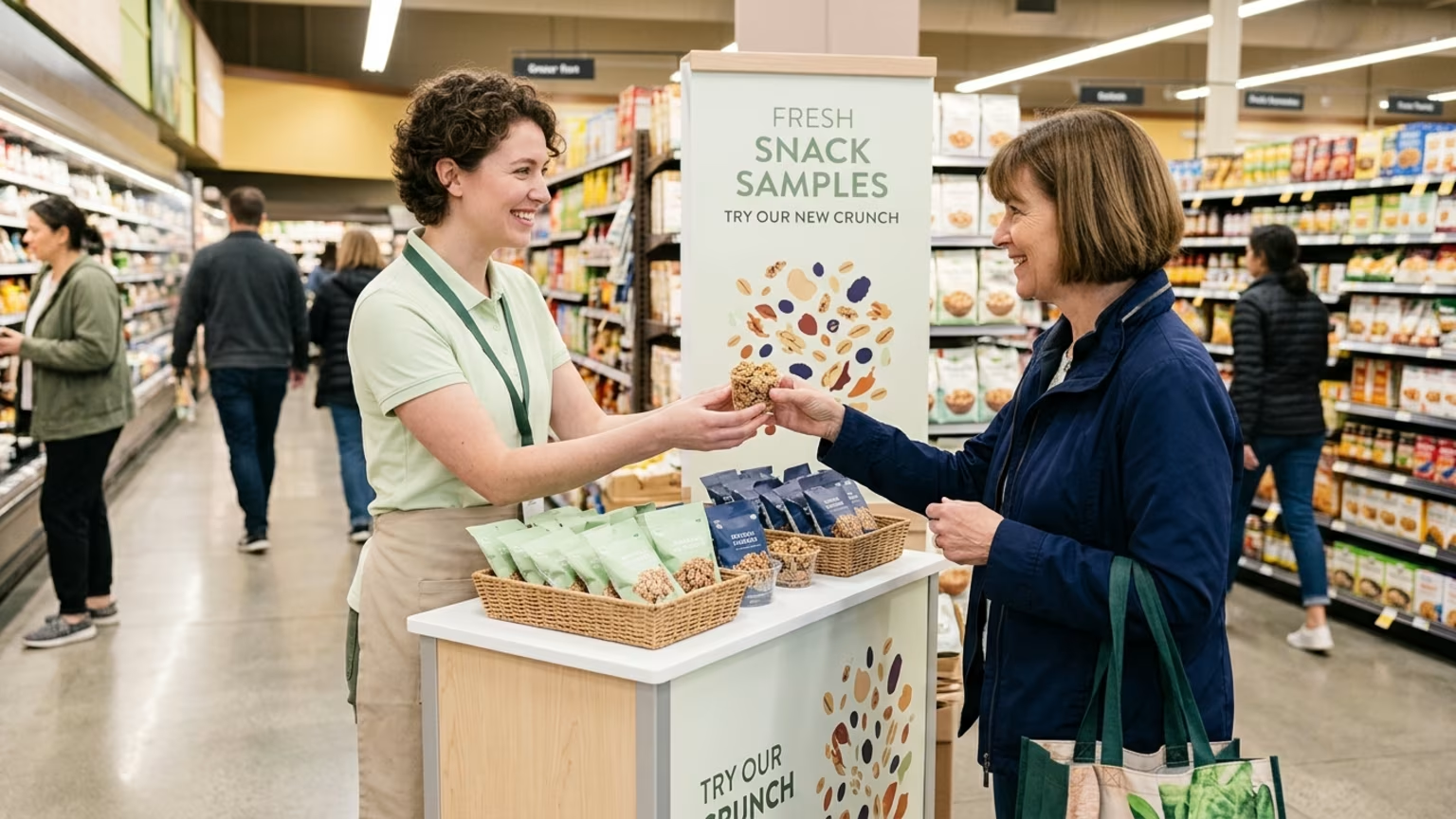
Retail demo programs often get judged on cups poured rather than on incremental pipeline generated. That operational mismatch is exactly why digital marketing efficiency is flatlining for consumer packaged goods. When marketing teams treat physical sampling as mere brand theater, they hemorrhage their trade budgets without securing real retail sell-through. Modern shopper marketing requires a complete reset that prioritizes measurable trial lift over simple engagement metrics.
Brands are throwing money at digital ads while their actual products sit untouched on store shelves. The modern consumer ignores online noise when evaluating sensory-driven categories like better-for-you snacks. Without a physical taste test, digital impressions fail to generate confidence at the retail shelf. Real business outcomes require putting the actual product into the hands of targeted shoppers. Experiential activations must operate with the precision of a high-performance media buy.
Mid-to-senior marketing leaders constantly face pressure to prove that activations lead directly to sales lift. Unfortunately, many field programs degrade into chaotic logistical nightmares with poor in-store presentation and weak reporting. Executives worry about inconsistent staffing and events that look busy but produce zero evidence of conversion. A well-designed physical pilot cuts through this fog by delivering undeniable performance metrics.
The data confirms that physical sampling aggressively outpaces standard digital advertising. According to a field marketing guide from American Guerrilla Marketing, sampling programs for sensory-driven products convert at 2 to 4x the rate of standard advertising. The same analysis reports that well-run programs typically achieve a 15 to 35 percent trial-to-purchase conversion. These high conversion rates occur when purchase is convenient for the shopper.
Timing metrics fundamentally dictate the success of these in-store activations. Aggregated demo analytics from a Startup CPG session reveal that Saturday midday is the single highest-converting demo window. Monday, Friday, and Sunday also perform strongly across the measured dataset. The performance data shows that July, August, and September are the top months for demos. September specifically holds the number one rank for average dollar sales performance.
Retail chain selection heavily influences the final Return on Investment for any sampling pilot. The Startup CPG demo analytics identify Whole Foods as generating the highest average dollar sales per demo. The data also shows that Sprouts and Central Market punch above their weight relative to their size. These metrics prove that choosing the correct retail partner is just as critical as the product itself.
In-store conversion mechanics also present surprising operational realities. The demo analytics webinar reports that paper coupons outperform QR code redemptions at the demo table. Consumers clearly respond better to immediate physical incentives when standing in the aisle. Once a shopper stops at a demo table, conversion rates remain roughly similar regardless of product price point. This data suggests that physical sampling works highly effectively even for higher-ticket items.
The operational characteristics of the product itself also dictate the strategic approach. American Guerrilla Marketing argues that sampling programs work best for products where sensory experience drives the purchase decision. This includes crowded food and beverage categories that struggle to stand out on shelves. It also applies heavily to products that are difficult to communicate through traditional advertising channels.
For a VP of Marketing staring at a fragmented trade budget, these metrics demand a ruthless reallocation of resources. You must stop funding scattered weekend events just to appease retail buyers or distributors. The proven 15 to 35 percent conversion benchmark proves that physical trial is a high-performance acquisition channel. Achieving those exact numbers requires rigorous operational discipline and strict performance tracking.
Leaders must treat in-store activations like clinical media tests. A guide to incrementality testing from GetKard advises withholding 10 to 20 percent of a target audience as a control group. Marketers should expose the rest to the campaign and compare sales over a 2 to 4 week window. You need a clear baseline conversion rate and a minimum meaningful lift of 5 to 10 percent. Hitting a 95 percent confidence level ensures your trial uplift represents a true behavioral shift.
Understanding consumer demands makes this level of targeted measurement absolutely necessary. McKinsey reports that growth in food and beverage is increasingly driven by offerings that reduce specific consumer trade-offs. Shoppers want products that balance taste, price, and functional benefits like health and wellness. Because better-for-you snacks operate in this exact intersection, physical trial remains the only way to prove product value.
The friction between national media campaigns and local retail execution causes massive budget waste. When you launch a new product, retailer confidence relies entirely on local sell-through velocity. Field marketing directors cannot secure more shelf space if they only present vague impressions from a digital dashboard. They need hard evidence of repeat purchase behavior generated by local in-store engagement.
If your current field marketing team cannot report on these precise margins, your brand is flying blind. You must demand clear incrementality testing frameworks for every structured retail sampling pilot you launch. Spending budget on vague brand awareness in physical stores is a massive operational failure. Every activation dollar must map directly back to a measurable lift in unit sales.
Operational rigor must now completely replace passive table presence on the retail floor. You cannot just drop a brand ambassador near an endcap and expect double-digit trial uplift. A case-study framework by Do What Matter recommends focusing on a clearly defined problem and a bounded pilot. Teams must define clear locations, exact durations, and concrete behavioral signals like usage or willingness to pay.
Street-level tactics provide a massive advantage for integrated consumer packaged goods campaigns. American Guerrilla Marketing notes that weekends from 10am to 4pm represent a strong window for lifestyle, food, and health brands. The playbook suggests surrounding sampling locations with street advertising within a 4 to 6 block radius. This perimeter should start one week before the actual activation. Maintaining these materials for 2 to 3 weeks afterward helps reinforce awareness and capture delayed purchases.
Many brands mistakenly assume that standard digital impressions hold weight with retail purchasing teams. However, retail buyers see thousands of digital marketing decks every single year. They know that online clicks do not always translate into physical register ring at their specific store locations. Showing up with concrete incrementality data from a bounded physical pilot changes the entire buyer conversation.
Building a physical trial funnel is mandatory because buyers and consumers share the exact same hesitation. A food and beverage lead generation guide from CUFinder notes that retail buyers typically taste before they trust. The guide recommends using physical product samples as a primary lead magnet. This approach must be supported by structured fulfillment and rapid follow-up to secure retail pipeline.
Sampling effectively neutralizes the risk for both the shopper and the retailer. American Guerrilla Marketing notes that sampling programs are best suited to products where sensory experience drives adoption. This applies especially well to emerging products that are genuinely difficult to communicate through a standard digital graphic. Once shoppers actually try the product in the aisle, they immediately grasp the value proposition.
Properly structured pilots eliminate the guesswork from local promotional campaigns. When you deploy paper coupons instead of QR codes, you remove digital friction from the immediate purchase decision. When you focus on Saturday midday shifts, you optimize your labor spend against the highest converting traffic. These small tactical adjustments compound to create a highly efficient retail conversion engine.
The execution on the floor requires brand ambassadors who understand how to close a sale. You must train your field staff to initiate real conversations rather than just handing out cups silently. The goal of a demo is never just to distribute inventory to passing foot traffic. The true objective is to create a customer who buys your product repeatedly after that initial interaction.
At makai, our team knows exactly how to bridge this gap between product trial and retailer confidence. Our team created a launch experience that resonated with retail shoppers and generated momentum for future collaborations.
A VP of Marketing reflected on our partnership: "Robbie, it was a pleasure working with you and your team. You turned our launch into an experience that connected with shoppers and built lasting excitement for our brand. We're already looking forward to the next project together."
Executing this standard requires targeting the proven Saturday midday window with strict staff training protocols.
Marketing operators must strip vanity metrics out of their field reports entirely this quarter. Update your internal dashboards to track incremental sales lift against a defined control group over a 2 to 4 week window. Shift your activation spend toward high-performing months like September to maximize average dollar sales. Prioritize proven retail partners like Whole Foods and Sprouts to secure the best possible return on investment.
Stop measuring how many people smiled at your booth or took a free sample. Start measuring how many targeted shoppers actually crossed the line to purchase your product. Physical activations are the most powerful acquisition tool in the modern marketing playbook. Treat your retail floor execution with operator-grade discipline to turn live brand experiences into measurable revenue.

30 Years Experiential & Retail Activation Partner for CPG & Beverage Brands | Multi-Market Demos, Roadshows & Costco/Club Programs That Actually Sell