Robbie Thain
Founder, CEO

Major outdoor trade shows are shifting from massive scale to strategic value by prioritizing qualified buyer meetings, pipeline creation, and measurable growth.

Trade show coordinators often scan massive convention halls filled with thousands of wandering attendees. Many of these passing visitors have no purchasing power at all. This mismatch between raw foot traffic and actual business value forces marketing operators to rethink their exhibition strategies. Budget constraints demand that every live activation produces documented returns.
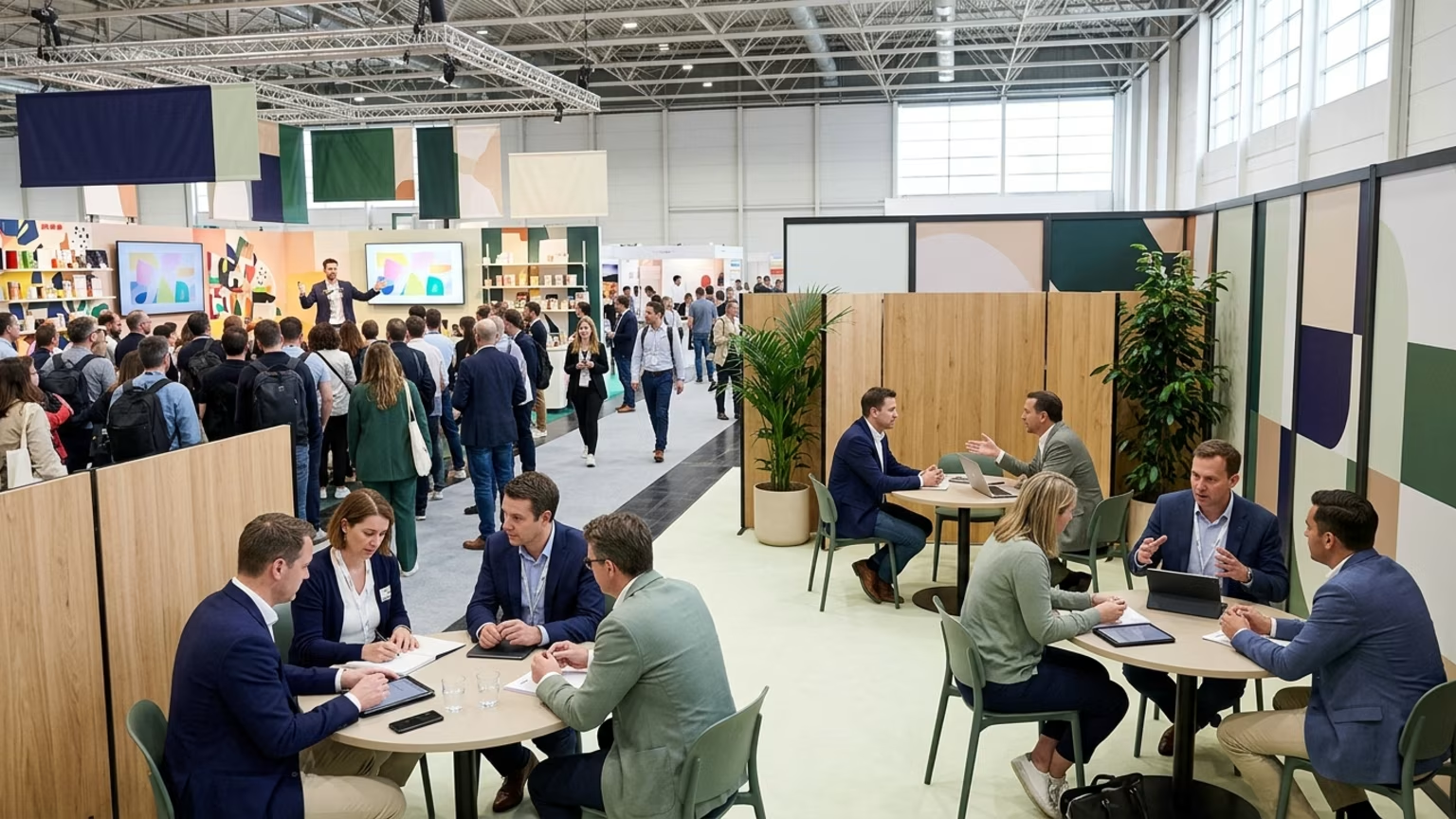
Value-driven exhibition is the deliberate design of physical event spaces to generate measurable sales pipeline rather than passive brand theater. This model strips away generic vanity metrics to focus strictly on qualified retailer interactions and trackable commercial outcomes. Field marketing teams must shift their primary objective from collecting business cards to securing targeted buyer meetings. When the focus moves to pipeline creation, the entire booth architecture changes to support deep product conversations.
The era of judging a trade show by its sheer crowd size is rapidly ending. Marketers must break down what this evolution means in the physical world of consumer goods and outdoor retail. Brands can no longer justify heavy investments in sprawling booths that produce very few usable contacts. Instead of chasing scale for appearances, operators are prioritizing controlled environments where every conversation has a clear business purpose.
The data reflects this operational shift toward stricter measurement standards across the industry. According to the AUMA Exhibitor Outlook cited by I Love Ski, trade fairs remain a core component of commercial strategy. The survey of 404 companies found that 97.5 percent of respondents still regard these events as vital platforms for exchange, innovation, and generating business. However, the average expected number of trade-fair participations fell from 5.4 to 5.1.
Companies are attending fewer events but demanding much higher strategic relevance from the shows they do select. This approach requires brands to heavily scrutinize their activation footprints. Among capital-goods trade-fair exhibitors, 85.4 percent considered trade fairs important or very important to their marketing strategy. The way these companies measure success is heavily skewed toward hard revenue indicators.
Approximately 49 percent of surveyed companies primarily evaluate trade-fair outcomes through leads, contacts, and new-customer acquisition. Only about 4 percent used brand awareness or visibility as their main success indicator. When trade shows shift from brand theater to revenue, the floor reality changes immediately. The industry is moving away from spaces designed simply to hold maximum capacity.
Event designers now prioritize layouts that foster deep product education and private negotiation. When expected trade-fair participations drop, the pressure on each remaining event increases significantly. Marketing teams must justify the cost of booth fabrication, staff travel, and lost operational time. Outdoor Retailer recently demonstrated this exact pivot in strategy.
The organizer announced a new direction in October 2025 to prioritize focused connections over massive crowds. Outdoor Retailer reports that its 2026 Minneapolis event attracted more than 1,800 attendees and 275 brands over three days. The event surpassed its target of 400 qualified retailers. This result is dramatically smaller than the 2018 Denver event jointly held by Outdoor Retailer and the SIA Snow Show. That 2018 event attracted more than 29,000 attendees and 7,500 accredited buyers.
Transforming an oversized booth presence into a disciplined sales machine requires three fundamental pillars. The first pillar is qualified retailer access. A brand must define exactly what makes a buyer qualified before the doors open. Outdoor Retailer established its specific target of 400 qualified retailers to center the event on commercial viability. Without a clear definition of an ideal buyer profile, field teams waste valuable hours speaking to the wrong people.
The second pillar is structured buyer engagement. Relying on random aisle traffic to generate revenue is a failing strategy. Organizers and brands must actively engineer meetings between the right parties. I Love Ski reports that ISPO plans to allocate €1 million to a Hosted Buyer Programme at its November 2026 Amsterdam event. This initiative is designed to connect approximately 500 buyers with brands through targeted meetings. ISPO expects more than 25,000 industry professionals and 850 exhibitors at the RAI Amsterdam venue.
Specialized events show the power of concentrating purchasing authority in one room. INTERALPIN 2025 in Innsbruck attracted 36,800 professionals and 650 companies. I Love Ski reports that approximately 75 percent of visitors had purchasing decision-making authority. More than 80 percent of those decision-makers attended with specific investment projects in mind. We have executed over 1000 campaigns across all 50 states, bringing brands to life in every major U.S. market. From retail demos in Seattle to roadshows in Miami and events in Honolulu, our teams activate brands wherever our clients' audiences are located.
The third pillar is integrated content capture. Physical events must now generate digital assets to justify their travel and setup costs. Outdoor Retailer said participating brands in Minneapolis were matched with more than 150 media representatives and creators. Its Wild Reach creator program generated more than 850 onsite brand-creator connections. The organizer reported a potential combined audience of 21.2 million outdoor consumers from this effort. A modern footprint must capture usable media while also driving pipeline. Popfly provided verified engagement data and an asset library for continued use after the event.
Smart brands deploy a strict tracking framework to measure these localized activations. Every interaction must tie back to a centralized customer relationship management system. Unstructured conversations do not translate into post-event sales. AUMA Managing Director Jörn Holtmeier argues that the sector's resilience comes from combining face-to-face interaction with digital progress. Capturing data efficiently on the show floor prevents high-value leads from going cold.
The measurement standard should move well beyond simple badge scans. Teams must capture estimated opportunity sizes, specific product interests, and scheduled follow-up dates. This data allows sales leaders to segment leads by account value and urgency immediately after the show concludes. Many brands are learning how interactive lead capture turns trade shows into sales pipelines to avoid losing critical deals. Integrating this technology ensures that the marketing team can defend its event spending.
The evolution of event formats provides more touchpoints for this targeted data collection. The 2026 OUTDOOR format in Riva del Garda combined exhibition activity with meetings, product testing, media, and sustainability initiatives. The event attracted more than 8,000 professionals from more than 60 countries. The associated OUTDOOR and ORBDAYS events included more than 250 exhibitors, more than 400 brands, and approximately 2,700 buyers. Diverse programming creates multiple specific zones for tracking active buyer engagement.
Mountain Planet 2026 in Grenoble also demonstrated steady demand for these focused professional gatherings. The event attracted more than 21,000 industry professionals and more than 480 exhibitors from 65 countries. Attendance actually increased 4.5 percent from the previous edition. Whether at a massive international summit or a targeted regional show, exhibitors must rigorously monitor meeting volume and sample requests.
Tracking these precise metrics is the only way to accurately calculate Return on Investment. Furthermore, the measurement framework must account for finding new brands and long-term pipeline development. The inaugural Ascent Summit at the Minneapolis show brought together 75 up-and-coming founders. They participated in workshops and peer-led sessions on scaling, retail distribution, and brand growth.
By tracking the progression of these emerging brands from initial meetings to retail listings, operators can prove lasting value. Brands can optimize their strategies by understanding how booth traffic blueprints scale to pop-up roadshows. Every activation dollar spent must be completely defensible against rigorous financial scrutiny. Connecting physical interactions directly to downstream sell-through is now a mandatory requirement.
Creating an immersive physical experience is only the beginning of a successful field marketing strategy. If the field team fails to capture the right data, the entire financial investment is wasted. Modern organizers are providing the digital tools to filter audiences, but brand operators must execute the rigorous physical work. Integrating lead capture with immediate post-show routing prevents hard-earned buyer interest from evaporating.
The days of measuring an event by the volume of promotional items given away are over. Executive leadership teams expect live events to perform with the same measurable efficiency as digital advertising campaigns. The bottom line is that value-driven exhibition requires replacing a passive hope for foot traffic with an operational demand for qualified pipeline. Field execution must always serve the balance sheet.
Chasing unverified booth traffic often results in low quality leads from crowded trade shows. Makai prevents this wasted effort by deploying our Consumer Events capability. We design memorable live experiences that bring brands and people together through interaction, emotion, and engagement. By focusing strictly on qualified pipeline rather than passive crowds, our operators ensure your field investments convert into measurable revenue.

30 Years Experiential & Retail Activation Partner for CPG & Beverage Brands | Multi-Market Demos, Roadshows & Costco/Club Programs That Actually Sell