Robbie Thain
Founder, CEO

A new trade-show guide offers a competitor-response framework built around target accounts, prepared staff, qualified conversations and CRM follow-up.

On October 12, 2026, Small Business Expo published “Competitor Won An Expo? Trade Show Marketing Guide”, a framework for responding when a competitor announces an expo-related customer win. The publication puts account selection and sales readiness at the center of the response rather than treating a crowded booth as the measure of success.
For CPG and beverage marketing leaders, that raises a practical planning issue. A competitor signal needs a defined place in the account plan without taking over the consumer experience.
Small Business Expo recommends checking what the competitor announced before building a response. The customer’s industry and region help define similar accounts. Company size is another selection factor. The guide also prioritizes accounts connected to the expo or recently active on the exhibitor’s website.
That information feeds a focused account list and a one-page sales battlecard. The proposed battlecard covers the announcement and the competitor’s likely positioning. It also includes counter-positioning points and ready-to-use outreach language.
The guide then recommends preparing reps through a short huddle and tracking objections during outreach. For show performance, it favors qualified leads and booked meetings alongside opportunities. Pipeline and revenue complete the commercial picture. Booth traffic and badge scans are not the sole scorecard.
The guide also proposes tracking target-account engagement and tagged opportunities. Response time and rep use of scripts are part of its suggested scorecard. For a marketing leader, that separates whether the response was executed from whether it created a commercial opportunity.
The boundary is straightforward: this is practitioner guidance for B2B selling, not a documented competitor win or a tested campaign. Its response windows and outreach cadence are proposed operating choices rather than validated benchmarks. Applying the framework to consumer trial or retail sell-through requires adaptation to that buying path.
The guide proposes a change in planning rather than a new show-floor requirement. Its operational recommendation is to use a verified market signal to choose relevant conversations and document what happens after them.
Makai’s stance is simple: stay welcoming in person and disciplined about the handoff. Aloha is the human side of the interaction. Commercial discipline means understanding what someone needs and preserving that context for the next conversation. A competitor announcement should sharpen relevance rather than turn the booth into an argument.
Our work connects physical engagement with commercial goals through experiential campaigns and trade show activations. We also deliver retail demonstrations through trained brand ambassadors who use real conversations and product trials. For us, the point is not to replace those interactions with a sales script. It is to make the right next step visible.
Our team reports reach, trials, leads, and sales to guide campaign optimization. Those categories answer different questions. A product trial records participation while a qualified business lead supports a different kind of follow-up. We believe both deserve a place in the plan without being treated as interchangeable evidence.
For a CPG application of the guide, priority accounts might be retailers or distributors. Other business partners may belong on the list as well. That adaptation keeps account selection tied to the brand’s buying path instead of treating every person accepting a sample as a buyer.
The strategic connection is between a show plan built around business outcomes and the live experience that supports it. In our view, strong hospitality and clear qualification are compatible. Staff can be warm without making every interaction count as pipeline.
For Makai, the downstream implication is a more explicit brief for people and space. The guide’s account focus can inform what booth staff need to know before doors open. Our services include trade show planning and management as well as integrated support from permitting to CRM reporting. We believe these operational pieces should serve the interaction the brand is trying to create.
Small Business Expo recommends a one-page battlecard and a 15-minute huddle. A short preparation session is meant to translate the competitor announcement into usable talking points. The same guide asks exhibitors to understand visitor needs and qualify conversations.
For CPG teams, our view is that the brief should connect accurate product positioning to the priority-account list. Staff preparation can cover the announcement without asking ambassadors to speculate about a competitor’s deal. The guide’s focus on visitor needs keeps the conversation centered on the person present.
That creates a useful distinction for matching field staffing to the interaction. Product trial and a business-account discussion have different purposes. The staffing plan should reflect those purposes rather than use total traffic as its only demand signal.
Small Business Expo advises exhibitors to book meetings before the event and capture next steps during conversations. Our interpretation is that the footprint should support product participation and qualified discussion. A meeting plan needs a place in the space plan rather than being left for staff to solve during the show.
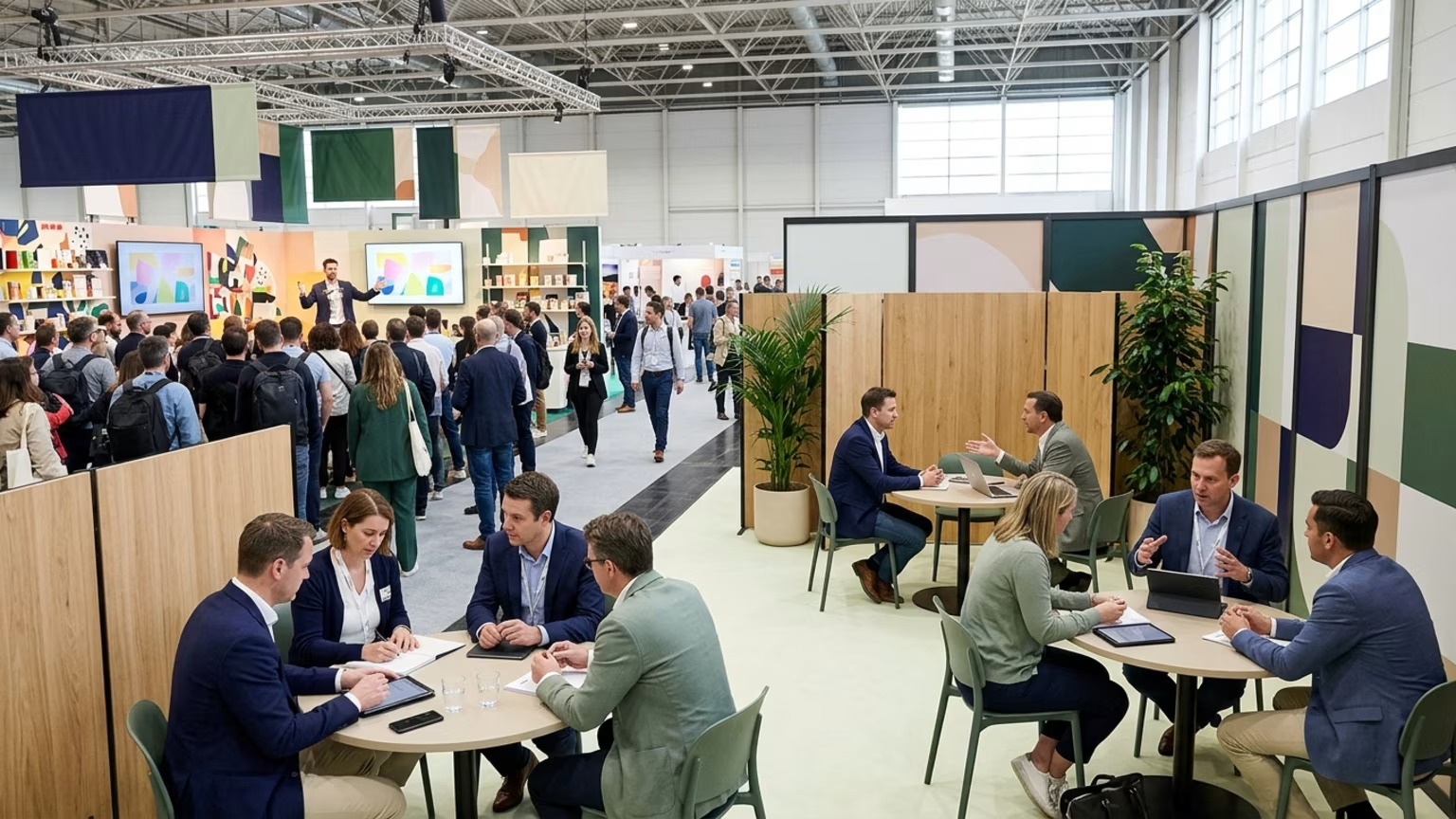
At Natural Products Expo West 2025, we designed and managed a 40 by 20 foot trade show environment for Glanbia. The activation brought think!, Isopure, Optimum Nutrition, and Amazing Grass into one coordinated space.
We handled concept and operations along with staffing and breakdown. More than 14,000 recorded product samples were distributed across the activation stations.
The lesson we take from that experience is about coordination across a multi-brand footprint. For an account-focused plan, sample distribution and business conversations need separate reporting categories. The account plan belongs alongside the activation layout rather than being confused with the sample total.
A separate trade-show Return on Investment guide recommends tagging event leads in the CRM and tracking event costs. It distinguishes event-sourced pipeline from event-influenced pipeline and recommends assessing revenue at multiple post-event intervals. For the response plan, that distinction gives the account record a more useful role than simply confirming attendance.
Small Business Expo’s guide also recommends capturing next steps and following up within 48 hours. The operational priority is to retain the visitor’s need in the record that reaches sales. In our view, the handoff is incomplete when sales receives a contact but not the reason for continuing the conversation.
An experiential-marketing analysis broadens evaluation beyond attendance and lead counts to include dwell time and completed engagements. Recall and sentiment sit alongside downstream pipeline quality in that framework. For a consumer-facing activation, these measures can complement the commercial record instead of replacing it.
A coherent review can therefore ask separate questions about participation and account progress. The connection is preserving context from the booth to the CRM. The objective is an agreed record of the interaction and its next step rather than a pile of scans.
This is where the competitor-response framework becomes useful for field execution. The announcement informs account selection. Staff preparation supports relevant conversations. CRM tagging and documented next steps carry that work into the post-event review.
Competitor news is a reason to review account priorities before changing the activation’s scale. The guide’s strongest transferable recommendation is to connect a qualified interaction with a documented next step.
Before your next activation, which priority account will you add to the plan today with a clear visitor need and an agreed sales follow-up?
Competitor-driven expo plans can lose focus when product interactions end without a clear sales follow-up. For CPG marketers facing inefficient post-event follow-up and CRM routing, Makai plans trade show spaces around qualified lead generation and delivers retail demonstrations led by trained brand ambassadors who pair product trials with in-store conversations.

30 Years Experiential & Retail Activation Partner for CPG & Beverage Brands | Multi-Market Demos, Roadshows & Costco/Club Programs That Actually Sell