Robbie Thain
Founder, CEO

Maximum return on event marketing investment comes from aligning distinct audience intent, spatial architecture, and commercial goals across diverse live.
Marketers frequently ask search engines how to choose between trade shows, conferences, and expos when planning annual budgets. Every live marketing format demands significant capital, dedicated staff hours, and operational focus. Choosing between trade shows, conferences, expos, conventions, field activations, and hosted buyer programs requires aligning attendee buying intent with your specific commercial objectives. This guide outlines the distinct operational mechanics, conversion profiles, and strategic trade-offs of each live event format so you can invest with total clarity.
Every veteran marketing director has experienced the sinking feeling of a mismatched event format. You arrive on-site, inspect your booth footprint, and immediately realize the room was built for a completely different purpose. Perhaps your sales team is standing in a custom twenty-foot booth waiting for retail buyers, but the aisles are filled exclusively with academic researchers. Perhaps you paid top-tier sponsorship rates at a national summit hoping for deep executive conversations, only to find attendees rushing past your table between keynotes.
Misaligned event formats burn through marketing budgets while exhausting internal teams. When brands treat every business gathering as an interchangeable lead-generation channel, execution suffers. Staff members become frustrated when their pitch falls flat against uninterested attendees. Field marketing leads struggle to justify booth expenditures when post-show reports show badge scans without commercial intent.
Live events create powerful human connections that digital channels cannot replicate. According to global research by the Events Industry Council and Oxford Economics, 67% of business event professionals identify relationship-building through face-to-face interaction as the commercial outcome most difficult to replace through virtual alternatives. The same study indicates that up to 22% of new customer acquisition traces directly back to in-person event interactions.
Achieving those outcomes requires selecting an event structure that mirrors your commercial sales cycle. A product demo that excels on a crowded trade show floor will fail in an intimate conference lounge. Matching the venue format to your operational goals turns live events from expensive brand theater into predictable pipeline engines.
Understanding why attendees purchase tickets is the single most critical step in event selection. Attendees arrive at different event types with radically different mindsets, expectations, and purchasing authority.
Trade shows exist primarily to facilitate direct commerce, vendor comparison, and channel distribution. Research from the Center for Exhibition Industry Research (CEIR) reveals that 94% of trade exhibition attendees possess net-buying influence for their organizations. These individuals specify products, recommend vendors, determine organizational needs, influence evaluations, or make final purchase decisions.
Trade show attendees are not casual browsers. They attend to evaluate competing options across a concentrated category footprint. CEIR data also shows that attendees visit exhibitions across an average of 3.2 industry sectors over a two-year span, while exhibiting companies participate in 2.2 sectors. This behavior makes trade shows exceptionally effective for category discovery, distributor recruitment, and direct competitive displacement.
When you exhibit at a trade show, your audience expects direct product comparisons, pricing conversations, and technical demonstrations. They arrive prepared to discuss implementation timelines and supply chain requirements. If your goal is selecting high-yield commercial gatherings, reviewing the definitive guide to choosing the right trade shows for your brand provides a reliable foundation for your planning.
Conferences operate on an educational logic. Attendees register for conferences to acquire domain knowledge, earn professional certifications, hear industry leaders speak, and build peer networks.
Freeman research published through the Professional Convention Management Association (PCMA) surveyed nearly 2,100 business event attendees. The study found that attendee motivation centers around four distinct drivers: learning, networking, doing business, and personal enjoyment. Learning remains the dominant anchor for conference registration. Seven out of ten respondents stated they prefer receiving professional education in person rather than online.
Networking at conferences also follows a specific structure. Freeman found that 81% of attendees rank interaction with subject-matter experts as their most valued networking activity. Connecting with new professional contacts followed at 68%, while peer-to-peer exchange reached 64%. Furthermore, 52% of attendees specifically sought connections with peers facing identical operational challenges.
A hard sales pitch inside a conference educational track alienates attendees. Marketers succeed at conferences by positioning their brand as an intellectual authority. If you cannot solve a problem or educate the room, a traditional conference will generate poor direct sales volume.
The term expo lacks a single standard definition across the live marketing industry. In practice, expos range from large public-facing consumer showcases to massive hybrid industry gatherings.
Because the format varies widely, audience intent varies as well. Consumer expos attract hobbyists, local shoppers, and enthusiast communities seeking entertainment and new products. B2B industry expos resemble trade shows, bringing together international suppliers and procurement managers.
Marketers should never assume buyer intent based on the word expo alone. You must analyze historical registration demographics, badge scanning records, and ticket qualification criteria. An expo is ideal for mass product trial, consumer sampling, and high-volume brand awareness. It is rarely the right venue for complex, multi-stakeholder enterprise contract negotiations.
Field events do not rely on third-party organizers to gather a crowd. A field event is an owned or highly targeted regional activation, such as an executive dinner, a localized product workshop, or a mobile brand tour.
Field marketing research highlights that these activations prioritize audience precision over mass foot traffic. Instead of scanning hundreds of random badges, field events bring twenty to fifty pre-qualified decision-makers into a single room.
The audience arrives because the host created an exclusive, hyper-relevant environment to discuss specific operational problems. Field events work exceptionally well for account-based marketing programs, regional retail support, and late-stage deal acceleration.
Hosted buyer programs create a structured matchmaking environment within larger expos and trade shows. Event organizers subsidize travel and lodging for verified procurement executives in exchange for mandatory, pre-scheduled vendor meetings.
CEIR examined structured matchmaking programs across North America and found that 80% of organizers implement them to improve face-to-face interaction quality. However, the study uncovered an execution gap: only 51% of exhibitors and 47% of buyers actively engaged with the matchmaking tools provided. Furthermore, attendee satisfaction with automated matchmaking tools frequently registered as neutral or negative.
A hosted buyer format guarantees calendar appointments on paper. Real success requires careful pre-qualification, direct agenda coordination, and deep account research before arriving at the table.
The physical floor plan of an event dictates attendee behavior and shapes commercial conversations. Each event category creates a distinct physical environment that either helps or hinders specific marketing tactics.
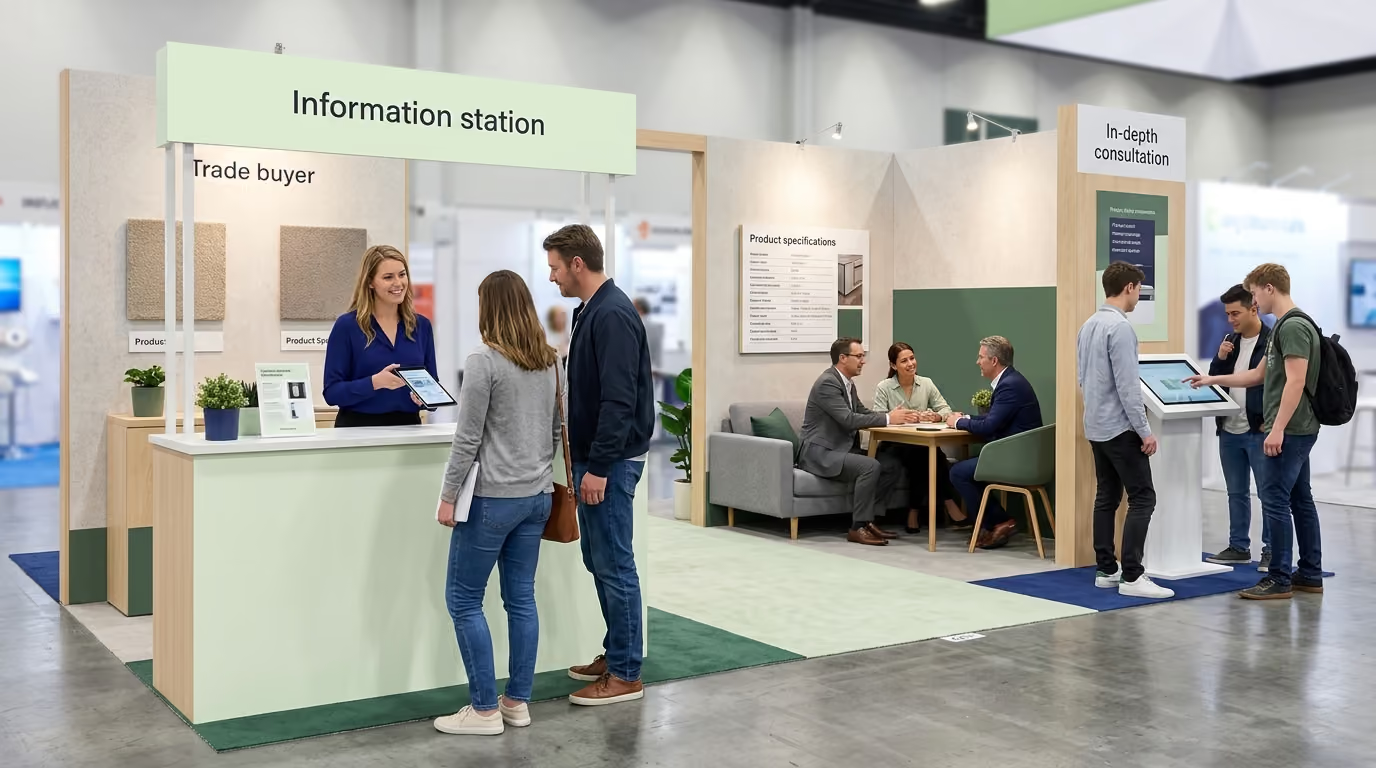
Trade shows are organized around high-density exhibit halls divided into aisles, standard pipe-and-drape spaces, and custom island footprints. This layout encourages steady foot traffic and side-by-side product comparisons.
In this environment, visual clarity and booth throughput determine success. Attendees decide within seconds whether to walk into a booth or keep moving down the aisle. Trade show footprints must feature open sightlines, active demonstration counters, and organized zones for quick lead capture.
Trade show floors create intense noise and visual competition. Because dozens of direct competitors sit within walking distance, your booth architecture must immediately communicate your primary product value. If a buyer cannot understand what you offer from ten feet away, they will keep walking toward your competitor.
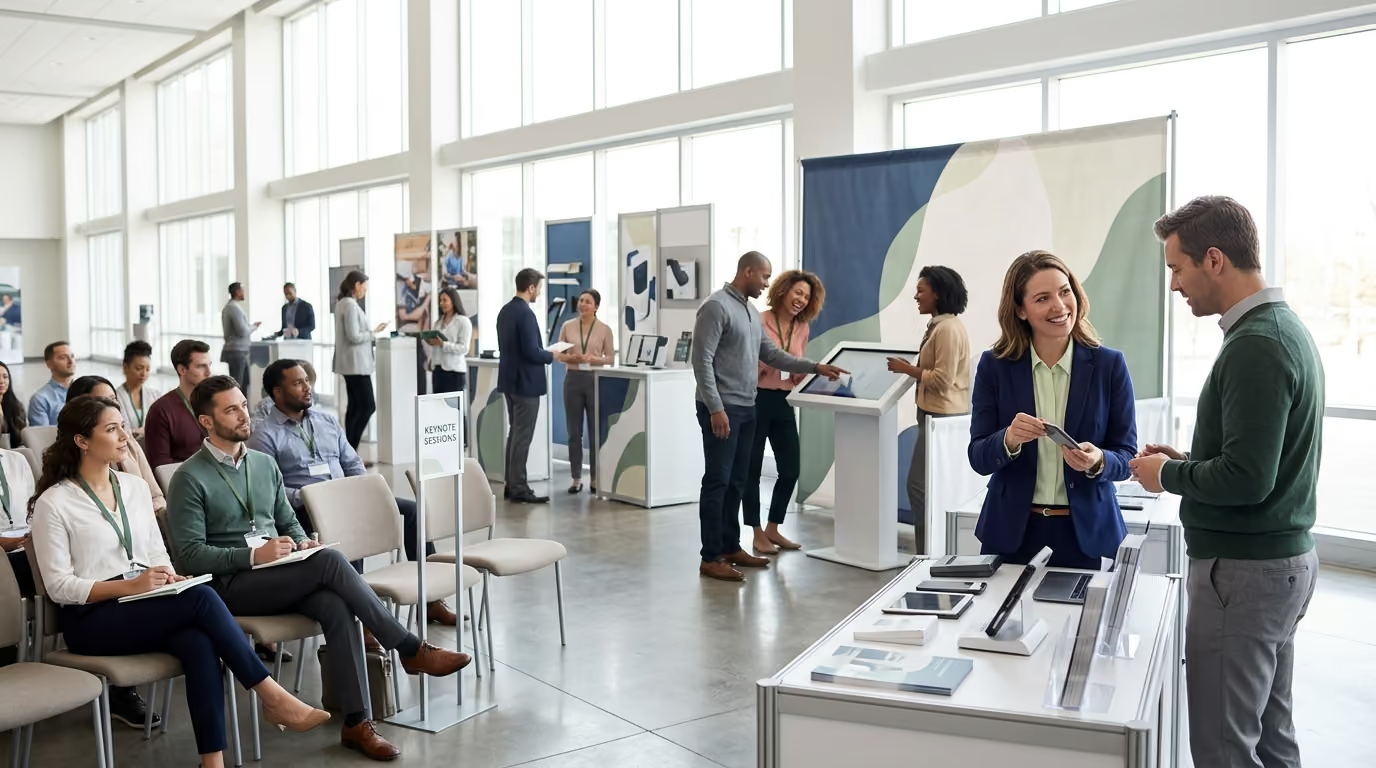
Conference venues center around keynotes, breakout rooms, workshop stages, and communal networking lounges. The exhibition area is often secondary, positioned in foyers or adjacent ballrooms.
Foot traffic at conferences moves in sharp waves. Aisles sit empty while mainstage presentations occur, then flood with attendees during thirty-minute coffee breaks. Traditional booth setups often struggle in this rhythm.
Success in conference spaces requires environments built for conversation rather than rapid-fire product demonstrations. Comfortable lounge seating, private meeting rooms, and collaborative whiteboards outperform static trade show counters. Research on event design indicates that 55% of organizers prioritize evening networking receptions, but only 34% of attendees express enthusiasm for unstructured parties. Attendees prefer targeted, topic-driven discussion roundtables where they can solve operational challenges with industry peers.
Conventions serve professional associations, fraternal orders, political bodies, and global corporate networks. They blend legislative assemblies, continuing education classrooms, award banquets, and vendor halls under one roof.
The convention floor plan accommodates multiple simultaneous agendas. Attendees may spend mornings in committee meetings, afternoons browsing vendor exhibits, and evenings at recognition dinners.
Because convention attendees share a strong professional identity, aggressive transactional sales tactics can feel invasive. Successful convention activations integrate naturally into the community culture. Brands often support educational tracks, sponsor association initiatives, and maintain hospitality suites to build durable long-term relationships.
Field activations provide total environmental control. Whether booking a private dining room in Chicago or deploying a mobile sampling asset in Austin, your brand dictates every sensory touchpoint.
In our experience across national activations, controlling the environment fundamentally changes conversion velocity. We have executed over 1000 campaigns across all 50 states, bringing brands to life in every major U.S. market. From retail demos in Seattle to roadshows in Miami and events in Honolulu, our teams activate brands wherever our clients' audiences are located.
Field activations eliminate competitive clutter entirely. When you host a targeted field workshop or regional roadshow, your prospects interact exclusively with your team and your product narrative. For consumer brands, connecting trade show awareness to local store movement is vital; learning about bridging trade shows with high-conversion roadshows helps link wholesale conversations to retail checkout counters.
Hosted buyer areas feature private meeting pods, semi-enclosed cubicles, or dedicated boardroom suites. These spaces are engineered for concise, fifteen-to-twenty-minute commercial presentations.
The architecture prioritizes quiet conversation, digital presentations, and quick note-taking over physical spectacle. Booth banners and display structures are minimized.
Presenters must arrive with structured slide decks, customized pricing sheets, and immediate qualification frameworks. In a hosted buyer room, you do not wait for foot traffic. You execute back-to-back pitches against a strict master schedule.
Choosing the correct event format requires a disciplined evaluation model. Marketers should assess every prospective event across five core dimensions before committing capital.
Use these five criteria to evaluate candidate events against your quarterly commercial targets:
Match your primary commercial goal directly to the event structure engineered to deliver that outcome:
Executing an event activation requires disciplined field coordination regardless of the format chosen. Use this operational sequence to manage live activations from preparation to post-show routing.
Maintaining consistent field execution across multiple regional markets requires disciplined staffing. Utilizing repeatable field teams across events ensures your brand narrative stays intact whether operating in New York, Chicago, or Los Angeles.
Proving live event value requires separating activity metrics from commercial pipeline data. Tracking badge scans alone provides a false sense of security. Marketing teams must track both lead and lag indicators to calculate accurate Return on Investment (ROI).
Applying a comprehensive field measurement framework that proves event pipeline value allows leaders to connect top-of-funnel field interactions to bottom-line enterprise revenue.
Leading indicators measure real-time engagement quality on the event floor:
Lagging indicators evaluate pipeline velocity and revenue generation over subsequent quarters:
Examining how successful brands deploy different event formats clarifies the strategic trade-offs involved in portfolio planning.
A premium functional beverage brand launched an updated shelf-stable product line. They secured an exhibit footprint at Natural Products Expo West, the premier trade show for the natural and organic food industry.
The brand designed an open, double-sided sampling bar staffed by trained brand ambassadors. Instead of passively waiting for attendees, the team ran organized tasting flights every ten minutes.
The primary objective was securing shelf distribution with regional grocery buyers and national distributors. The team used badge scanners programmed with direct retail qualification fields, capturing retail banner names, store counts, and distributor affiliations. Over three days, the activation generated four hundred verified retail buyer leads and twenty-six wholesale distribution commitments. The high-density trade show format provided the category concentration needed to achieve national retail placement.
Six months later, the same beverage brand participated in BevNET Live, an intimate conference focused on beverage industry executives, investors, and supply chain partners.
Rather than building an elaborate sampling booth, the brand sponsored the mainstage morning panel on sustainable packaging. The company's chief operating officer shared real-world data regarding supply chain optimization alongside packaging engineers.
Outside the main presentation hall, the brand hosted a small networking lounge equipped with comfortable seating and an espresso bar. The goal was not high-volume lead capture. The team aimed to initiate relationships with co-packers, packaging suppliers, and growth-stage private equity investors. The conference format created the industry authority required to negotiate new manufacturing partnerships and prepare for subsequent funding rounds.
To support their newly secured grocery distribution, the brand deployed a series of weekend retail roadshows across targeted club stores and regional grocers in five Western states.
The team deployed self-contained mobile demonstration assets to high-volume store locations. Brand specialists engaged shoppers entering the aisles, offering cold samples and immediate store coupons.
This field activation format provided complete operational control. The team did not share floor space with competitors. Every interaction focused exclusively on driving immediate point-of-sale velocity at the local register. The roadshow campaign drove an average 340% unit sales lift over baseline store performance during activation weekends, cementing the brand's position on retail shelves.
When building your annual event calendar, balance your portfolio across multiple formats to support every stage of your sales funnel. No single event type solves every commercial challenge.
Take these practical steps this week to audit and refine your upcoming event investments:

30 Years Experiential & Retail Activation Partner for CPG & Beverage Brands | Multi-Market Demos, Roadshows & Costco/Club Programs That Actually Sell