Robbie Thain
Founder, CEO

Trade shows offer far more than ephemeral badge scans when teams convert live booth interactions into full-funnel marketing and sales enablement assets.
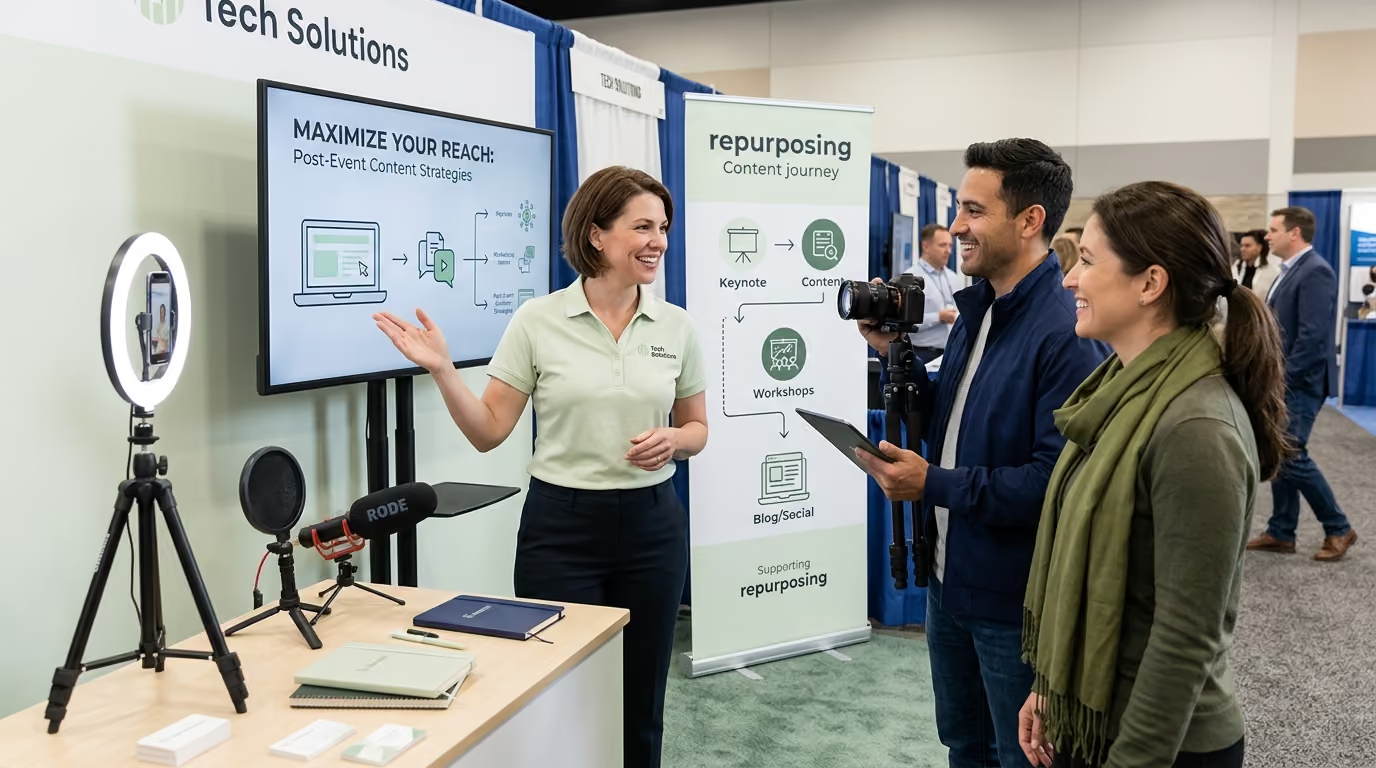
Most marketing organizations treat a trade show as an ephemeral three-day expense, yet the exhibit floor is the most cost-effective media studio your brand will step into all year. By systematically converting real-world booth interactions into durable digital assets, commercial teams turn short-term foot traffic into years of pipeline momentum.
The convention center floor is loud, chaotic, and physically draining. Exhausted booth staff compete for fleeting glances from badge holders rushing between keynote sessions. Product samples disappear into tote bags, badge scanners beep incessantly, and conversations end mid-sentence as crowds shift toward the next hall. By the final afternoon, freight crates roll onto the carpet, displays collapse into shipping containers, and teams fly home with hundreds of raw badge scans that quickly decay in a customer relationship management queue.
Treating a trade show as a temporary marketing flashpan is a massive misallocation of corporate capital. Research from the Center for Exhibition Industry Research reveals that exhibiting companies commit an average of 41 percent of their annual marketing budgets to trade shows. Furthermore, 68 percent of exhibitors rank lead generation among their top three primary objectives. Another 62 percent attempt to measure Return on Investment (ROI) by evaluating immediate sales revenue against booth costs.
When your measurement begins and ends with badge scans collected in seventy-two hours, your event economics remain fragile. The real value of a trade show is not merely the badge scans gathered at a physical counter. The floor represents a rare physical concentration of subject matter experts, target buyers, executive leadership, customer advocates, and retail partners.
When you treat the exhibit as a live media capture environment, you extract lasting commercial value. Instead of hoping a brief conversation sparks an immediate order, you capture the interaction, package the insight, and distribute the proof across the entire buyer journey. You shift your team from event coordinators to strategic content publishers who generate pipeline long after the hall lights turn off.
Strategic content repurposing requires strict operational discipline before packing a single flight case. You must start with downstream commercial jobs rather than camera gear. If an asset does not help a buyer make an informed decision, it should not be recorded on the floor.
The content engine operates on a five-stage progression:
To execute this progression, break down broad event materials into content atoms. A content atom is the smallest standalone unit of commercial insight extracted from a recording or conversation. A single twenty-minute customer conversation at your booth contains multiple atoms. It might include a specific operational pain point, an objection overcome during evaluation, a reaction to your packaging, and a quantified business result.
Extracting these individual atoms allows your team to map assets directly to the buyer journey. Align each asset with the appropriate commercial stage:
At the top of the funnel, prospective accounts require category perspective and proof of momentum. Use your booth presence to produce:
Buyers evaluating alternatives require operational details and technical clarity. Extract assets that address evaluation criteria:
When commercial buyers approach a final decision, risk reduction is paramount. Deploy evidence-heavy content atoms:
Event assets can accelerate post-sale onboarding for current accounts:
Applying our framework for moving beyond single-day trade shows allows teams to construct these assets while foot traffic is actively moving through the aisles.
Capturing high-value assets in a noisy convention hall demands strict production standards. Spontaneous, unscripted filming yields disorganized files that editors struggle to assemble. Plan your media capture with the same rigor you apply to your booth logistics.
Structure your video capture across four distinct operational layers:
HubSpot analysis of Wyzowl research indicates that 89 percent of businesses use video marketing, with 93 percent of marketers reporting strong returns from video investments. More recent Wyzowl industry survey data from 266 respondents shows that 82 percent of marketers confirm video yields positive commercial outcomes. High-quality visual assets are critical for turning complex product demonstrations into clear purchase justification.
Poor audio ruins good video. Convention halls generate severe acoustic interference from industrial air handlers, neighboring sound systems, and thousands of conversations.
Equip your field crew with wireless omnidirectional lapel microphones placed close to the speaker collar. Always monitor audio channels through closed-back headphones to catch signal dropouts or floor interference immediately. Maintain a secondary audio recorder with dedicated gain controls as a safety track. If ambient noise exceeds acceptable limits, move scheduled customer interviews to a quiet meeting room adjacent to the hall.
Photography should function as a commercial library rather than a casual social album. Instruct your photographer to shoot with generous negative space around subjects. This visual padding allows web designers to place text overlays, adjust aspect ratios for mobile screens, and crop headers for email layouts.
Organize photography into four operational folders:
By implementing repeatable trade show staffing and execution playbooks, your booth team can support the capture process without interrupting commercial conversations.
Publishing event assets without verified consent creates immediate legal exposure. Content distribution plans fall apart when featured customers, employees, or retail buyers demand asset removal after distribution. Consent collection must be integrated into your standard field operations.
The Dutch Data Protection Authority establishes clear operational principles regarding personal privacy at public events. Recognizable attendees or partners should only be photographed and published when the organization holds a verified legal basis. While regional privacy statutes differ, ethical practice requires clear, affirmative consent before deploying recognizable likenesses in commercial campaigns. Individuals must also be provided with a straightforward process to withdraw their consent at any time.
Establish separate permission levels across your media agreements:
When capturing footage, attach consent metadata directly to media files in your digital asset management system. Record the participant full name, organization, job title, date of capture, permission tier, and direct contact details. If an individual later changes employers or requests asset removal, your operations team can locate and retire the relevant files in minutes.
Federal Trade Commission (FTC) endorsement guidelines dictate that commercial testimonials must reflect genuine experiences. Furthermore, any material connection between an endorser and a brand must be clearly disclosed. If an interviewee receives travel reimbursement, product samples, or financial incentives to visit your booth, that relationship must appear in the final asset. Maintain strict truth in advertising by avoiding selective edits that distort the customer original technical assessment.
Raw event footage is useless if it sits in unorganized cloud folders. Your marketing operations team must convert master recordings into modular packages tailored to the daily workflows of account executives.
For every high-value interview or product demonstration recorded, produce:
Arm your sales team with practical collateral within five business days of the event closing:
Research from Redpoint Insights indicates that B2B buyers place significant trust in third-party validation when evaluating vendors. Specifically, 70 percent of buyers rely on original research, 64 percent value expert opinions, 62 percent trust peer insights, and 55 percent depend on customer testimonials.
Similarly, the NetLine State of B2B Content report identifies playbooks and case studies among the top content formats associated with purchase decisions within twelve months. Repurposing live event discussions directly satisfies this buyer demand for authentic peer proof.
Deploy these materials through your centralized revenue enablement platform. Tag every asset by industry vertical, target persona, buyer pain point, and competitive alternative. If a sales representative cannot locate an asset within thirty seconds during an active call, that asset will not get used. You can learn more about systematically qualifying trade show pipeline to ensure captured content aligns with true revenue opportunities.
Consumer packaged goods, beverage, and hardware brands often fail to capture retail-specific content at consumer shows. Retail merchant buyers and wholesale distributors evaluate products through a purely commercial lens. They care little about brand lifestyle imagery; they care about inventory turnover, shelf productivity, and merchandising compliance.
Capture dedicated retail assets on the show floor to accelerate retail sell-in:
Photograph your full product line arranged precisely on retail shelving standards. Capture clear images showing case pack dimensions, secondary display units, and shelf-ready packaging footprints. Retail category managers need to see how your package communicates value on a crowded shelf from four feet away.
Record high-resolution images of your package certification seals, nutrition facts panels, barcode placements, and tamper-evident features. These visual assets feed directly into wholesale distributor portals, digital product catalogs, and retailer e-commerce listings without requiring separate studio photo shoots.
Produce short forty-five-second demonstration videos explaining key product differentiators directly to retail floor staff. When launching across regional or national retail accounts, share these mobile-optimized clips with retail store managers. Equipping store associates with clear talking points directly increases retail sell-through velocity.
Connecting these assets to your retail sampling and demonstration strategies ensures your field teams and retail partners execute consistently across every store location.
Proving the value of a content repurposing program requires looking beyond vanity engagement metrics. Likes, shares, and raw video views indicate reach, but they do not prove commercial traction. Measure your program across four rigorous operational layers.
Track your operational capture efficiency:
Measure how internal and external stakeholders interact with the material:
Evaluate how target accounts interact with event assets:
Connect content consumption directly to financial returns:
Evaluating trade show performance requires connecting floor execution to long-term pipeline progression. You can review our detailed measurement framework for calculating event pipeline value to establish reliable attribution across complex commercial cycles.
Calculate your comprehensive Return on Investment (ROI) using an expanded attribution formula:
$$\text{Event Content ROI} = \frac{(\text{Sourced Revenue} + \text{Influenced Margin} + \text{Production Savings}) - \text{Total Event Costs}}{\text{Total Event Costs}} \times 100$$
Factoring in the replacement value of asset production prevents leadership from evaluating trade show budgets as unrecoverable marketing expenses.
Strategic content repurposing delivers massive competitive advantages when applied across specific market scenarios. Review how different brand models turn temporary floor attention into permanent commercial assets.
A functional beverage brand uses a major industry expo to unveil a new functional ingredient line. Instead of simply handing out liquid samples, the team positions a dedicated camera crew at the sampling counter.
The crew captures consumer first-taste reactions, unboxing demonstrations, and founder explanations of the ingredient supply chain. Within forty-eight hours, the brand edits these assets into three digital formats:
Our team has executed this precise approach across national retail activations. A Director of Brand Strategy in the CPG snack division shared: "The Makai team turned our product launch into a sensory event that shoppers still talk about. From creative storytelling to flawless in-store execution, they made snack time unforgettable. We couldn't have asked for a stronger partner." Our team created an in-store experience that left a lasting impression on consumers and became a memorable brand moment.
A B2B food technology manufacturer invites five enterprise clients to their trade show booth for recorded discussions. A structured interviewer asks each client to describe their operating costs before and after implementing the processing hardware.
The resulting media yields:
Research from TrustRadius confirms that 77 percent of enterprise buyers consult user reviews and peer experiences during evaluation. Rather than relying on static marketing claims, the brand deploys authentic peer validation directly to hesitant prospects.
A commercial kitchen equipment vendor logs every question asked by booth visitors across three days. The marketing team records seventy-two distinct inquiries, identifying three recurring buyer hesitations regarding water filtration and cleaning maintenance.
The team turns these insights into immediate enablement assets:
By treating the trade show as qualitative market research, the organization eliminates buyer friction and accelerates active deals across their sales pipeline. Explore our guide to trade show conversion design for more architectural strategies that support active content collection.
Consistent execution turns temporary event investments into lasting pipeline growth for modern marketing organizations.

30 Years Experiential & Retail Activation Partner for CPG & Beverage Brands | Multi-Market Demos, Roadshows & Costco/Club Programs That Actually Sell