Robbie Thain
Founder, CEO

Five distinct commercial outcomes guide successful conference exhibiting strategies by integrating physical floor designs, expert staffing.

Treating an industry conference like a standard trade show is the fastest way to waste marketing budget. Conference exhibiting requires an integrated system that connects thought leadership, expert staffing, private meeting architecture, and rigorous demand capture to generate measurable pipeline.
Exhibiting at major industry conferences often defaults to counting badge scans and handing out branded pens. Teams fly cross-country, set up expensive backdrops, and stand in aisles waiting for foot traffic that rarely converts into pipeline. The floor is noisy, sensory overload is high, and visitors walk past generic corporate slogans without stopping. Sales reps pitch anyone who slows down, while actual buyers slip past looking for technical experts and credible education. When the event ends, marketing delivers a list of unqualified names to sales, leading to stalled follow-up and disappointing commercial results.
Most marketing teams treat conference exhibits as direct sales engines or brand awareness billboards. Data reveals that both extremes fail to capture how business buyers operate. Research from the Center for Exhibition Industry Research (CEIR) shows that 68% of exhibitors rank lead generation among their top three exhibiting goals. The same study reveals that 86% of exhibitors use intermediate performance metrics to evaluate success. These intermediate measures represent the vital steps that occur before a deal closes.
Global research by UFI and Explori demonstrates that exhibitors meet networking and brand awareness goals more consistently than direct sales goals. Buyers at educational conferences are rarely looking to sign contracts on the exhibit floor. They attend conferences to solve operational headaches, understand market shifts, and evaluate credible vendors.
If your team measures success solely by immediate closed deals, you miscalculate the event value. If you measure only foot traffic, you gather vanity numbers without commercial substance. Conferences work best when planned as an integrated portfolio of experiences that address every stage of the buyer journey.
A successful conference strategy balances five distinct commercial outcomes:
Establish your company as the standard for solving complex industry challenges. When your team shares proprietary insights and research, you reframe how prospects view their problems.
Advance high-stakes conversations with key accounts, distribution partners, industry analysts, and media. In-person access creates relationship equity that digital channels cannot match.
Prompt qualified prospects to recognize unseen costs, inefficiencies, or missed growth opportunities. This shifts passive attendees into active buyers.
Identify buyers with active project timelines and budgets. Qualified conversations capture high-intent prospects and route them directly to dedicated account teams.
Accelerate existing sales opportunities through pre-scheduled executive briefings and private technical workshops. Face-to-face working sessions compress weeks of back-and-forth email exchanges into thirty minutes.
Research conducted by Freeman and The Harris Poll confirms the lasting psychological effect of live environments. Among 1,824 professionals surveyed, 95% reported trusting brands more after meeting them at in-person events. Furthermore, 92% said live events positively shaped their view of the company, and 87% visited the brand website afterward. In addition, 47% noted that this positive perception lasted a few months or longer. Conference exhibiting is a trust accelerator that fuels both immediate demand and long-term brand equity.
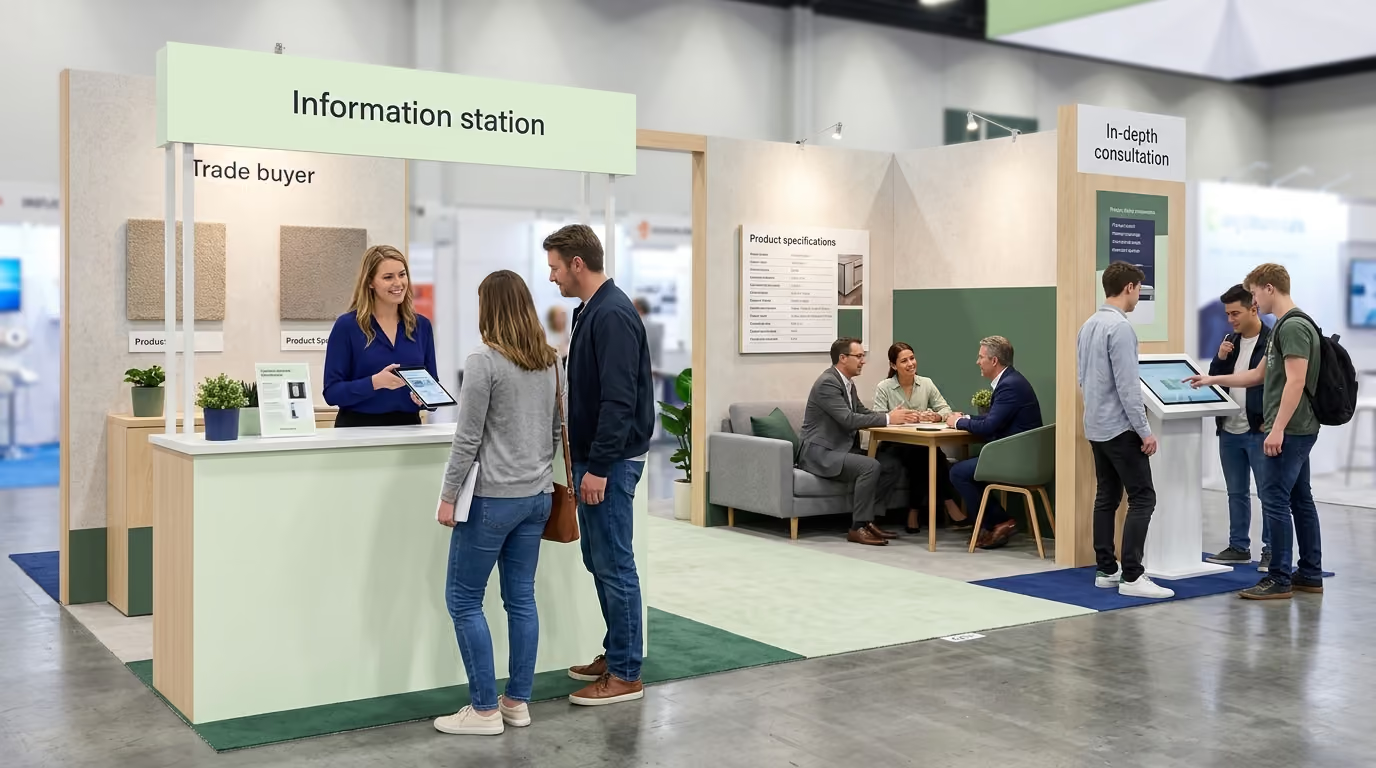
Many booths fail because they try to do everything in a single, crowded footprint. An effective conference booth functions like a specialized facility with dedicated zones for education, qualification, and private discussion.
Eye-tracking research published in the Journal of Convention & Event Tourism analyzed how attendees navigate exhibition environments. The findings revealed that visually distinctive structures like towers, canopies, and interactive elements capture far more visual attention than flat graphics or video walls. The study also revealed that sensory overload and chaotic environments cause absolute gaze contact to drop sharply. Crowding your booth with flashing screens, loud audio, and competing calls to action repels serious decision-makers.
The outer perimeter must deliver a clear, readable value proposition within three seconds of visual contact. Replace generic corporate mission statements with an industry problem statement or a compelling benchmark statistic. Keep structural elements clean, open, and physically accessible. When choosing your booth footprint, review the definitive guide to choosing the right trade shows for your brand to match your layout to venue logistics.
The center of your exhibit should host focused, small-group interactions. Set up diagnostic stations, interactive benchmarking tools, or short technical demonstrations. This area gives visitors a reason to stop without feeling trapped in a high-pressure sales pitch. Keep presentations brief, concrete, and centered on solving specific customer problems.
Reserve dedicated space for pre-booked meetings and qualified deep-dive conversations. High-value prospects rarely discuss budget, architecture, or supplier issues in an open aisle. Use semi-private partitions or fully enclosed meeting rooms with acoustic dampening. Equip these rooms with presentation screens, comfortable seating, and proper hospitality.
A major failure point in conference exhibiting is staffing the booth with the wrong mix of roles. Many organizations send only field sales representatives and junior brand ambassadors. While energetic, this staffing model directly clashes with what professional conference attendees want.
An academic study in the International Journal of Research in Marketing examined data from 9,215 attendees and 885 exhibitors. The researchers discovered a pronounced mismatch between attendee preferences and exhibitor staffing. Exhibitors consistently overrepresented executive and sales personnel while significantly underrepresenting technical and subject-matter experts. Attendees attend conferences to gather detailed, credible answers from specialists who understand the mechanics of their operational challenges.
To maximize credibility and conversion, build a balanced cross-functional roster:
These team members lead diagnostic reviews, answer deep product questions, and provide educational consultations. Their presence changes the conversation from a generic sales pitch into a credible working session.
Experienced commercial managers handle qualification, lead discovery, and navigate complex organizational structures. They identify account-level pain points and structure clear commercial next steps.
Senior executives host scheduled briefings with Tier-1 accounts, strategic partners, and media contacts. Their presence signals executive commitment to prospective clients and builds executive-to-executive rapport.
A designated operator manages the daily meeting schedule, greets arriving VIPs, and keeps technical specialists on time. This role prevents double-booked rooms and ensures that every lead capture is logged accurately.
Prepare your team with structured scenario training before stepping onto the show floor. Staff must know how to qualify visitors quickly, transition conversations to technical specialists, and exit non-target discussions gracefully. Learn how our teams manage field execution by studying the complete guide to experiential marketing and brand activation.
Conference attendees look to main-stage sessions, panels, and workshops for guidance on industry direction. Exhibiting without an integrated speaking strategy isolates your brand in the expo hall, cut off from the main intellectual current of the event.
The 2024 Edelman and LinkedIn B2B Thought Leadership Impact Report proves the strong commercial influence of authoritative ideas. The research found that 75% of decision-makers and C-suite executives said a specific piece of thought leadership led them to research a product or service they had not previously considered. Furthermore, nine out of ten executives said they were more receptive to sales and marketing outreach from companies that consistently produce high-quality thought leadership.
Do not treat speaking slots as live advertisements. High-performing conference sessions deliver genuine market education:
Share original data, industry surveys, or performance benchmarks that highlight emerging operational shifts. Provide attendees with objective diagnostic criteria they can use to evaluate their current operations.
Invite an active customer to co-lead your session. Real-world case studies detailing implementation realities, hurdles overcome, and verified performance gains generate immense commercial credibility.
Secure classroom or breakout slots for hands-on problem-solving workshops. These sessions attract high-intent practitioners looking for practical methodologies.
End your speaking presentation with a clear bridge to your physical booth. Offer an expanded research report, a custom diagnostic review, or an in-person consultation with your technical team. Ensure your booth staff is fully briefed on the session content so they can continue the conversation seamlessly.
Securing qualified pipeline from a major conference requires disciplined operational execution across three distinct phases.
Evaluating a major conference solely on badge scan volume produces misleading conclusions. A high-volume booth can easily yield low-quality contacts, while a quiet booth running targeted executive briefings can generate millions in qualified pipeline.
According to CEIR research, 62% of exhibitors use Return on Investment metrics, focusing on sales revenue and sales potential relative to total exhibiting cost. Freeman highlights the value of measuring Return on Objective alongside Return on Investment. Return on Objective accounts for essential brand and relationship milestones that precede revenue, such as brand trust, account retention, and market credibility.
In our experience, successful conference reporting bridges brand awareness, engagement, and conversion. We provide clear reporting on reach, trials, leads, and sales to guide next steps in campaign optimization. Our measurement approach tracks awareness, engagement, and conversion, turning brand moments into actionable data that demonstrates business impact.
Track these critical metrics across three distinct horizons:
For deeper analysis on multi-touch event measurement, review our guide on experiential marketing attribution models compared.
A major food ingredient manufacturer prepared to exhibit at a premier national food science and manufacturing conference. In previous years, the brand used a standard 20x20 island booth with glossy graphics, generic corporate messaging, and a team of general sales representatives. Despite collecting over 400 badge scans, post-event sales conversion remained low. Attendees took product brochures but rarely booked technical follow-up calls.
For the upcoming conference, the company restructured its entire exhibiting model around category education, expert staffing, and structured qualification.
The brand redesigned its physical booth to resemble an active food science laboratory. They eliminated generic marketing walls and constructed a central formulation testing bench flanked by two private, acoustically isolated meeting rooms.
Instead of general sales staff, the on-site team included three senior food formulation scientists, two enterprise account leaders, and a dedicated executive host. The brand's chief scientist secured a breakout session presentation detailing new functional protein stabilization research.
Aisle messaging focused on a single technical challenge: solving shelf-life degradation in plant-based beverages without synthetic additives. Visitors were invited to run a five-minute ingredient compatibility audit at the central formulation bench.
The food scientists walked attendees through the technical diagnostic, showing real-time formulation data on interactive touchscreens. When an attendee met target volume criteria, the scientist introduced them to an enterprise account leader for a private briefing in the meeting room. To see how these engagement models work across commercial sectors, review what is engagement marketing.
The redesigned activation fundamentally altered the company's conference results:
By shifting from passive booth promotion to expert-led problem solving, the company transformed its conference presence into a dependable commercial growth engine. For additional tactics on commanding attention on crowded show floors, explore our guide to standing out at local events and trade shows.
Exhibiting at industry conferences delivers extraordinary commercial value when you replace passive trade show habits with an expert-led, systematic demand generation engine.

30 Years Experiential & Retail Activation Partner for CPG & Beverage Brands | Multi-Market Demos, Roadshows & Costco/Club Programs That Actually Sell