Robbie Thain
Founder, CEO

Free merchandise does not retain campus talent, so base pay, performance bonuses and clear promotion paths decide what ambassadors actually deliver.

Paying student brand ambassadors entirely on commission or expecting them to work for free merchandise is the fastest way to collapse a campus marketing campaign. When brands assume college students will distribute samples, host events, and build authentic peer advocacy purely for branded hoodies, they end up with empty tables and abandoned activations.
Selecting the right compensation structure requires aligning specific field behaviors with predictable reward mechanisms rather than relying on generic pay templates. This guide examines ten distinct compensation models, legal compliance standards, and operational guardrails to help marketing leaders build an accountable, high-performing student field team.
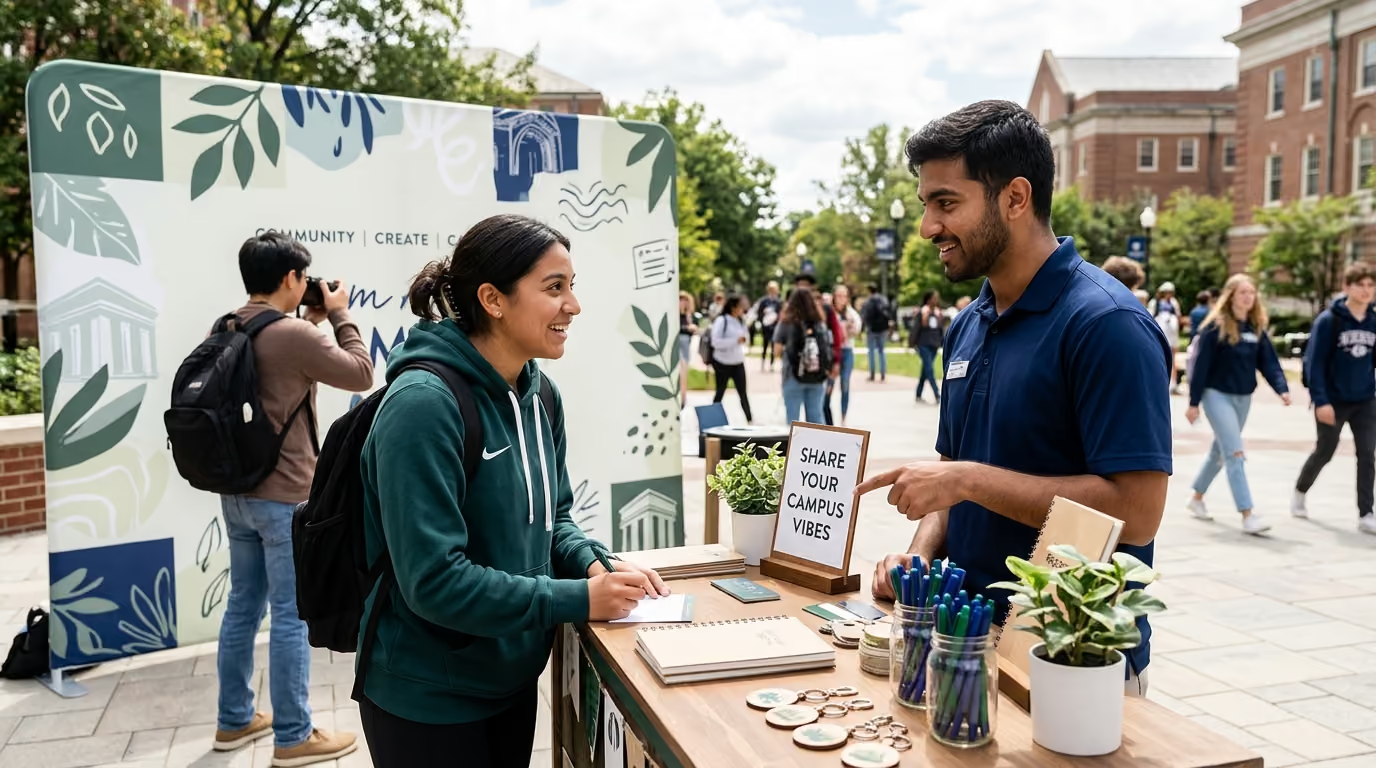
On a busy campus during fall orientation or game day, the operational reality becomes chaotic very quickly. You ship fifteen pallets of product, deliver display collateral to student housing, and schedule twenty ambassadors to execute sampling blitzes across three campus zones. If your pay structure is ambiguous or relies on vague commission promises, half your staff will fail to show up, leaving inventory sitting in dormitory hallways while prospective consumers walk past unattended activation footprints. When compensation is tied strictly to verifiable inputs and realistic performance milestones, students show up on time, represent the brand professionally, and capture clean consumer data.
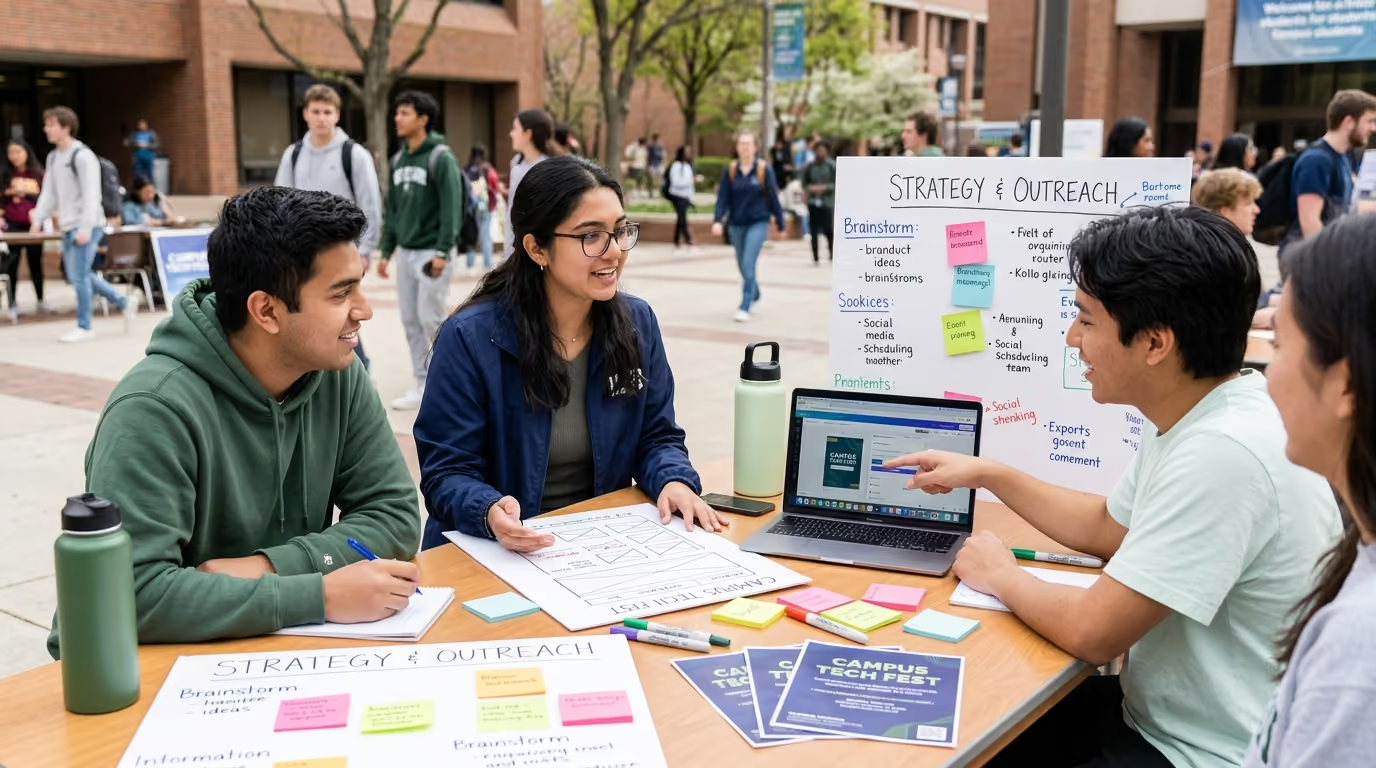
Every campus campaign requires a distinct mix of operational labor and commercial outcomes. The primary mistake brand managers make is asking how much to pay student ambassadors before deciding which specific behaviors the program must generate. A campaign built to drive retail velocity at grocery stores near campus demands different physical tasks than a program designed to acquire digital app subscriptions.
To design an effective model, marketing teams must separate input activities from output results. Input activities include attending mandatory training, setting up sampling tables, distributing promotional items, and submitting post-event field reports. Output results include verified app downloads, attributed e-commerce transactions, email signups, and local retail scan counts.
Paying strictly for outcomes forces students to absorb all commercial risk. If a product has poor brand recognition, a clunky checkout page, or pricing that exceeds a student budget, ambassadors will quickly quit. Conversely, paying solely for hours worked without performance incentives can lead to passive attendance, where ambassadors stand behind tables looking at their phones.
In our experience managing field teams across the country, the most resilient programs establish a firm wage baseline for physical labor, then layer targeted bonuses for measurable achievements. You can read more about balancing operational structure with performance goals in our guide on building a structured student brand ambassador program.
Base pay provides predictable earnings for students and establishes clear operational accountability for the brand. When ambassadors know their time is valued, they are far more likely to follow brand guidelines, complete administrative reporting, and maintain scheduled activation shifts.
Hourly compensation pays ambassadors a set wage for documented time worked in the field. It remains the gold standard for high-touch experiential events, retail sampling, and structured campus canvassing.
Industry campus marketing benchmarks typically place event-based hourly wages between $15 and $25 per hour, depending on the geographic market and living costs. For routine street team activations and basic distribution tasks, rates in some regions range from $10 to $15 per hour for commitments of five to twenty hours per month. These figures serve as market context rather than legal standards, as brands must always verify local minimum wage requirements.
Hourly pay offers several distinct advantages:
The primary disadvantage is that hourly pay requires rigorous time tracking, geo-fenced check-ins, and active field management. Without clear deliverables, hourly workers may log hours without actively engaging consumers. Brands should never pay for mere presence. Every shift must require a completed checklist, photo verification, and a summary report.
A stipend provides a predetermined lump-sum payment distributed across a defined period, such as a monthly allotment or a single end-of-semester payment. Typical industry stipend ranges for ongoing campus programs run between $200 and $600 per month.
Stipends work exceptionally well for ongoing community management, steady content production calendars, and long-term brand building where daily hours fluctuate. They give students predictable income they can balance against their academic schedules.
To prevent stipends from turning into passive retainers, brands must establish explicit monthly milestones. The agreement should clearly list required deliverables, such as hosting two campus events, submitting four social media assets, and attending bi-weekly strategy calls. If an ambassador fails to complete the required deliverables, the brand must have clear contractual provisions to prorate or withhold subsequent installments.
Stipends should never be used as a tool to bypass wage laws. If the brand dictates exact working hours, direct supervision, and strict step-by-step methods, regulatory bodies may classify the relationship as employment regardless of the stipend label.
The per-task model pays ambassadors fixed dollar amounts for completing discrete, verified deliverables. Rather than tracking minutes, the brand pays for finished units of work.
Common task-rate benchmarks include:
This model is easy to scale across multiple university markets because it establishes flat unit costs. It allows flexible ambassadors to take on more work while minimizing financial waste on inactive staff.
However, per-task pay can inadvertently encourage volume over quality. If an ambassador receives $30 per campus event, they may rush through short, low-impact interactions just to log the task. Brands must enforce strict verification gates, including timestamped photography, GPS-tagged submissions, and mandatory proof of engagement before releasing task payments.
Variable compensation rewards tangible commercial outcomes. It aligns program expenses directly with revenue generation, making it popular for e-commerce, digital products, and direct retail sales pushes.
Commission structures pay ambassadors a percentage of the gross or net revenue they generate. In collegiate ambassador programs, sales commissions typically range between 5% and 10% on consumer goods, apparel, and direct subscriptions.
Commission models align brand costs directly with realized revenue, simplifying calculations for Return on Investment (ROI). They motivate entrepreneurial ambassadors to leverage their personal networks and social channels to drive sales.
Despite these benefits, pure commission models carry substantial operational risks:
To manage commissions effectively, brands must clearly define attribution windows, return policies, chargeback deductions, and rules regarding self-referrals.
A referral bounty pays a fixed dollar amount for a specific, verified user action rather than a percentage of cart value. This model is common for app downloads, student housing leases, credit card applications, and membership signups.
Common unit bounty examples include:
A notable example of this structure occurred in a collegiate housing campaign documented in a Waterloo student ambassador case study. The program contracted 50 ambassadors over a nine-month period, generating $15,550 in direct referral commissions within a total program expenditure of $18,690.75. The campaign achieved an average cost per ambassador-referred lease of $62.72. While this vendor-reported study represents a specific commercial scenario, it illustrates how fixed bounties allow brands to calculate unit acquisition economics with precision.
To safeguard against fraud, referral programs require strict verification gates. Payments should only trigger when a referral uses a valid university email address, completes active account onboarding, and remains active past a mandatory retention period.
Tiered bonuses introduce escalating rewards when ambassadors cross cumulative volume thresholds. This structure prevents high performers from losing momentum once they hit baseline targets.
A typical tiered framework might look like this:
Published campus program structures, such as programs offering a $10 payment per subscriber combined with a $500 bonus upon reaching 25 signups, prove that milestone targets drive engagement.
The primary risk of tiered bonuses is the cliff effect. An ambassador who finishes the semester with 24 conversions may feel demoralized after missing a 25-unit bonus by a single signup. Furthermore, large threshold gaps can encourage questionable end-of-semester promotional tactics as ambassadors scramble to cross the bonus line. Brands should use progressive, graduated tiers rather than steep binary cliffs.
A hybrid model blends guaranteed base pay with performance-based bonuses, striking an optimal balance between operational control and sales motivation.
Under a hybrid model, ambassadors receive guaranteed compensation for their baseline labor, covering training, physical presence, and administrative reporting. They also earn performance incentives for driving conversions, sales, and qualified leads.
This structure protects students from market factors outside their control while keeping them focused on commercial goals. Learn more about architecting balanced compensation in our resource on budgeting for a student brand ambassador program.
While monetary pay ensures operational commitment, non-monetary incentives help build emotional brand loyalty and professional pride. However, marketing teams must understand the operational costs and regulatory realities of non-cash rewards.
Product seeding provides ambassadors with free inventory, demo kits, branded apparel, and early access to product releases. It equips ambassadors with physical inventory for personal trial, peer sampling, and social content creation.
Product seeding gives ambassadors genuine product knowledge, making their on-campus recommendations more credible. In food, beverage, and consumer packaged goods (CPG) categories, physical product is mandatory for executing live trials.
However, retail value does not equal perceived compensation. A brand cannot offer a coat with a $200 retail price tag and expect a student to perform forty hours of event labor in exchange. Furthermore, physical seeding introduces significant shipping, warehousing, and inventory management costs.
Product seeding also carries regulatory implications. The Federal Trade Commission (FTC) views free products as a material connection requiring unambiguous disclosure whenever an ambassador posts about the brand online.
Digital rewards such as store credit, brand discount codes, and third-party gift cards provide convenient, instant rewards. They are simple to distribute digitally and encourage ambassadors to engage with the brand's e-commerce catalog.
Brand managers frequently make the mistake of assuming gift cards function as tax-free gifts. Under Internal Revenue Service (IRS) regulations, cash-equivalent awards, including gift cards and gift certificates with a stated face value, are treated as taxable income regardless of the dollar amount. University financial policies and employer compliance manuals consistently affirm that gift cards represent taxable compensation that must be tracked for reporting purposes.
Experiential incentives offer unique personal and professional value that cash cannot match. These include:
Career-oriented incentives are extraordinarily effective for recruiting high-achieving students who value professional development over small hourly wages. Securing an internship interview or building a professional creative portfolio often provides greater utility to an ambitious college junior than a modest stipend.
Brands must establish transparent eligibility criteria for experiential rewards. If travel is involved, the brand must account for student academic calendars, liability insurance, travel expenses, and tax implications, as luxury travel awards are generally classified as taxable compensation by the IRS.
Campus ambassador programs operate at the intersection of consumer protection laws, federal wage mandates, and institutional university rules. Failing to structure compensation and management controls correctly exposes brands to significant legal and financial liabilities.
The FTC mandates that whenever an individual endorses a product and has a material connection to the seller, that connection must be clearly and conspicuously disclosed. A material connection includes cash payments, stipends, free products, discounted items, gift cards, event access, or employment relationships.
The disclosure must be obvious and unavoidable for ordinary consumers:
#ad or #brandpartner must be placed prominently before the caption's fold, not hidden in a cluster of irrelevant hashtags.
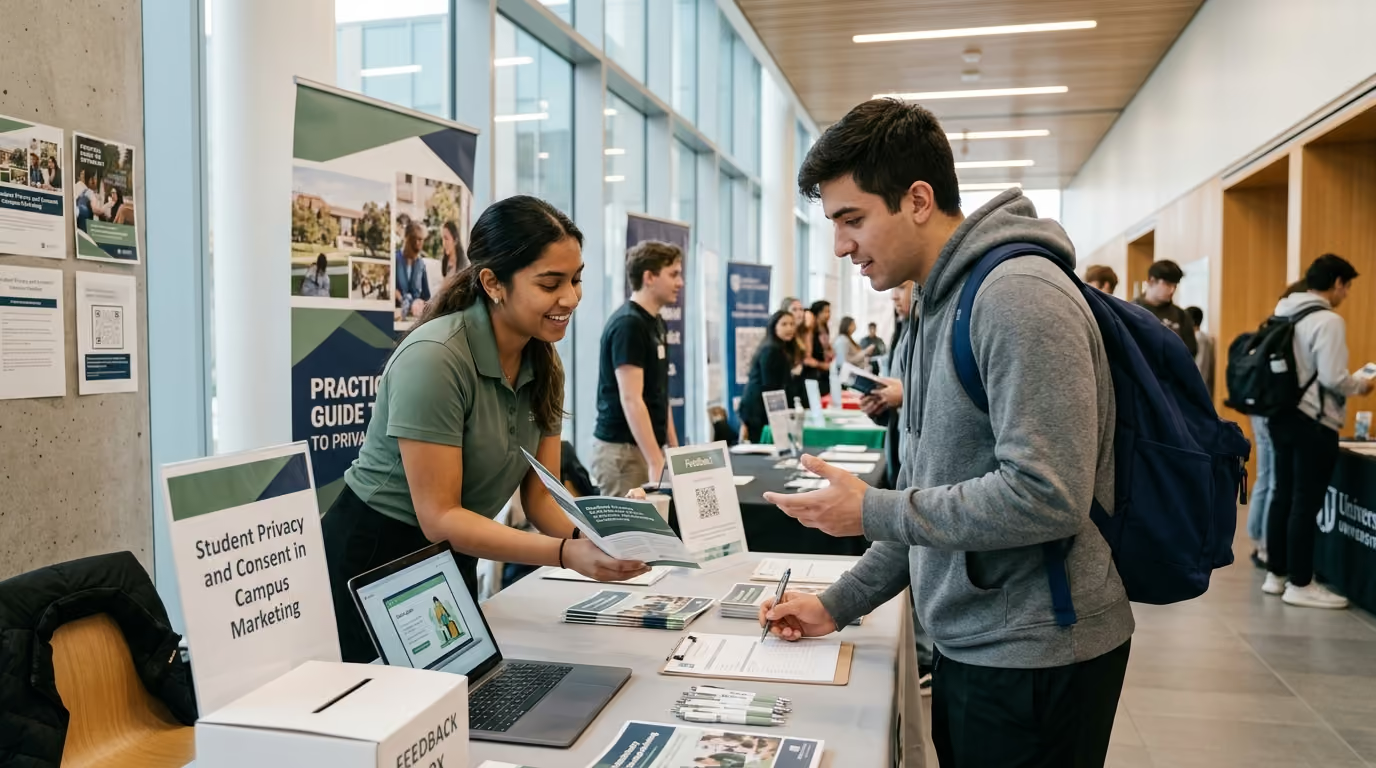
Brands cannot rely on students to navigate these legal nuances independently. You must provide clear written guidelines, conduct compliance training, and routinely audit social channels. We break down the operational mechanics of compliant ambassador training in our analysis of building an FTC-compliant brand ambassador program.
Worker classification remains one of the greatest operational risks in collegiate field marketing. The U.S. Department of Labor (DOL) evaluates worker status under the Fair Labor Standards Act (FLSA) based on the economic realities of the working relationship rather than the label written on an agreement.
The DOL examines six primary economic reality factors:
If a brand requires ambassadors to wear specific uniforms, follow rigid behavioral scripts, attend mandatory weekly meetings, and work designated shifts under direct supervision, the DOL may classify those workers as statutory employees. Misclassification exposes companies to severe penalties, including back pay for minimum wage and overtime, payroll tax assessments, and statutory fines.
All forms of compensation, whether delivered in cash, gift certificates, retail merchandise, or travel experiences, carry tax reporting obligations under the Internal Revenue Code:
Brand operators should coordinate with their corporate accounting and legal teams to establish clear tax reporting procedures during the program onboarding process.
Every college campus operates as a distinct regulatory environment. Conducting brand activations within university boundaries requires navigating specific institutional policies:
Executing a nationwide or regional campus ambassador campaign requires disciplined operational systems. Below is the step-by-step playbook our teams use to transition compensation strategy into repeatable field execution.
#ad disclosures are prominent and unapproved product claims are absent.
* Review customer referral logs to identify and eliminate self-referrals, bot traffic, or duplicate submissions before processing payouts.
* Provide constructive feedback and escalate top-performing ambassadors into leadership roles or advanced task tiers.
For deeper insights on training campus teams for high-conversion field environments, explore our framework for training field brand ambassadors for retail conversions.
Measuring the success of a student ambassador program requires looking beyond basic vanity metrics. Marketing operators must monitor a balanced scorecard of lead and lag indicators to determine the true Return on Investment of their campus spend.
Lead indicators measure execution volume and field activity. They tell you whether your campus team is actually performing the necessary baseline work:
Lag indicators measure commercial impact and financial efficiency. They demonstrate whether field activity translates into business growth:
To build an advanced tracking infrastructure for your campus programs, read our comprehensive guide on how to measure student brand ambassador program ROI.
To understand how compensation structures perform under real market conditions, we can examine two contrasting operational applications.
In the previously referenced Waterloo student ambassador case study, a collegiate real estate organization deployed 50 student ambassadors to drive lease agreements across a competitive campus market.
The organization structured compensation around a pure referral bounty model, offering fixed commissions for completed student leases. Over the nine-month campaign term, the program recorded the following financial metrics:
Because student housing carries high contract values, the unit economics easily justified the referral bounty model. The fixed payout per conversion protected the brand from upfront fixed-labor waste while providing ambassadors with strong financial incentives to close leases within their peer networks.
A national functional beverage brand launching across collegiate markets sought to drive immediate product trial and retail velocity at off-campus grocery accounts. Initially, the brand attempted an affiliate-only model, offering students a free twelve-pack of product and a 10% commission on e-commerce sales generated through personal discount codes.
The pure affiliate strategy failed within four weeks. Ambassadors consumed the free product, made two low-effort social media posts, and stopped promoting the brand because college students rarely purchase heavy beverage cases online for dorm delivery.
The brand restructured its program into a hybrid compensation model:
By shifting compensation from pure e-commerce commissions to guaranteed hourly pay for live sampling, the brand ensured consistent field execution. Within sixty days, shift fulfillment rose from 22% to 96%, and targeted off-campus retail partners recorded an average 38% lift in baseline sales velocity. For more strategies on linking campus activations to grocery checkout lanes, see our guide on connecting student ambassadors with retail demos.
Managing student teams across dozens of university ecosystems inevitably introduces unique operational edge cases. Designing rules to handle these scenarios in advance preserves budget integrity and prevents ambassador disputes.
On densely populated campuses, prospective consumers frequently interact with multiple ambassadors before making a purchase. If Ambassador A conducts an in-person product demonstration, but the student later clicks a social link shared by Ambassador B, attribution conflicts arise.
Brands must establish an unambiguous attribution hierarchy in the ambassador agreement:
High-conversion referral campaigns frequently encounter customer returns, subscription cancellations, and failed credit card transactions.
The ambassador compensation agreement must clearly define chargeback and clawback mechanics. The standard policy places all variable referral payouts in a mandatory thirty-day holding escrow. If a referred customer cancels their subscription, returns the product, or initiates a chargeback during that thirty-day window, the referral bounty is automatically deducted from the ambassador's pending balance.
University schedules do not mirror standard corporate operating calendars. Ambassador productivity drops significantly during midterm exams, final exam weeks, and academic breaks.
Brands that demand heavy weekly deliverables during exam periods experience elevated ambassador burnout and sudden program resignations. Marketing managers should construct compensation milestones around the academic calendar, instituting formal blackout periods during exam weeks and scheduling major activation pushes during high-energy periods like syllabus week, homecoming, and spring festival weekends.
When student ambassadors produce photos, TikToks, and Instagram Reels, brands often assume they own the intellectual property outright. However, unless the ambassador contract contains explicit intellectual property assignment and name, image, and likeness (NIL) licensing clauses, the creator retains underlying rights to their content.
Ambassador agreements must specify that all content submitted for compensation includes a perpetual, irrevocable, worldwide license for the brand to use, edit, repost, and run paid digital advertising against the assets across all marketing channels.
Selecting an optimal compensation structure requires aligning your business model, management capacity, and commercial objectives.
CPG brands need physical product sampling, local retail velocity lift, and direct consumer engagement.
Digital platforms need verified user registrations, active app onboarding, and ongoing software engagement.
Organizations offering high-contract-value student services need direct peer referrals and qualified consultation appointments.
Lifestyle and apparel brands prioritize authentic social content, on-campus peer advocacy, and digital e-commerce traffic.
We have been connecting brands with people through live experiences, retail programs, and national activations since 1995. Over three decades, we have built a track record of creating meaningful brand moments across the country. We know that building an elite student ambassador program requires treating college students as professional marketing operators rather than sources of free promotional labor. When you design a compensation structure that respects their time, provides clear performance boundaries, and rewards verified results, your campus field team becomes an undeniable growth channel.
Structuring your student ambassador compensation with operational discipline ensures that your brand commands attention across campus and turns student interactions into measurable commercial growth.

30 Years Experiential & Retail Activation Partner for CPG & Beverage Brands | Multi-Market Demos, Roadshows & Costco/Club Programs That Actually Sell