Robbie Thain
Founder, CEO

Four operational risk levels define how brand teams handle surging student crowds, safety hazards, and emergency response protocols on college grounds.
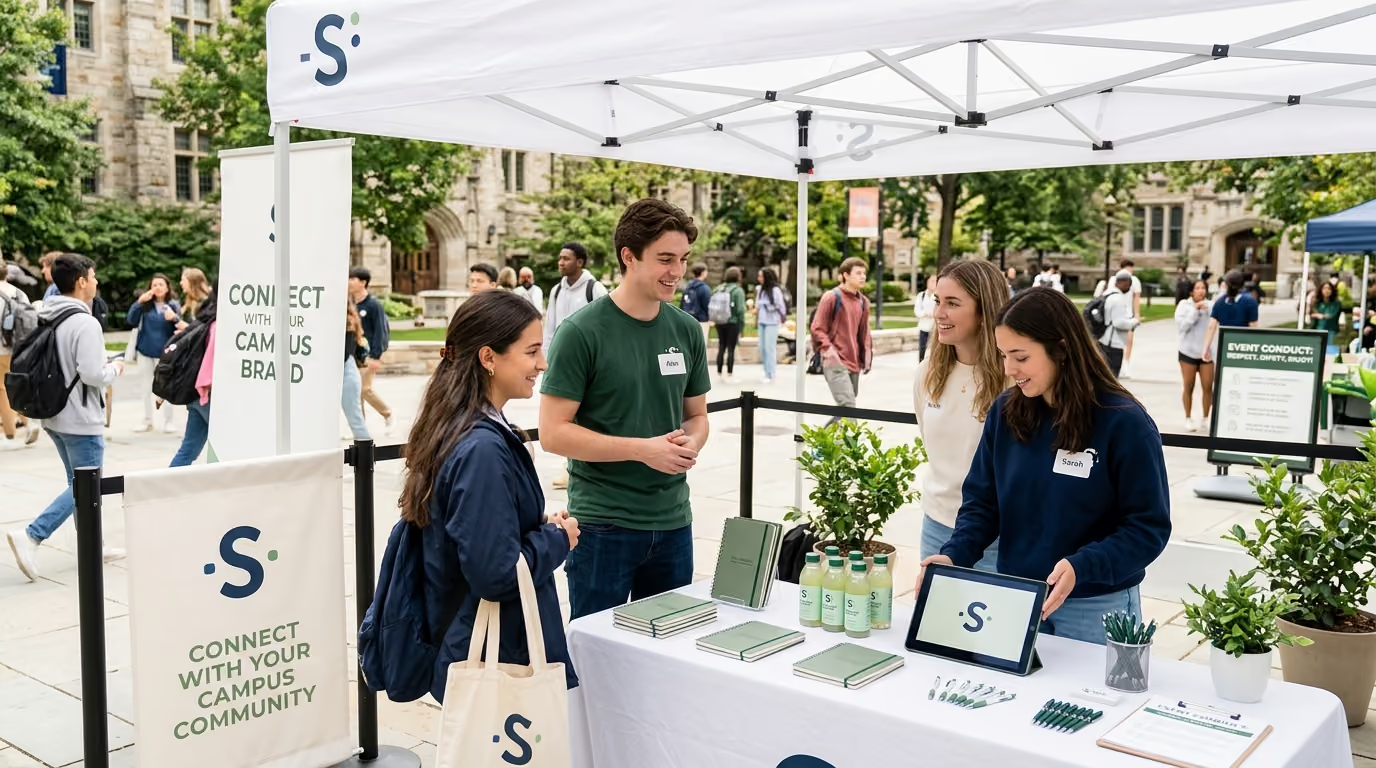
Campus marketing activations promise unmatched brand engagement, but they operate in highly unpredictable environments that can instantly jeopardize attendee safety and brand reputation. This operational guide delivers a complete risk management framework to help experiential leaders identify hazards, protect brand ambassadors, secure student data, and maintain full compliance across university grounds.
Most marketing executives believe campus activations carry less operational risk than commercial festivals because universities feel like controlled, enclosed environments. In practice, college campuses present distinct logistical and legal complexities that rival major public events. An open campus green is not a private venue with a single security checkpoint. It is a shared municipal environment where foot traffic spikes unpredictably between class periods, local regulations intersect with institutional policies, and public passersby mix freely with student populations.
When a brand sets up a promotional footprint on a university quad, chaos can emerge in minutes. A routine beverage giveaway can draw five hundred students in six minutes if an uncoordinated social media post goes viral. Queues spill across emergency access lanes, blocking campus shuttle paths and university facilities vehicles. Meanwhile, enthusiastic student brand ambassadors face aggressive behavior from frustrated crowds without security support, while weather conditions shift rapidly without an adverse weather plan in place.
These operational breakdowns do not just disrupt event schedules. They trigger immediate institutional sanctions, municipal fire code citations, and lasting damage to brand equity among Gen Z consumers. experiential leaders must recognize that campus marketing requires the same operational rigor, safety infrastructure, and risk governance as a stadium activation. By building a disciplined risk framework before setting foot on campus, field teams protect both participants and the organization.
To build reliable campaigns, review our guide on experiential marketing risk management to ground your strategy in established field practices.
Risk is defined mathematically as the combination of the probability that a hazard will occur multiplied by the severity of its consequences. In campus environments, marketing operators must evaluate inherent risk, which is the total exposure present before any safety measures exist, against residual risk, which is the remaining exposure after controls are applied. The objective of professional event production is not to achieve an impossible zero risk state. The true objective is to drive residual risk down to an acceptable, defensible standard while executing the creative mission of the brand.
Achieving this standard requires applying the formal hierarchy of risk controls across every facet of production:
The most effective control is removing the hazard entirely from the activation design. If an open cooking element introduces burn risks and fire code conflicts with university safety boards, eliminate on-site cooking. Replace it with pre-packaged items that need no open heat source. If gathering physical addresses creates high data liability, eliminate that field from digital registration forms.
When elimination is impossible, substitute high-risk elements with safer alternatives. Replace heavy glass sample bottles with recyclable aluminum cans or compostable paper cups to prevent cut injuries. Replace open-air liquid dispensers with sealed, single-serve packaging to reduce contamination risks during high-volume periods.
Engineering controls isolate people from hazards through physical barriers and site design. Install heavy duty rubber cable ramps across every pedestrian path to prevent trips. Erect sturdy steel bike-rack barricades to direct crowd flow and prevent queue collapse. Use commercial water ballasts on pop-up canopies to anchor structures against sudden wind gusts.
Administrative controls establish safe operating procedures and behavioral rules. These include formal safety briefings, mandatory hydration breaks for student ambassadors, strict zero-tolerance harassment policies, and clear escalation protocols. Administrative rules provide the operating discipline required to manage sudden changes in weather or crowd behavior.
Personal protective equipment represents the final barrier against injury. Equip brand ambassadors and event crews with high-visibility vests during vehicle loading operations, non-slip footwear in wet weather, cut-resistant gloves during equipment breakdown, and sun protection during outdoor activations.
Assign every identified risk on campus to a specific risk owner who possesses the authority to act immediately. A risk register that lacks assigned owners is merely an operational wish list. The event producer owns overall operational risk, the safety lead manages first aid and structural integrity, the people lead protects ambassador welfare, and the data lead oversees attendee privacy.
When managing regional college tours, many brands choose to centralize permit and compliance operations to ensure local municipal and university safety standards are uniformly enforced.
Field execution requires clear operating procedures that teams can execute under pressure. When an incident occurs, staff must know their exact roles without hesitation.
To establish the broader strategic goals behind these operational steps, study our framework on how to build a campus marketing strategy that aligns field safety directly with business performance.
Crowd surges represent one of the most common operational hazards in campus environments. The primary driver of campus crowd risk is artificial scarcity created by marketing teams. Limited product giveaways, celebrity athlete appearances, exclusive merchandise drops, and surprise social media activations draw large volumes of students into small footprints.
According to event safety guidelines from the Federal Emergency Management Agency (FEMA), special event planning must systematically address crowd rush, crowd dispersal, access control, and evacuation routes to prevent crush injuries. When hundreds of students converge on a ten-by-ten canopy, structural failure and trip injuries can happen very quickly.
To eliminate crowd surge hazards, production teams must engineer the footprint for high throughput and continuous dispersal:
Never allow arriving attendees to mix with departing consumers. Establish a strict one-way flow where students enter on one side of the footprint, move through the brand experience, collect their sample, and exit into an open dispersal zone. Use tensabarriers or bike-rack barricades to enforce this path physically.
Linear lines that stretch down a campus sidewalk block building entrances and create dangerous pinch points. Use serpentine queue layouts that keep waiting crowds organized within a defined, manageable space. Serpentine lines prevent line cutting, reduce perceived wait times, and allow queue marshals to monitor attendee behavior easily.
When activating limited merchandise drops, clearly mark the end of the line once capacity is reached. Station a visible brand ambassador at the back of the queue with an official "Line Ends Here" sign. Communicate stock status openly to prevent frustrated students from waiting in vain, which often triggers arguments and aggressive pushing.
Under no circumstances should an event queue or display structure encroach upon required ADA pathways or designated emergency access routes. Keep a minimum six-foot clearance on all perimeter walkways. If an unexpected crowd forms, pause product distribution immediately until the pathway is cleared.
Student brand ambassadors represent the heart of campus marketing programs, but their public-facing roles expose them to real safety and interpersonal risks. These young workers engage with thousands of strangers across campus quadrangles, tailgate lots, and campus borders. Brands have an ethical, legal, and operational responsibility to protect ambassadors from sexual harassment, stalking, physical intimidation, and unsafe working environments.
Data from the National Center for Education Statistics (NCES) underscores the necessity of safeguarding protocols on college campuses. In 2021, postsecondary institutions reported 23,400 on-campus criminal incidents, representing 16.9 incidents per 10,000 full-time students. Forcible sex offenses accounted for 10,400 of these reported incidents, or 44 percent of the total, while aggravated assaults accounted for 2,100 incidents. Furthermore, under the Jeanne Clery Disclosure of Campus Security Policy and Campus Crime Statistics Act (Clery Act), institutions are legally required to document and disclose campus crime data. Brand teams must align their safety practices with these institutional safeguarding requirements.
To establish a safe operating culture for student brand ambassadors, experiential directors must implement core safeguarding standards across all deployments:
Never permit a student ambassador to work in isolation. Every ambassador must operate within sight and hearing of a designated partner at all times. This rule applies to quad flyering, dorm drops, retail audits, and inventory restocking runs. If an ambassador needs to leave the activation footprint to use a restroom or take a rest break, their partner or a field supervisor must accompany them.
Every student hire, agency staffer, and third-party contractor must sign a comprehensive Code of Conduct before working. This document must clearly define prohibited behaviors, including unwanted physical contact, suggestive remarks, discriminatory comments, and aggressive solicitation. Establish a secure, confidential reporting hotline that allows ambassadors to report misconduct directly to agency leadership without fear of retaliation.
Ambassadors should never be stranded on campus after dark following an evening activation. Event budgets must include provisions for pre-arranged transportation, verified rideshare credits, or supervised group walks back to student housing or transit hubs. Field supervisors must conduct a formal sign-out roll call at the end of every shift to verify that all ambassadors depart safely.
If an ambassador experiences or reports harassment during an activation, field leadership must follow an established safeguarding procedure:
For deep execution guidance on organizing field personnel safely, consult our complete guide to street team marketing planning.
Product sampling is a central objective of experiential campus campaigns, particularly for food, beverage, and nutritional brands. Handing out physical samples introduces distinct product liability risks that require rigorous controls. Distributing an unverified product or mislabeling an allergen can lead to severe medical emergencies, emergency room visits, and catastrophic regulatory fines.
Data from the U.S. Food and Drug Administration (FDA) highlights why product controls are essential. In a comprehensive analysis of FDA-regulated food recalls involving 26,877 events, undeclared allergens and microbial contamination represented the vast majority of all safety recalls. Industry recall tracking from Food Safety News revealed that in the first quarter of 2024 alone, FDA recall events jumped 27.6 percent to 134 incidents, with undeclared allergens serving as the leading trigger across 51 separate recall events.
To eliminate food safety and allergen risks during high-volume campus sampling activations, teams must establish uncompromising product verification gates:
Maintain a comprehensive product log on-site detailing the precise lot numbers, batch codes, manufacturing dates, and expiration windows for every case of product received. Cross-reference lot numbers against national FDA recall databases before loading inventory into field vehicles. If a manufacturer announces a recall during an active tour, the field team can instantly isolate and quarantine affected inventory within minutes.
Display prominent, high-contrast signage at every distribution point listing the major food allergens identified by the FDA: milk, eggs, peanuts, tree nuts, fish, crustacean shellfish, wheat, soybeans, and sesame. Require brand ambassadors to ask consumers, "Are you aware this product contains [specific allergen]?" before handing over an open or unwrapped sample. Never permit ambassadors to guess ingredient profiles or give casual advice on dietary compatibility.
Perishable beverage and snack products must maintain continuous refrigeration below 40 degrees Fahrenheit (4 degrees Celsius) from warehouse storage to final consumer hand-off. Equip all commercial coolers and mobile refrigeration units with calibrated digital thermometers. Record temperature readings in a written log every two hours. Discard any perishable inventory that enters the danger zone (40 to 140 degrees Fahrenheit) for more than two continuous hours.
When activating non-food consumer packaged goods, cosmetics, tech devices, or personal care products, apply equal scrutiny:
In our experience, we build festival zones, premieres, and pop-ups that turn viewers into fans and fans into advocates. We design moments people want to share, using music tie-ins, screenings, and live stunts to bring stories to life while our crews manage execution and track reach and response metrics.
If your campus tour links directly to local grocery and retail sell-through, review our operational playbook on connecting campus marketing to retail sales for execution frameworks that preserve product integrity from distribution to checkout.
Modern campus activations rely heavily on digital touchpoints to capture leads, distribute coupons, and build brand loyalty. Brand ambassadors encourage students to scan QR codes, fill out survey forms, download mobile apps, and share personal social media handles. However, gathering consumer data on college campuses carries distinct legal and privacy responsibilities.
The National Institute of Standards and Technology (NIST) Privacy Framework establishes fundamental guidelines for managing privacy risk through systematic data minimization. NIST Special Publication 800-122 emphasizes that organizations must only collect personally identifiable information (PII) that is directly relevant and strictly necessary to fulfill a specific, disclosed purpose. Furthermore, organizations must delete that information as soon as the business need concludes.
Experiential marketing leaders must build secure data governance into their campus technology stacks:
Evaluate every single field on your registration tablets. If an activation giveaway only requires an email address to send a digital coupon, do not collect phone numbers, mailing addresses, birthdates, or student identification numbers. Collecting unnecessary data creates severe security and regulatory vulnerabilities without adding business value.
The Family Educational Rights and Privacy Act (FERPA) protects the privacy of student educational records held by educational institutions. While FERPA applies directly to universities rather than private commercial brands, problems occur when brands partner with student organizations or academic departments. Never request, access, or store institutional student directories, official enrollment lists, or university ID card scan data. Ensure all marketing lead capture occurs via direct, voluntary, and fully informed consumer consent.
Tablets and mobile devices used by student ambassadors in the field represent common points of data compromise:
Never bundle event entry with mandatory marketing subscription opt-ins. If a student scans a QR code to enter a campus raffle, present a clear, unbundled checkbox for joining marketing email lists. Ensure the digital privacy notice clearly identifies the brand, explains how information will be processed, and provides a one-click unsubscribe mechanism.
Measuring the performance of a campus marketing activation requires balancing marketing conversion against operational discipline and risk reduction. Experiential teams must move beyond vanity foot-traffic estimates to track precise lead and lag indicators that prove true business value.
Return on Investment (ROI) in live marketing is heavily impacted by operational efficiency, regulatory compliance, and incident prevention. A campaign that generates thousands of leads but incurs severe fines, property damage claims, or public relations crises yields a negative overall return for the enterprise.
To quantify your activation performance accurately, track these essential lead and lag metrics across every campus tour stop:
Lead metrics measure the health of your safety and operational controls before an incident can occur:
Lag metrics evaluate the tangible business outcomes and safety records generated by the activation:
To evaluate which campus channels yield the highest return while maintaining compliance, read our detailed comparison of campus marketing channels and tactics.
Examining a real-world field scenario demonstrates how disciplined risk management protects brand equity and sales conversion during unexpected operational disruptions.
A rapidly growing functional beverage and plant-based snack brand launched an ambitious autumn sampling tour across fifteen major Division I university campuses. The activation footprint featured a custom branded sampling trailer, an interactive outdoor fitness zone, and digital lead-capture kiosks designed to distribute 180,000 samples over six weeks.
During the third week of the tour at a large university in the Midwest, two severe operational challenges emerged simultaneously:
Because the brand deployed a structured risk management plan, the field team executed an immediate, disciplined response:
The campaign concluded its fifteen-campus run with zero safety incidents, zero property damage claims, and full compliance praise from university student affairs offices. Crucially, the operational discipline protected the brand's commercial outcomes, driving an average twenty-two percent sales lift at grocery retailers surrounding the fifteen target campuses.
Risk management does not end when the final road case is packed into the logistics truck. A truly mature experiential marketing organization treats every campus activation as an operational learning cycle. The post-event debrief process allows brand directors, agency producers, and field managers to evaluate what worked, identify near misses, and refine standard operating procedures before the next deployment.
According to the National Institute of Standards and Technology (NIST) Special Publication 800-61 Revision 3, formal incident handling requires continuous post-incident learning to build organizational resilience. This systematic approach must be applied to physical, logistical, and safeguarding operations across all live events.
To execute a structured post-event review, convene a mandatory debrief session within forty-eight hours of event completion using a standardized four-step methodology:
Examine the factual records generated during the activation rather than relying on general impressions. Review the incident log, the weather monitoring log, cold-chain temperature sheets, and the near-miss log. Near misses are early indicators of systemic risk. If an electrical cable ramp shifted out of position three times during a five-hour activation, that represents an engineering failure that must be corrected before a trip injury occurs.
Bring together all operational leaders, including the event producer, the campus relations manager, the product lead, the safeguarding director, and representative student brand ambassadors. Ask direct, structured questions:
When operational breakdowns occur, avoid assigning individual blame to frontline workers. Instead, use the "Five Whys" root-cause analysis method to uncover the systemic failure behind the symptom. If an ambassador distributed an unverified product sample, trace the breakdown through the entire operational chain:
Translate post-event findings into immediate updates for your standard operating procedures. If high winds required emergency ballast additions on campus quads, increase the baseline canopy ballast requirement from forty pounds to sixty pounds across all future tour stops. If student lead capture experienced network timeouts on university Wi-Fi, update technical requirements to mandate dedicated satellite cellular routers for all field footprints.
Managing risk in campus marketing is not about restricting creativity or diminishing the energy of live brand activations. It is about building an operational foundation that allows creative campaigns to succeed without putting consumers, student ambassadors, or brand equity in jeopardy.
By embedding structured safety controls into every stage of campus tour planning, experiential marketers protect their teams, secure their data, and deliver memorable brand moments that drive measurable retail growth.

30 Years Experiential & Retail Activation Partner for CPG & Beverage Brands | Multi-Market Demos, Roadshows & Costco/Club Programs That Actually Sell