Robbie Thain
Founder, CEO

While most managers treat street teams as simple handout dispensers, effective campaigns rely on structured management to generate qualified pipeline growth.

Street team marketing transforms public spaces into high-converting consumer touchpoints when teams focus on meaningful human engagement rather than indiscriminate distribution. This comprehensive operating guide provides brand leaders with the exact staffing frameworks, territory management models, safety protocols, and attribution methodologies required to turn physical interactions into measurable pipeline growth.
On a typical downtown street corner or event concourse, the traditional promotional model breaks down quickly. Unprepared temporary workers shove flyers into the hands of irritated commuters who drop them into the nearest trash can ten feet away. Unsupervised brand ambassadors cluster together to check their mobile phones while expensive product inventory melts in the midday sun. Local authorities threaten citations because nobody secured the correct municipal distribution permits. Meanwhile, marketing directors sit in corporate offices reviewing end of day reports that celebrate thousands of distributed units, completely unaware that zero qualified leads or retail sales were generated.
Most marketing leaders believe that street team success is simply a numbers game. They assume that handing out five thousand product samples automatically produces five thousand brand advocates. In practice, pushing product onto hurried consumers who have no interest creates waste and brand fatigue. The real objective of street team marketing is not distribution volume. The primary unit of value is the useful interaction.
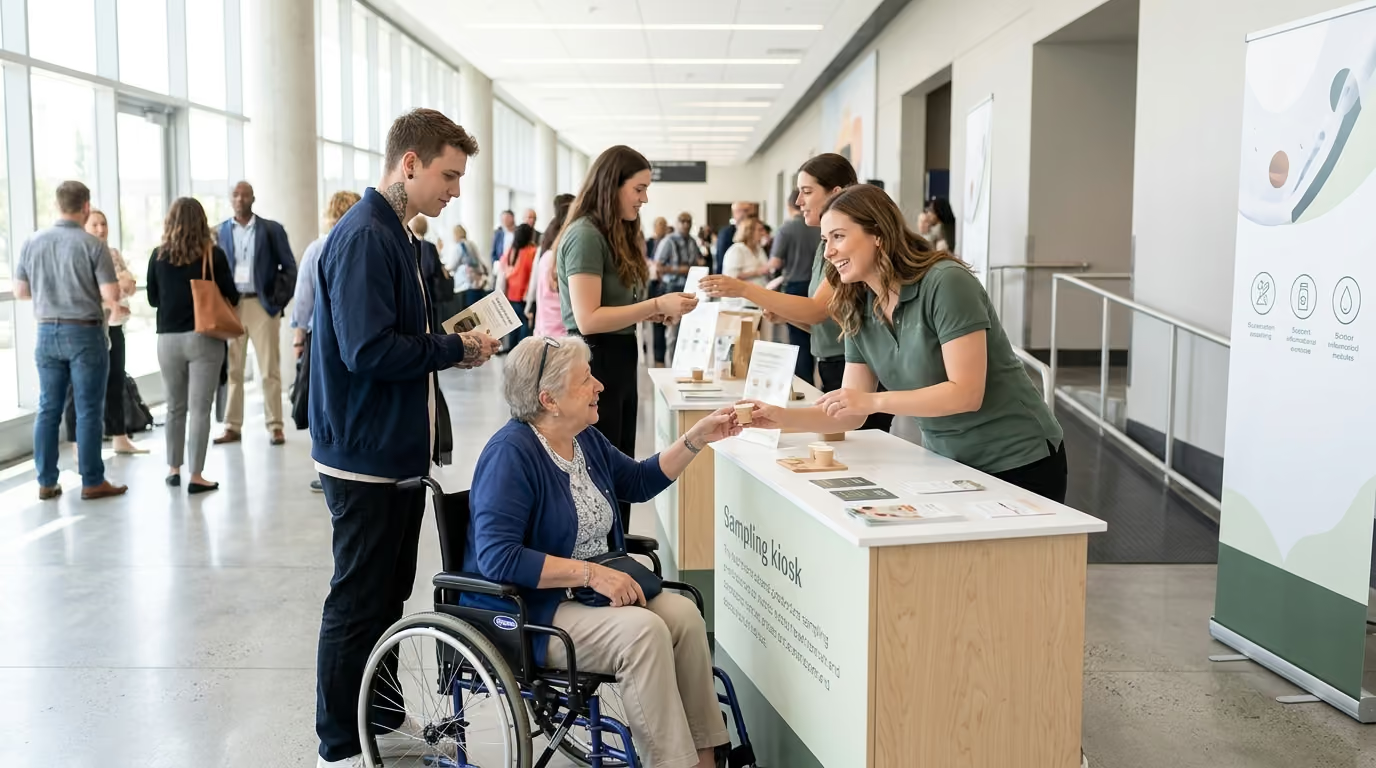
A useful interaction occurs when a trained representative answers a question, solves an immediate consumer problem, conducts a targeted demonstration, or directs someone to an adjacent retail shelf. When an engagement provides immediate utility, the consumer willingly gives their attention. That brief window of authentic rapport allows the brand to establish relevance and prompt a clear next step.
To plan effectively, brand operators must distinguish between four related field tactics:
These operational distinctions matter because they dictate how you allocate capital and measure success. A pure sampling run might track unit delivery costs. A high-performance street team activation measures qualified dialogues, app installations, coupon redemptions, and incremental retail sell-through.
Every activation must be built around a unified planning equation:
The Right Person multiplied by the Right Place, the Right Moment, Relevant Help, and a Clear Next Step.
Defining the target person requires behavioral criteria rather than basic demographics. You must define the problem they are experiencing right now, the environmental trigger that makes them receptive, and their primary hesitation. For instance, an emerging cold-brew brand outside a morning commuter hub targets fatigued office workers seeking an immediate productivity boost. A consumer fintech platform outside a university campus targets students struggling to split apartment utility bills.
Location selection requires looking beyond raw pedestrian counts. High-volume transit hubs often fail if pedestrians are sprinting to catch trains and refuse to stop. Lower-volume environments with longer consumer dwell times, such as public plazas, food truck corridors, and retail plazas, consistently yield higher conversion rates.
Academic research confirms that structured customer experiences directly drive commercial behavior. In empirical studies on experiential marketing modules, sensory, affective, and cognitive experiences show strong correlations with consumer purchase intent. Research published in the International Journal of Hospitality Management demonstrates that sensory, affective, and cognitive brand interactions produce statistically significant positive impacts on purchase intentions. However, the exact balance of these experiential dimensions varies across retail categories.
A study of 1,224 retail apparel consumers published by the International Foundation of Fashion Technology Institutes found that emotional, cognitive, and physical interactions significantly drove buying intent, while passive sensory exposure showed less influence in that specific vertical. Similarly, an empirical study on sports sponsorship activation published in the Journal of Business & Industrial Marketing revealed that experiential activations accounted for 48% of the variance in consumer purchase intention, demonstrating a total effect of β = 0.66 at p < 0.001.
Your field activations must identify the specific cognitive or sensory trigger that drives purchase decisions in your category. You can design an activation that delivers immediate practical value rather than superficial brand noise. For a deeper breakdown of tactical field methodologies, review our precision street activation guide to align field footprints with consumer behavior.
A disorganized field activation is usually the result of vague job descriptions. Brand ambassadors are frequently expected to manage inventory, capture digital leads, explain complex technical specifications, resolve compliance disputes, and distribute samples simultaneously. This lack of role clarity guarantees operational failure.
High-performance field programs separate core responsibilities into distinct, specialized positions. This operational design ensures every team member focuses on a single primary objective throughout their shift.
The ambassador serves as the frontline conversationalist. They initiate contact, read body language, deliver the opening hook, and conduct the initial product handover. They are trained to engage passersby within three seconds, qualify interest, and transition qualified consumers to specialists or conversion points.
When products involve technical nuances, dietary restrictions, or regulated ingredients, product specialists step in. They manage complex consumer inquiries, explain formulation differences, and handle comparisons against legacy competitors. This separation keeps the frontline ambassador moving quickly while giving interested consumers access to expert consultation.
Operating digital hardware while holding physical inventory creates friction. Lead-capture specialists manage registration tablets, verify customer email inputs, troubleshoot QR code redemption issues, and distribute targeted digital incentives. By isolating this operational task, frontline ambassadors maintain unbroken eye contact and conversation flow with consumers.
The team lead oversees a specific operating cluster or physical activation footprint. They manage morning check-ins, distribute assigned geographic zones, coordinate mandatory break schedules, run continuous inventory checks, and enforce uniform hygiene standards.
The field supervisor oversees multiple footprints across a city or territory. They manage site permissions, interface with local law enforcement or facility managers, monitor safety compliance, and reallocate field personnel in response to shifting crowd densities.
The operations manager oversees campaign architecture from headquarters. They govern multi-market workforce planning, lead logistics coordination, approve staffing agency agreements, track aggregate field data, and deliver Return on Investment (ROI) reports to executive leadership.
To ensure accountability across markets, every campaign must implement a clear RACI matrix across its core functions:
In our experience across more than 1,000 campaigns in all 50 states, spanning retail demos in Seattle to mobile footprints in Miami and consumer events in Honolulu, structured operational accountability makes the difference between consistent customer acquisition and wasted marketing spend. When team members understand their exact functional role, field execution remains disciplined across diverse venues.
Span of control directly dictates field performance. A single supervisor cannot effectively manage twenty ambassadors spread across six different city blocks. A reliable planning model pairs one team lead with four to six frontline ambassadors in compact urban settings. When activations expand across broader geographic corridors, assign one field supervisor for every three to four operating clusters.
Supervisors must be able to reach any active deployment point within ten minutes to address logistical bottlenecks, conduct coaching, manage supply shortages, or resolve safety incidents. To explore operational workforce deployment strategies, consult our guide to workforce planning for field activations.
Hiring for street activations often defaults to selecting the loudest, most extroverted individuals available in a staffing agency database. This approach frequently backfires. Overly aggressive promoters tend to alienate consumers, ignore social boundaries, and misrepresent brand values in public spaces.
The most effective brand representatives possess high situational awareness, active listening skills, and professional emotional control. They can read pedestrian pacing, identify receptive body language, and accept consumer rejections politely.
Every recruitment funnel should filter candidates through an eight-step evaluation process:
During the role-play stage, evaluate candidates against realistic public interactions rather than scripted corporate recitations:
Recruiting local staff provides a significant advantage over flying in non-local teams. Local representatives understand neighborhood transit habits, speak with authentic regional inflection, and respect community culture. This authentic connection builds consumer trust and removes friction during brief interactions.
Field representatives should never be deployed with only a quick brief and a product catalog. Comprehensive training requires a modular curriculum that systematically builds operational capability, product knowledge, and safety discipline.
Ambassadors must master primary product benefits, pricing structures, key ingredients, and retail availability within their assigned territory. Crucially, they must understand prohibited claims. Staff should never make unauthorized medical claims, promise unverified health outcomes, or speculate on unlisted ingredients. When asked questions outside their training brief, ambassadors must execute a standard escalation protocol to direct consumers to official channels.
Train teams to execute a disciplined conversational sequence that respects consumer time while driving qualified engagement:
When consumers express skepticism, ambassadors must avoid defensive debate. Train teams to utilize the three-step response framework:
First, acknowledge the consumer's perspective with empathy. Second, deliver a clear, approved factual answer addressing the specific concern. Third, release the consumer respectfully if they remain unready to engage.
For instance, if a consumer states they avoid energy drinks due to sugar content, the ambassador responds: "I completely understand why you avoid high-sugar drinks. Our blend uses organic green tea extracts with zero added sugar. You are welcome to try a chilled sample, or I can let you get back to your morning."
Field teams must maintain high standards of public professionalism. Personnel must never obstruct pedestrian movement, touch consumers, pressure minors, or follow individuals who decline an offer. Refusals must be accepted instantly with courtesy. When operating near private storefronts or transit turnstiles, teams must maintain designated clearance buffers to avoid public obstruction.
Safety training must address environmental and occupational hazards. Field personnel must understand thermal stress indicators, hydration protocols, first-aid kit locations, and emergency evacuation paths. Under Occupational Safety and Health Administration (OSHA) standards, employers must protect field personnel working in high-temperature environments.
OSHA technical guidance dictates that employers provide accessible drinking water, shaded recovery stations, and scheduled rest cycles for outdoor workers. For continuous operations exceeding two hours in extreme heat, electrolyte-replacement beverages should be provided alongside standard water supplies.
Furthermore, OSHA emphasizes acclimatization protocols for new or returning field personnel. Supervisors must implement gradual exposure schedules, staging shorter shifts and more frequent rest intervals during an employee's first week in extreme heat conditions.
Field reporting fails when metrics are poorly defined. A common breakdown occurs when ambassadors report every pedestrian who walked past as an engagement. Training must clearly define and separate operational metrics:
Teams that understand these structural distinctions produce reliable field data, enabling brand managers to calculate accurate operational unit economics.
Rigid, word-for-word scripts sound robotic and destroy conversational rapport in public settings. When an ambassador focuses entirely on reciting memorized corporate copy, they fail to listen to consumer cues. High-performing street teams utilize modular decision trees that provide structured talking points while allowing natural dialogue.
A functional conversational framework contains five core branches:
Uniforms operate as functional tools rather than simple branded costumes. A cohesive visual presentation establishes immediate legitimacy and brand trust in public environments. Field apparel must be comfortable, climate-appropriate, and easily identifiable from thirty feet away.
Equip teams with branded outerwear, moisture-wicking shirts, ergonomic athletic footwear, and high-visibility badges displaying official credentials. In high-density transit corridors, neat uniforms signal authority, reassuring consumers that the engagement is legitimate and safe. For comprehensive field logistics frameworks, review our field logistics contingency planning resource to protect operational continuity.
Field campaigns often fail when teams are deployed to locations chosen solely for foot traffic volume. Selecting high-density areas without evaluating audience alignment, consumer dwell time, and retail proximity leads to wasted spend.
Territory planning requires evaluating locations using a structured scorecard across seven criteria:
The concept of the buying orbit is critical for Consumer Packaged Goods (CPG) street activations. A buying orbit represents the physical radius within which a consumer can act on a recommendation before their purchase intent degrades.
For grocery, snack, and beverage brands, the optimal activation zone is within two blocks of a stocking retail store. When an ambassador offers a trial sample followed by a high-value discount coupon, the consumer can immediately redeem that offer at the adjacent supermarket or convenience store.
If product distribution is scattered across an entire metropolitan area, consumer purchase friction increases dramatically. Field teams should confirm on-shelf inventory levels at local retail partners before deploying to street corners. An activation that drives consumers to an out-of-stock retail shelf damages brand credibility and wastes marketing investment.
To evaluate retail-driven field performance and channel execution, review our guide to street team sales force metrics for actionable measurement practices.
Deploying personnel into public spaces requires strict adherence to legal, health, and worker safety regulations. Assuming that public sidewalks permit commercial marketing without prior authorization invites cease-and-desist orders, equipment impoundment, and substantial municipal fines.
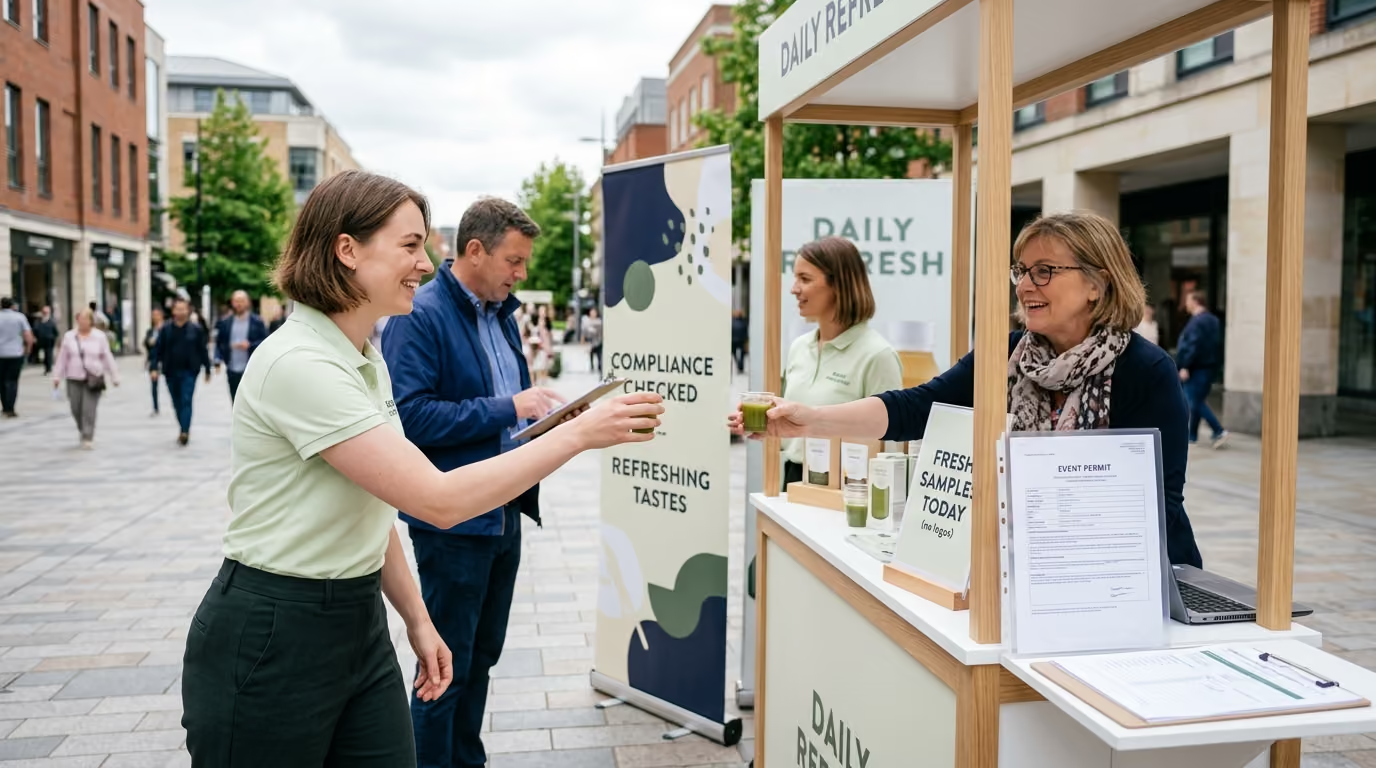
Permit requirements vary significantly by city, property boundary, and product classification. Public sidewalks typically require street activity or mobile distribution permits issued by municipal departments of transportation. Public parks require park board approvals, while transit plazas demand dedicated transit authority authorizations.
Whenever an activation crosses onto private property, written real estate authorization must be secured and carried on-site by field supervisors. For mobile tour activations involving staging vehicles, review our comprehensive guide on mobile sampling tour execution to establish compliant operational footprints.
Consumable food and beverage sampling introduces public health considerations. The U.S. Food and Drug Administration (FDA) emphasizes hazard prevention through standardized food defense protocols.
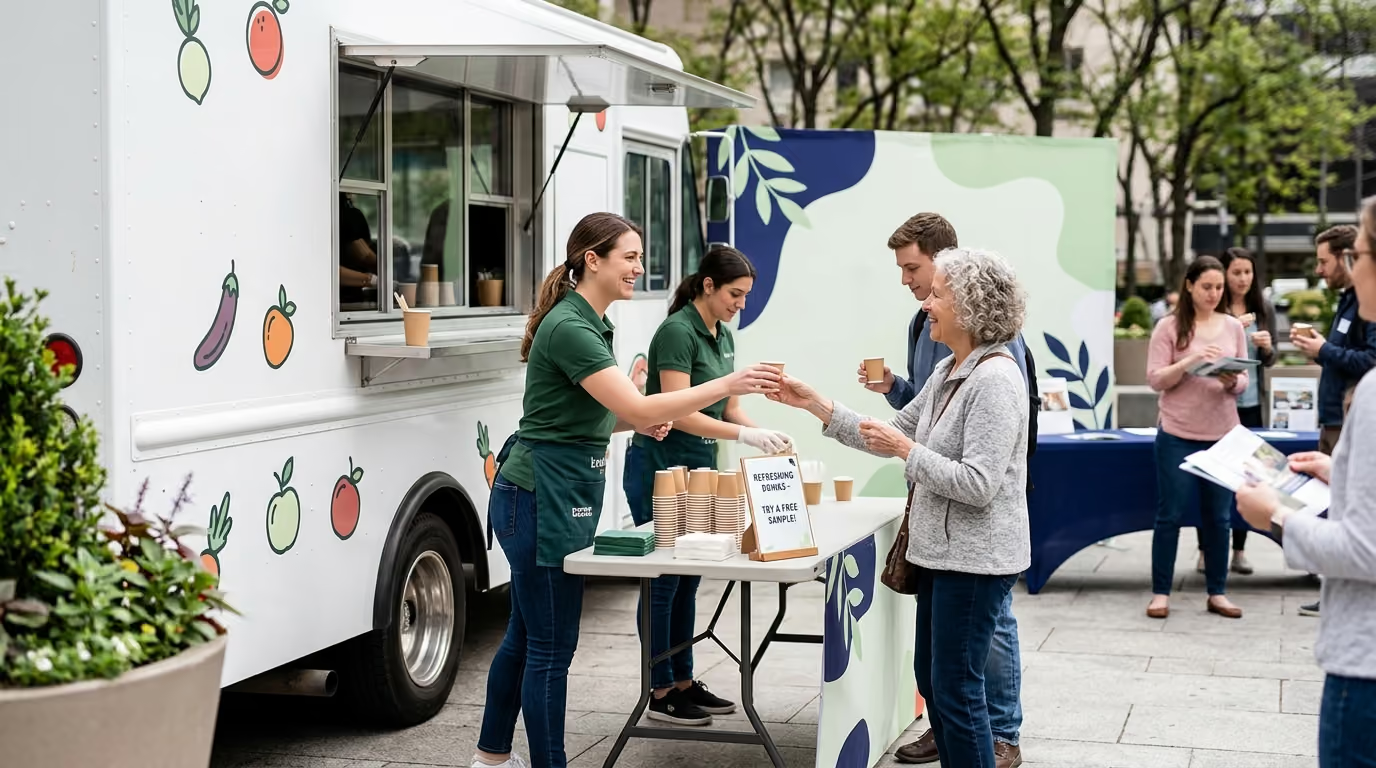
Field teams distributing consumable products must maintain continuous cold-chain integrity, using calibrated digital thermometers to log product temperatures every two hours. Single-use sanitary gloves, sealed waste management containers, and allergen advisory signage must be integrated into every sampling footprint.
Safety planning must also address the physical work environment. Under OSHA walking-working surfaces standards, activation areas must remain free of slip, trip, and fall hazards. Cable runs across public pathways must be covered with industrial-grade cord protectors, folding tables must be anchored securely, and pop-up canopies must be stabilized with heavy canopy weights rated for severe wind gusts.
Federal Trade Commission (FTC) compliance is equally important when street teams encourage consumers to share digital content. Under FTC endorsement guides, any consumer or ambassador receiving paid compensation, free products, or promotional rewards in exchange for posting on social media must disclose that material connection clearly and conspicuously. Endorsement disclosures must appear directly within social media captions, using visible identifiers such as #Ad or #PaidPromotion rather than hidden tags.
To navigate complex municipal approvals, explore our deep-dive on permit compliance and risk management to maintain regulatory compliance across North American markets.
Flawless street execution relies on clear, standardized daily workflows. Operating without written run-of-show checklists leads to delayed deployments, inventory discrepancies, and inconsistent consumer interactions.
Follow this step-by-step operational playbook to maintain consistent execution in the field:
Evaluating a street team program solely on estimated impressions or raw sample volume obscures actual business performance. High-performing brand organizations evaluate street activations across a five-layer measurement model that connects physical field engagements directly to bottom-line financial returns.
According to research published by the Event Marketing Institute in its EventTrack study, 90% of consumers reported more positive feelings toward brands after participating in live product experiences. Furthermore, 74% of surveyed consumers affirmed that engaging with physical brand activations made them significantly more likely to purchase the featured products. While these figures illustrate the potential of physical engagement, actual performance depends on execution quality and disciplined targeting.
Establishing true incrementality requires rigorous experimental design. Simply tracking total sales spikes during an activation week risks conflating natural seasonality, price discounts, or digital ad performance with street team output.
The Interactive Advertising Bureau (IAB) measurement guidelines emphasize that controlled experiments provide the most reliable framework for validating marketing incrementality. Brands should deploy matched-market or matched-store testing architectures.
To execute a matched-market test, select ten retail locations with comparable historical sales velocity, demographic footprints, and promotional pricing. Deploy street teams within the immediate buying orbits of five test locations, leaving the remaining five control stores without field activations.
Following a four-week campaign window, compare Point-of-Sale (POS) scanner data between the two cohorts. The difference in baseline sales velocity between test and control stores isolates the net incremental sales lift generated by the field team.
Unique territory promotional codes provide another reliable attribution method. By assigning distinct QR codes or discount identifiers to individual teams, cities, or retail corridors, operators can track conversions directly back to specific field footprints.
For example, during a multi-city launch for a functional beverage brand, an agency campaign across Los Angeles, Chicago, and Houston generated 82,600 live impressions and 63,000 verified product samples, driving measurable retail sales increases across all three target territories.
Similarly, an app-based mobile street campaign documented by field researchers engaged nearly 1,500 qualified consumers, achieving a 20% immediate application download and promotion redemption rate.
When street activations are managed with operational discipline, human engagement consistently turns into measurable commercial growth.
Disciplined street team marketing turns public foot traffic into measurable commercial pipeline when organizations prioritize operational precision, safety compliance, and genuine human engagement.

30 Years Experiential & Retail Activation Partner for CPG & Beverage Brands | Multi-Market Demos, Roadshows & Costco/Club Programs That Actually Sell