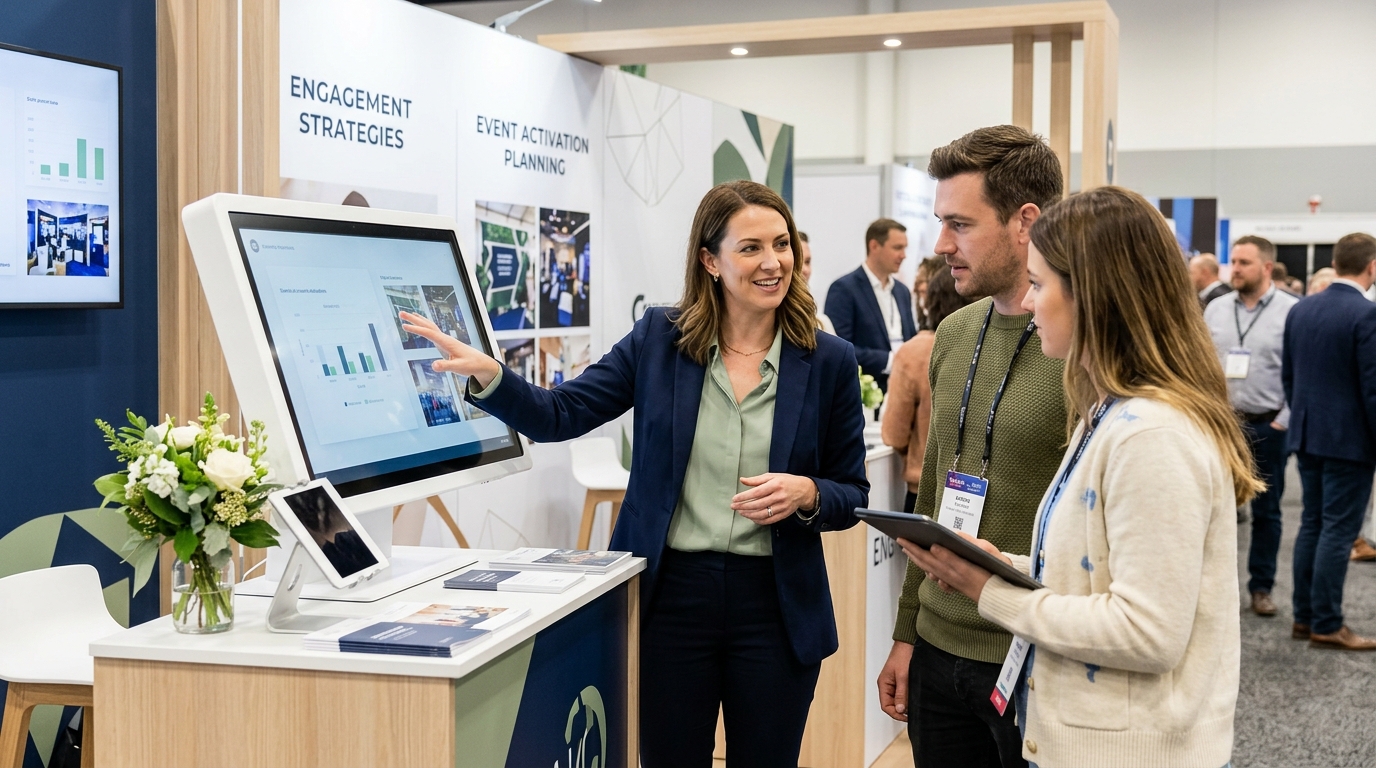
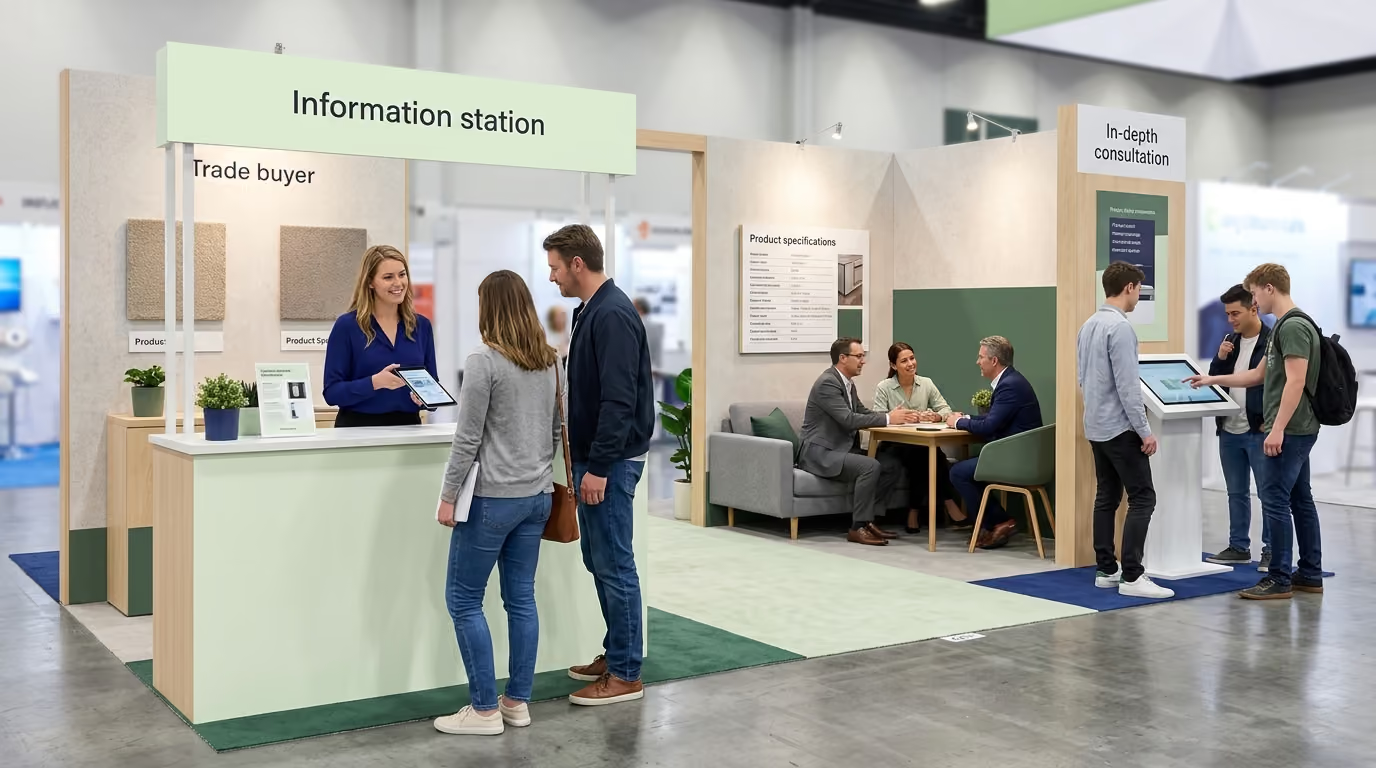
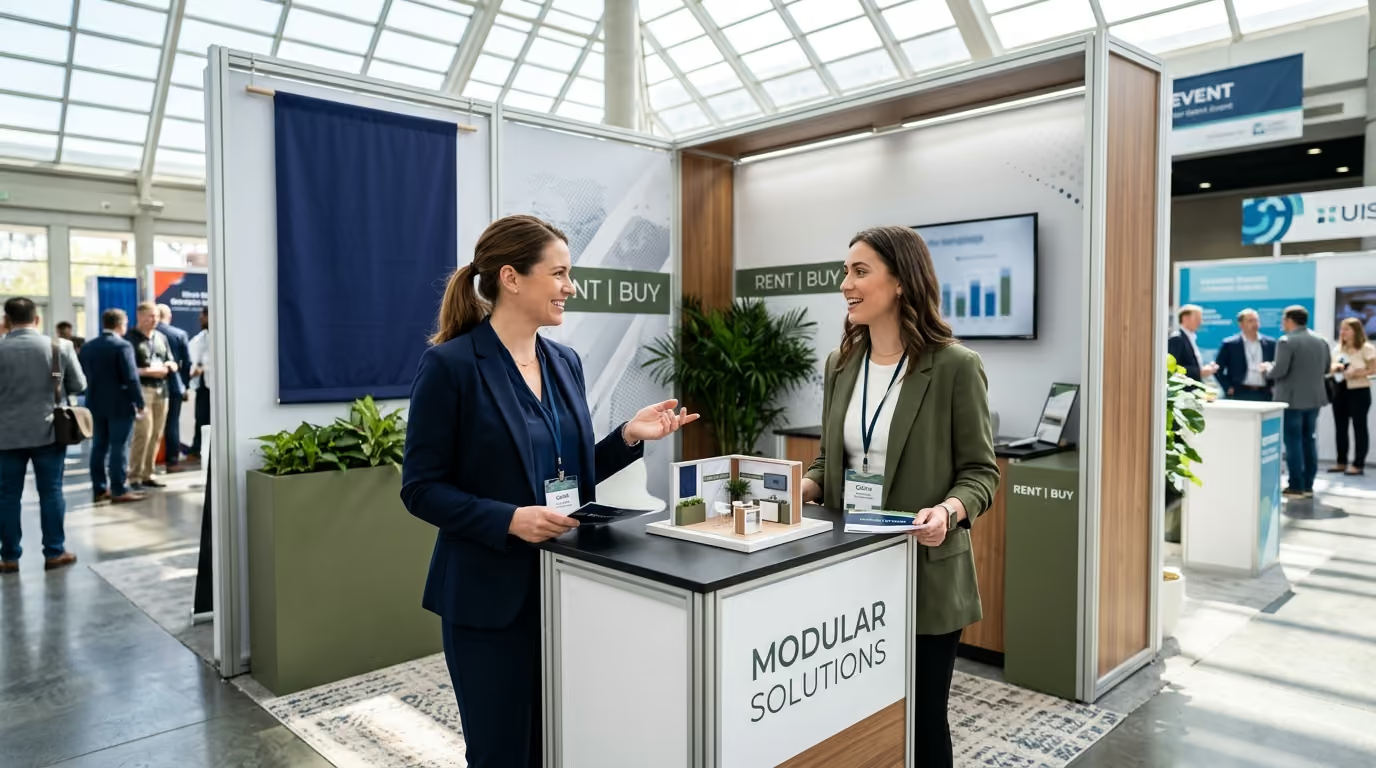
The trade show floor opens in twenty minutes. Aisles fill with early attendees, registration lines stretch across the lobby, and your team scrambles to fix a broken monitor on the back wall. Across the aisle, a competitor commands a packed demonstration area where buyers line up for structured product trials and sales conversations.
This guide delivers a systematic framework for evaluating, selecting, and managing a trade show activation partner capable of converting booth investments into measurable business outcomes. Marketing leaders will gain an operational evaluation rubric, a structured RFP process, and practical criteria to distinguish visual exhibit builders from integrated experiential partners.
The difference between a chaotic booth and a high-converting footprint rarely comes down to square footage or construction budget. It comes down to whether your agency designed an architectural sculpture or an operational commercial engine.
The Reality of the Modern Trade Show Floor
Every trade show floor presents a chaotic collision of competing distractions, tight timelines, and aggressive sales quotas. Exhibitors face unpredictable venue rules, strict union labor jurisdictions, compressed installation windows, and distracted buyers walking the aisles. Research from the Center for Exhibition Industry Research (CEIR) indicates that lead generation remains the top priority, with 68 percent of exhibitors ranking it among their top three objectives. Yet most booth environments fail to facilitate a single qualified sales interaction.
Staff members often cluster behind tall counters, checking laptops while attendees drift past without engaging. High-cost digital walls play looping brand videos that communicate zero specific product value to passersby. Meanwhile, the actual target buyers cannot find a quiet space to discuss commercial terms or test products.
When an exhibit treats audience engagement as an afterthought, marketing dollars vanish into the carpet without generating pipeline. A booth should never serve as a static billboard or a passive lounge. It must function as an intentional, high-throughput workspace engineered to attract, qualify, and convert qualified buyers.
Why Exhibit Design Differs From Full Experiential Activation
Selecting an agency requires understanding the fundamental differences between traditional exhibit houses and experiential activation partners. Many vendors use these labels interchangeably, but their internal capabilities and operational incentives differ significantly.
Traditional Exhibit Houses
An exhibit house focuses on structural design, fabrication, rental hardware, and venue logistics. Their core competencies include:
- Structural engineering and architectural drafting
- Physical fabrication using wood, metal, and tension fabric
- Freight routing, advance warehouse management, and direct-to-show logistics
- Official general service contractor coordination and union labor supervision
- Asset storage, crate maintenance, and exhibit refurbishment
These providers excel at delivering physical structures that meet venue building codes. However, their scope often ends where attendee interaction begins. They rarely train your field staff, choreograph product demonstrations, or build post-show lead conversion systems.
Experiential Marketing Agencies
An experiential agency focuses on human interaction, brand immersion, and audience participation. Their strengths typically center on:
- Live brand activations and creative storytelling
- Interactive product trials and sampling programs
- Brand ambassador staffing, management, and performance coaching
- Social amplification, influencer touchpoints, and digital content capture
- Attendee journey mapping and immersive environmental design
While experiential shops craft memorable consumer interactions, many lack deep knowledge of convention hall restrictions. They may struggle with electrical drops, drayage calculations, structural rigging permits, or union work rules.
Integrated Trade Show Activation Partners
An integrated activation partner combines structural discipline with live engagement strategy. This type of agency designs the physical architecture around the commercial sales workflow.
They build spaces specifically to guide foot traffic, support rapid product trial, and protect private sales conversations. When choosing a partner, you must verify which services they execute in-house versus subcontracting to third parties. If you want to dive deeper into overarching planning methodologies, review our resource on planning a high-performance trade show activation.
- INTEGRATED TRADE SHOW ACTIVATION PARTNER
- STRUCTURAL DISCIPLINE LIVE ENGAGEMENT STRATEGY
- Architectural Engineering Attendee Journey Mapping
- Venue Regulations & Union Labor Hands-On Product Demonstrations
- Freight & Drayage Logistics Field Staff Coaching & Scripting
- Electrical, Rigging & Permits Pipeline-Integrated Lead Capture
- COMMERCIAL REVENUE & PIPELINE IMPACT
Seven Core Dimensions for Evaluating Activation Agencies
To select the right partner, evaluate prospective agencies across seven distinct operational dimensions. Avoid picking an agency based entirely on a polished creative pitch. Use these criteria to score their true operational capabilities.
1. Strategic Capability
A strategic partner aligns every physical detail with your broader commercial pipeline goals. They should identify your primary target buyer, understand your sales cycle, and build the space around clear conversion checkpoints.
Ask these questions during agency evaluation:
- How does your spatial design reflect our buyer journey from awareness to contract?
- What specific behavior should an attendee exhibit within the first sixty seconds?
- How does this activation support our field sales team during and after the show?
- Can you share an example where you challenged a client brief to protect their commercial goals?
If an agency presents creative sketches before asking about your target accounts, qualification criteria, or sales goals, proceed with caution.
2. Creative and Experiential Quality
Creative concepts must drive functional participation rather than passive observation. Research published by Freeman reveals that 74 percent of attendees view in-person events as the premier channel for discovering new solutions. Furthermore, 42 percent deprioritized vendors because they lacked hands-on product interaction.
Evaluate creative concepts using five strict tests:
- Relevance: Does the concept speak directly to your specific industry buyer?
- Clarity: Can a walking attendee grasp your core value proposition in under five seconds?
- Participation: Does the space invite hands-on trial rather than passive screen watching?
- Memorability: Does the activation create a distinct, defensible brand impression?
- Conversion: Does every interactive touchpoint lead naturally to a qualified lead capture?
A concept that looks stunning in a 3D rendering but creates bottlenecks in the aisles will hurt your performance. Test how the layout handles both high-volume foot traffic and private executive discussions.
3. Operational and Production Discipline
Trade show deadlines are fixed and unforgiving. If your freight arrives late or your electrical order is incorrect, your activation fails before the doors open.
Demand full visibility into the agency's production management workflows. In our experience managing complex national programs, execution discipline separates high-performing activations from costly logistics failures.
Review the agency's internal systems for:
- Master production timelines and milestone approval gates
- Engineering reviews and venue rule compliance checks
- Advance warehouse shipping strategies and direct-to-site contingency plans
- Dedicated on-site labor supervision and escalation protocols
- Structured change-order management and budget tracking
Inquire about their contingency plans for delayed freight, damaged components, or malfunctioning hardware. Make sure you know exactly who will stand on the show floor during setup and dismantle.
4. Relevant Category and Audience Experience
Category experience goes beyond having worked in your broad industry. It means understanding your specific sales cycle, regulatory constraints, and buyer psychology.
For instance, food and beverage brands require specialized sampling sanitation, cold-chain logistics, and retail buyer engagement. You can examine these specific retail dynamics in our analysis of winning retail distribution through trade show activations.
Ask prospective partners:
- Have you built activations for our specific audience seniority level?
- How do you navigate health department regulations, sampling permits, or strict industry compliance rules?
- Have you managed activations at our specific target venues and convention centers?
- Do you currently represent direct competitors at this same event?
Ensure the agency has contractual safeguards to prevent conflicts of interest and protect your proprietary launch details.
5. Measurement and Attribution Frameworks
Many agencies highlight vanity metrics such as overall booth scans or general foot traffic. True measurement connects physical engagements to sales progression and Return on Investment (ROI).
According to CEIR research, 86 percent of exhibitors track intermediate performance indicators prior to a commercial transaction. Additionally, 62 percent apply formal Return on Investment metrics to evaluate event success.
A competent agency must deliver a measurement plan spanning four structured tiers:
- Delivery Metrics: On-time booth readiness, scheduled demonstrations completed, and total operational hours logged.
- Engagement Metrics: Average dwell time, hands-on product trials, and structured conversations completed.
- Pipeline Metrics: Marketing-qualified leads, booked follow-up meetings, and sales opportunities generated.
- Commercial Metrics: Direct revenue sourced, pipeline accelerated, and customer acquisition cost reduction.
Demand to see their standard post-show reporting dashboard before signing a contract. For technical approaches to tracking pipeline data, explore our guide on pipeline-integrated lead capture.
6. Cultural and Working-Model Fit
Your agency partner functions as an extension of your internal marketing and sales teams under high-stress conditions. You need a team that communicates transparently, flags risks early, and handles sudden show-floor changes calmly.
Assess their operating style:
- How frequently do you conduct status updates during production?
- What is your protocol when an unexpected cost or production delay occurs?
- Will the pitch team actually manage the on-site execution?
- How do you collaborate with internal corporate sales, product, and brand stakeholders?
Run a live working session during the pitch process. Give the agency a realistic curveball, like a surprise 20 percent budget cut, to see how they prioritize trade-offs.
7. Total Value and Commercial Risk
A low initial quote often conceals substantial missing scope. Unscrupulous agencies may exclude essential show services, structural engineering stamps, or freight fees to win a competitive bid.
Require all agencies to provide standardized line-item proposals. Evaluate the multi-event lifespan of your physical assets. An asset designed for multi-city deployment delivers far superior lifecycle value compared to a single-use build.
For organizations expanding across multiple event formats, consider adopting a modular roadshow design for multi-channel deployment to control long-term fabrication costs.
- TOTAL COST OF OWNERSHIP (TCO) COMPARISON OVER 3-YEAR LIFECYCLE
- Cost ($)
- / Single-Use Custom Build
- / (High rebuild & disposal costs)
- / / Modular System Build
- / / (Amortized fabrication, reusable assets)
- Time / Show Cycles
- Year 1 Year 2 Year 3
How to Structure an Agency Request for Proposal
A well-structured Request for Proposal (RFP) establishes clear scope boundaries, prevents hidden costs, and ensures objective agency comparisons. Provide detailed parameters so participating agencies bid on identical assumptions.
- STANDARD ACTIVATION RFP STRUCTURE
- # RFP Section Key Information Required
- 1 Executive Context Business goals, brand positioning, competitors
- 2 Portfolio Parameters Show names, booth footprints, venue rules
- 3 Audience Profiles Target accounts, buyer personas, pain points
- 4 Engagement Requirements Demos needed, meeting rooms, hospitality scope
- 5 Scope of Work Strategy, fabrication, logistics, staffing
- 6 Commercial Pricing Matrix Line-item costs, storage, labor, travel rates
- 7 Submission Milestones Question deadlines, pitch dates, award timeline
Essential RFP Sections
Your activation RFP must include seven foundational sections:
- Executive Summary and Business Context: Outline your market position, primary commercial objectives, target accounts, and current event performance hurdles.
- Event Portfolio Specifications: Provide exact booth dimensions, hall locations, orientation, height limits, and utility restrictions for each target expo.
- Audience and Persona Profiles: Detail the specific job titles, technical proficiencies, and operational pain points of your target booth visitors.
- Functional Space Requirements: Specify needed demonstration stations, private meeting rooms, reception desks, storage closets, and hospitality zones.
- Detailed Scope of Services: Explicitly define who manages design, engineering, graphic production, AV rentals, shipping, installation labor, staffing, and measurement.
- Commercial Pricing Schedule: Require agencies to break out fixed agency fees, hardware fabrication, asset rentals, variable show services, and pass-through costs.
- Submission Guidelines and Timeline: Establish strict deadlines for written clarification questions, final proposal submissions, and oral shortlist presentations.
To avoid unexpected budget variances across these phases, review our detailed trade show activation budgeting guide.
Mandatory Information to Share With Bidders
Agencies can only build accurate proposals if you provide clear operational parameters. Give every bidding team the following information:
- Complete exhibitor service manuals and booth location maps
- Realistic total budget ceilings or target budget ranges
- Existing physical inventory, AV hardware, and reusable graphics available for repurposing
- Required integration points for lead scanners, CRM systems, and marketing automation software
- Clear timelines for internal corporate approvals and engineering sign-offs
Distribute all agency clarification questions and answers to every bidder simultaneously. This maintains fairness and prevents any single agency from gaining an unearned advantage.
A 100-Point Agency Evaluation Rubric
Never select an activation agency using gut feel or presentation charisma alone. Implement an objective, weighted scorecard to evaluate each proposal across critical performance areas.
- AGENCY EVALUATION WEIGHT DISTRIBUTION
- Total: 100 Points
- 20 pts
- 1. Strategic Capability & Audience Journey Mapping
- 15 pts
- 10 pts
- 5 pts
Rubric Breakdown
Score each prospective partner using this 100-point framework:
Strategic Capability (20 Points)
- Depth of audience insight and empathy for buyer challenges (5 points)
- Alignment between spatial zones and the commercial sales funnel (5 points)
- Integration with broader pre-show and post-show marketing workflows (5 points)
- Clarity of staff qualification pathways and conversation workflows (5 points)
Creative Quality and Conversion Logic (20 Points)
- Distinctiveness and category relevance of the central concept (5 points)
- Speed and clarity of value proposition communication from the aisle (5 points)
- Quality of interactive product demonstration and trial choreography (5 points)
- Visual accessibility, balance, and sightline optimization (5 points)
Operational Discipline and Production Management (20 Points)
- Detail and feasibility of the master production schedule (5 points)
- Experience with convention center labor jurisdictions and show contractors (5 points)
- Rigor of on-site supervision, risk mitigation, and contingency plans (5 points)
- Transparency and control mechanisms within change-order management (5 points)
Measurement and Pipeline Systems (15 Points)
- Specificity of lead capture workflows and qualification scoring criteria (5 points)
- Technical architecture for direct CRM and marketing automation integration (5 points)
- Post-show reporting dashboards and attribution frameworks (5 points)
Category and Venue Experience (10 Points)
- Proven execution record in similar technical or regulatory categories (5 points)
- Established operational history at your specific target convention centers (5 points)
Cultural Fit and Account Team Stability (10 Points)
- Senior leadership involvement and direct access to production leads (5 points)
- Transparent communication habits and constructive feedback management (5 points)
Total Value and Cost Transparency (5 Points)
- Granularity of line-item pricing and absence of hidden markups (3 points)
- Multi-show asset reuse potential and long-term storage efficiency (2 points)
Evaluation Scoring Scale
Apply a standard five-point scale for each individual rubric line item:
- 5 (Exceptional): Exceeds requirements with verifiable proof points and low operational risk.
- 4 (Strong): Meets all requirements thoroughly with clear operational capability.
- 3 (Acceptable): Meets basic requirements but lacks distinctive execution depth.
- 2 (Weak): Reveals notable operational gaps, missing documentation, or elevated delivery risk.
- 1 (Unacceptable): Fails to meet requirements or presents unacceptable commercial risk.
Disqualification Red Flags
Disqualify any agency immediately if they display these critical operational warning signs:
- Refusal to provide transparent, line-item pricing breakdowns
- Inability to name the dedicated on-site project lead who will oversee setup
- Absence of commercial general liability or workers' compensation insurance coverage
- Vague or evasive answers regarding proprietary lead data ownership
- Active representation of direct competitors at the same event without clear team separation
Execution Playbook: Selecting and Onboarding an Agency
Executing a successful agency search requires disciplined stage-gate management. Follow this structured roadmap from internal planning to post-event optimization.
- PHASE 1: Internal Alignment & Scope (Weeks 1-2)
- PHASE 2: Market Scan & Shortlisting (Weeks 3-4)
- PHASE 3: RFP Release & Clarification (Weeks 5-6)
- PHASE 4: Proposal Scoring & Working Sessions (Weeks 7-8)
- PHASE 5: Reference Verification & Contracting (Weeks 9-10)
- PHASE 6: Production Kickoff & Site Survey (Weeks 11-16)
- PHASE 7: Show-Floor Execution & Conversion (Show Week)
- PHASE 8: Post-Event Attribution & Asset Care (Weeks post-show)
Phase 1: Internal Alignment and Scope Definition
- Assemble key internal stakeholders from marketing, field sales, product management, and procurement.
- Establish non-negotiable commercial targets, audience profiles, and budget boundaries.
- Audit existing exhibit properties, hardware, and marketing collateral for potential reuse.
- Finalize the written RFP brief, evaluation criteria, and decision timelines.
Phase 2: Market Scan and Shortlisting
- Identify five to seven candidate agencies with verified experience in your specific industry.
- Conduct initial screening calls to confirm production capacity, venue experience, and client exclusivity.
- Eliminate agencies with unresolved competitor conflicts or poor production scale.
- Issue non-disclosure agreements and formal RFP documentation to three to five finalists.
Phase 3: RFP Clarification and Proposal Development
- Host a group or individual clarification session to answer operational questions.
- Publish written responses to all bidder inquiries simultaneously.
- Enforce strict submission deadlines for technical proposals and commercial cost models.
- Review incoming proposals against mandatory qualification criteria prior to committee scoring.
Phase 4: Proposal Evaluation and Working Sessions
- Score written submissions using the 100-point evaluation rubric.
- Invite the top two or three agencies to a working pitch session with your evaluation committee.
- Require prospective account leads, production managers, and creatives to present together.
- Run a live stress-test exercise during the meeting to evaluate real-time problem-solving skills.
Phase 5: Reference Checks and Final Selection
- Speak directly with past client references, focusing on operations, budget discipline, and problem resolution.
- Ask references specifically about surprise change orders and on-site team responsiveness.
- Negotiate master service agreements, statements of work, payment schedules, and performance clauses.
- Formally notify the winning partner and provide constructive feedback to unsuccessful bidders.
Phase 6: Production Kickoff and Pre-Show Alignment
- Hold a formal kickoff meeting to review master production schedules, venue deadlines, and milestone gates.
- Finalize engineering drawings, booth layouts, graphic proofs, and utility service orders.
- Conduct booth staff training sessions covering lead qualification criteria, demonstration scripts, and tech usage.
- Review emergency escalation paths, contact lists, and shipping tracking manifests.
Phase 7: Show-Floor Execution and Daily Management
- Complete early on-site walk-throughs to supervise installation, electrical connections, and AV setup.
- Run a complete dress rehearsal of all digital elements, product demonstrations, and lead capture systems.
- Hold daily morning briefings with booth staff to review daily goals and refine engagement tactics.
- Monitor real-time lead capture numbers and adjust spatial flow if congestion occurs.
Phase 8: Post-Show Attribution and Asset Disposition
- Supervise systematic exhibit dismantle, repacking, and asset return shipping to the storage warehouse.
- Ingest all captured lead data into your CRM within twenty-four hours of show closing.
- Conduct a formal post-event debrief with agency leadership to review performance metrics against targets.
- Finalize asset storage inventories, repair broken components, and log insights for the next event.
Metrics That Matter for Live Activation Return on Investment
Measuring activation success requires tracking both leading indicators on the show floor and lagging financial metrics after the event. Establish clear definitions for every metric prior to opening day.
- LEAD METRICS (On-Site Velocity) LAG METRICS (Commercial Pipeline)
- Hourly Footprint Velocity Lead-to-Meeting Rate (%)
- Demo Completion Volume Sales-Accepted Pipeline ($)
- Dwell Time Over 3 Minutes Direct Revenue Sourced ($)
- Tier-1 Qualified Lead Scans Commercial ROI Multiple
Lead Metrics (On-Site Operational Velocity)
Lead metrics monitor immediate engagement volume and operational throughput while the event is live:
- Footprint Engagement Velocity: Number of unique attendees entering the activation footprint per open hour.
- Demonstration Completion Volume: Total structured product demonstrations delivered by staff or digital stations.
- Meaningful Interaction Rate: Percentage of booth visitors who maintain active conversations for over three minutes.
- Qualified Lead Volume: Total scans capturing mandatory qualification data, including buying timeline and decision authority.
Lag Metrics (Post-Show Pipeline Progression)
Lag metrics evaluate how effectively your show presence generated real commercial value:
- Lead-to-Meeting Conversion Rate: Percentage of booth leads that convert into completed post-show sales discovery calls.
- Sales-Accepted Pipeline: Total dollar value of sales opportunities created directly from activation interactions.
- Sales Cycle Acceleration: Reduction in standard sales cycle length for existing pipeline accounts that engaged with the booth.
- Direct Sourced Revenue: Closed-won commercial revenue attributed to event interactions within your agreed sales window.
Calculating Activation Return on Investment
Calculate program Return on Investment using an explicit financial formula:
$$\text{Activation ROI} = \frac{\text{Gross Margin from Sourced Revenue} - \text{Total Activation Cost}}{\text{Total Activation Cost}} \times 100$$
Ensure your Total Activation Cost includes design fees, hardware fabrication, venue space rental, freight, show labor, utilities, travel, and internal staff time. Calculating Return on Investment without accounting for show-service costs creates a misleading view of event performance.
Real-World Application: Premium Food Brand Trade Show Activation
A premium natural food and beverage brand sought to launch a functional snack line at Natural Products Expo West. Their primary goal centered on securing retail distribution across regional grocery banners while generating consumer awareness.
- RETAIL ACTIVATION BOOTH WORKFLOW
- Aisle Traffic
- AISLE-SIDE TASTING BAR
- Rapid sampling & initial hook
- PRODUCT VALUE THEATER
- Ingredient education & trial
- PRIVATE BUYER MEETING ROOM
- Margin review & retail sell-in
Strategic Approach and Footprint Design
The brand selected an integrated activation partner to build an efficient 20x20 island exhibit. Rather than building a large central lounge, the agency engineered a three-tier customer journey:
- Zone 1 (Aisle-Side Tasting Bar): Professional brand ambassadors delivered rapid product tastings to attract passing retail buyers.
- Zone 2 (Product Value Demonstration Area): Brand specialists explained ingredient sourcing and nutritional profiles using hands-on display stations.
- Zone 3 (Semi-Private Retail Meeting Room): An enclosed, quiet conference zone reserved for pre-booked distributor and grocery buyer discussions.
Operational Execution and Results
The agency managed cold-chain logistics, certified food-handler staffing, and health department permitting. Brand ambassadors used tablet-based lead capture apps that automatically routed enterprise retail buyers directly to sales managers.
Over three days, the activation generated clear commercial outcomes:
- 1,450 consumer tasting demonstrations completed
- 184 Tier-1 commercial retail leads verified and qualified
- 32 on-site distributor meetings completed
- 8 new regional grocery accounts secured within ninety days of the show
The structured workflow ensured that high-volume sampling never compromised high-value commercial sales conversations.
Incorporating Accessibility and Sustainability
Modern trade show activations must account for physical accessibility and environmental sustainability from the initial design phase. Treating these elements as afterthoughts creates operational hurdles and legal risk.
Designing Accessible Activations Under ADA Standards
In the United States, trade show exhibits function as public accommodations under Title III of the Americans with Disabilities Act (ADA). Your agency must integrate physical and sensory accessibility directly into the architectural plans.
Ensure your design complies with foundational accessibility requirements:
- Clear Circulation Paths: Maintain at least 36 inches of unobstructed clearance along all interior walking aisles.
- Wheelchair Turning Radius: Provide clear 60-inch turning spaces within meeting areas and demonstration zones.
- Counter and Display Heights: Build service counters and check-in desks with accessible sections between 28 and 34 inches high.
- Interactive Reach Zones: Position interactive digital touchscreens and product displays between 15 and 48 inches above the floor.
- Visual and Audio Inclusivity: Include synchronized closed captioning on all video presentations and provide large-print or digital product literature.
Require your agency partner to submit a formal ADA compliance review before approving physical construction drawings.
Implementing Sustainable Event Practices
Sustainable exhibit design reduces environmental waste while lowering ongoing storage, freight, and disposal expenses. Ask prospective agencies how they apply frameworks like ISO 20121 for sustainable event management.
Evaluate green production practices:
- Modular Reusable Architecture: Constructing core exhibit frames with durable, reconfigurable aluminum systems rather than single-use lumber.
- Eco-Conscious Materials: Using low-VOC finishes, recyclable tension fabrics, and certified sustainable timber.
- Optimized Freight Routing: Consolidating crating configurations to minimize overall shipping volume and fuel consumption.
- Energy-Efficient Infrastructure: Standardizing on low-wattage LED fixtures and smart energy management controls.
- End-of-Life Asset Management: Establishing documented donation, recycling, or refurbishment programs for old graphics and structural elements.
An agency that designs for modular reusability protects your budget across multiple show cycles while reducing physical waste.
Common Agency Selection Mistakes
Avoid these frequent mistakes when selecting an exhibit activation partner:
- Focusing Exclusively on Visual Renderings: A photorealistic rendering shows how an exhibit looks under ideal lighting. It does not show how foot traffic moves, where cables run, or how staff operate during peak hours.
- Treating Foot Traffic as Commercial Success: A crowded booth giving away cheap promotional items burns budget without qualifying real buyers. Measure qualified conversations rather than general foot traffic.
- Overvaluing Client Logos on Agency Websites: An agency displaying impressive brand logos may have only handled a minor graphic printing task. Inquire about the exact scope delivered for each featured reference.
- Ignoring Union Labor and Venue Regulations: An agency unfamiliar with convention center labor jurisdictions can trigger costly overtime surcharges and on-site assembly disputes.
- Leaving Lead Strategy to Post-Show Cleanup: If you do not define qualification criteria, CRM fields, and routing rules before the show, your sales team will receive cold, low-value lead data.
When to Revisit This Resource
Review this guide whenever your organization faces a major event inflection point:
- Planning an annual trade show budget and issuing multi-year agency RFPs
- Launching an important new product line that requires hands-on customer demonstrations
- Entering a new regional market or expanding into large-scale national industry expos
- Experiencing flat lead conversion or poor sales follow-up from existing booth investments
- Transitioning from static exhibit rentals to modular, multi-show activation assets
Choosing the right trade show activation agency turns a stressful logistical exercise into a reliable, high-converting commercial engine.
Sources
- IAEE Releases Comprehensive Update of U.S. B2B Trade Show Industry
- IAEE CEIR Exhibition Index Overview
- Exhibitor Group Guidance on ADA Guidelines for Exhibits
- ISO 20121 Sustainable Events Management Standards
- UFI Guidelines on Sustainable Event Management Implementation