Robbie Thain
Founder, CEO

Shoppers scrutinizing functional ingredients need qualified product education, compliant health claims, and safe in-store trial experiences that convert.
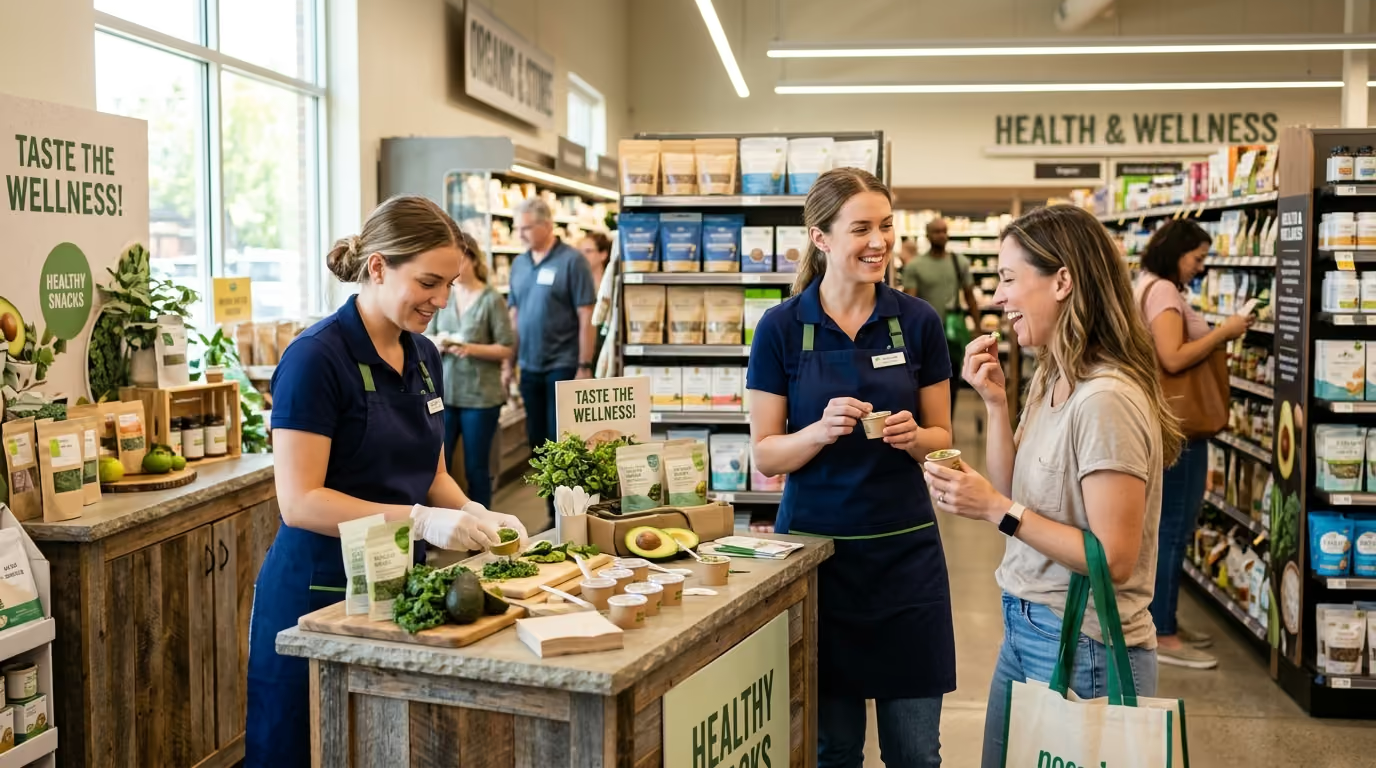
Product sampling in specialty retail is an educational conversion mechanism, not a passive giveaway. This guide outlines how health, natural, and wellness brands can build compliant, high-converting product trial programs that satisfy strict retail standards and drive verified sales lift.
Every weekend across natural grocery chains and specialty wellness stores, brand activations descend into operational chaos. An untrained brand ambassador stands behind a folding table, struggling to answer basic questions about adaptogens or cold-pressed processing while shoppers walk past. Open sample cups sit uncovered near high-traffic aisles, creating cross-contact risks for shoppers with severe food allergies. At the same time, the field representative makes off-the-cuff claims about inflammation or immunity that violate federal regulations. Down the aisle, the store manager discovers the demo station has run out of product inventory, leaving interested shoppers with nowhere to purchase the item they just tasted.
Winning in specialty retail requires an operational system that balances scientific credibility, sensory execution, and strict regulatory compliance. Brands that treat sampling as a simple numbers game waste capital. High-performing health brands use structured field operations to educate shoppers, protect retail relationships, and generate measurable category growth.
Health and natural retail environments operate under different consumer psychology than conventional grocery stores. Shoppers in these aisles scrutinize ingredient decks, evaluate functional claims, and pay premium price points. A generic giveaway does not overcome their skepticism.
To turn physical interactions into retail pipeline, brands must understand several foundational retail concepts:
Sample distribution measures only the raw unit volume handed to passersby. It does not track whether the recipient was an appropriate consumer, understood the value proposition, or consumed the item.
A qualified trial occurs when an aligned shopper receives targeted product education, samples the product under proper conditions, and understands its retail placement. We specialize in creating retail demos, product sampling programs, and roadshows that bring brands face to face with their audiences. In our experience, optimizing for qualified trials rather than gross distribution volume reduces overall customer acquisition costs and generates higher purchase conversion.
Academic research on retail scanner data by Liu, Chandukala, and Dotson confirms that in-store sampling generates both immediate sales spikes and sustained baseline lift across product categories. Their research demonstrates a category expansion effect, where live sampling expands total category volume rather than merely shifting brand choice. Furthermore, empirical research published on sampling promotions shows that free trials draw completely unplanned shoppers into new categories while encouraging brand switching among existing category buyers.
Measuring real Return on Investment (ROI) requires isolating incremental sales from baseline velocity. Incremental volume represents the purchases directly caused by the field activation that would not have occurred through standard shelf presence.
To execute repeatable field activations, brand operators should deploy the structured SAMPLE model across every campaign:
Operators designing field campaigns can examine a complete guide to retail product sampling programs to align these strategic principles with their wider brand objectives.
Specialty and natural retail activations carry significant legal and operational risks. Health claims made verbally by field staff are legally recognized as commercial advertising touchpoints. Unvetted ambassador statements can expose a brand to regulatory scrutiny and severe retail penalties.
The Federal Trade Commission requires advertisers to maintain competent and reliable scientific evidence for any objective product claims made to consumers. For health products, the FTC generally expects rigorous clinical trial evidence to support specific physiological benefits. Spoken statements delivered at a demo table must match the substantiation on file.
The Food and Drug Administration enforces strict boundaries regarding dietary supplements and functional foods. Structure and function claims describe the role of a nutrient intended to maintain normal bodily structures or functions. These statements must be truthful, non-misleading, and backed by documented substantiation. Dietary supplement labels featuring these claims must display the standard FDA disclaimer and undergo formal 30-day post-market notification.
Field ambassadors must never cross into unauthorized disease claims. Stating that an herbal beverage treats chronic inflammation or that a mushroom tincture cures anxiety violates federal regulations. Field scripts must clearly distinguish between sensory statements, compositional facts, and approved structure or function claims. When unexpected customer medical questions arise, ambassadors must follow a defined escalation policy rather than attempting to provide health advice.
The FDA recognizes nine major food allergens: milk, eggs, fish, crustacean shellfish, tree nuts, peanuts, wheat, soybeans, and sesame. Specialty food shoppers frequently manage severe dietary restrictions. A single cross-contact incident can result in acute consumer injury and permanent brand damage.
Field execution requires strict allergen management protocols:
The FDA Food Code establishes baseline standards for retail food protection and employee hygiene. Field teams preparing open food must follow established commercial kitchen protocols. Staff must wash hands thoroughly at designated sinks rather than relying exclusively on hand sanitizer or disposable gloves.
Cold foods must remain held at 41 degrees Fahrenheit or below throughout the activation. Hot foods must stay at 135 degrees Fahrenheit or above using calibrated heating gear. Field teams should maintain digital temperature logs, checking product status every 30 minutes during active sampling hours.
Executing a high-yield retail campaign requires structured timing, rigorous training, and clear on-site coordination. When brands fail to organize these steps, field operations break down quickly. Operators looking to diagnose existing field breakdowns can study troubleshooting retail sampling programs to identify common operational leaks.
Different wellness products present distinct barriers to purchase. Selecting the appropriate sampling format ensures marketing capital directly addresses consumer hesitations. Brands evaluating tactical choices can review strategic approaches to retail demos and roadshows to match their operational format to their retail category.
Functional beverages such as botanical sodas, kombuchas, and herbal tonics frequently encounter taste skepticism. Shoppers assume health drinks taste bitter, excessively sour, or chalky.
Dietary supplements carry high price points and complex ingredient profiles. Customers must understand why an ingredient exists and how it works before purchasing.
Protein powders and superfood greens trigger concerns regarding grit, solubility, and artificial aftertastes. Demonstrating proper blending techniques overcomes these objections immediately.
Specialty wellness retail relies heavily on trusted recommendations from in-store employees. Independent natural grocers and cooperative markets employ category buyers who guide customer selections daily.
Tracking gross samples handed out provides zero visibility into financial performance. Operators must evaluate lead indicators, trailing revenue metrics, and incrementality to determine true marketing efficiency. Brand leaders can examine essential metrics to prove sampling event ROI for a detailed breakdown of field reporting frameworks.
A balanced retail measurement system tracks both real-time operational execution and downstream commercial impact:
To prove genuine incrementality, field operators should implement matched-market testing methodologies across retail accounts:
Field marketing managers must measure direct gross margin generation against total operational expenses. Brand executives refining their retail channel strategies can review methods to refine retail demo sampling ROI for advanced budgeting models.
If an activation costs $400 in total field expenses and generates $600 in incremental revenue at a 50% gross margin, the immediate financial return equals:
While initial same-day margin may not fully cover field costs, sustained baseline lift and recurring consumer purchases generate positive net channel profitability over time.
A functional ready-to-drink beverage brand producing adaptogenic cold-brew coffee secured distribution across 45 regional natural specialty grocery stores. Initial sales velocity stalled at 1.8 units per store per day. Shoppers were confused by unfamiliar adaptogenic ingredients such as lion's mane and cordyceps mushrooms, assuming the beverage carried an earthy, medicinal taste.
The brand deployed a standardized sampling program across all locations, focusing on educational execution:
Over eight weeks, the brand executed 90 four-hour retail activations. Field teams generated 6,750 qualified consumer trials, resulting in 2,362 immediate unit purchases and an on-site conversion rate of 35%. Post-campaign scanner data revealed that sustained baseline velocity increased from 1.8 to 3.8 units per store per day across the retail footprint. The brand leveraged this verified sell-through data to secure endcap placement and expand into two additional retail divisions.
Operators looking to scale these tactical frameworks can study high-converting retail demo sampling strategies to optimize their field execution models.
Field representatives must never offer medical advice, interpret personal health symptoms, or suggest that a food product replaces prescribed medical care. When a shopper asks if a product can treat a medical condition, the ambassador should state that the product is a functional food intended for general wellness and encourage them to consult a qualified physician.
For premium supplements costing over fifty dollars per unit, direct taste trials are often impractical. Brands should combine structured educational conversations with distribution of premium single-serving trial sachets. The representative walks the shopper through the ingredient mechanism, hands them a sachet for home usage, and provides a scannable QR card offering detailed product sourcing literature.
Limit the demonstration to two complementary flavors or formulations. Presenting too many options overwhelms the consumer with choices, creating decision fatigue that lowers final purchase conversion. Featuring a primary top-seller alongside a seasonal innovation provides adequate variety while keeping the sales conversation focused.
Field staff handling open food should maintain current food handler safety certifications recognized within their state or local municipality. Team leaders should complete formal food safety management training to oversee handwashing compliance, cold-chain monitoring, and allergen prevention protocols across live retail environments.

30 Years Experiential & Retail Activation Partner for CPG & Beverage Brands | Multi-Market Demos, Roadshows & Costco/Club Programs That Actually Sell